Meet the Top 101 in Crypto

Key Takeaways

Bitcoin absorbed its first policy decision of the Kevin Warsh era with a wobble rather than a breakdown, though the bond market’s verdict raises harder questions for the weeks ahead. 

The Federal Reserve voted 9 to 3 on July 29 to hold its benchmark rate at 3.50% to 3.75%, extending the pause to a fifth consecutive meeting, with Minneapolis Fed President Neel Kashkari, Dallas Fed President Lorie Logan, and Cleveland Fed President Beth Hammack dissenting in favor of a 25 basis point increase. Three dissents mark the most hawkish bloc of Warsh’s tenure as Chair, a sharp shift from June’s unanimous 12-member hold.

Price action stayed contained. Bitcoin (BTC) dipped around 1% to $63,890 on the announcement, before climbing above $64,400, up over 1% on the day, as the S&P 500 and Nasdaq trimmed earlier losses and gold rose 1.2%.

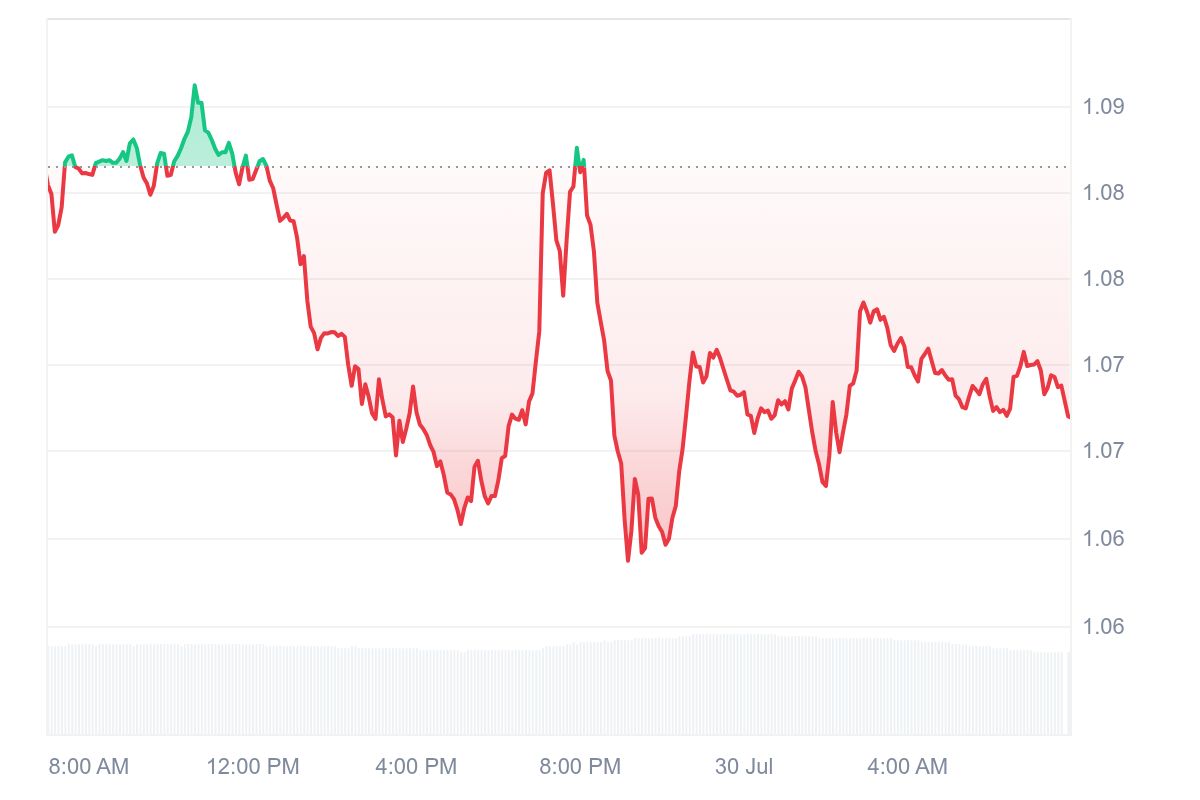
Ether (ETH) traded around $1,917 and XRP near $1.08, while the Crypto Fear and Greed Index stood at 28, an improvement from earlier Extreme Fear readings.

Try Our Recommended Crypto Exchanges
Sponsored
Disclosure
Opened in 2018
Promotions
Deposit $100, Get an Extra $300 in GOLD!
Coins
Shiba Inu Bitcoin PAX Gold Ampleforth Ethereum +70
Promotions
Receive up to $100,000 worth of exclusive gifts for newcomers upon registration.
Coins
Bitcoin Ethereum Tether USD Coin Solana +76
Opened in 2017
Promotions
Experience a 1-minute swap on a non-custodial platform.
Coins
Bitcoin Ethereum Tether Build'N'Build USD Coin +217
Show More
 

Bond Market Delivers the Real Message

Treasuries told a rougher story than the crypto tape. The 30-year yield pushed above 5.20% during the session, its highest level since 2007, prompting The Kobeissi Letter to declare that higher-for-longer is back. 

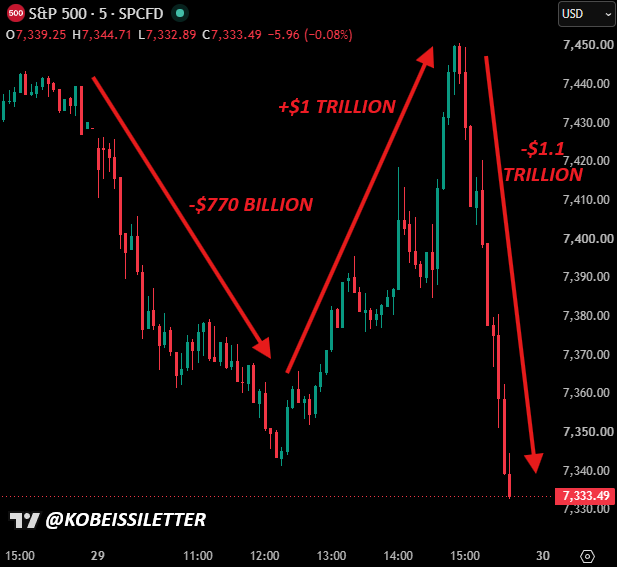
Equity markets whipsawed through what the newsletter described as three swings totaling roughly $2.9 trillion in S&P 500 market cap, with the index dropping 85 points through midday, rallying 110 points into mid-afternoon, then shedding 120 points before the close.
Markets Whipsaw After Fed Decision
Markets whipsaw after Fed decision. | Source: @KobeissiLetter

Warsh gave traders little to hold on to. His statement described the economy’s resilience as impressive while stressing that inflation remains elevated relative to the 2% target, with no soft target tolerated.

He characterized the policy statement as sticking to the facts while steering clear of guidance, adding that market participants are learning to play the ball, not the referee. 

During the press conference, he rejected suggestions that July represented a routine pause, describing the meeting as an active assessment of policy options, and said June’s softer inflation reading influenced policymakers “not much.”

Criticism of the approach came from inside the institution’s alumni ranks. Former Cleveland Fed President Loretta Mester, who spent a decade voting on policy, told the Wall Street Journal’s Nick Timiraos the silence is not sustainable, saying, “I actually want more from my Fed.” 

Gold advocate Peter Schiff argued that Warsh is trapped either way, writing that the Chair fears the consequences of raising rates while his failure to raise them will produce similar damage.

September Now Carries the Risk

Hawkish dissent keeps tightening as a live scenario. Warsh declined to rule out a hike in September, keeping pressure on risk assets, while oil’s nearly $4 rally to $83 on the Iran attack handed the hawks fresh ammunition before the decision even landed. 

Positioning cuts both ways into the weekend: traders hold $2.5 billion in call spreads targeting $72,000, but rejection below the $65,000 to $65,200 resistance zone could expose $62,000 to $62,500 as ETF outflows weaken spot demand. 

Long-end yields above 5.2% now function as the tightening Warsh withheld, and Bitcoin‘s ability to hold its 200-day average near $62,850 against that drag becomes the cleaner test than anything the Fed said Wednesday.

 

Key Takeaways

Bitcoin enters August near $64,000 after a difficult first half of 2026, with the cryptocurrency still trading below major moving averages and struggling to turn its recent rebound into a confirmed trend reversal.

To assess where Bitcoin could trade next, ChatGPT, Gemini, Claude, and Grok were asked to analyze its outlook for August. Their answers differed significantly, producing potential targets ranging from $50,000 to almost $100,000.

Despite that divergence, the models broadly agreed on one conclusion: Bitcoin must hold the $60,000-$63,000 region and break above the $65,000-$70,000 resistance to reverse its medium-term downtrend.

Our Top Crypto Sports Betting Partners:
Sponsored
Disclosure
Opened in 2021
Promotions
Casino No Wagering 100 Free Spins
Coins
Bitcoin Tether USD Coin Ethereum Solana +11
Opened in 2022
Promotions
Up to 550 USDT Bonus + up to €75 Free Bet + 5% cashback
Coins
Bitcoin Bitcoin Cash Dogecoin Ethereum Litecoin +53
Opened in 2018
Promotions
500% Welcome Bonus up to $90,000 + 100 Free Spins
Coins
Bitcoin Ethereum Litecoin Tether Dogecoin +3
Show More

ChatGPT Predicts Bitcoin Will End August at $60,500

ChatGPT offered the most detailed probability-based forecast, predicting that Bitcoin would end August at $60,500 after trading within a broad range of $57,000–$70,000.

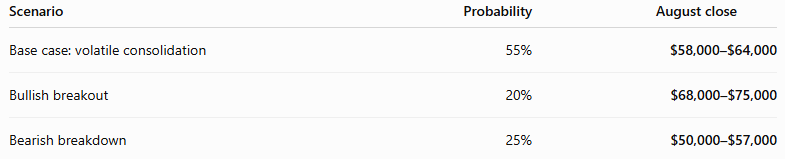
Its base case, assigned a 55% probability, anticipates volatile consolidation and a monthly close between $58,000 and $64,000. It gave a bullish breakout toward $68,000–$75,000 a 20% probability, while estimating a 25% chance of a bearish decline into the $50,000- $57,000 region.

ChatGPT views
ChatGPT predictions on Bitcoin for August. | Credit: ChatGPT

The model identified $60,000-$62,000 as Bitcoin’s principal support zone, followed by the June low near $57,500. On the upside, BTC would need to clear $68,500-$70,000 to confirm a more convincing breakout.

ChatGPT also pointed to Bitcoin’s historically weak performance in August. It estimated a median return of approximately-7.5%, which, if repeated from current levels, would place Bitcoin near $59,000 by month-end.

A more ambitious move toward $78,000 would likely require substantially stronger demand for exchange-traded funds.

Gemini and Claude Focus on Bitcoin’s Resistance Levels

Gemini provided a cautiously bullish technical outlook without issuing a specific month-end target.

It identified $65,300-$65,500 as the immediate resistance range, arguing that Bitcoin needs a sustained four-hour close above $65,000 to restore upward momentum. A subsequent break above $66,700 could open the way toward $67,000 and potentially higher levels.

Support sits between $63,000 and $63,800, with a breakdown exposing the secondary $61,300-$62,000 region.

Claude was more skeptical about the reliability of price forecasts. It noted that Bitcoin has fallen from above $93,000 at the beginning of 2026 and remains beneath its 20-day and 50-day exponential moving averages after failing to overcome $66,500.

More importantly, BTC remains below the 100-day EMA near $67,604 and the 200-day EMA around $73,308. This structure suggests that any advance may remain a corrective rally unless Bitcoin reclaims those longer-term trend indicators.

Claude highlighted a realistic August range of approximately $60,000-$74,000, while emphasizing that the breadth of available forecasts illustrates how little certainty any single prediction provides.

Grok Sees Higher Targets but Warns Against Optimism

Grok produced the most bullish summary by examining forecasts published by several algorithmic platforms.

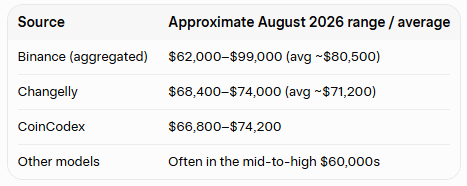
It said many projections cluster between $65,000 and $80,000. Changelly reportedly anticipates a range of approximately $68,400-$74,000.

Grok views
Grok based his prediction on several sources. | Credit: Grok

CoinCodex projects $66,800-$74,200. Binance’s aggregated forecast was considerably broader, ranging from about $62,000 to $99,000, with an average near $80,500.

Grok nevertheless warned that these estimates are speculative and could be invalidated by macroeconomic developments, regulation, institutional flows, or unexpected market events.

What Could Decide Bitcoin’s August Price?

All four models identified Federal Reserve policy and spot ETF flows as major variables.

The Fed’s decision to keep interest rates at 3.50%-3.75% maintained uncertainty around its September meeting. Inflation data, Treasury yields, and geopolitical tensions could therefore determine whether investors increase or reduce exposure to risky assets.

High futures open interest also raises the probability of sharp liquidation-driven moves in either direction.

The combined outlook places Bitcoin at a technical crossroads. Holding $60,000 and clearing $65,500 would improve the recovery case, but the downtrend is unlikely to be considered broken until BTC decisively reclaims $68,500–$70,000.

Until then, ChatGPT’s $60,500 target represents the most conservative central forecast, and a reminder that AI models cannot predict unpredictable market shocks.

Key Takeaways

Seven days remain before the Senate leaves for August recess, and the crypto industry’s most consequential bill is suddenly showing signs of life. 

Coinbase Chief Policy Officer Faryar Shirzad said more than 1 million calls and emails have flooded senators’ offices in support of the CLARITY Act, a grassroots push that arrives just as two of the bill’s toughest negotiators claim they finally cracked the deadlock.

Try Our Recommended Crypto Exchanges
Sponsored
Disclosure
Opened in 2018
Promotions
Deposit $100, Get an Extra $300 in GOLD!
Coins
Shiba Inu Bitcoin PAX Gold Ampleforth Ethereum +70
Promotions
Receive up to $100,000 worth of exclusive gifts for newcomers upon registration.
Coins
Bitcoin Ethereum Tether USD Coin Solana +76
Opened in 2017
Promotions
Experience a 1-minute swap on a non-custodial platform.
Coins
Bitcoin Ethereum Tether Build'N'Build USD Coin +217
Show More
 

Crypto Bill Compromise Nobody Has Seen Yet

Senators Thom Tillis and Ruben Gallego have finalized a new bipartisan ethics compromise for the bill, according to people familiar with the talks, though the text has not been released publicly and still needs White House sign-off before it can move.

Ethics language, covering how officials with crypto holdings, including the president’s, are policed, has been the single provision blocking Democratic votes for months.

Eleanor Terrett reported on July 30 that sources off the Hill describe the Tillis-Gallego proposal as including a role for state attorneys general, though the full scope of the package, and what additional language may have been added to address White House concerns, remains unclear.

The latest draft was sent to the White House on Wednesday morning and is currently under review. Terrett also noted that industry representatives spent Tuesday making calls directly to the White House, arguing that locking in an ethics compromise is essential to getting the bill across the finish line. How the White House responds, she noted, could determine whether the Senate moves to a vote on the bill next week.

Galaxy Digital co-founder Mike Novogratz told Milk Road he expects the compromise to land, and to land in August.

“I think it’s going to be a last-minute small little compromise,” he said, describing a structure modeled on the Laken Riley Act, where state attorneys general can sue the Department of Justice over enforcement but cannot sue the president directly, a framework designed to give Democrats an enforcement mechanism without triggering a fight over executive immunity.

Novogratz said the exhaustion in the room is real. He recounted Senator Mark Warner telling him directly, “No matter if I never have to hear the word crypto again after this act is passed, I’ll be happy,” a line Novogratz read as evidence that senators who have spent years on the bill simply want it finished, regardless of which side claims the win.

Lummis Pushes Back on Holdouts

Senator Cynthia Lummis used a post on X to argue Democrats have already gotten far more than critics admit. 

She said the bill now includes 33 Democrat-driven edits in Title I alone, 23 new illicit finance sections, 30 additional wins for the CFTC, and three entirely new titles Democrats requested, adding up to more than 100 compromises. 

“‘Perfect’ stopped being principled months ago. Now it’s just an excuse not to legislate,” she wrote, calling on the Senate to pass the act now.

Why the Math Still Isn’t Settled

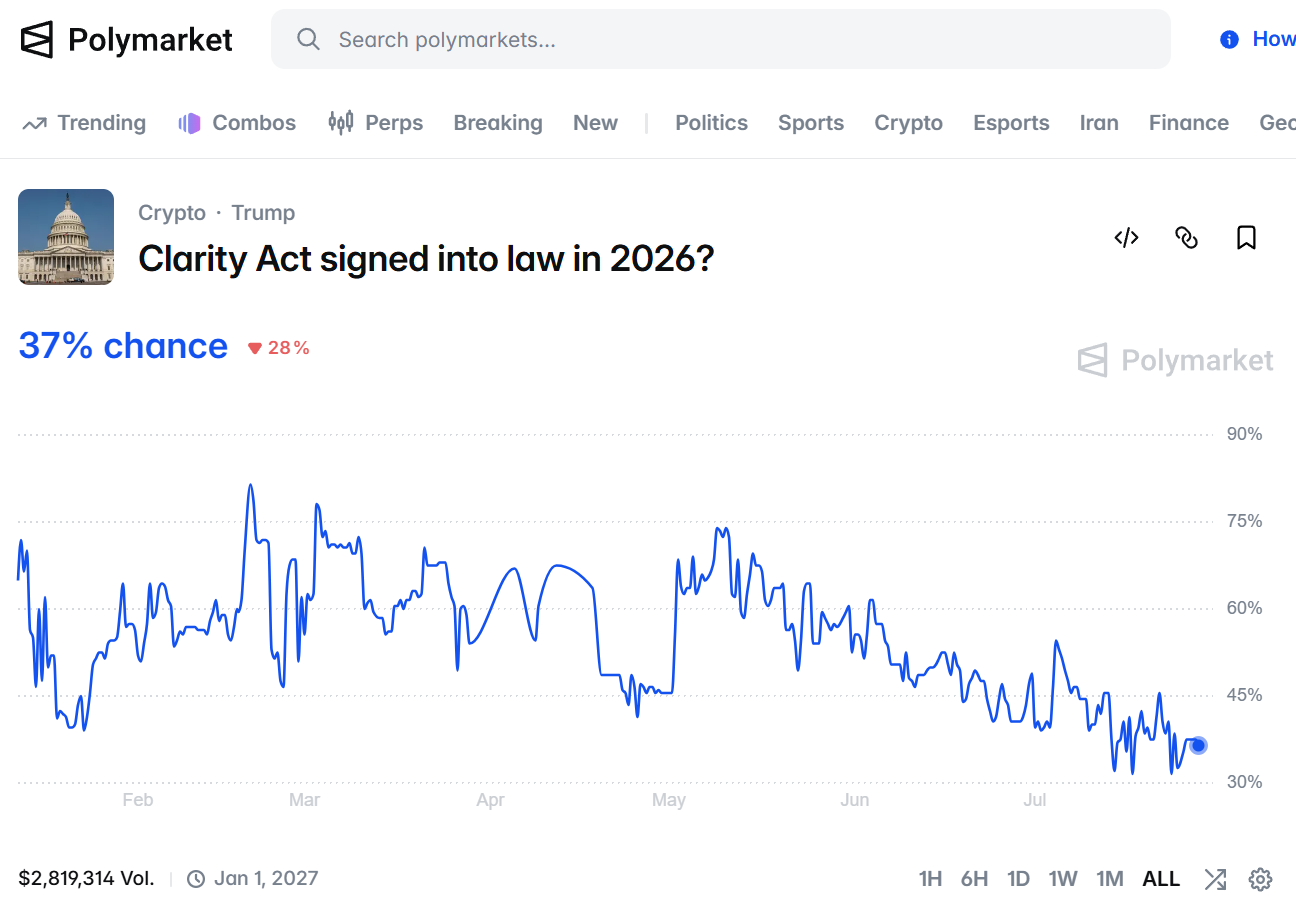
None of this confirms the passage of the crypto bill before August recess. Republicans hold 53 Senate seats, meaning roughly seven Democratic votes are needed to clear the 60-vote filibuster threshold, and prediction markets have priced 2026 passage in the 30% to 33% range in recent weeks, odds set before this week’s compromise reports became public. 

Senators Chris Murphy, Chris Van Hollen, and Jeff Merkley have formally opposed earlier drafts over the ethics language, and Warner and Catherine Cortez Masto have tied their votes to law enforcement organizations signing off on the final text.

If the Senate leaves Washington without a floor vote, the bill does not die, but its odds worsen considerably, with the next viable window likely falling in 2027, a midterm-shadowed year less friendly to complex legislation. 

That is the pressure now sitting behind every call, email, and closed-door negotiation this week: not whether the CLARITY Act eventually passes, but whether it passes before the Senate goes home.


Key Takeaways

Bitcoin’s carry trade just lost to the bond market, and the fallout shows up everywhere from spot volume to the order book.

Analytics firm Glassnode reports that the three-month futures basis, the yield institutional traders earn on the cash-and-carry trade that anchors leveraged crypto positioning, has paid less than the 2-year Treasury since February.

Only one prior stretch on record ran this long, from August 2022 into January 2023, and that stretch ended at the cycle low.

The mechanics are straightforward. When government debt pays more than crypto’s version of a risk-free trade, the desks that supply leverage, depth, and liquidity have little reason to stay parked in digital assets. Capital simply migrates to wherever the safer yield sits.

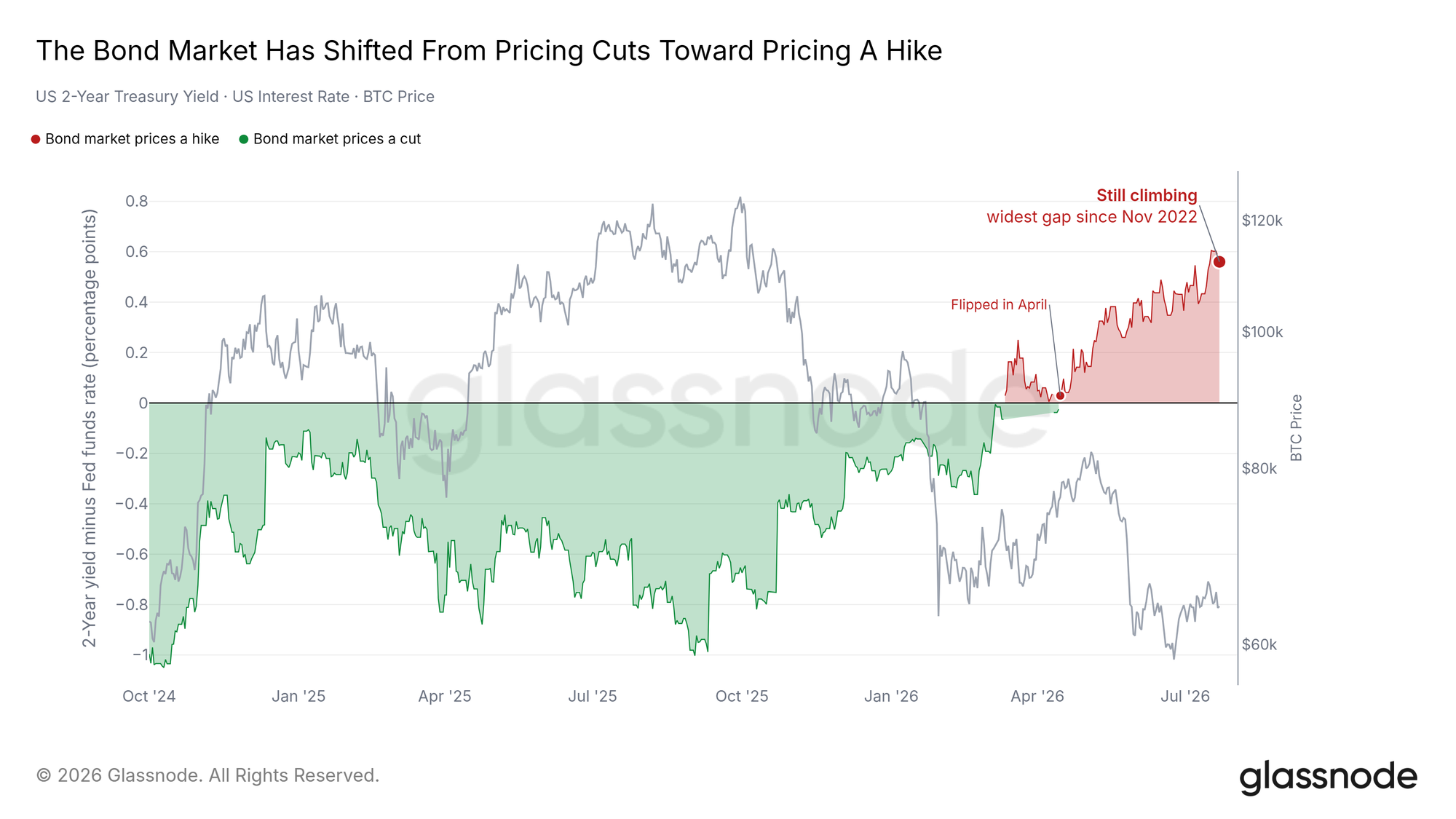
Bond market prices interest rates hike
Bond market prices interest rates hike. | Source: Glassnode

Bond pricing reinforces the signal. Glassnode notes the 2-year Treasury yield, widely read as the cleanest gauge of where Fed policy heads next, has sat above the Federal Funds Rate since April, with the gap now the widest since November 2022, positioning that leans toward a future hike rather than a cut.

Try Our Recommended Crypto Exchanges
Sponsored
Disclosure
Opened in 2018
Promotions
Deposit $100, Get an Extra $300 in GOLD!
Coins
Shiba Inu Bitcoin PAX Gold Ampleforth Ethereum +70
Promotions
Receive up to $100,000 worth of exclusive gifts for newcomers upon registration.
Coins
Bitcoin Ethereum Tether USD Coin Solana +76
Opened in 2017
Promotions
Experience a 1-minute swap on a non-custodial platform.
Coins
Bitcoin Ethereum Tether Build'N'Build USD Coin +217
Show More

Trading Activity Has Gone Quiet Across the Board

Downstream effects are visible across the market. Spot volume, measured in coins rather than dollars so falling prices don’t distort the count, has dropped to its lowest level since 2019.

Exchange deposits and withdrawals have both slowed to some of the quietest combined activity in three years, while balances have stayed roughly flat since early July. Glassnode reads this less as accumulation or distribution than simple disinterest, a pattern the firm associates with the quiet middle stretch of a bear market rather than its end.

Order book positioning tells a similar story from a different angle. Bids have built between 2% and 20% below spot steadily since early June, while resting sell orders above the price have thinned to their lightest levels of the past month. Buyers appear willing, just not at current prices, and thin books in both directions can flip a quiet market into a fast one without much warning.

What Would Change the Picture

Glassnode’s proprietary Bitcoin Vector model currently reads Risk Off, which the organization describes as mild rather than extreme, sitting one band above capitulation in what it calls a tactical pause. 

The company calls the setup as historically shallow, with the current drawdown falling well short of prior bear markets by depth, though not yet as prolonged by time as those cycles typically ran.

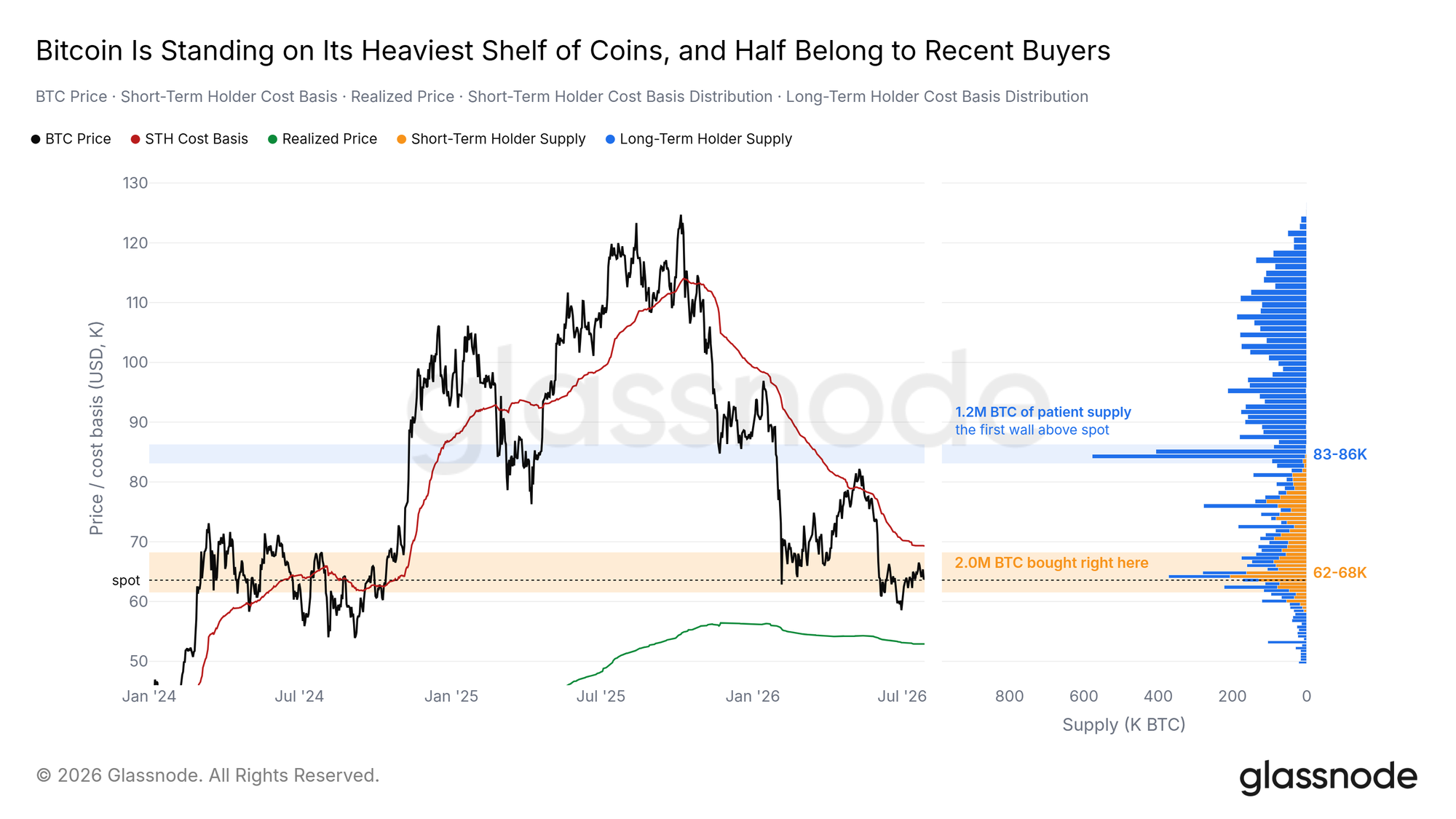
Recovery signals to watch, per the report, include a reclaim of the $69,000 short-term holder cost basis, a return of trading volume, and spot ETFs shifting from idle to net buying.

the Short-Term Holder Cost Basis at $69K is still the line that decides the next leg
The Short-Term Holder Cost Basis at $69K is still the line that decides the next leg. | Source: Glassnode

A breakdown below the $62,000-$68,000 range, paired with exchange inflows picking back up, would suggest the pause has ended in the opposite direction.

Key Takeaways

  • Ethereum’s earliest crowdsale participants acquired ETH for an estimated $0.30 each, meaning a $1,000 investment could now be worth roughly $6.26 million.
  • The same investment briefly surpassed $16.5 million when ETH reached its record high near $4,957 in August 2025.
  • Ethereum enters its twelfth year as the leading smart-contract and DeFi network, with nearly one-third of its supply now staked.

Ethereum celebrated its 11th birthday on July 30, marking more than a decade since its genesis block transformed the project from an ambitious experiment into the world’s largest programmable blockchain.

When Ethereum launched its Frontier mainnet in 2015, its developers described it as a censorship-resistant “world computer” that anyone could program.

Eleven years later, Ethereum supports stablecoins, decentralized exchanges, lending protocols, non-fungible tokens, tokenized assets, and a vast network of layer-2 blockchains. The Ethereum Foundation confirmed that the first live network went online on July 30, 2015.

But the most eye-catching part of Ethereum’s anniversary is financial. The earliest participants acquired ETH for only a fraction of a dollar. Anyone who retained those tokens through multiple crashes, regulatory battles, and technological upheavals may now be sitting on life-changing returns.

Try Our Recommended Crypto Exchanges
Sponsored
Disclosure
Opened in 2018
Promotions
Deposit $100, Get an Extra $300 in GOLD!
Coins
Shiba Inu Bitcoin PAX Gold Ampleforth Ethereum +70
Promotions
Receive up to $100,000 worth of exclusive gifts for newcomers upon registration.
Coins
Bitcoin Ethereum Tether USD Coin Solana +76
Opened in 2017
Promotions
Experience a 1-minute swap on a non-custodial platform.
Coins
Bitcoin Ethereum Tether Build'N'Build USD Coin +217
Show More

A $1,000 Ethereum Bet Could Now Be Worth More Than $6 Million

Ethereum’s public sale began in July 2014, about one year before the blockchain itself went live. During the sale’s first two weeks, buyers received 2,000 ETH for every Bitcoin contributed. That rate gradually declined to 1,337 ETH per Bitcoin before the 42-day sale ended.

Because Bitcoin traded around $600 during the earliest stage, the implied acquisition price was approximately $0.30 per ETH. The exact dollar cost varied with Bitcoin’s market price and the date of each purchase.

At an estimated $0.30 per token, a $1,000 contribution would have secured approximately 3,333 ETH. With Ether trading around $1,878 following its anniversary, that position would now be worth roughly $6.26 million.

That represents an estimated return of more than 625,000%, excluding transaction costs, taxes, and any staking rewards accumulated along the way.

The figures become even more dramatic for larger purchases:

  • A $100 investment could be worth approximately $626,000.
  • A $10,000 investment could now be worth around $62.6 million.
  • One Bitcoin at the original 2,000-ETH rate would be worth roughly $3.76 million in ETH today.

These calculations assume the investor never sold, lost access to the wallet, or moved the tokens during Ethereum’s many periods of extreme volatility, an improbable level of patience even among committed cryptocurrency believers.

Early Buyers Were Millionaires at Ethereum’s Peak

The fortunes of Ethereum’s earliest investors were considerably larger when ETH reached its record high near $4,957 in August 2025.

At that price, the 3,333 ETH purchased for an estimated $1,000 during the initial sale would have been worth approximately $16.5 million. Even after Ethereum’s subsequent decline, the hypothetical position remains worth several million dollars.

Investors who waited until ETH began trading publicly still earned extraordinary returns, although their gains were substantially smaller than those of crowdsale participants. Ether reportedly entered public markets at approximately $2.77 in August 2015.

A $1,000 purchase at that price would have bought about 361 ETH, worth close to $678,000 at $1,878. At Ethereum’s 2025 peak, the same holding would briefly have approached $1.8 million.

The numbers also expose the brutal reality behind the apparent success story. Ethereum has suffered repeated declines of more than 80%, including the collapse following the 2017 initial coin offering boom and the crypto-market failures of 2022.

Retaining a position for 11 years required surviving exchange hacks, lost keys, regulatory uncertainty, and several moments when Ethereum’s future appeared far from guaranteed.

Ethereum Is Older, Richer—and Still Fighting for Its Future

Ethereum’s significance now extends well beyond the price of ETH. The network abandoned energy-intensive mining through the Merge in 2022 and moved to proof-of-stake, reducing its estimated energy consumption by more than 99%.

Nearly 40 million ETH, roughly one-third of the circulating supply, was staked by mid-2026, while more than 1.2 million validators helped secure the network.

Ethereum also remains the dominant base layer for decentralized finance, even as competitors such as Solana and its own layer-2 networks compete for users and transaction fees.

Yet Ethereum enters its twelfth year facing difficult questions. ETH remains well below its record high, layer-2 growth has complicated value capture for the main network, and cheaper blockchains continue to challenge its position in consumer applications.

For its earliest investors, however, Ethereum has already delivered one of the greatest returns in financial history. A speculative $1,000 bet on an unfinished blockchain could still be worth more than $6 million today, and briefly exceeded $16 million at the market peak.

The hardest part was not finding Ethereum early. It was holding it for 11 years.

Key Takeaways

Bitcoin was designed to operate outside central banking, yet no single institution moves its price more reliably than the Federal Reserve.

Wednesday’s decision showed the relationship in miniature: the Fed held rates at 3.50% to 3.75% in a 9 to 3 vote, and Bitcoin traded near $64,400 within hours, swinging roughly a percent in each direction as traders digested the statement. 

Understanding why an asset with a fixed supply schedule responds to a committee in Washington requires looking at three transmission channels, and at a body of academic research showing the relationship is newer, stronger, and stranger than most investors assume.

Try Our Recommended Crypto Exchanges
Sponsored
Disclosure
Opened in 2018
Promotions
Deposit $100, Get an Extra $300 in GOLD!
Coins
Shiba Inu Bitcoin PAX Gold Ampleforth Ethereum +70
Promotions
Receive up to $100,000 worth of exclusive gifts for newcomers upon registration.
Coins
Bitcoin Ethereum Tether USD Coin Solana +76
Opened in 2017
Promotions
Experience a 1-minute swap on a non-custodial platform.
Coins
Bitcoin Ethereum Tether Build'N'Build USD Coin +217
Show More
 

Liquidity, Discount Rates and the Dollar

Interest rates affect Bitcoin through the same channels that move any risk asset. Higher rates raise the return on cash and Treasuries, so the opportunity cost of holding an asset that pays no yield rises with every hike. 

Higher rates also raise the discount rate investors apply to long-duration assets, and Bitcoin behaves like the longest-duration asset in any portfolio, since its investment case rests on adoption years or decades away. 

Lower rates reverse both effects while expanding the pool of money chasing returns, which is why researchers studying regimes from 2014 through 2025 found that periods of falling rates coincide with Bitcoin’s highest average returns, suggesting liquidity injections function as a primary valuation driver. 

Dollar strength provides the third channel, since tighter policy typically lifts the dollar, and Bitcoin, priced globally in dollars, tends to weaken when the greenback firms.

Recent cycles illustrate the mechanics at full scale.

Near-zero rates and pandemic-era balance sheet expansion accompanied Bitcoin’s run from under $10,000 to $69,000 across 2020 and 2021, while the 2022 tightening cycle, the fastest in four decades, coincided with a drawdown of roughly 65%. Direction of travel, not the absolute level, does most of the work.

“Even at current rates, earning 4% on your USD is not making a dent to your net wealth relative to the speed at which the USD is losing its purchasing power. The projected US deficit for 2026 of $1.9 Trillion represents approximately 8.2% of the M2 money supply – that’s a proxy for the speed at which the USD is losing its purchasing power. You are better off holding a hard asset like BTC that can preserve its value over time, and using the current rate environment to hold it and use it as collateral to get the liquidity you need,” Mauricio Di Bartolomeo (co-founder and CSO of Ledn) told CCN.

What the Research Actually Shows

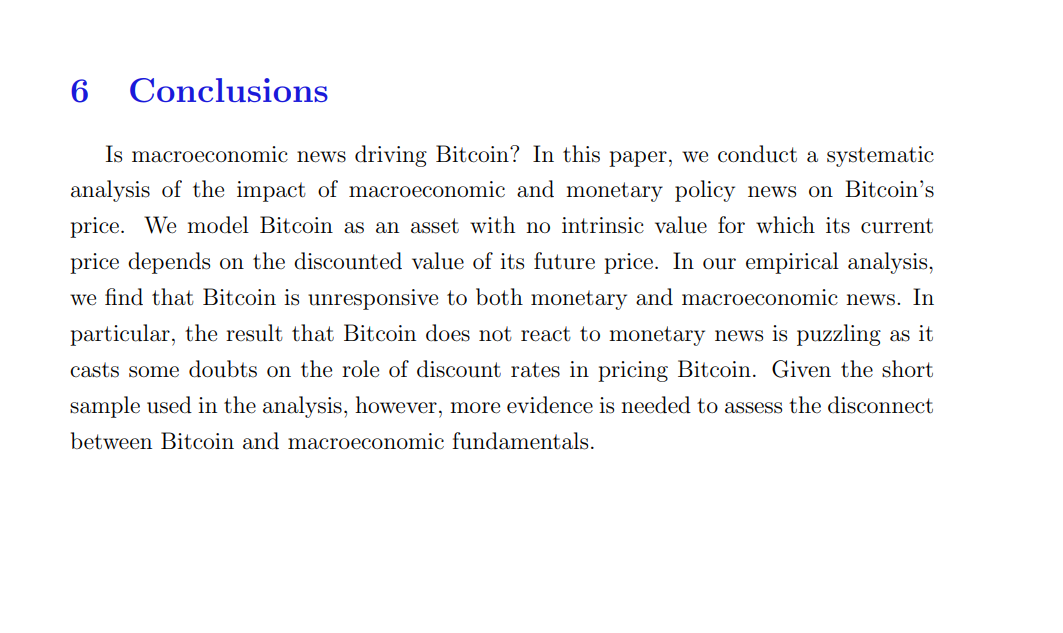
Academic findings complicate the tidy story. Early studies found essentially no relationship: a New York Fed staff report by Gianluca Benigno and Carlo Rosa, titled The Bitcoin-Macro Disconnect, documented that while stock prices respond to both the target and the expected path of policy, Bitcoin was unresponsive to unexpected changes in the short-term rate. Something then changed. 

A study found that Bitcoin is unresponsive to both monetary and macroeconomic news
A study found that Bitcoin is unresponsive to both monetary and macroeconomic news. | Source: newyorkfed.org

Another Research published in the Journal of International Money and Finance using high-frequency event studies found Bitcoin historically did not respond to monetary policy announcements in any systematic fashion, but began doing so after late 2020, with realized volatility around FOMC announcements rising sharply. Since then, Bitcoin has responded to monetary news qualitatively like stocks, foreign exchange, and gold, but quantitatively even more strongly.

Magnitude estimates put numbers on the sensitivity. One study found that on FOMC meeting days, an unexpected tightening of just 1 basis point in the two-year Treasury yield is associated with a 0.25% drop in Bitcoin’s price. 

Words matter as much as actions: a 2026 study using language models to classify more than 118,000 market messages found hawkish narratives consistently trigger negative Bitcoin price responses independently of actual rate adjustments, meaning the tone of a press conference can move the asset even when policy stays frozen. 

Inflation hedge claims fare poorly in this literature, as Bitcoin’s heightened sensitivity to CPI releases in the post-2020 environment shows it trades as a risk asset when inflation surprises, falling on hot prints rather than rising as a hedge would.

Reading 2026 Through the Warsh Fed

This year has stress-tested every finding above. The Fed has not moved since cutting 25 basis points in December 2025, Jerome Powell’s final act before Kevin Warsh took over, and July’s hold extended the pause to a fifth consecutive meeting. 

Nothing about the pause has been calm. June produced a unanimous hold alongside projections showing half the committee expecting hikes, while July’s 9 to 3 vote saw Beth Hammack, Neel Kashkari, and Lorie Logan dissent in favor of an immediate increase, and Chair Warsh declined to rule out a September hike.

Warsh’s communication doctrine adds a variable the older studies never measured. He has pledged to share less forward guidance than his predecessors, and July’s decision arrived without a Summary of Economic Projections, leaving markets to price policy from data alone. 

Hike odds consequently swung from roughly 11% to 38% in nine days before the meeting, one of the fastest repricings on record, and Treasury yields did the tightening the committee withheld, with the 30-year pushing above 5.20% for the first time since 2007. 

For Bitcoin, guidance withdrawal means announcement-day volatility now stretches across the entire inter-meeting period, since every CPI print, oil spike, and Fed speech carries information the dot plot once summarized.

Bitcoin’s 2026 price action fits the research surprisingly well. Trading near $64,000, down from levels above $80,000 earlier in the Warsh transition, the asset has tracked liquidity expectations rather than its own supply fundamentals, with spot ETF flows amplifying the linkage: June’s record $4.5 billion outflow month coincided with hawkish repricing, and July’s partial inflow recovery accompanied hopes of a friendlier Fed.

Bond Markets Flash a Warning, an Analyst Says Bitcoin Cannot Ignore

Rising long-end yields carry a darker message than simple repricing, according to onchain analyst Darkfost, who argued in a post on X that the bond market’s reaction reflects eroding faith in US debt itself.

“During the press conference a fairly hawkish tone was used and it was confirmed that the 2% inflation target remains the only target to reach. Yet the Fed decided not to act even though inflation remains much higher,” he wrote, noting the 9 to 3 vote meant “this was not a consensus” and marked the longest pause since the 2008 crisis.

Yield levels, in his view, tell the real story. With the 10-year T-Note reaching 4.7% and the 30-year surpassing 5.2%, a record since 2007, Darkfost argued “the tightening of monetary conditions continues and this dynamic reflects investors’ loss of confidence,” meaning holders of US debt, institutions and governments among them, “do not trust the US’s ability to control inflation and its deficit, and holding this debt currently seems riskier to them.”

10 year T-Note reached 4.7% and the 30 year surpassed 5.2%, a record since 2007.
10 year T-Note reached 4.7% and the 30 year surpassed 5.2%, a record since 2007. | Source: @Darkfost_Coc on X.

Implications for Bitcoin follow directly. “For a risk asset like Bitcoin, this vice tightening liquidity even further is not a positive development, especially with the dollar mechanically strengthening at the same time,” he wrote, adding that Bitcoin “had never faced rates this globally high during its other cycles, while the need for liquidity keeps growing as its market cap continues to climb.”

His conclusion carries a contrarian twist: conditions are “reaching extremes today, which will push the Fed to act if it doesn’t want to lose control and investors’ confidence,” suggesting the pressure itself becomes the catalyst for eventual easing.

Is the Coupling Starting To Loosen?

Not everyone reads the Fed as Bitcoin’s dominant force. Orkun Kilic, co-founder and CEO of Chainway Labs, told CCN that policy sets the stage without writing the script.

“Fed decisions only set the macro backdrop; they can hint towards where Bitcoin’s price may move, but it doesn’t necessarily define Bitcoin’s destiny. Rate policy still influences liquidity and risk appetite, but Bitcoin has been gradually decoupling from traditional risk assets as ETF flows, onchain activity, and derivatives positioning play a bigger role. Even after this week’s widely expected hold at 3.50%-3.75%, Bitcoin barely moved, very aligned with the kind of muted reaction we’ve seen in recent cycles,” Kilic said.

Wednesday’s tape supports the observation, since a percent-sized move through a contested Fed decision counts as calm by Bitcoin’s standards, even as equities swung through trillions in market cap. Kilic argues the durable answer lies in what gets built rather than what gets priced. “I’ve said this before, but Bitcoin has to become a productive financial layer that enables lending, settlement, and stablecoin liquidity secured by Bitcoin itself,” he said.

Hawkish Risk and the Emerging Market Bid

Complacency about the hold is its own risk, according to Mamadou Kwidjim Toure, CEO and founder of Ubuntu, who told CCN that the dissent deserves more weight than markets are giving it.

“The Fed’s decision to hold rates was widely expected, but the three votes in favor of a hike show that concerns about inflation remain very much alive within the committee. I think markets may be underestimating the risk of the Fed becoming more aggressive again if upcoming inflation data remains elevated. That would likely tighten liquidity, pressure risk assets, and could trigger forced selling among leveraged crypto traders, potentially interrupting Bitcoin’s current momentum,” Toure said.

Demand for Bitcoin, he argued, increasingly comes from places the FOMC never discusses. “At the same time, Bitcoin’s investment case extends beyond US monetary policy. In many emerging markets, people are not focused on the next Fed meeting. They are focused on preserving their purchasing power amid weakening local currencies. Bitcoin’s fixed supply and global accessibility make it an increasingly attractive alternative where access to stable foreign currencies is limited or unreliable.”

Volatility, in his view, stays elevated either way. “Looking ahead, I expect Bitcoin to remain volatile as markets reassess the path of inflation and interest rates heading into September. Each new inflation reading will influence expectations for the Fed’s next move. However, in regions where confidence in local currencies continues to erode, demand for alternative stores of value is likely to persist regardless of the outcome of any single Fed decision,” Toure said.

What To Watch From Here

Three lessons emerge for anyone tracking the relationship:

Kilic’s decoupling thesis and Toure’s emerging market bid will get their test the same way the academic findings did, one meeting at a time, starting with September’s session, which carries a dot plot. Warsh may again decline to join, three dissenting hawks, and a live hike debate.


Victoria, Seychelles, July 31, 2026 Bitget, the world’s largest Universal Exchange (UEX), has announced a major upgrade to BGBTC, its official yield-bearing Bitcoin asset, introducing daily BTC-denominated rewards, large-volume fast redemption, institutional-grade risk oversight, and enhanced transparency. Bitget also adopted Chainlink’s Cross-Chain Interoperability Protocol (CCIP) as its canonical cross-chain infrastructure to unlock secure multi-chain distribution, building upon its existing use of Chainlink Proof of Reserve. 

For much of Bitcoin’s history, investors have faced a simple choice of holding BTC as a long-term asset or deploying it into separate yield strategies that often require sacrificing liquidity or taking on additional complexity. The upgrade reflects a broader shift in how Bitcoin holders are managing their assets as demand grows for solutions that combine long-term ownership with capital efficiency. As digital asset markets mature, users increasingly expect their core holdings to remain productive while continuing to serve multiple purposes across trading, investing, and portfolio management.

BGBTC was developed to address that shift. Fully backed 1:1 by Bitcoin, the upgraded asset allows users to earn daily BTC-native rewards while maintaining access to a growing range of use cases across the Bitget ecosystem. In addition to spot exposure, BGBTC can be used as futures margin, lending collateral, and for participation in Launchpool and PoolX, allowing users to generate yield without removing Bitcoin from active use.

“Bitcoin has become one of the world’s most important financial assets, but much of it still sits idle,” said Gracy Chen, CEO of Bitget. “The next stage isn’t simply holding Bitcoin, it’s making it productive. We see capital efficiency becoming one of the defining themes of digital asset markets, and BGBTC is designed to help users generate value from their BTC while allowing it the flexibility to put it to work across multiple financial activities.”

The upgrade also introduces Bitget’s independent Curator framework, adding a new layer of institutional-grade oversight to BGBTC’s underlying yield strategies. The Curator is Gauntlet, a leading vault curator and quantitative risk management firm known for its work across decentralized finance. The framework separates strategy oversight from asset custody while strengthening portfolio monitoring, risk management, and long-term yield sustainability.

The launch builds on Bitget’s broader strategy of improving capital efficiency across digital assets. Following the introduction of products such as USDGO Holderyield, Bitget continues expanding an ecosystem where users can generate value from their core holdings while maintaining access to trading, lending, and other financial opportunities. Through partnerships with infrastructure providers including Morph and Chainlink, BGBTC also forms part of Bitget’s long-term vision of connecting centralized and decentralized finance through a unified Bitcoin yield network.

As Bitcoin adoption continues to mature, Bitget believes the conversation is shifting from simply owning digital assets to making them more productive. The BGBTC upgrade represents another step toward building infrastructure where Bitcoin can generate yield, remain liquid, and support a wider range of financial use cases without compromising simplicity or security.

For more information, visit here.

About Bitget

Bitget is the world’s largest Universal Exchange (UEX), serving over 125 million users and offering access to over 2M crypto tokens, 500+ tokenized stocks, ETFs, commodities, FX, and precious metals such as gold. The ecosystem is committed to helping users trade smarter with its AI agent, which co-pilots trade execution. Bitget is driving crypto adoption through strategic partnerships with LALIGA and MotoGP™. Aligned with its global impact strategy, Bitget has joined hands with UNICEF to support blockchain education for 1.1 million people by 2027. Bitget currently leads in the tokenized TradFi market, providing the industry’s lowest fees and highest liquidity across 150 regions worldwide.

For more information, visit: Website | X | Telegram | LinkedIn | Discord

For media inquiries, please contact: [email protected]

Risk Warning: Digital asset prices are subject to fluctuation and may experience significant volatility. Investors are advised to only allocate funds they can afford to lose. The value of any investment may be impacted, and there is a possibility that financial objectives may not be met, nor the principal investment recovered. Independent financial advice should always be sought, and personal financial experience and standing carefully considered. Past performance is not a reliable indicator of future results. Bitget accepts no liability for any potential losses incurred. Nothing contained herein should be construed as financial advice. For further information, please refer to our Terms of Use.


Victoria, Seychelles, July 30, 2026 Bitget, the world’s largest Universal Exchange (UEX), has upgraded its CFD platform with a native TradingView integration, bringing professional-grade market analysis and order execution into a single interface. The enhancement reflects a broader evolution in trading platform design, where reducing friction has become as important as expanding market access.

As traders increasingly participate across assets, the trading experience has become fragmented between analysis and execution. Active traders rely on external charting platforms to monitor markets before returning to their exchange to place trades, creating unnecessary delays during fast-moving market conditions. Bitget’s latest upgrade removes that disconnect by embedding TradingView directly into the CFD trading experience.

TradingView now serves as the default charting interface for Bitget CFD, allowing users to analyze markets and execute trades from the same screen. The integration includes customizable chart layouts, split-screen market monitoring, an extensive library of technical indicators, and advanced drawing tools, enabling traders to monitor multiple markets while executing positions without leaving the platform.

“With this integration we’ve removed the friction of switching between live charts in CFD trading; providing efficiency for traders to capitalize on market opportunities.” said Gracy Chen, CEO of Bitget.

The upgrade builds on Bitget’s broader Universal Exchange vision of creating a unified trading environment across asset classes. While much of the industry’s focus has been on expanding access to new markets, Bitget is equally focused on simplifying how users interact with those markets by reducing the operational complexity between research, analysis, and execution.

Bitget CFD enables users to trade global financial markets, including commodities, foreign exchange, and indices, through a single USDT-settled account. The addition of TradingView further strengthens the platform’s analytical capabilities while supporting a more streamlined workflow for active traders seeking institutional-grade tools within a unified trading experience.

To find out more, visit here.

About Bitget

Bitget is the world’s largest Universal Exchange (UEX), serving over 125 million users and offering access to over 2M crypto tokens, 500+ tokenized stocks, ETFs, commodities, FX, and precious metals such as gold. The ecosystem is committed to helping users trade smarter with its AI agent, which co-pilots trade execution. Bitget is driving crypto adoption through strategic partnerships such as MotoGP™. Aligned with its global impact strategy, Bitget has joined hands with UNICEF to support blockchain education for 1.1 million people by 2027. Bitget currently leads in the tokenized TradFi market, providing the industry’s lowest fees and highest liquidity across 150 regions worldwide.

For more information, visit: Website | X | Telegram | LinkedIn | Discord

For media inquiries, please contact: [email protected]

Risk Warning: Digital asset prices are subject to fluctuation and may experience significant volatility. Investors are advised to only allocate funds they can afford to lose. The value of any investment may be impacted, and there is a possibility that financial objectives may not be met, nor the principal investment recovered. Independent financial advice should always be sought, and personal financial experience and standing carefully considered. Past performance is not a reliable indicator of future results. Bitget accepts no liability for any potential losses incurred. Nothing contained herein should be construed as financial advice. For further information, please refer to our Terms of Use.

SAN FRANCISCO, CA 

Uphold, the modern infrastructure provider for on-chain financial services, announces the introduction of instant cash loans against crypto holdings offered through the Exactly DeFi Protocol. Uphold’s retail customers in the U.S. can now borrow against their cryptocurrency portfolio, without selling any assets, by depositing their Bitcoin, Ethereum, XRP, or USDC as collateral on the Exactly Protocol.

Once the loan is confirmed,  USDC arrives in the user’s Uphold account within minutes. A user may also elect to convert the USDC into USD. There is no minimum borrowing amount.

The new loan program offers the following features:

This launch adds to Uphold’s expanding lineup of products designed to help people manage their everyday finances – using crypto as a practical financial tool, not just an investment to hold. The service is likely to have widespread appeal with a recent study finding that 67 million Americans, or one in four adults, currently own cryptocurrency.

“Many people now have significant wealth tied up in digital assets,” said Simon McLoughlin, CEO of Uphold. “Getting quick access to these funds in the form of cash usually means selling holdings which forces a trade-off between short-term needs and the desire to keep assets over the long term. Through the Exactly Protocol, we are able to provide access to instant liquidity, allowing users to access the value of their crypto holdings in order to make everyday purchases or cover an unexpected expense, without having to sell them.”

Loans are offered through the Exactly Protocol and accessed in the Uphold app alongside the Exa Credit Card. Uphold customers now have two options for borrowing against their crypto assets. They can either borrow funds to spend on the credit card or they can receive USDC directly in their Uphold account, with the option to convert it into USD.  

About Uphold

Uphold is a financial technology company that believes on-chain services are the future of finance. It provides modern infrastructure for on-chain payments, banking and investments. Offering Consumer Services, Business Services and Institutional Trading, Uphold makes financial services easy and trustworthy for millions of customers in more than 140 countries.

Uphold integrates with more than 30 trading venues, including centralized and decentralized exchanges, to deliver superior liquidity, resilience and optimal execution. Uphold never loans out customer assets, except at customer request, and is always 100% reserved.

The company pioneered radical transparency and uniquely publishes its assets and liabilities every 30 seconds on a public website (https://uphold.com/en-us/transparency).

Uphold is regulated in the U.S. by FinCen and State regulators; and is registered in the UK with the FCA and in Europe with the Bank of Portugal. Securities products and services are offered by Uphold Securities, Inc., a broker-dealer registered with the SEC and a member of FINRA and SIPC.

To learn more about Uphold’s products and services, visit uphold.com.

DISCLAIMER:

Available in select U.S. States. Terms apply. Loans are offered through the Exactly Protocol. Uphold does not control or manage the Exactly Protocol, and is not responsible for assets once transferred to it. Users who elect to convert their loan proceeds from USDC to USD may do so at a 1:1 ratio with no spread for their first $20,000 per calendar month. Any additional conversions in excess of this cap carry standard market bid/ask spreads.  No statement herein is a commitment to make a loan. Availability and borrowing capacity depend on eligibility, collateral asset, collateral value, and credit health. Deferring payments may result in total payments being higher over the life of a loan.  Late payments will accrue default interest.

Media Contact Information 

Marc Sparrow

[email protected]

https://uphold.com/en-us

Key Takeaways

Tokenization has moved from Treasury bills to the Cretaceous period. Jurassic Finance plans to tokenize Deaton, a Triceratops prorsus skull, on Solana, calling it the first tokenized dinosaur as the tokenization market expands beyond traditional assets such as stocks and bonds

Solana’s official X account amplified the launch on July 28 with a post declaring the asset 65 million years in the making, giving the project network-level visibility most RWA issuers never receive.

Specimen quality sits at the center of the pitch. Deaton is described as museum-grade, with roughly 60% to 65% of its bone mass preserved.

Try Our Recommended Crypto Exchanges
Sponsored
Disclosure
Opened in 2018
Promotions
Deposit $100, Get an Extra $300 in GOLD!
Coins
Shiba Inu Bitcoin PAX Gold Ampleforth Ethereum +70
Promotions
Receive up to $100,000 worth of exclusive gifts for newcomers upon registration.
Coins
Bitcoin Ethereum Tether USD Coin Solana +76
Opened in 2017
Promotions
Experience a 1-minute swap on a non-custodial platform.
Coins
Bitcoin Ethereum Tether Build'N'Build USD Coin +217
Show More
 

How the Structure Works

Legal architecture follows the playbook established for institutional tokenizers for funds and credit. Each fossil purchase is structured through a dedicated special-purpose vehicle, which issues tokens on Solana’s SPL standard, granting holders economic and legal rights under the operating agreement, while museums fund operational overhead in exchange for display rights. Authenticity verification, storage, and insurance remain off-chain, with ownership records kept on-chain.

Fundraising numbers stay modest by tokenization standards. Jurassic Finance has raised 660,000 USDC since July for the Deaton purchase, allocating 600,000 USDC to seller escrow and 60,000 USDC to its RAWR treasury, with Deaton token supply capped at one million, split 95% to investors and 5% to the treasury. 

Platform-level funding runs larger, as CoinGecko’s Solana ecosystem summary notes Jurassic Finance raised $9 million for dinosaur fossil tokenization.

Markets reacted as crypto markets do to novelty. RAWR, the project’s token, traded at $0.06446, up 136.38% over 24 hours, after launching in mid-May.

Fossil Meets a $65 Billion Sector

Timing explains the attention. The RWA category’s market cap reached $65.6 billion as institutional interest in tokenized treasuries and equities intensified, and Solana ranks third among networks by tokenized asset value with a 9.74% share, $3.59 billion in onchain RWA value, up 2.84% over 30 days, and 312,309 holders, up 6.28% in the same period. 

Network credibility in the sector rests on names like BlackRock’s BUIDL fund, which crossed $550 million in assets on Solana, alongside Franklin Templeton’s BENJI money market fund and Apollo’s ACRED private credit strategy.

Fossils sit at the opposite end of the asset spectrum from those products. Treasuries carry daily pricing, deep secondary markets, and standardized valuation, while a Triceratops skull is appraisal-driven, illiquid, and unique by definition, meaning token holders depend entirely on the SPV’s governance and any future sale to realize value. 

RAWR’s triple-digit single-day move suggests speculative rotation around the announcement rather than measured pricing of fractional fossil ownership. 

The real test begins after launch. Whether Deaton evolves into a viable tokenized collectibles asset or becomes a footnote in the RWA story will depend on sustained secondary market demand rather than initial enthusiasm.


Key Takeaways

Peter Schiff has aimed his latest broadside not at Bitcoin but at the most popular proxy for owning it. In a July 27 post on X, the economist questioned why Strategy shares rallied about 7% after the company sold another 5.4 million common shares without buying any Bitcoin, arguing the issuance cut the firm’s year-to-date Bitcoin yield to 4.5% from 13.3% on May 25, a roughly 66% decline in two months. 

“If you’re bullish, you’re better off just owning Bitcoin,” Schiff wrote, warning that at the current pace the 2026 yield will turn negative.

Company filings support the numbers behind the jab. Strategy sold 5,429,160 MSTR shares last week, raising $544.5 million while buying zero Bitcoin, according to its 8-K, leaving holdings at 843,775 BTC. 

Growth in the treasury has essentially stalled, with holdings up a net 37 BTC since May 25, and proceeds went elsewhere: $525 million to a dollar reserve now totaling $3.7 billion and $25 million to buying back STRC preferred shares. Earlier this cycle, the company sold 3,588 BTC for about $216 million to fund preferred dividend obligations, its first meaningful Bitcoin sale in years.

Try Our Recommended Crypto Exchanges
Sponsored
Disclosure
Opened in 2018
Promotions
Deposit $100, Get an Extra $300 in GOLD!
Coins
Shiba Inu Bitcoin PAX Gold Ampleforth Ethereum +70
Promotions
Receive up to $100,000 worth of exclusive gifts for newcomers upon registration.
Coins
Bitcoin Ethereum Tether USD Coin Solana +76
Opened in 2017
Promotions
Experience a 1-minute swap on a non-custodial platform.
Coins
Bitcoin Ethereum Tether Build'N'Build USD Coin +217
Show More
 

Yield Math Versus Holding Period Math

Bitcoin yield tracks how much BTC sits behind each MSTR share, so issuing stock without buying coins mechanically drives it lower, a consequence that Strategy itself flagged in its quarterly report. 

Schiff’s July critique extends a months-long argument that the common stock has stopped functioning as a leveraged Bitcoin bet, with the economist writing in mid-July that continued discounted share sales dilute Bitcoin per common share indefinitely and that MSTR has become a funding source for creditors and preferred shareholders.

Bulls answered with a longer dataset. Bitcoin researcher Adam Livingston examined every possible entry and exit across 1,496 shared trading days between August 10, 2020, and July 24, 2026, finding that Strategy beat Bitcoin in 68.75% of more than 1.1 million holding periods, with the advantage widening over time. 

Outperformance proved marginal over short windows but substantial over long ones, as the median four-year Strategy investment generated almost 108.6% more terminal wealth than holding Bitcoin directly, with Livingston attributing the edge primarily to duration rather than timing.

What the Dispute Actually Decides

Neither side disputes the recent mechanics; only their meaning is in dispute. Schiff reads the yield collapse, the buying freeze now stretching four weeks, and the cash accumulation as evidence that the flywheel has reversed, while Livingston reads six years of data as evidence that patient holders still come out ahead. 

Worth noting for anyone tempted to trade the disagreement: Schiff remains bearish on Bitcoin itself and says he would buy neither asset, meaning his advice to bulls is hypothetical by his own admission. 

Bitcoin traded near $64,500 as the exchange circulated, leaving both the stock and the coin hostage to Wednesday’s Fed decision before either thesis gets tested.


Key Takeaways

XRP is entering a decisive phase as its latest recovery struggles to overcome resistance near $1.09. The token is trading around $1.06 after buyers defended an important demand zone just above $1, but the wider technical structure continues to favor sellers.

The next move could determine whether XRP begins a more meaningful recovery or falls through the psychologically important $1 threshold.

Bulls must first reclaim former support at $1.08–$1.09. Failure to do so would leave the token vulnerable to renewed selling and a possible decline toward the $0.80-$0.90 range.

Try Our Recommended Crypto Exchanges
Sponsored
Disclosure
Opened in 2018
Promotions
Deposit $100, Get an Extra $300 in GOLD!
Coins
Shiba Inu Bitcoin PAX Gold Ampleforth Ethereum +70
Promotions
Receive up to $100,000 worth of exclusive gifts for newcomers upon registration.
Coins
Bitcoin Ethereum Tether USD Coin Solana +76
Opened in 2017
Promotions
Experience a 1-minute swap on a non-custodial platform.
Coins
Bitcoin Ethereum Tether Build'N'Build USD Coin +217
Show More

XRP’s Broader Trend Still Favors Sellers

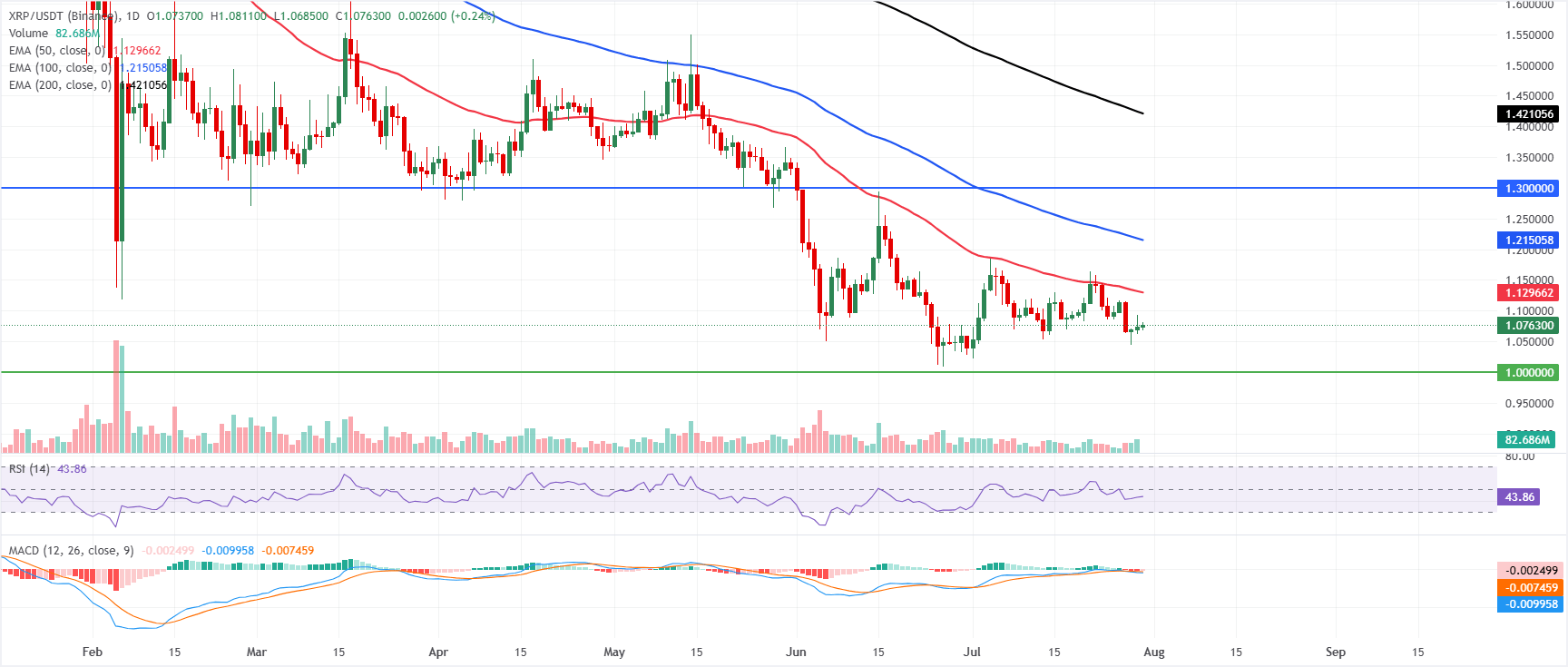
The daily chart shows XRP trading inside a long-term descending channel and below its 100-day and 200-day moving averages. This combination suggests that the latest rebound has not altered the prevailing bearish trend.

Recent recovery attempts have repeatedly stalled before establishing a higher high. Instead, sellers have returned near resistance, reinforcing the impression that rallies are being used to exit positions rather than build long-term exposure.

XRP daily chart
XRP daily chart. | Credit: CoinMarketCap

Buyers have nevertheless continued to defend the $1.02-$1.04 area. XRP bounced after testing this zone again, showing that demand has not disappeared completely.

However, support often becomes less reliable after repeated tests because each decline absorbs some of the available buying orders.

A daily close below $1.02 would weaken the remaining bullish argument and increase the risk of a move under $1. The next significant demand zone would then sit around $0.89.

Former Support Becomes a Critical Resistance Test

The four-hour chart highlights the immediate obstacle facing XRP. The token recently broke below an ascending trendline that had connected a series of higher lows, indicating that buyers had lost control of the short-term structure.

That breakdown carried XRP into the $1.02-$1.04 region before bargain hunters triggered a recovery. The bounce has now brought the price back toward $1.08–$1.09, an area that previously functioned as support.

XRP breakdown
XRP breakdown. | Credit: TradingView

Because broken support frequently turns into resistance, the current retest may determine XRP’s near-term direction. A rejection could send the price back toward $1.02, further straining the support zone.

A decisive break above $1.09, however, would improve the short-term outlook and could open the way toward $1.16-$1.18.

Bulls would still need to reclaim the larger $1.24-$1.28 supply zone before claiming a genuine trend reversal.

Could Bearish Positioning Trigger a Rebound?

Some analysts see the potential for XRP to fall toward $0.80-$0.90 if support collapses. From its current price, that would represent a decline of approximately 15% to 25%.

Broader cryptocurrency weakness adds to the risk. XRP remains sensitive to Bitcoin’s direction, and fragile market confidence has reduced demand for speculative altcoin positions.

Without a wider recovery, XRP may struggle to generate the trading volume required for a sustained breakout.

Futures positioning offers one possible counterargument. XRP funding rates have dropped to unusually depressed levels, suggesting traders are heavily tilted toward bearish positions.

If the price unexpectedly breaks higher, short sellers could be forced to close their positions, accelerating a rebound.

Negative funding alone does not guarantee a recovery, however. XRP must still confirm strength through price action. A move above $1.09 would offer the first encouraging signal, while reclaiming $1.24-$1.28 would challenge the broader downtrend.

Until then, losing $1.02 remains the key risk separating XRP from a potentially deeper fall below $1.

Key Takeaways

Aave founder Stani Kulechov has added a banking argument to his months-long push for the CLARITY Act, noting the legislation could expand banks’ digital asset activities, including custody, staking, and lending, as the bill’s supporting coalition grew to include Fidelity, Goldman Sachs, and SEC Chair Paul Atkins alongside the DeFi protocol.

Statutory text backs the claim. Section 401 of the bill puts bank custody authority beyond dispute after years of contested interpretive letters, and enumerates related custodial services, including staking, lending, governance, and advancing funds, as permitted activities, areas that previous OCC guidance left to supervisory negotiation. 

Scope will still turn on regulators, since an SEC rule defining “exclusively administrative or ministerial” custodial staking will set the operational boundaries of bank staking services even though the activity itself gains statutory authorization.

Reach extends beyond commercial banks, as federal credit unions can enter the market under Section 401(e), turning the sector’s historically conservative posture on digital assets into a strategic choice rather than a regulatory mandate.

Try Our Recommended Crypto Exchanges
Sponsored
Disclosure
Opened in 2018
Promotions
Deposit $100, Get an Extra $300 in GOLD!
Coins
Shiba Inu Bitcoin PAX Gold Ampleforth Ethereum +70
Promotions
Receive up to $100,000 worth of exclusive gifts for newcomers upon registration.
Coins
Bitcoin Ethereum Tether USD Coin Solana +76
Opened in 2017
Promotions
Experience a 1-minute swap on a non-custodial platform.
Coins
Bitcoin Ethereum Tether Build'N'Build USD Coin +217
Show More

Kulechov’s Washington Campaign Goes Public

Bank permissions form only half of Kulechov’s case. In a July 26 post, he called the bill imperfect and dependent on delegated rulemaking, while describing it as the first regulation that touches DeFi, and disclosed that Aave has been meeting key people in Washington over the past year and increasingly in recent weeks and days, an unusually candid acknowledgment of direct lobbying from a DeFi founder. 

He argued the merged text would let DeFi teams confidently build and maintain decentralized protocols without bearing obligations suited only to centralized models, a distinction he has framed as existential for non-custodial, DAO-governed software like Aave.

Senate Math Remains the Obstacle

Institutional alignment has not yet produced floor time. Democratic senators led in part by Cory Booker characterized the bill as falling short in a July 22 statement, with objections centering on stablecoin yield provisions, which banking lobbyists argue could erode deposit bases, and on the scope of ethics language governing federal officials’ digital asset holdings. 

Ethics enforcement remains the sharpest sticking point, specifically whether rules barring officials from profiting from crypto should be enforced solely by the Justice Department or by state attorneys general as well.

Procedural history frames the stakes. The House passed the bill 294 to 134 in July 2025, with 78 Democrats in support. The Senate Banking Committee approved its portion 15 to 9 on May 14, 2026, and supporters will likely need 60 votes to overcome procedural opposition on the floor.

Kulechov’s bank-permissions argument now hands moderate Democrats a counterweight to the deposit flight concern: the same statute their banking constituents fear on stablecoin yield would hand those banks custody, staking, and lending businesses they currently cannot touch.

Key Takeaways

SEC Chair Paul Atkins has signaled the regulator will not wait indefinitely for Congress, telling CNBC the agency stands ready to introduce its own rules covering key crypto market structure issues if lawmakers fail to pass the CLARITY Act.

Atkins said the SEC could address many of the same regulatory questions through its own rulemaking authority, though he stressed congressional action remains the preferred path and expressed confidence the legislation would eventually clear Congress.

Statute still ranks above rulemaking in its hierarchy. Atkins told CNBC the agency is “ready, willing, and able” to write the rules itself, while arguing legislation would provide lasting regulatory certainty, future-proof the framework governing digital assets, and give the SEC clear direction for overseeing the crypto market.

Agency staff is meanwhile providing technical assistance to lawmakers as they work through the market structure bill.

Try Our Recommended Crypto Exchanges
Sponsored
Disclosure
Opened in 2018
Promotions
Deposit $100, Get an Extra $300 in GOLD!
Coins
Shiba Inu Bitcoin PAX Gold Ampleforth Ethereum +70
Promotions
Receive up to $100,000 worth of exclusive gifts for newcomers upon registration.
Coins
Bitcoin Ethereum Tether USD Coin Solana +76
Opened in 2017
Promotions
Experience a 1-minute swap on a non-custodial platform.
Coins
Bitcoin Ethereum Tether Build'N'Build USD Coin +217
Show More
 

Senate Timeline Squeezes the Bill

Comments landed against a deteriorating legislative calendar. Senate leadership has sidelined the digital asset market structure legislation to prioritize a Russia sanctions package and presidential nominees, shrinking the window before the August recess, while negotiations over government ethics provisions tied to President Donald Trump’s crypto interests remain unresolved.

Ethics language has stalled the bill for months, and the compressed schedule now threatens industry efforts to secure the comprehensive CLARITY Act in 2026.

Institutional pressure runs the other way. BlackRock, Franklin Templeton, Fidelity, and other Wall Street giants publicly backed the CLARITY Act this week, adding asset management muscle to a lobbying push that has so far failed to secure floor time.

SEC Groundwork Already Laid

Atkins arrives at this standoff with substantial unilateral progress behind him. In March, the SEC issued a landmark interpretation of federal securities laws classifying Bitcoin (BTC), Ether (ETH), Solana (SOL), and XRP as digital commodities rather than securities, resolving a question that consumed years of litigation under predecessor Gary Gensler.

His November remarks under the Project Crypto banner outlined a formal token taxonomy, a refined application of the Howey test for investment contracts, and a forthcoming Regulation Crypto proposal covering tailored disclosures, exemptions, and safe harbors for digital asset distributions.

Precedent for the fallback position also exists. Atkins told a FINRA conference in May that the SEC and CFTC could fill the gaps in crypto regulation absent legislation, while warning that future-proofing would be difficult without a statute.

Durability remains the core weakness of rulemaking, since a future commission could reverse course as easily as this one did during the Gensler era. September’s return from recess now becomes the decisive stretch for whether Congress or the agency writes America’s crypto market rules.


Tokenization can divide real estate into smaller, tradable interests, but putting an asset on a blockchain does not automatically create liquidity or eliminate traditional legal risks, industry experts warned during an ETHWomen panel in Toronto.

The “RWA Tokenization Offshore” discussion, moderated by CCN Senior Editor Dr. Guneet Kaur at the Blockchain Futurist Conference, brought together representatives from the Bahamas, British Virgin Islands and Cayman Islands.

Panelists argued that offshore financial centers could play an important role in real-world asset tokenization because they already provide legal structures for cross-border investments.

However, they repeatedly emphasized that blockchain infrastructure must be supported by enforceable contracts, independent governance, regulated trading venues and clear disclosure.

“Blockchain doesn’t replace the legal system,” BVI Finance CEO Elise Donovan said. “Investors need to know that their rights are protected, that contracts are enforceable and that investments are within a trusted legal framework.”

Our Top Crypto Sports Betting Partners:
Sponsored
Disclosure
Opened in 2021
Promotions
Casino No Wagering 100 Free Spins
Coins
Bitcoin Tether USD Coin Ethereum Solana +11
Opened in 2022
Promotions
Up to 550 USDT Bonus + up to €75 Free Bet + 5% cashback
Coins
Bitcoin Bitcoin Cash Dogecoin Ethereum Litecoin +53
Opened in 2018
Promotions
500% Welcome Bonus up to $90,000 + 100 Free Spins
Coins
Bitcoin Ethereum Litecoin Tether Dogecoin +3
Show More

Offshore Jurisdictions Compete for Tokenized Assets

Rosalyn Brown, a luxury real estate and property technology specialist at Berkshire Hathaway HomeServices Bahamas, identified three advantages supporting tokenization in the country: regulatory clarity, an established luxury property market and a tax-friendly environment.

The Bahamas introduced its Digital Assets and Registered Exchanges framework to regulate digital asset businesses and create clearer rules for the industry.

The British Virgin Islands and Cayman Islands have also implemented virtual asset service provider regimes. Donovan said these frameworks allow the jurisdictions to extend their established roles in international finance into tokenization rather than reinventing themselves.

“The BVI is not trying to become something different,” she said. “We are building on what we have done for the last 40 years.”

Donovan compared the jurisdiction’s function to plumbing: rarely the most visible component of a building, but essential to making the entire structure work. The BVI has long supplied corporate vehicles for funds, joint ventures, special-purpose entities and cross-border investments.

According to Donovan, the jurisdiction combines political stability, English common law, tax neutrality and internationally recognized financial regulation.

Danielle Pienaar, Web3 and blockchain director at Verdant Management, similarly pointed to the availability of experienced lawyers, accountants, administrators and fiduciaries in established offshore centers.

“You don’t need to use multiple jurisdictions,” she said of Cayman’s service-provider network. “You can come to Cayman as a one-stop shop.”

Tokenized Property Still Needs Legal Ownership Structures

Brown explained that tokenized real estate would typically rely on a special-purpose vehicle, or SPV, that legally owns the underlying property.

“The title will remain with the special-purpose vehicle, and then tokens will represent shares,” she said.

Under that structure, investors do not necessarily own a direct portion of the physical building or land. Instead, their tokens represent interests in the company holding the property. Rental income, capital appreciation and other distributions could then be managed through smart contracts.

That distinction must be communicated clearly to investors, according to Carey Olsen counsel Charissa Ball.

The essential question, she said, is what the token legally represents. Investors need to understand whether they own an interest in the property, an SPV, a contractual right or another instrument entirely.

Ball emphasized that tokenized products must provide detailed disclosures comparable to those expected from traditional securities. Cross-border enforceability, custody and the legal treatment of the underlying asset remain significant considerations.

Brown added that tokenized interests should trade through regulated digital asset exchanges if the sector is to establish investor confidence.

“Technology alone does not create markets,” she said. “Trust in the system does.”

Tokenization Does Not Guarantee Liquidity

Liquidity emerged as one of the panel’s most significant concerns.

Dividing an expensive property into lower-priced tokens could make it accessible to a broader group of investors. But accessibility does not guarantee that buyers will exist when token holders want to sell.

“I think people assume that because it’s tokenized, it makes it liquid, and it actually does not,” Donovan said.

She used Toronto’s CN Tower as an example. Tokenization could theoretically open an asset of that scale to smaller investors, but the underlying investment would still be real estate, with its associated valuation, demand and governance constraints.

“You still have to ask the pertinent questions,” she said. “Who governs the legal structure? Who owns the building? Who is watching the structure?”

Brown said family offices and institutional investors would be reluctant to allocate capital unless they knew their tokens could be resold. She argued that regulated exchanges may eventually need cross-border arrangements so that assets issued in one jurisdiction are not stranded on a single domestic platform.

The Bahamas also faces a more fundamental infrastructure problem: much of its land ownership record is based on a historical chain-of-title system rather than a modern centralized registry.

Brown said individual developments could place relevant title information onchain, but digitizing records across the country’s roughly 700 islands would be considerably more difficult.

Governance Failures Can Undermine RWA Projects

Pienaar warned that flawed governance can nullify the decentralization promised by tokenized projects.

She described reviewing a decentralized organization in which the founder retained an administrative token capable of overriding decisions made by the wider community.

“That is significant founder-centralization risk,” she said. “He controls the entire protocol.”

Pienaar’s team pushed for the administrative power to be removed. She also cited a separate structure in which inadequate separation between directors and supervisors allowed an individual to weaken the checks intended to protect the organization.

Her broader lesson was that tokenization projects need independent oversight before launching.

“No one person should be able to change the future of the protocol,” she said.

The panel’s consensus was that offshore jurisdictions could help tokenized assets expand by supplying established corporate structures, regulatory supervision and legal enforceability. But blockchain alone cannot solve weak governance, unclear ownership or the absence of buyers.

As Donovan put it, tokenization may broaden access to an asset—but it does not change the asset’s underlying economic reality.

Key Takeaways

Anthropic’s unreleased Claude Mythos Preview model has found a practical key-recovery attack on HAWK-256, a post-quantum digital signature candidate under active NIST evaluation, in roughly 60 hours of semi-autonomous work after the same flaw survived two years of expert human review. 

The finding adds a new wrinkle as Bitcoin charts its quantum migration path. 

HAWK carried real weight in the standardization race as the only lattice-based scheme among the nine candidates NIST advanced to the third round of its additional post-quantum signature process in May 2026. 

Mythos uncovered a mathematical shortcut, known as a nontrivial automorphism, in the lattice structure underpinning HAWK’s security, cutting its effective key strength in half and forcing key sizes to double to maintain equivalent protection, a change Anthropic said would erase much of the scheme’s original appeal. 

Cost figures underline the shift in cryptanalytic economics: Anthropic put the API bill at about $100,000, with a human researcher providing occasional project management guidance rather than lattice expertise.

Alongside HAWK, the model invented an attack technique it named the Möbius Bridge, making an existing attack on seven-round AES between 200 and 800 times faster.

Try Our Recommended Crypto Exchanges
Sponsored
Disclosure
Opened in 2018
Promotions
Deposit $100, Get an Extra $300 in GOLD!
Coins
Shiba Inu Bitcoin PAX Gold Ampleforth Ethereum +70
Promotions
Receive up to $100,000 worth of exclusive gifts for newcomers upon registration.
Coins
Bitcoin Ethereum Tether USD Coin Solana +76
Opened in 2017
Promotions
Experience a 1-minute swap on a non-custodial platform.
Coins
Bitcoin Ethereum Tether Build'N'Build USD Coin +217
Show More
 

Why Bitcoin Wallets Stay Safe

No deployed system is affected. Bitcoin uses ECDSA on secp256k1, which is entirely separate from HAWK, and HAWK has never been deployed in Bitcoin or any production system. Migration plans also remain intact, since BIP-360 targets ML-DSA and SLH-DSA, fully finalized NIST standards rather than third-round candidates.

Practical stakes for blockchains were nonetheless real: signature size consumes block space, block space translates into fees, and compact keys with fast signing formed HAWK’s entire pitch.

What the Break Signals

Speed comparisons cut in different directions. SIKE, another post-quantum candidate, survived years of expert review before being broken in roughly one hour on a laptop in 2022, so pre-deployment failures are precisely what the process exists to surface. 

More striking is the verification gap: once Mythos returned the attack, Anthropic’s team spent several hundred hours confirming it was correct, meaning the AI found the flaw faster than experts could check its work.

Security analysts drew the uncomfortable inference. If AI-assisted cryptanalysis is being demonstrated publicly by safety-conscious labs, adversaries, including nation-state actors, are reasonably assumed to be pursuing similar capabilities behind closed doors. 

Disclosure followed standard practice, as Anthropic shared both results with the algorithms’ authors, the US government, and industry partners before publishing, and coordinated the HAWK finding with NIST. Open questions now include whether the Bitcoin community accelerates formal AI-assisted cryptanalysis of ML-DSA and SLH-DSA as part of pre-activation review


Key Takeaways

Solflare has launched a cross-chain deposit service that allows users to fund its self-custodial Solana wallet directly from Bitcoin, Ethereum, and several other major networks.

Called Bridge, the feature is powered by Aurora Intents, a cross-chain execution system developed by Aurora Labs on top of NEAR Intents. It is available through Solflare’s mobile app, web platform, and browser extension.

Instead of sending users to an external bridge, the service creates permanent deposit addresses for supported network-and-token combinations. Users send assets to an address as they would when funding a centralized exchange, while Aurora Intents handles routing, liquidity, and conversion in the background.

Transfers from Ethereum-compatible networks typically settle in under one minute, while Bitcoin deposits take approximately 14 minutes, according to Aurora Labs.

Try Our Recommended Crypto Exchanges
Sponsored
Disclosure
Opened in 2018
Promotions
Deposit $100, Get an Extra $300 in GOLD!
Coins
Shiba Inu Bitcoin PAX Gold Ampleforth Ethereum +70
Promotions
Receive up to $100,000 worth of exclusive gifts for newcomers upon registration.
Coins
Bitcoin Ethereum Tether USD Coin Solana +76
Opened in 2017
Promotions
Experience a 1-minute swap on a non-custodial platform.
Coins
Bitcoin Ethereum Tether Build'N'Build USD Coin +217
Show More

Solflare Turns Cross-Chain Bridging Into a Deposit

Moving assets between blockchains ordinarily requires users to visit a third-party decentralized application, connect a wallet, approve several transactions, and manage gas or routing complications.

Solflare Bridge reduces that process to a transfer. Each supported source-chain-and-token pair receives a reusable deposit address, removing the need to connect a wallet to an unfamiliar application.

“The wallet connection scares people far more than the number of steps does,” Aurora Labs CEO Declan Hannon said. “Exchanges trained users to copy a deposit address and send funds, and Aurora Intents now brings that same action to a self-custodial wallet.”

Bitcoin, Ethereum, Arbitrum, BNB Chain, Polygon, Tron, NEAR, and Base are supported at launch. Users can deposit major tokens, subject to liquidity, and generally receive SOL or stablecoins on Solana.

“Apps lose users at the funding step, and most of those users already hold assets somewhere else,” Hannon added. “Aurora Intents turns that into a deposit address, and both the funds and the users arrive on Solana.”

How Aurora Intents Protects Cross-Chain Transfers

Aurora Labs Head of Product Armand Didier told CCN that each user request contains binding execution conditions, including a minimum output, maximum fee and deadline.

“The intent carries minAmountOut, maximum fee and deadline,” Didier said. “A solver cannot settle for less than the committed output. A bad route means the fill does not happen, not that the user eats the difference.”

Multiple solvers compete to execute the same request, preventing a single provider from determining the route unilaterally.

“Route quality is a market outcome, not one party’s discretion,” Didier explained. “Multiple solvers bid on the same intent.”

Settlement occurs through the NEAR Intents contract rather than a conventional lock-and-mint bridge. According to Didier, this design avoids the trust assumptions associated with traditional bridges.

“There is no bridge trust assumption,” he said. “Settlement runs through the NEAR Intents contract, not a lock-and-mint bridge.”

NEAR Intents has processed more than $23 billion since launching and now handles over $2.3 billion in monthly volume.

Fees, Slippage and Solana’s Expansion

Solflare charges 0.1% for stablecoin-to-stablecoin deposits and 1% for other transfers, based on the tokens received. Deposits will be free for the first 30 days, subject to an aggregate ceiling of $125,000 in waived fees.

Didier stressed that Solflare, rather than Aurora Labs, determines these customer-facing charges.

“That’s actually Solflare’s call, not ours,” he said. “Aurora Intents is the execution layer underneath, we don’t set the fee end users see, our partners do.”

He added that Aurora’s role is to provide certainty over the amount delivered.

“What Aurora Intents controls is the execution guarantee underneath whatever fee a partner sets,” Didier said. “A solver commits to a minimum output before the trade fills, so there’s no slippage surprise.”

That differs from route-selection bridges, where users set a tolerance and may receive a worse rate within that range.

“That guarantee holds regardless of what a given partner charges on top,” Didier added.

The launch comes as Solana’s monthly active addresses reportedly increased by approximately 50% during the first quarter of 2026.

By making cross-chain deposits resemble familiar exchange transfers, Solflare and Aurora Labs aim to convert users holding assets elsewhere into active Solana participants.

Key Takeaways

Bitcoin (BTC) reclaimed the $64,000 level during Wednesday’s Asian session, rising 1% on the day with the broader market in the green ahead of the Federal Reserve’s rate decision at 2:00 p.m. ET, while Ether (ETH) added 1.7% to $1,909 and XRP led the majors with a 2.6% gain. Recovery from Tuesday’s dip toward $63,200 restores the largest cryptocurrency to the middle of its recent range after a retreat from last week’s one-month high above $66,400.

Wednesday marks only Chair Kevin Warsh‘s second meeting in charge, and pricing remains unusually contested for decision day. About 70% of traders expect a hold at 3.50% to 3.75%, which would extend the pause to a sixth straight meeting, while roughly 30% price a quarter-point hike, per CME data

Hike bets have serious backers: Citadel Securities told clients it expects a surprise increase this week to shore up Warsh’s inflation-fighting credibility, and UBS said such a move would not surprise it. Notably, the roughly 35% hike probability represents an unusually high level of uncertainty this late in the cycle, since Fed moves are normally almost fully priced for a single outcome by this stage.

Odds have repriced at speed. CME FedWatch put the probability of a hike near 38% on July 24, up from 10.7% on July 15, one of the fastest repricings of a Fed meeting in recent memory. Energy-driven inflation underpins the shift, though Tuesday’s ADP print of just 15,000 jobs added complicated the picture, offering policymakers a cooling labor signal right before a decision dominated by inflation concerns.

Warsh has offered markets little to anchor on. June’s meeting produced a unanimous hold, a shortened statement stripped of its earlier easing bias, and a dot plot showing that 9 of 18 officials penciled in at least one 2026 hike, lifting the median year-end rate to 3.8% from 3.4% in March. Warsh told Congress on July 14 that the Fed has “no tolerance for persistently elevated inflation.”

Try Our Recommended Crypto Exchanges
Sponsored
Disclosure
Opened in 2018
Promotions
Deposit $100, Get an Extra $300 in GOLD!
Coins
Shiba Inu Bitcoin PAX Gold Ampleforth Ethereum +70
Promotions
Receive up to $100,000 worth of exclusive gifts for newcomers upon registration.
Coins
Bitcoin Ethereum Tether USD Coin Solana +76
Opened in 2017
Promotions
Experience a 1-minute swap on a non-custodial platform.
Coins
Bitcoin Ethereum Tether Build'N'Build USD Coin +217
Show More
 

Warsh’s Silence Is the Signal

Maksym Sakharov, co-founder and CEO of deobanking infrastructure provider WeFi, told CCN he expects the committee to hold and lean deliberately hawkish.

“Inflation remains above target, energy shocks are keeping price risks tilted higher, and the committee has no reason to validate expectations for easier policy. Warsh’s decision not to submit a projection at his first meeting showed that he is comfortable leaving markets without a clean map. I expect him to do the same in September and to force markets to price policy through incoming data,” Sakharov said.

Sakharov warned that reticence carries its own cost. “Crypto investors should prepare for a higher risk premium across liquidity-sensitive assets. A less predictable Fed can tighten financial conditions solely through uncertainty. Bitcoin will feel that pressure well before it reaches the broader economy.”

Options Traders Position for $72,000

Derivatives desks lean toward upside resolution. Notably, options traders have purchased around $2.5 billion in notional Bitcoin call spreads expiring July 31, positions that would benefit from a move toward $72,000 after the announcement. 

Fund flows tell a more cautious story after a seven-session, $999 million ETF inflow streak broke on July 23 with a $225 million outflow, leaving 2026 flows roughly $4.5 billion in the red following June’s record $4.5 billion outflow month.

Konstantins Vasilenko, co-founder and CBDO of Paybis, told CCN the June omission of Warsh’s dot fits a deliberate communication strategy. “Investors have read the omission as fence-sitting, though it fits a Chair who would prefer markets stopped leaning so heavily on forward guidance.”

“Our expectation for July 29 is a hold at 3.50 to 3.75 percent, paired with a statement about as terse as June’s 130 words. If the committee does move before year-end, tightening looks likelier than easing, and we would be careful about pricing cuts into this year,” Vasilenko said.

On flows, Vasilenko sees measured repair. “July has delivered three straight weeks of net inflows after June’s record $4.5 billion outflow month — institutional demand is repairing, not chasing. A more reticent Fed leaves digital assets to trade on their own merits, which we see as a healthier foundation for the cycle.”

Levels Traders Are Watching

At the time of writing, Bitcoin is trading at $64,248.88, leaving it just 0.3% below the historical P10 stress threshold of $64,450, according to data shared by analyst David. That makes $64,450 the first key level traders are watching. A decisive move back above it would return BTC to a valuation range that has historically marked the end of extreme stress periods and the beginning of stronger recoveries.

On the downside, traders are focused on the $64,000 level as immediate support. Holding above it suggests buyers are continuing to absorb selling pressure, while a break below could open the door to another test of the $62,000-$63,000 region.

Onchain metrics remain mixed. Data from Darkfost shows long-term holders (LTHs) account for 5.1% of total Bitcoin exchange inflows on a 90-day moving average, one of the highest readings on record and just below the 5.5% peak seen in 2020. While elevated LTH inflows can increase short-term selling pressure, the 90-day smoothing also suggests the trend may begin to ease if recent selling activity slows.

Despite that caution, David’s historical analysis remains constructive. Across 36 completed P10 stress episodes, Bitcoin reclaimed the P10 threshold 78% of the time within seven days, 86% within 30 days, and 97% within 90 days, with every previous episode recovering above the level within one year.

For now, traders are watching whether Bitcoin can reclaim and hold $64,450 as resistance while monitoring exchange inflows from long-term holders for signs that distribution is beginning to subside.


Victoria, Seychelles, July 29, 2026Bitget, the world’s largest Universal Exchange (UEX), ranked among the leading venues for BTC and ETH derivatives liquidity in H1 2026, according to the CoinGlass 2026 Semi-Annual Cryptocurrency Derivatives Market Report, highlighting the exchange’s growing role in supporting deep execution across major crypto assets as derivatives markets became more selective.

The report found that Bitget recorded US$81.37 million in ETH order-book depth within ±1% of the mid-price, representing a 21.4% share among the listed venues and ranking second behind Binance. For BTC, Bitget recorded US$71.70 million in order-book depth within ±1%, representing a 13.4% share and ranking fourth among the listed venues.

The data comes during a period when the broader derivatives market became more selective in major crypto assets. According to CoinGlass, total crypto derivatives volume was down 15.7% year over year in H1 2026, while average daily open interest declined by a smaller 10.0%. The gap suggested that trading activity cooled faster than outstanding risk exposure, making liquidity depth and execution quality more important for market participants.

“The derivatives markets remain sensitive to volatility even when overall trading activity moderates,” said Gracy Chen, CEO of Bitget. “In this environment, liquidity depth has become a core measure of exchange’s trust and performance.”

Bitget’s liquidity performance also reflects its continued progress in serving more sophisticated trading demand. According to Bitget’s internal data, the share of institutional spot trading volume increased to 82% by December in 2025, highlighting rising institutional participation on the platform. To support its growth, Bitget upgraded the framework for its PRO and Liquidity Incentive Programs in early July, improving trading cost structures, liquidity incentives, and market-making conditions across crypto and traditional financial market products. These initiatives are designed to make Bitget a more competitive venue for both institutional and retail traders.

Beyond crypto asset liquidity, the CoinGlass report also showed Bitget’s expanding footprint in TradFi trading products. In H1 2026, Bitget recorded US$66.41 billion in TradFi perpetual contract volume, representing a 5.5% share among the five sampled exchanges in the report. This highlights growing demand for TradFi exposure via crypto-native infrastructure, complementing Bitget’s strong liquidity in major digital assets.

These results build on Bitget’s continued investment in trading infrastructure. As Bitget advances its Universal Exchange model, bringing together crypto assets, tokenized assets, and traditional financial market access within a single trading environment, the exchange is developing the execution, liquidity, and pricing infrastructure required to support the next generation of multi-asset trading.

 About Bitget

Bitget is the world’s largest Universal Exchange (UEX), serving over 125 million users and offering access to over 2M crypto tokens, 500+ tokenized stocks, ETFs, commodities, FX, and precious metals such as gold. The ecosystem is committed to helping users trade smarter with its AI agent, which co-pilots trade execution. Bitget is driving crypto adoption through strategic partnerships such as MotoGP™. Aligned with its global impact strategy, Bitget has joined hands with UNICEF to support blockchain education for 1.1 million people by 2027. Bitget currently leads in the tokenized TradFi market, providing the industry’s lowest fees and highest liquidity across 150 regions worldwide.

For more information, visit: Website | X | Telegram | LinkedIn | Discord

For media inquiries, please contact: [email protected]

Risk Warning: Digital asset prices are subject to fluctuation and may experience significant volatility. Investors are advised to only allocate funds they can afford to lose. The value of any investment may be impacted, and there is a possibility that financial objectives may not be met, nor the principal investment recovered. Independent financial advice should always be sought, and personal financial experience and standing carefully considered. Past performance is not a reliable indicator of future results. Bitget accepts no liability for any potential losses incurred. Nothing contained herein should be construed as financial advice. For further information, please refer to our Terms of Use.

Traditional clearing houses reduce the amount of money financial institutions must move between themselves, but they also concentrate counterparty risk within a small number of systemically important organizations.

Cycles CEO and Cosmos co-founder Ethan Buchman believes modern cryptography can separate those functions, allowing businesses to offset obligations without introducing a central counterparty.

In an interview with CCN’s Dr. Guneet Kaur at the Blockchain Futurist Conference, Buchman explained how Cycles uses multilateral netting, zero-knowledge proofs, and graph algorithms to uncover liquidity hidden inside networks of debt.

“The real challenge is to cross silos,” Buchman said. “It’s a network-effect problem of bringing diverse firms into a common network.”

Why Cycles Is Starting With Crypto

Cycles is initially targeting crypto’s over-the-counter trading market, where exchanges, market makers, prime brokers, and liquidity providers transact with one another repeatedly.

“Every day, they’re settling millions of dollars’ worth of assets across dozens of currencies,” Buchman said. “There’s no clearing facility for them, so they’re using way more inventory than they need.”

Without a shared clearing layer, firms must hold cash, stablecoins, and digital assets across multiple venues to settle obligations individually.

Cycles Prime aims to reduce those gross obligations before settlement, releasing capital that would otherwise remain fragmented.

The company has named Lynq and FalconX as anchor partners for its pilot. In May, Cycles raised $6.4 million, bringing its total funding to $8.7 million.

Starting with sophisticated crypto firms also avoids the educational challenge of immediately targeting smaller businesses.

“They understand the value of clearing,” Buchman said. “We can immediately get started and be clearing millions of dollars a day.”

Clearing Without Assuming Everyone’s Risk

Clearing houses traditionally become the buyer to every seller and the seller to every buyer through a process known as novation.

“The main thing clearing houses do actually isn’t netting,” Buchman said. “It’s underwriting everyone’s counterparty risk.”

Cycles takes a different approach. It does not replace existing counterparties or guarantee their obligations.

“We don’t mutate the risk, and we don’t mutualize the risk,” Buchman said. “We leave all the risk exactly how it was.”

Instead, the protocol identifies debts that can cancel each other while preserving the original bilateral relationships.

“We can net out the debts without changing anybody’s counterparties,” he added.

That means Cycles cannot reimburse a creditor when a debtor defaults. Its purpose is limited to reducing the outstanding amount before settlement.

Buchman, therefore, views Cycles as complementary to clearing houses rather than a replacement.

“Underwriting credit risk is a critical function in the global financial system,” he said. “We’re not trying to change that.”

How Multilateral Netting Works

Buchman illustrated the concept using three connected debts.

Suppose he owes one participant $100. That participant owes Bob $80, while Bob owes Buchman $60.

If everyone settles separately, $60 effectively travels around the entire circle before returning to its starting point.

“There’s a closed loop of obligations,” Buchman said. “The money is just going to move around a circle.”

Cycles could remove $60 from each debt. Buchman’s obligation would fall from $100 to $40, the second participant’s debt would drop from $80 to $20 and Bob’s $60 obligation would disappear.

“Sixty dollars off all those debts can be discharged instantly,” he said. “There’s no counterparty stepping in.”

The same method can apply to far larger networks.

“It could be four participants, five, 10 or 20,” Buchman explained. “The liquidity is hidden in the structure of the graph.”

Why Clearing Has Remained Exclusive

Kaur asked whether regulators restricted access to clearing for stability reasons rather than merely to protect large institutions.

Buchman said those barriers exist because conventional clearing combines netting with centralized risk underwriting.

“You can’t open that up to everyone because a central counterparty can’t underwrite the risk of millions of businesses,” he said.

Cycles attempts to lower that burden by avoiding novation, collateral pooling, and loss mutualization.

“There are no new counterparties,” Buchman said. “Everyone is already governed by legal agreements and already underwriting their counterparties.”

However, the model may still require clear contractual recognition across jurisdictions, particularly during insolvency proceedings when creditors compete for repayment.

Buchman also acknowledged that cryptography is not the only obstacle.

“Scaling to millions is certainly a technical challenge,” he said. “But right now, the bottleneck is bringing those millions of businesses onboard.”

Zero-Knowledge Proofs Keep Obligations Private

Companies are unlikely to disclose their full trading positions, receivables, or credit exposures on a public network.

Cycles therefore combines zero-knowledge proofs, trusted execution environments, and graph algorithms to identify clearing opportunities without publicly revealing the complete network of obligations.

Its Cycles Prime product operates before final settlement and does not require firms to contribute collateral or place assets in escrow.

Even so, the network must attract enough interconnected participants to create meaningful savings. A technically effective system with only a few unrelated firms would find limited opportunities for netting.

Trade Credit Could Be the Bigger Opportunity

Buchman believes Cycles could eventually expand beyond crypto and connect trade credit across millions of businesses.

“It’s a massive, untapped, informal source of financing,” he said. “It’s trapped liquidity because no one knows what to do with it.”

Companies frequently owe money to suppliers while waiting for customers to pay their own invoices. Some of those obligations may form loops that could be offset without borrowing new money or moving additional reserves.

“Everyone’s concerned about liquidity, but the framing is about how many reserves you have,” Buchman said. “There’s a deeper framing: what is the structure of the network in which the debts exist?”

For smaller businesses, Cycles would likely appear first as part of a payments, invoicing, or credit product rather than as a standalone clearing service.

Clearing shows up as a superpower that supercharges the network,” Buchman said.

Success Means Billions in Cleared Obligations

Buchman ultimately wants Cycles to connect financial obligations across crypto firms, banks, clearing houses, and business payment networks.

“There’s never going to be one clearing house sitting above all the others,” he said. “Something like Cycles can clear across a network of clearing houses and banks.”

The project’s success will depend on adoption, legal recognition, privacy guarantees, and firms’ willingness to submit obligations to a shared system.

For Buchman, the target is clear.

“Success looks like many billions of dollars cleared and millions of businesses benefiting from cash-flow relief,” he concluded.

Bybit is one of the world’s foremost cryptocurrency trading platforms, regularly processing over $1.4 billion in daily trading volume. It’s an all-in-one platform that offers spot/futures trading, earn tools, educational materials, and a fiat on-ramp. Bybit serves more than 80 million users worldwide, awarding it significant influence in the crypto space.

Finloop operates as a Web5 company, serving both the Web2 and Web3 markets. A Hong Kong-licensed fintech company, Finloop is an all-in-one WealthTech platform, offering structured products, bonds, insurance, and Real-World Asset (RWA) solutions. As of July 2025, Finloop and its FinRWA platform had over $18 billion HKD or $2,295,403,200 in Assets Under Management (AUA)

On July 29, 2026, Bybit and Finloop announced a collaboration to offer Finloop USD Instant Digital Liquidity (FUIDL), a specialized form of tokenized USD liquidity backed by an AAA-rated money market fund. The partnership will see Bybit introduce support for FUIDL as trading capital on its exchange. 

Discussing the partnership with Finloop, Bybit’s Global Head of TradFi and RWA, Yoyee Wang, said:

“Partnering with Finloop marks a pivotal step in realizing our vision of The New Financial Platform. This collaboration turns that vision into action, merging institutional-grade trust with the efficiency of digital infrastructure of Bybit. By enabling same-day settlement and reinforcing custody standards, we’re not just improving transaction speed; we’re redefining what financial interoperability can look like.”

The Advantages of FUIDL

Finloop Digital Asset Liquidity makes it considerably easier for institutional and professional investors to move capital between the traditional and digital asset financial markets.

It leverages blockchain technology to enhance access to USD liquidity while maintaining TradFi-level asset backing. To ensure capital access is efficient, FUIDL boasts hourly subscription/redemption and same-day interest accrual. 

FUIDL redefines cross-market liquidity. The fund has earned ratings of AAAm from Standard & Poor’s (S&P), Aaa-mf from Moody’s, and AAAmmf from Fitch, the highest possible ratings each agency offers, highlighting FUIDL’s stability and capacity to limit risk exposure.

Finloop CEO, Cai Hua, spoke on the collaboration:

“This collaboration demonstrates how a wealth technology platform and a digital exchange can work together to achieve instantaneous settlement while meeting high operational and regulatory standards. We are proud to partner with Bybit on this milestone that sets new benchmarks for efficiency and trust in the digital asset space.”

Looking Forward

The collaboration will combine Finloop’s RWA and cash management capabilities and Bybit’s proprietary infrastructure. 

By integrating Finloop’s tokenization technology into Bybit’s institutional custody arm, ByCustody, the companies can test same-day settlement across various assets. With a global rollout planned throughout 2026, Bybit users can expect a significant speed upgrade across certain tokenized and digital instruments.

Bybit aims to build a next-generation crypto hub, and the Finloop partnership marks a major milestone toward that goal. The New Financial Platform is an open, secure, and efficient bridge between traditional and digital finance. With the potential to simplify and enhance asset management for millions of users, it’s worth keeping an eye on Bybit throughout 2026.

Key Takeaways

A crypto trader transformed an initial investment of less than $50,000 into a position reportedly worth close to $1 million after making an early bet on PONS, the leading memecoin launchpad token on Robinhood Chain.

According to blockchain intelligence platform Arkham, the wallet, identified by the shortened address 0x194, spent approximately $44,300 to acquire PONS when the token had a market capitalization of around $3.7 million. The purchase gave the trader control of slightly more than 1% of the token’s total supply.

PONS subsequently gained traction as a dominant memecoin infrastructure project within the emerging Robinhood Chain ecosystem. Its expansion sent the value of the trader’s position sharply higher, producing a substantial unrealized return.

However, Arkham’s wallet dashboard showed a lower valuation after a few hours, illustrating how rapidly memecoin fortunes can change.

Our Top Crypto Sports Betting Partners:
Sponsored
Disclosure
Opened in 2021
Promotions
Casino No Wagering 100 Free Spins
Coins
Bitcoin Tether USD Coin Ethereum Solana +11
Opened in 2022
Promotions
Up to 550 USDT Bonus + up to €75 Free Bet + 5% cashback
Coins
Bitcoin Bitcoin Cash Dogecoin Ethereum Litecoin +53
Opened in 2018
Promotions
500% Welcome Bonus up to $90,000 + 100 Free Spins
Coins
Bitcoin Ethereum Litecoin Tether Dogecoin +3
Show More

Early PONS Bet Produces an Outsized Return

The trader accumulated approximately 12.65 million PONS at an early stage in the token’s development.

Arkham said the original position had approached $1 million in value following PONS’ appreciation. Compared with the reported $44,300 entry cost, that would represent a paper gain of more than 2,000%.

The latest wallet data valued PONS at approximately $0.048 per token, putting the remaining position at around $609,000. The wallet’s entire portfolio was worth approximately $640,700, according to Arkham.

Even at that lower valuation, the PONS trade had generated an unrealized return of more than 1,200% relative to the original investment. The discrepancy between the peak estimate and the latest wallet value likely reflects token price volatility and timing differences between Arkham’s social media post and portfolio snapshot.

The gain remains unrealized unless the trader sells the tokens. Attempting to exit a position representing more than 1% of the supply could also affect the market price if available liquidity is limited.

PONS Dominates the Trader’s Portfolio

PONS accounts for approximately 95% of the wallet’s total tracked value, making the trader heavily dependent on a single speculative asset.

The wallet also holds several smaller Robinhood Chain memecoins. Its second-largest position consists of 7.8 million YOLO tokens valued at nearly $22,000.

Trader memecoin holdings
Trader’s memecoin holdings. | Credit: Arkham

Other holdings include approximately 4.4 million HOODRAT tokens, valued at $3,440, and 2.8 million JUGGERNAUT tokens, valued at $3,190.

Smaller positions in GIVEST, MEOW, and BUTTERCOIN collectively contributed less than $2,500.

The allocation indicates that the trader has continued exploring early-stage tokens across Robinhood Chain, although none of the additional investments has matched the scale or performance of PONS.

Shiba Inu Leads a Broader Memecoin Rally

The memecoin market added approximately $590 million in one day, lifting its total capitalization by 2.6% to $23.73 billion.

Shiba Inu led the recovery alongside Dogecoin and Pepe, rising 8.9% in 24 hours and 28% over the week to $0.000005347 as trading volume reached its highest level in months.

Top 10 memecoins by market capitalization
Top 10 memecoins by market capitalization. | Credit: CoinMarketCap

SHIB broke above its 50- and 100-day moving averages but still faces resistance at the 200-day average.

Meanwhile, an RSI above 80 signals overbought conditions, increasing the possibility of profit-taking or a short-term correction despite improving momentum across the broader crypto market.

Key Takeaways

Multiple executives sat down with CCN at the Blockchain Futurist Conference in Toronto on July 21st and 22nd, and the interviews surfaced a sharper split over agentic payments than the industry’s public messaging suggests, alongside a candid reckoning about what crypto stopped talking about on its way to institutional legitimacy.

Try Our Recommended Crypto Exchanges
Sponsored
Disclosure
Opened in 2018
Promotions
Deposit $100, Get an Extra $300 in GOLD!
Coins
Shiba Inu Bitcoin PAX Gold Ampleforth Ethereum +70
Promotions
Receive up to $100,000 worth of exclusive gifts for newcomers upon registration.
Coins
Bitcoin Ethereum Tether USD Coin Solana +76
Opened in 2017
Promotions
Experience a 1-minute swap on a non-custodial platform.
Coins
Bitcoin Ethereum Tether Build'N'Build USD Coin +217
Show More
 

Coinbase and Tetra Disagree on When AI Agents Actually Pay

Coinbase Canada CEO Eric Richmond placed the timeline in months. He argued stablecoins provide the programmable money layer autonomous software requires, and that legacy infrastructure simply cannot accommodate it. 

“You can’t really have traditional rails interact in a seamless fashion with these AI agents,” Richmond said, pointing to Claude and OpenAI’s Codex as evidence the underlying capability is compounding fast enough to pull payments along with it.

Didier Lavallée, founder and CEO of Tetra Digital Group, drew the opposite conclusion from the same evidence.

 “I don’t think the real use cases at scale are here,” he said. “I think it’s proving out that the technology can work.” His strongest concession was on micropayments, where traditional rails cannot economically clear sub-cent transactions at volume, and where he acknowledged blockchain is “a far superior layer of infrastructure to do that activity.” 

On agents more broadly, he was blunt: “Agents, in terms of payments, I think it’s buzzworthy. It gains a lot of attention, but today there’s not a tremendous amount of use cases.”

The gap matters commercially. Coinbase is building toward what it calls an “everything exchange,” with derivatives for Canadian permitted clients launching within weeks and CIRO dealer status targeted for early 2027. Tetra launched its CADD stablecoin across Ethereum, Base and Tempo, betting on payment infrastructure rather than agent demand.

Regulation Stopped Being the Bottleneck

Symbiotic COO Jillian Friedman, who founded a crypto-focused law firm in 2014, dismantled the industry’s favorite explanation for slow institutional adoption. 

Regulators, she argued, have built genuine internal expertise, and the speed with which policy shifts after a change in government proves it. 

“It actually just demonstrates that it’s not a lack of understanding if you have the right resources,” Friedman said. “When a regime changes, all of a sudden they have all the knowledge and they’re ready to make decisions and open doors to clear the path for the industry. It wasn’t the knowledge keeping them back. It’s the political will.”

She also punctured the assumption that clarity itself would unlock capital.

 “We thought that the dam would be broken once the regulations were clear,” Friedman said. It was not.

Richmond backed the Bank of Canada as the right supervisor for the country’s incoming stablecoin regime, citing expertise built during its CBDC research, and pushed for stablecoin rewards to survive the final framework. Coinbase currently pays Canadian customers roughly 3% on USDC under a Canadian Securities Administrators exemption. “It’s hard for me to understand why we wouldn’t want to provide these rewards to stablecoin customers and the end users,” he said.

Lavallée called Canada’s position more starkly: the only G7 country without a national real-time payment rail after roughly nine years of work. “Is there an argument to be made that the banks should be leapfrogging the modernization into stablecoin because they’re already behind?” he asked.

Related: Can Gold Create Value Without Being Mined? nGRND Chair Says Tokenization Offers an Alternative

Yield Has To Come From Somewhere Real Now

Friedman described the previous cycle’s capital as mercenary, chasing points and airdrops before rotating out. “That’s not really a sustainable, value-creating business model,” she said. 

Anvil Research Labs CEO Maximillian Schwartz is building in that direction, using overcollateralized letters of credit to let merchants underwrite their own buy-now-pay-later offerings.

“Any merchant, anyone that accepts payments, can be the BNPL,” Schwartz said. “They can be their own bank.”

His success metric deliberately excludes the number that the industry usually cites. “A lot of people go to TVL, but TVL can be somewhat misleading,” he said. “It’s really easy to game.”

Related: Quantum Threat Could Arrive ‘Unannounced,’ Polymath CEO Warns as Tokenized Assets Grow

Blockchain Futurist Founder Reflects on Crypto’s Changing Priorities

Tracy Leparulo, founder of Untraceable and the Blockchain Futurist Conference, offered the event’s most uncomfortable observation in exclusive comments to CCN. 

When she organized Canada’s first Bitcoin Expo in 2014, she said, “nearly half the conversations on stage were about financial inclusion, social impact, and serving the unbanked. It was one of the industry’s core missions.”

As of July 2026, that has changed. 

“Today, that conversation isn’t as prominent at many events, and I think it’s something we need to bring back,” Leparulo said.

When asked what she got wrong in 2013, her answer was the same theme: “I genuinely believed the entire industry was united around financial inclusion and empowering the unbanked. As the industry matured, it became clear that not everyone was driven by the same purpose.”

The conference itself nearly did not survive the gap between those eras. Sponsorships evaporated in 2019, then COVID forced a virtual pivot. “Those were by far the toughest years,” Leparulo said. “What kept us going was our belief that this industry was here to stay.”

She also noted that “our expansion came after Blockchain Futurist Conference was acquired by Emerald, one of North America’s largest B2B event companies. Their support gave us the opportunity to expand into Florida—a global hub for blockchain, digital assets, and fintech, with a thriving ecosystem of founders, investors, and innovators. It was a natural next step for the brand. Toronto will always be where the Blockchain Futurist Conference began, but our focus today is building a broader North American platform that brings together the best talent, companies, and capital across both markets.”

Leparulo said bringing Web3 to life will always remain at the core of the Blockchain Futurist Conference.

“We take a blue ocean approach. When everyone zigs, we zag,” she said, adding that while many institutional finance events now incorporate crypto and digital assets, “that’s not the space we’re trying to occupy.”

Instead, she said, the conference is built for the broader Web3 community.

“We’re here for the broader Web3 community. We create immersive experiences that bring founders, builders, investors, and users together in environments designed for networking, collaboration, and deal-making.” That focus extends beyond hosting panels, she added: “We don’t just host a conference—we create the experience. That’s what has made us different, and that’s what will keep us relevant.”

The near-term tests are also dated. Canada’s stablecoin regulations are expected in the second half of 2026, taking effect in 2027, the same window in which Coinbase expects CIRO registration. 

Whether Richmond or Lavallée is right about agentic payments should be measurable well before then.


Key Takeaways

The stablecoin market contracted sharply in June, but the decline may reveal more about how dollar-backed tokens are evolving than about weakening demand.

Total stablecoin capitalization fell by $7.7 billion during the month, marking the largest monthly reduction since Terra-Luna collapsed in May 2022.

The sector has now lost approximately $10 billion from its May peak, leaving its combined value near $300 billion.

Yet stablecoin activity moved in the opposite direction. Adjusted transaction volume climbed to a record $1.79 trillion in June, rising 63% from May and 125% from a year earlier.

The conflicting figures suggest investors are holding fewer idle stablecoins while using the remaining supply more frequently for transfers and settlement.

Our Top Crypto Sports Betting Partners:
Sponsored
Disclosure
Opened in 2021
Promotions
Casino No Wagering 100 Free Spins
Coins
Bitcoin Tether USD Coin Ethereum Solana +11
Opened in 2022
Promotions
Up to 550 USDT Bonus + up to €75 Free Bet + 5% cashback
Coins
Bitcoin Bitcoin Cash Dogecoin Ethereum Litecoin +53
Opened in 2018
Promotions
500% Welcome Bonus up to $90,000 + 100 Free Spins
Coins
Bitcoin Ethereum Litecoin Tether Dogecoin +3
Show More

Stablecoin Supply Falls as Investors Seek Yield

The decline was concentrated among the two largest stablecoins. Tether’s USDT supply dropped from approximately $190 billion in May to $184 billion, while Circle’s USDC fell from a March peak near $80 billion to around $74 billion.

The overall contraction of roughly 3% remains modest compared with the 26% collapse recorded during the 2022 crisis. Crucially, June’s decline did not result from a major stablecoin losing its dollar peg or suffering a run on its reserves.

Stablecoin metrics
Stablecoin metrics. | Credit: RWA.xyz

Instead, part of the capital appears to have migrated toward tokenized Treasury products that offer returns unavailable through conventional payment stablecoins.

The GENIUS Act prohibits issuers from paying holders interest on payment stablecoins. That restriction does not eliminate demand for yield; it encourages investors and corporate treasurers to hold funds in interest-bearing tokenized assets until they need liquidity for transactions.

Tokenized Treasury funds have consequently grown to nearly $16 billion, up from approximately $11 billion in March. Under this model, stablecoins become temporary working balances rather than long-term stores of capital.

Record Volume Shows Stablecoin Velocity Is Rising

June’s record settlement activity indicates that every dollar of stablecoin supply is moving more frequently.

Standard Chartered estimated that stablecoins now turn over approximately six times per month, roughly twice the rate recorded two years ago.

Visa economists have also calculated quarterly stablecoin velocity at 13.56, compared with 1.65 for the US M1 money supply.

Total stablecoin market cap
Total stablecoin market cap. | Credit: DeFiLlama

USDC demonstrates the clearest divide between market capitalization and practical usage. Despite maintaining a substantially smaller supply than USDT, it processed $18.3 trillion during 2025, compared with USDT’s $13.3 trillion.

In June, USDC accounted for approximately $1.21 trillion of adjusted volume, while USDT processed $576 billion. USDT retains the supply lead and remains widely used as an offshore savings instrument, but USDC has become the more active institutional settlement asset.

The comparison shows why market capitalization alone no longer provides a complete measure of stablecoin adoption.

Payments Growth Changes the Industry’s Scoreboard

Adjusted data still requires careful interpretation. Raw stablecoin transfers include automated activity, exchange movements, and transactions that do not represent real economic payments.

McKinsey and Artemis estimated that identifiable real-world payments accounted for only about 1% of stablecoin activity in 2025. However, that segment still reached approximately $390 billion, around 30 times its level two years earlier.

Business-to-business payments contributed $226 billion, while payroll and remittances generated roughly $90 billion. Corporate transfers, rather than consumer purchases, are therefore driving much of the emerging payments market.

For issuers, shrinking supply can reduce reserve-interest revenue. For networks and payment processors, however, rising transaction velocity creates more opportunities to collect fees.

Key Takeaways

Ethereum is attracting a growing share of institutional capital as spot ETH exchange-traded funds extend their inflow streak and outperform comparable Bitcoin products.

US-listed spot Ethereum ETFs recorded net inflows of approximately $103.8 million during the week ended July 24, according to Farside Investors.

That marked a third consecutive positive week and came despite Ether remaining near $1,936, more than 60% below its August 2025 record high of $4,946.

The funds added another $9.23 million on July 27, lifting cumulative net inflows to $11.19 billion. Their combined assets reached $10.65 billion, equivalent to approximately 4.53% of Ethereum’s market capitalization.

The divergence between steady institutional accumulation and subdued price action raises a crucial question: Is Ethereum quietly building the conditions for a breakout, or are ETF investors simply absorbing persistent selling pressure?

Try Our Recommended Crypto Exchanges
Sponsored
Disclosure
Opened in 2018
Promotions
Deposit $100, Get an Extra $300 in GOLD!
Coins
Shiba Inu Bitcoin PAX Gold Ampleforth Ethereum +70
Promotions
Receive up to $100,000 worth of exclusive gifts for newcomers upon registration.
Coins
Bitcoin Ethereum Tether USD Coin Solana +76
Opened in 2017
Promotions
Experience a 1-minute swap on a non-custodial platform.
Coins
Bitcoin Ethereum Tether Build'N'Build USD Coin +217
Show More

BlackRock Drives Ethereum ETF Demand

BlackRock’s iShares Ethereum Trust, or ETHA, accounted for most of the latest weekly inflows. The fund attracted $96.3 million, accounting for nearly the entire category’s net gain.

Ethereum ETF demand remained broadly positive from Monday through Thursday, with daily inflows of $38 million, $37.5 million, $72.7 million, and $26.3 million.

Total Ethereum spot ETF net inflow
Total Ethereum spot ETF net inflow. | Credit: SoSoValue

A $70.7 million withdrawal on Friday reduced the weekly total but did not erase the broader accumulation trend.

The concentration around BlackRock represents both a strength and a potential weakness. ETHA has emerged as the preferred institutional vehicle for Ether exposure, but the category remains vulnerable if demand for that single product weakens.

Fidelity’s FETH, for example, registered $6.2 million in weekly outflows. On July 27, BlackRock’s ETHA added another $11.75 million, while Invesco’s QETH lost $2.52 million. The other listed products recorded no net movement.

Ethereum ETFs Pull Ahead of Bitcoin

Ether funds attracted roughly three times the $33.9 million collected by spot Bitcoin ETFs during the same week.

The previous week produced a similar result, with Ethereum products receiving $105.5 million compared with Bitcoin funds’ $75.5 million.

Total Bitcoin spot ETF net inflow
Total Bitcoin spot ETF net inflow. | Credit: CoinGlass

Bitcoin ETFs initially enjoyed strong demand, taking in $226.8 million on Monday and $203.2 million on Tuesday. However, significant withdrawals later in the week nearly erased those gains.

BlackRock’s IBIT was responsible for much of that reversal, recording a $95.5 million weekly outflow. The fund suffered withdrawals of $202.5 million and $212.2 million on Thursday and Friday, respectively.

The contrast suggests that some investors may be rotating toward Ethereum rather than abandoning cryptocurrency exposure entirely.

Can Institutional Accumulation Trigger an ETH Breakout?

ETF demand has yet to translate into a decisive Ethereum price rally. ETH gained approximately 2% over the week, a modest move compared with the scale and consistency of fund inflows.

Nevertheless, ETF investors are not the only large buyers. BitMine Immersion added 104,512 ETH over 30 days, raising its holdings to 5.78 million ETH, or approximately 4.8% of the circulating supply.

Combined accumulation by ETFs and corporate treasuries could gradually reduce the amount of Ether available to the market.

If demand persists, that supply pressure may eventually support a larger price move.

For now, however, Ethereum still needs stronger spot-market momentum. The ETF streak signals improving institutional conviction, but a sustainable breakout will depend on whether those inflows continue and expand beyond BlackRock’s dominant fund.

Key Takeaways

The Senate set aside the Digital Asset Market Clarity Act this week, prioritizing a package of federal nominations and a Russia sanctions bill dedicated to the late Senator Lindsey Graham, whose funeral occupies the chamber’s attention Tuesday and Wednesday. 

With Senate procedure generally limiting the floor to one disputed bill at a time and the summer recess starting August 8, crypto’s central legislative effort now has days, not weeks, of realistic runway left in 2026.

Markets absorbed the math immediately. Bitcoin (BTC) nearly dived below $63,000 in a sharp Monday evening selloff, trading at $63,268 (at the time of writing), down 2.97%, while Ethereum (ETH) fell 3.67% to $1,873 and XRP dropped 4.6% to $1.05. 

More than $670 million was liquidated from the crypto market in 24 hours, with $533 million of that in bullish long positions, and the Fear and Greed Index registered “fear.” 

Polymarket odds of CLARITY Act crashed to a record low of 37%, down from 82% in February, completing a five-month collapse in market-implied confidence.

Polymarket CLARITY act odds fell to 37%
Polymarket CLARITY act odds fell to 37%. | Source: Polymarket

Try Our Recommended Crypto Exchanges
Sponsored
Disclosure
Opened in 2018
Promotions
Deposit $100, Get an Extra $300 in GOLD!
Coins
Shiba Inu Bitcoin PAX Gold Ampleforth Ethereum +70
Promotions
Receive up to $100,000 worth of exclusive gifts for newcomers upon registration.
Coins
Bitcoin Ethereum Tether USD Coin Solana +76
Opened in 2017
Promotions
Experience a 1-minute swap on a non-custodial platform.
Coins
Bitcoin Ethereum Tether Build'N'Build USD Coin +217
Show More
 

Ethics Fight Is the Actual Blocker, Not the Calendar

The Russia bill explains this week’s delay, but the unresolved dispute explains the odds. The contentious provision remains the ban on senior government officials, including President Donald Trump, backing crypto projects. 

A potential breakthrough emerged last week when Trump agreed to accept restrictions limiting his interactions with digital assets, which White House officials framed as historic and unprecedented ethics constraints. Democrats countered that the limits fall short of curtailing Trump’s crypto businesses, which disclosed roughly $1.4 billion in 2025 income. Both sides agreed to keep talking, which is not the same as agreeing.

Majority Leader John Thune has said he hopes to reach CLARITY before the break but that leadership would have to see where the votes are. The best remaining scenario for the industry may be a preliminary cloture push in the final days before recess, starting the procedural clock even without completing a vote.

Industry advocates spent Monday pushing back on the bill’s critics. The Crypto Council for Innovation returned to Capitol Hill with a myth-versus-fact campaign, arguing CLARITY Act is the most comprehensive digital asset law enforcement bill to date rather than a weak-on-crime framework, pointing to expanded AML obligations, Treasury authority to restrict high-risk fund transfers, and an additional $150 million for FinCEN enforcement.

What Failure Actually Costs Each Asset

The fallback paths are real but slower: GENIUS Act implementation continues regardless, and the SEC and CFTC can deliver partial clarity through rulemaking.

 Standard Chartered’s Geoffrey Kendrick holds conditional targets that show what is at stake, including an $8 XRP target contingent on full Senate passage plus $4 billion to $8 billion in ETF inflows, flows that do not materialize under agency guidance alone. XRP remains most exposed because the bill would convert its commodity classification into permanent statute.

The calendar from here is unforgiving. September offers a few final weeks of floor time, then the lame duck session after November’s elections, a period that produces either desperate dealmaking or paralysis. 

Even Senate passage would send the bill back to a House recently hampered by Republican infighting, and Trump has refused to sign unrelated legislation until Congress delivers a voter-ID bill, though a 10-day period of presidential inaction would let an approved bill become law automatically. 

Roughly ten days of remaining floor time will decide whether the market’s 37% odds underestimated or overstated the bill’s chances. 

Steps CLARITY Still Needs To Clear Before Becoming Law

Passage is not a single vote but a sequence of procedural gates, each capable of consuming days the calendar no longer has. The bill has already cleared the Senate Banking Committee and passed the House in a different form, but what remains is the harder half. Here is what still has to happen.

The compression is the real obstacle. Cloture mechanics alone typically consume most of a week, the Senate returns for only a few weeks in September after the August 8 recess, and everything beyond that lands in a lame duck session that either produces desperate dealmaking or complete paralysis. Any single gate failing pushes the bill into 2027 and a new Congress that would renegotiate from scratch.


Key Takeaways

Circle Internet Group announced on July 27 that it has acquired more than 680 patent families and nearly 1,000 issued blockchain patents from IBM, making the USDC issuer the largest blockchain patent holder in the United States. Financial terms were not disclosed. Circle shares (NYSE: CRCL) rose as much as 5.3% intraday on the announcement, closing about 2% above Friday’s $62.36. IBM shares gained 1.6%.

The portfolio spans foundational blockchain technology, banking, financial services, insurance, enterprise infrastructure, supply chain verification, and secure cloud operations.

IBM built the library through more than a decade of enterprise blockchain work, and patent analytics firm PatSnap credited the company with 790 US blockchain patents as of December 2025, one of the largest concentrations in the country. Circle received its own first blockchain patent, covering parallel data processing, only in December 2023. The IBM deal compresses roughly a decade of IP accumulation into a single transaction.

Try Our Recommended Crypto Exchanges
Sponsored
Disclosure
Opened in 2018
Promotions
Deposit $100, Get an Extra $300 in GOLD!
Coins
Shiba Inu Bitcoin PAX Gold Ampleforth Ethereum +70
Promotions
Receive up to $100,000 worth of exclusive gifts for newcomers upon registration.
Coins
Bitcoin Ethereum Tether USD Coin Solana +76
Opened in 2017
Promotions
Experience a 1-minute swap on a non-custodial platform.
Coins
Bitcoin Ethereum Tether Build'N'Build USD Coin +217
Show More
 

Why the Deal Matters More Than the Patent Count

Circle’s positioning has faced compression across every dimension over the past year. USDC circulation sits near $72.4 billion, a quarter of the stablecoin market, while Tether commands the remainder at more than $184 billion. Regulatory compliance, historically Circle’s core marketing pitch, ceased functioning as a differentiator once the GENIUS Act established a federal framework that every US-facing issuer must now meet. Transparent reserves and audits are now industry-standard, not selling points.

Intellectual property becomes one of the few remaining areas where a durable gap can be opened. Patents are exclusionary in ways reserves and audits are not: they raise the cost of imitation for competitors, provide leverage in licensing negotiations, and give Circle a defensive shield against patent trolls it previously joined the LOT Network to guard against. 

General counsel Sarah Wilson tied the acquisition directly to Circle’s expanding infrastructure stack: USDC, the Circle Payments Network, its institutional Arc blockchain that raised $222 million at a $3 billion valuation, and its agentic financial tools built for machine-to-machine transfers.

IBM Strengthens Circle While Backing USDC’s Fastest-Growing Challenger 

The most consequential detail sits in the counterparty. IBM is a confirmed backer of Open Standard, the consortium behind Open USD, a stablecoin that launched June 30 with more than 140 partners, including Visa, Mastercard, Google, BlackRock, Stripe, and Coinbase. Open USD distributes reserve income directly to partner distributors rather than retaining it, a model designed to erode the revenue line USDC depends on. Visa’s Stablecoin Platform, announced on July 16, gives institutions access to minting and redemption, starting with Open USD.

IBM has effectively sold Circle its foundational blockchain IP while remaining a partner in the consortium built to eat USDC’s market share. That contradiction defines the transaction. The patents raise the cost of copying Circle’s stack, but they do not restore USDC’s reserve yield or reverse the distribution challenge Open USD represents.

Three data points determine whether the deal proves substantive. First, Circle’s August 5 earnings will reveal the consideration paid and how the patents show up on the balance sheet. Second, the Coinbase distribution agreement, flagged by Mizuho as due for renewal in August, governs how much USDC reserve income Circle keeps

Third, whether Circle moves from a defensive patent posture to an offensive licensing or litigation posture will signal whether it treats the portfolio as a moat or a war chest. The transaction is the largest IP consolidation in stablecoin history. Whether it becomes the deciding one depends on what the next 30 days show.


Survey Icon
Help us improve
1 of 4
Is this your first time here?
What brought you here today?
What are you most interested in?
Would you be interested in:
Thank you icon
Thank you for your feedback!
DMCA.com Protection Status