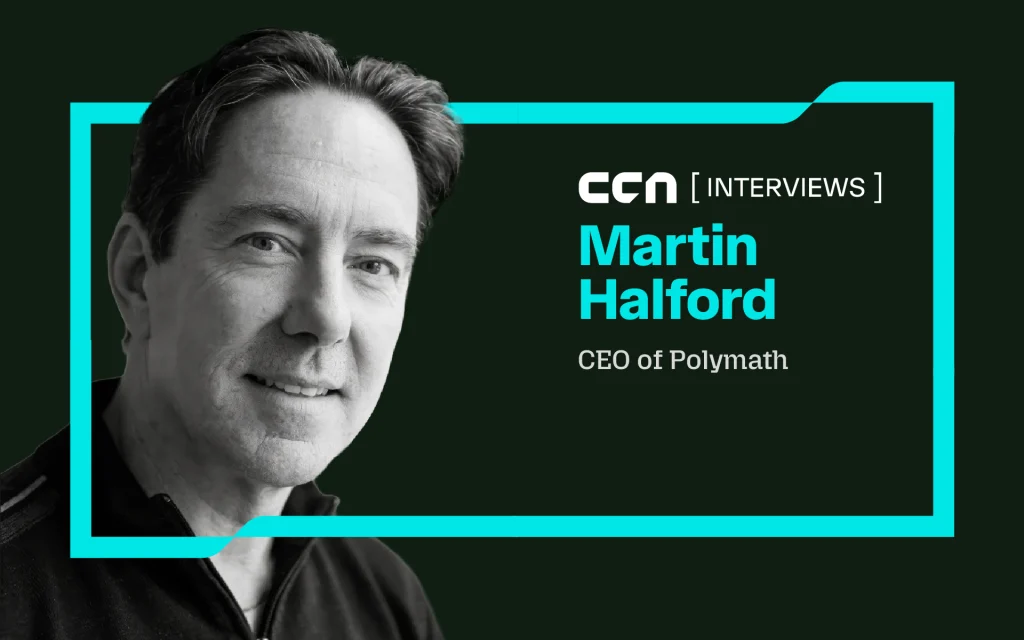
Polymath CEO Martin Halford told CCN that a quantum threat could arrive unannounced.
Share
Key Takeaways
Polymath CEO Martin Halford warned that a significant quantum computing breakthrough could arrive “unannounced.”
Polymath is developing post-quantum protection, but making the technology commercially scalable remains a major challenge.
Halford acknowledged that Polymath had previously fallen short in embracing regulation and enabling wider access to its technology.
A commercially significant quantum computing breakthrough could arrive without warning, creating a security risk for sensitive financial data, Polymath CEO Martin Halford has warned.
Talking to CCN on the sidelines of the Blockchain Futurist Conference in Toronto, Halford said institutions must begin protecting information against “harvest now, decrypt later” attacks.
Quantum Breakthrough Could Arrive ‘Unannounced’
Halford rejected attempts to predict precisely when quantum computers will become capable of threatening existing encryption.
“I would love to be able to say quantum’s two years away, five years away. We just don’t know,” he said.
He compared this uncertainty with the rapid emergence of generative AI, arguing that transformative technologies can appear to advance suddenly after years of research.
“We know that day will come with quantum sometime soon,” Halford said. “We don’t know exactly when.”
However, this uncertainty does not mean companies can afford to wait until quantum computers become commercially available before responding, he argued.
Martin Halford is talking at the Blockchain Futurist Conference in Toronto.
Halford pointed to the threat of “harvest now, decrypt later,” where attackers collect encrypted information today in the hope that future computing capabilities will allow them to access it.
“We have to protect data today because data lives for a long time,” he said.
According to Halford, the breakthrough could come with little warning because several competing approaches are being pursued with billions of dollars in funding.
“At some point, they’ll announce, ‘We can now do 1,000 qubits,’ or whatever it is, and that suddenly becomes a real issue for us,” he said.
“We have to be prepared for that day to come, and it’ll come unannounced.”
Polymath Priming Its Post-Quantum Technology
Despite the urgency, Halford acknowledged that Polymath has not completed a post-quantum version of its confidential asset infrastructure.
“We haven’t developed the quantum version just yet. We’re actively working on it,” he said.
The cryptographic methods needed to provide post-quantum protection are already mathematically possible, according to Halford.
However, making them fast and affordable enough for widespread institutional use remains a significant challenge.
Post-quantum cryptography can require larger keys and considerably more processing power, increasing the time needed to encrypt and decrypt transaction information.
“The challenge now is even more than zero-knowledge proofs because it takes even longer to encrypt and decrypt quantum data,” Halford said.
The company is considering dedicated hardware and off-chain components to perform some intensive calculations, thereby reducing the computational burden on the blockchain.
“Mathematically, it can be done today,” he said. “But in a commercial, scalable setting, we need to do our research and make that more scalable.”
‘Technology Is Table Stakes’ for Institutional Tokenization
Halford joined Polymath after approximately 25 years of building and scaling technology companies.
Unlike previous roles in which he had been required to overhaul existing systems, Halford said Polymesh’s underlying technology was already in strong condition when he arrived.
Because the blockchain’s code was open source, he was able to examine the infrastructure before joining the company.
“I was able to do verification on that code base and went, ‘Actually, this is pretty good. This is fantastic. How come I didn’t know about this before?’” Halford said.
However, he argued that strong technology alone was no longer enough to drive institutional adoption.
“The technology is table stakes,” he said. “You have to have very good technology that works, is stable and can handle the load and scale.”
For institutions seeking to tokenize assets, the underlying blockchain is ultimately less important than their ability to raise capital and meet their legal obligations, Halford said.
“At the end of the day, people don’t really care about the tech,” he said.
“They want to be able to raise capital, and they need to be able to engage with the regulators, custodians and broker-dealers.”
Halford said understanding that the regulatory and financial ecosystem had represented his largest learning curve since becoming CEO.
How Polymesh Combines Privacy With Regulatory Oversight
Privacy creates a particular challenge for institutional tokenization.
Financial institutions may not want transaction values and counterparties displayed publicly, but regulators, auditors, and other authorized parties can still require access to specific information.
Halford said Polymesh addresses the conflict by embedding cryptography directly into the blockchain’s protocol layer.
The primary technical challenge, he argued, was not choosing between privacy and compliance, but making zero-knowledge proofs sufficiently fast and efficient.
“Zero-knowledge proofs are expensive in terms of computation and in terms of time,” Halford said.
The company spent significant time and money optimizing the system so that confidential transactions would no longer take an hour to complete, he added.
Under Halford’s model, authorized participants see only the information required to perform their roles.
“When a mediator views their part of the transaction, they can see just the data they need to see, and the rest of it is obfuscated,” he said.
“We trust the math. We don’t have to see the numbers.”
Why ERC-1400 Was Not Enough
Halford also said Ethereum’s security token standards correctly identified the need to incorporate compliance into tokenized assets.
However, he argued that placing those controls inside a smart contract left potential routes for the intended rules to be avoided or bypassed.
“The ERC standards around tokenization got a lot of things right,” Halford said. “The main thing they understood is there had to be some sort of regulatory compliance aspect to it.”
The weakness was that the compliance logic was implemented in a smart contract rather than enforced by the blockchain’s underlying protocol, he said.
“The logic that was inside the ERC could, through nefarious means, be avoided or somehow sidestepped,” Halford said.
That limitation helped drive the decision to build Polymesh as a purpose-built blockchain for regulated assets.
By enforcing requirements at the protocol layer, Halford said.
Polymesh was designed to prevent participants from deliberately or inadvertently completing a noncompliant transaction.
“You couldn’t even accidentally not comply,” he said.
Polymath’s Path to Regulatory Compliance
Looking ahead, Halford said success would depend on turning Polymath’s technical capabilities into meaningful adoption.
He acknowledged that the company had spent several years operating below the industry’s radar, despite having developed what he described as strong infrastructure.
“Polymath has been flying under the radar for a few years now,” Halford said.
However, he conceded that the company had not previously done enough to embrace regulatory requirements.
“We are working on embracing the regulations and ensuring that we can actually enable users to access our tech,” he said.
Halford said the company’s priority was now to expand adoption of the platform rather than continue treating technology development as the primary measure of success.
“I would love to see that adopted,” he said. “It deserves to see the light of day and be used en masse.”
Kurt Robson is a London-based reporter at CCN, specialising in the fast-moving worlds of crypto and emerging technology. He began his career covering local news in Cornwall after graduating from Falmouth University with First Class Honours in Journalism. There, he cut his teeth on everything from council meetings to missing swans.
He quickly rose through the ranks to become a frontline journalist at several of the UK’s leading national newspapers. Over the years, he has interviewed musicians and celebrities, reported from courtrooms and crime scenes, and secured multiple front-page exclusives.
Following the upheaval of the COVID-19 pandemic, Kurt shifted his focus to technology journalism—just ahead of the AI boom. With a natural curiosity and a trained eye for emerging trends, he has found a new rhythm in reporting on innovation.
At CCN, Kurt's work focuses on the cutting edge of crypto, blockchain, AI, and the evolving digital world. Drawing on his background in people-first reporting and his deep interest in disruptive tech, Kurt delivers stories that are insightful, entertaining, and human-centric.
Dr. Guneet Kaur is a senior editor at CCN.com and a Science Fellow at Exponential Science. She is a fintech and blockchain expert with extensive experience in digital finance education, blockchain ecosystems, and cryptocurrency markets. She has worked with global media such as Cointelegraph, as well as education and blockchain platforms, to design and lead strategic content and learning initiatives. As an educator and assessor for top-tier executive programs, she bridges real-world fintech trends with academic insight.
Dr. Kaur is also a published researcher and peer reviewer across fintech and data science journals, including Financial Innovation Journal and International Journal of Big Data Intelligence and Applications. Her work spans data-driven analysis, Web3 innovation, and technical content development. With a strong foundation in both industry and academia, she translates complex financial technologies into practical applications, empowering learners, professionals, and institutions across the rapidly evolving digital finance landscape.