Key Takeaways
- The CLARITY Act faces potential delays in the Senate.
- Stablecoin rules remain the biggest hurdle.
- Analysts and industry leaders say passage could unlock institutional capital and boost crypto prices.
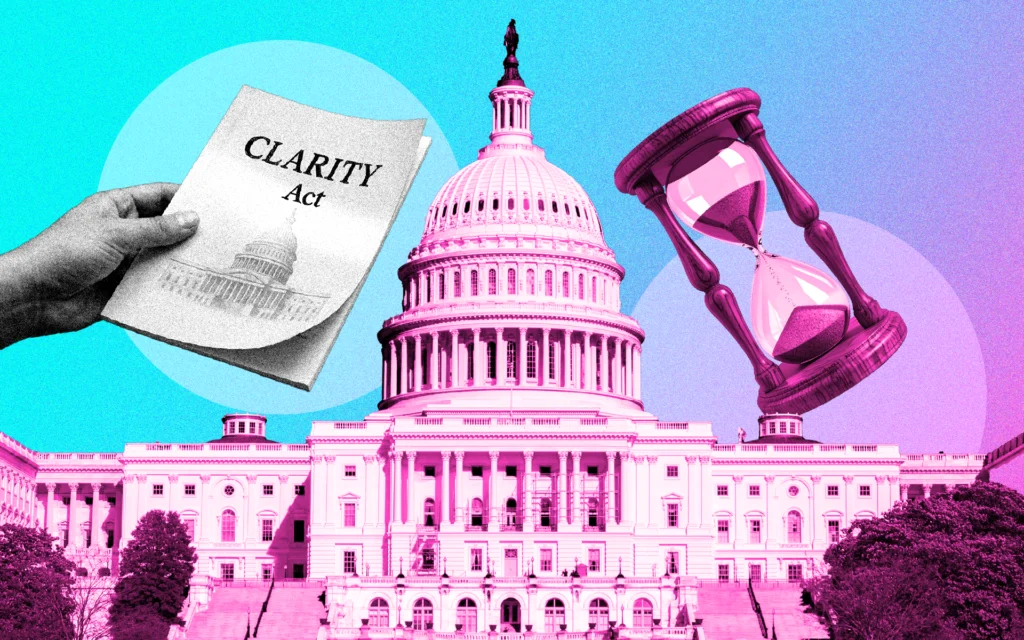
A sweeping US crypto market structure bill again faces renewed uncertainty as lawmakers weigh delaying key discussions, raising concerns that time may be running short to pass the legislation before election-year politics take over.
The Digital Asset Market CLARITY Act, widely seen as a cornerstone proposal to define how cryptocurrencies are regulated in the US, remains stalled in the Senate despite clearing the House of Representatives last year.
Senate Delay Clouds CLARITY Act Timeline
Momentum behind the bill has slowed after a senior Republican senator urged colleagues to postpone a planned committee review, according to a media report from Punchbowl News.
Shared by Punchbowl’s senior reporter on Monday, Sen. Thom Tillis told reporters that he does not expect the Senate Banking Committee to “mark up crypto market structure legislation in April.”
According to the report, Tillis has been attempting to convince banks and crypto companies to restrict stablecoin yield.
The senator has reportedly told Banking Chair Tim Scott that “we need to be looking at May as a markup time.”
“It’s very important to me not to accelerate things, to hear everybody, and give them a rational basis for what we do accept,” Tillis said, according to Punchbowl.
Why The Delays?
At the center of the dispute is how to regulate yield-bearing stablecoins.
Banking groups have pressed for tighter restrictions, warning that interest-like features could introduce risks similar to traditional financial products without equivalent oversight.
Crypto firms, however, have pushed back, arguing that overly strict limits could stifle innovation.
Further details discussed among policymakers suggest the scope of such restrictions could be broader than previously understood.
According to analysis from the CCN Education Team, draft principles circulating among lawmakers would frame stablecoins primarily as payment instruments rather than investment products, effectively limiting their use as yield-generating assets.
Those proposals would restrict not only traditional interest payments but also a wide range of rewards or incentives tied to holding or using stablecoins, focusing on the economic benefit rather than how it is labeled.
The same framework envisions only narrow exemptions, with regulators retaining discretion to permit transaction-based incentives that do not resemble deposit-like products.
It also points to stricter enforcement and disclosure requirements, including penalties for non-compliance and tighter rules around how stablecoins are marketed to users
Industry Group Urges Swift Action
Amid the uncertainty, industry advocates are stepping up pressure on lawmakers.
A leading blockchain trade association, the Digital Chamber, wrote to members of the Senate Banking Committee on Monday, calling for the legislation to be brought forward for consideration at the earliest opportunity.
In the letter, the group stressed that moving the bill ahead would provide long-awaited regulatory certainty for tens of millions of Americans using digital assets.
“…while reinforcing the United States’ leadership in responsible innovation and next-generation financial technology,” Digital Chamber CEO Cody Carbone said in the letter.
The letter added that moving forward with a markup is the “clearest way” to carry the work already done into the next phase of the legislative process.
Industry Voices Warn Deadlock Risks Broader Consequences
Some industry leaders say the ongoing standoff over stablecoin rules reflects a deeper shift already underway across global finance.
Anil Oncu, CEO of Bitpace, told CCN that the divide between traditional banking and crypto may already be fading in practice, even as policymakers continue to debate frameworks.
“While Washington argues over regulatory perimeters, adoption is rendering the ‘banks versus crypto’ framing obsolete,” Oncu said.
He pointed to recent developments including crypto firms pursuing bank charters and traditional institutions launching tokenized assets, adding:
“The lines between DeFi and TradFi are not blurring, but rather dissolving.”
Oncu warned that the bigger risk lies in ineffective compromise.
“The greatest danger now is not that stablecoins destabilise the banking system, or that banks stifle innovation,” he said.
“It is that the current deadlock… produces either no regulation at all, or regulation so compromised that it satisfies nobody and protects nothing.”
He also highlighted how fragile industry alignment has been in recent months, referencing Coinbase’s earlier withdrawal of support for parts of the draft legislation.
“But walking away from the table is not a strategy,” Oncu said, adding that reaching a workable balance between banks and crypto firms remains essential.
“Finding a balance… will resolve the deadlock, and the CLARITY Act is the vehicle to do it.”
More broadly, Oncu framed the debate as part of a larger transformation of the financial system already in motion.
“The stablecoin war was never really about banks versus crypto,” he said.
“It is about whether the global financial system can evolve fast enough to accommodate a technology that is already here… and already reshaping how money moves.”
Commentators Warn of Shrinking CLARITY Act Window
Market participants and commentators say the coming weeks could determine the fate of the legislation, with several warning that the window to act is rapidly closing.
“The crypto industry is running out of time to get the most important bill in its history passed. And we are very close to losing it entirely,” crypto-focused account Bull Theory wrote on X.
The commentator highlighted how the bill still had procedural steps to cover even after clearing the Senate Banking Committee.
This included a series of procedural steps, including a Senate floor vote requiring 60 votes and reconciliation between competing committee versions.
The legislative calendar adds further pressure.
“If the bill does not reach the Senate floor by May it gets buried by midterm campaign politics,” the influencer wrote.
Bull Theory highlighted recent warnings from lawmakers who claimed the bill could be pushed back to the end of the decade if speed did not pick up.
On April 10, Senator Cynthia Lummis said that it was the “last chance to pass the Clarity Act until at least 2030.”
“We can’t afford to surrender America’s financial future,” she added.
Commentators also highlight the limited number of working days left in the Senate schedule, with long recess periods expected later in the year.
“There is almost no working time left,” Bull Theory said.
A Window Despite Delays?
Some industry executives say that even if the CLARITY Act is delayed, progress toward clearer regulation may not come to a complete halt—but key gaps would remain.
Antoine Scalia, CEO and founder of crypto accounting firm Cryptio, said recent regulatory guidance has already begun to shape the market, even in the absence of formal legislation.
“If CLARITY misses the current legislative window, that would be a setback, but it wouldn’t leave the industry with nothing,” Scalia said.
“The SEC’s recent guidance is already meaningful because it clarifies that most crypto assets are not securities by default, while acknowledging that transactions involving them can still become investment contracts depending on context.”
He added that, in practice, this signals movement toward a more functional regulatory environment, even before Congress finalizes a comprehensive framework.
“What that means in practice is that the market is moving toward a more usable framework even before Congress finishes the job,” Scalia said.
However, Scalia cautioned that agency-level clarity alone is not sufficient for long-term growth, particularly for institutional participants.
Adding: “Institutions still need durable market structure rules, clear jurisdictional boundaries, and systems that can classify and report these distinctions in practice. Without that combination, progress remains real, but incomplete.”
CLARITY Act Support Grows Despite Earlier Divisions
Despite earlier disagreements within the crypto sector, signs of renewed alignment have emerged in recent weeks.
Executives from major firms and financial institutions have increasingly voiced support for advancing legislation, while policymakers and administration officials have also signaled that establishing a comprehensive framework remains a priority.
Ripple CEO Brad Garlinghouse said after recent meetings with US lawmakers that progress toward regulatory clarity appears closer than at any point in the past decade, describing the current period as a critical opportunity to act.
His comments follow months of debate that at times saw key industry players withdraw support over concerns about provisions affecting decentralized finance and the balance of regulatory authority.
Will the CLARITY Act Boost Crypto Prices?
It comes as some firms say crypto could see renewed momentum later this year if the CLARITY Act eventually passes.
In March, JPMorgan analysts said comprehensive crypto legislation could help unlock fresh demand by reducing regulatory uncertainty.
“If passed, it will reshape market structure by providing regulatory clarity, ending ‘regulation by enforcement,’ promoting tokenization, and facilitating greater institutional participation,” the bank said in a recent note.
Clearer rules could make it easier for traditional financial firms to enter the space, potentially increasing liquidity and supporting valuations across major digital assets.
US Treasury Secretary Scott Bessent also suggested that progress on stalled legislation could help stabilize sentiment.
“Bitcoin has a history of volatile movement,” Bessent said.
“But part of the volatility here is self-induced,” pointing to delays in advancing a bipartisan market structure bill.
End To Crypto Winter?
In January, Matt Hougan, chief investment officer at Bitwise Asset Management, likened the bill’s fate to a seasonal signal for markets.
“The CLARITY Act is the Punxsutawney Phil of this crypto winter,” he wrote on X.
“If it sticks its head out but fails in Congress, the winter could continue. If instead it passes and is signed into law, we’re heading to new all-time highs.”
Hougan has also argued that structural changes in the Bitcoin market could amplify the impact of such policy shifts.
Speaking on the Investopedia podcast, Hougan said traditional price cycles tied to Bitcoin’s halving events may no longer dominate market behavior.
“Institutional adoption… regulatory progress… Those are decade-long trends,” Hougan said, adding that these forces are becoming more influential than historical patterns.
“One of the few times in its history, I think the fundamentals are ahead of the price.”
That shift, he suggests, could make the market more responsive to regulatory developments like the CLARITY Act.
If passed, he said the combination of clearer rules and rising institutional involvement could support a more sustained rally across crypto.
Top Trending Crypto Articles

Kurt Robson is a London-based reporter at CCN, specialising in the fast-moving worlds of crypto and emerging technology. He began his career covering local news in Cornwall after graduating from Falmouth University with First Class Honours in Journalism. There, he cut his teeth on everything from council meetings to missing swans.
He quickly rose through the ranks to become a frontline journalist at several of the UK’s leading national newspapers. Over the years, he has interviewed musicians and celebrities, reported from courtrooms and crime scenes, and secured multiple front-page exclusives.
Following the upheaval of the COVID-19 pandemic, Kurt shifted his focus to technology journalism—just ahead of the AI boom. With a natural curiosity and a trained eye for emerging trends, he has found a new rhythm in reporting on innovation.
At CCN, Kurt's work focuses on the cutting edge of crypto, blockchain, AI, and the evolving digital world. Drawing on his background in people-first reporting and his deep interest in disruptive tech, Kurt delivers stories that are insightful, entertaining, and human-centric.