Key Takeaways
- Regulatory clarity has not triggered the rapid wave of institutional crypto adoption that early industry lawyers expected, Symbiotic Chief Operating Officer told CCN.
- Regulators are increasingly understanding blockchain and DeFi, the COO said.
- Symbiotic is targeting sustainable yield tied to real business models.
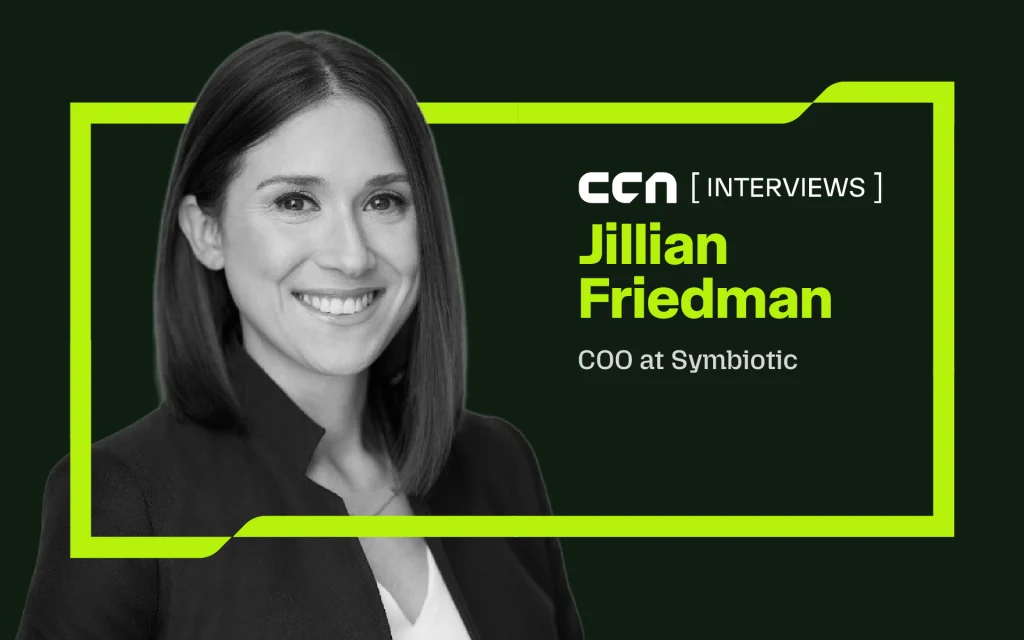
Crypto regulation has been held back more by political will than a lack of technical understanding, Symbiotic Chief Operating Officer Jillian Friedman has said.
Speaking to CCN at the Blockchain Futurist Conference in Toronto, Friedman said many regulators had developed significant expertise in digital assets, blockchain, and decentralized finance.
However, she argued that institutional adoption had progressed far more slowly than early crypto lawyers expected, despite growing regulatory clarity.
Regulatory Clarity Did Not Open the Institutional Floodgates
Friedman began working in the crypto industry in 2014, when she founded a law firm focused on the emerging sector.
At the time, Bitcoin dominated the industry, and there was little dedicated legal or regulatory infrastructure.
Friedman said one of the biggest assumptions during those early years was that regulatory clarity would trigger an immediate wave of adoption by large financial institutions.
“The thinking was that as soon as the regulation is clearer, then all of the big institutions, like financial institutions, are going to start building and operating with this new technology,” she said.
Traditional firms were believed to be staying on the sidelines partly because blockchain could threaten their existing businesses and partly because of uncertainty about how the technology would be regulated.
However, Friedman said the competitive threat had not materialized as many initially expected.
Although greater regulatory clarity had encouraged traditional financial institutions to enter the sector.
“We thought that the dam would be broken once the regulations were clear,” Friedman said.
Political Will, Not Understanding, Is Holding Regulation Back
Friedman also rejected the suggestion that policymakers had failed to act because they did not understand crypto.
She said regulators in several jurisdictions had invested heavily in developing internal expertise covering blockchain and decentralized finance.
That knowledge can become particularly visible when a change in government or regulatory leadership is followed by a rapid shift in policy.
“It actually just demonstrates that it’s not a lack of understanding if you have the right resources,” Friedman said.
“When a regime changes, all of a sudden they have all the knowledge and they’re ready to make decisions and open doors to clear the path for the industry and for the technology.”
The ability of regulators to move quickly after a political shift suggested that knowledge had not been the principal barrier, she argued.
“It wasn’t the knowledge keeping them back. It’s the political will,” Friedman said.
Symbiotic Moves Beyond Crypto’s ‘Mercenary Capital’ Era
Friedman said the difference between committed capital and another cycle of highly leveraged crypto speculation could be seen in the source of the returns being offered.
During previous market cycles, investors frequently moved capital between protocols to collect points, qualify for airdrops, or benefit from token generation events.
The strategy often involved selling the newly issued assets once they became tradable before moving capital to the next project, offering incentives.
Friedman described this as “mercenary capital” and said the model had served a particular category of investor for a limited period.
However, she argued that it did not provide the basis for sustainable value creation.
“That’s not really a sustainable, value-creating business model,” Friedman said.
Symbiotic is instead seeking to support investment and yield opportunities connected to operating businesses and identifiable sources of economic value.
“What we’re focused on, and what a lot of the industry is focused on, is enabling the establishment of yield opportunities and investment opportunities that are tied to real business models,” she said.
Those business models could exist either onchain or off-chain, Friedman added, provided they created meaningful underlying value rather than relying mainly on token incentives.
Staking Was Not Left Behind—It Provided the Blueprint
Friedman previously helped build Ether Capital around Ethereum staking as a central treasury strategy.
However, she pushed back against the suggestion that moving to Symbiotic meant leaving staking behind.
Instead, Friedman described staking as the first major example of capital being used to underwrite risk in blockchain.
“Staking really is that first use case, or that first idea on a digital blockchain front, of using capital to underwrite risks,” Friedman said.
The same principle underpins Symbiotic’s broader model, which allows collateral to be committed against different obligations and risk types.
“What we’re doing at Symbiotic is actually very similar, and it has parallels in digital finance and blockchain, but also in traditional finance,” she said.
Rather than replacing staking, Symbiotic seeks to extend its underlying risk-and-reward structure to a wider range of financial applications.
“The underlying theme here connects the dots very clearly for me,” Friedman added.
How Symbiotic Differs From Traditional Clearing
Friedman said Symbiotic was building infrastructure that allows capital to be committed against specific obligations and access different investment opportunities.
While traditional derivatives clearing frequently relies on pooled capital, Symbiotic’s blockchain-based architecture can isolate capital by risk type.
That capital can then be reallocated across different opportunities through smart contracts.
“What’s unique about Symbiotic, and what blockchain technology can uniquely unlock, is the ability to have capital that’s risk-isolated,” Friedman said.
She added that the same capital could be reassigned to underwrite different risks in a more automated and efficient way than was possible before smart contracts.
“The bigger picture is to enable the ecosystem to be built at the same time that we’re also building up this ability to lock up and commit capital to different use cases,” Friedman said.
Top Trending Crypto Articles
The information provided in this article is for informational purposes only. It is not intended to be, nor should it be construed as, financial advice. We do not make any warranties regarding the completeness, reliability, or accuracy of this information. All investments involve risk, and past performance does not guarantee future results. We recommend consulting a financial advisor before making any investment decisions.

Kurt Robson is a London-based reporter at CCN, specialising in the fast-moving worlds of crypto and emerging technology. He began his career covering local news in Cornwall after graduating from Falmouth University with First Class Honours in Journalism. There, he cut his teeth on everything from council meetings to missing swans.
He quickly rose through the ranks to become a frontline journalist at several of the UK’s leading national newspapers. Over the years, he has interviewed musicians and celebrities, reported from courtrooms and crime scenes, and secured multiple front-page exclusives.
Following the upheaval of the COVID-19 pandemic, Kurt shifted his focus to technology journalism—just ahead of the AI boom. With a natural curiosity and a trained eye for emerging trends, he has found a new rhythm in reporting on innovation.
At CCN, Kurt's work focuses on the cutting edge of crypto, blockchain, AI, and the evolving digital world. Drawing on his background in people-first reporting and his deep interest in disruptive tech, Kurt delivers stories that are insightful, entertaining, and human-centric.

Dr. Guneet Kaur is a senior editor at CCN.com and a Science Fellow at Exponential Science. She is a fintech and blockchain expert with extensive experience in digital finance education, blockchain ecosystems, and cryptocurrency markets. She has worked with global media such as Cointelegraph, as well as education and blockchain platforms, to design and lead strategic content and learning initiatives. As an educator and assessor for top-tier executive programs, she bridges real-world fintech trends with academic insight.
Dr. Kaur is also a published researcher and peer reviewer across fintech and data science journals, including Financial Innovation Journal and International Journal of Big Data Intelligence and Applications. Her work spans data-driven analysis, Web3 innovation, and technical content development. With a strong foundation in both industry and academia, she translates complex financial technologies into practical applications, empowering learners, professionals, and institutions across the rapidly evolving digital finance landscape.