Home / Education / Crypto / Investing / White House Crypto Meeting Could Decide the Fate of Stablecoins — Here’s Why Crypto Could Dump if the CLARITY Act Delays
Banks want limits on yield-bearing stablecoins to protect deposits, while crypto firms see yield as essential to on-chain markets.
Postponing the CLARITY Act prolongs regulation by enforcement and weakens confidence among institutional investors.
Failure to reach a deal now risks deferring crypto legislation to the next Congress, potentially delaying clarity by years.
Any regulatory threat to stablecoin business models can ripple across DeFi, exchanges, and token markets.
A high-stakes White House meeting on Feb. 10 could decide the future of stablecoins in the United States and by extension, have a profound impact on the wider crypto market. The meeting aims to break a deadlock over the CLARITY Act, a landmark crypto market-structure bill stalled in the Senate.
At the heart of the stalemate is a contentious issue: Should stablecoin issuers or platforms be allowed to pay interest (“yield”) on stablecoin deposits? The outcome of this debate may determine whether stablecoins become viable high-yield alternatives to bank accounts or remain tightly constrained payment tokens.
🚨 The White House is holding a closed door meeting tomorrow to decide the future of the U.S. crypto market structure bill.
The White House wants both sides to reach compromise language by the end of Feb 2026, with stablecoin yield being the main issue blocking the bill.
Many analysts warn that if lawmakers delay or derail the CLARITY Act, it would prolong regulatory uncertainty, a scenario they say could trigger a crypto market downturn affecting not just stablecoins but also major cryptocurrencies like Bitcoin (BTC), Ethereum (ETH), Ripple’s XRP, and Solana (SOL).
To understand why markets are tense, it helps to look past short-term price action and focus on what is actually at stake: stablecoin yields, regulatory certainty, and the timing of U.S. lawmaking.
🚨MASSIVE: President Trump says: “We are preparing to do something big with crypto.”
Banks vs. Crypto: The Battle Over Stablecoin Yield
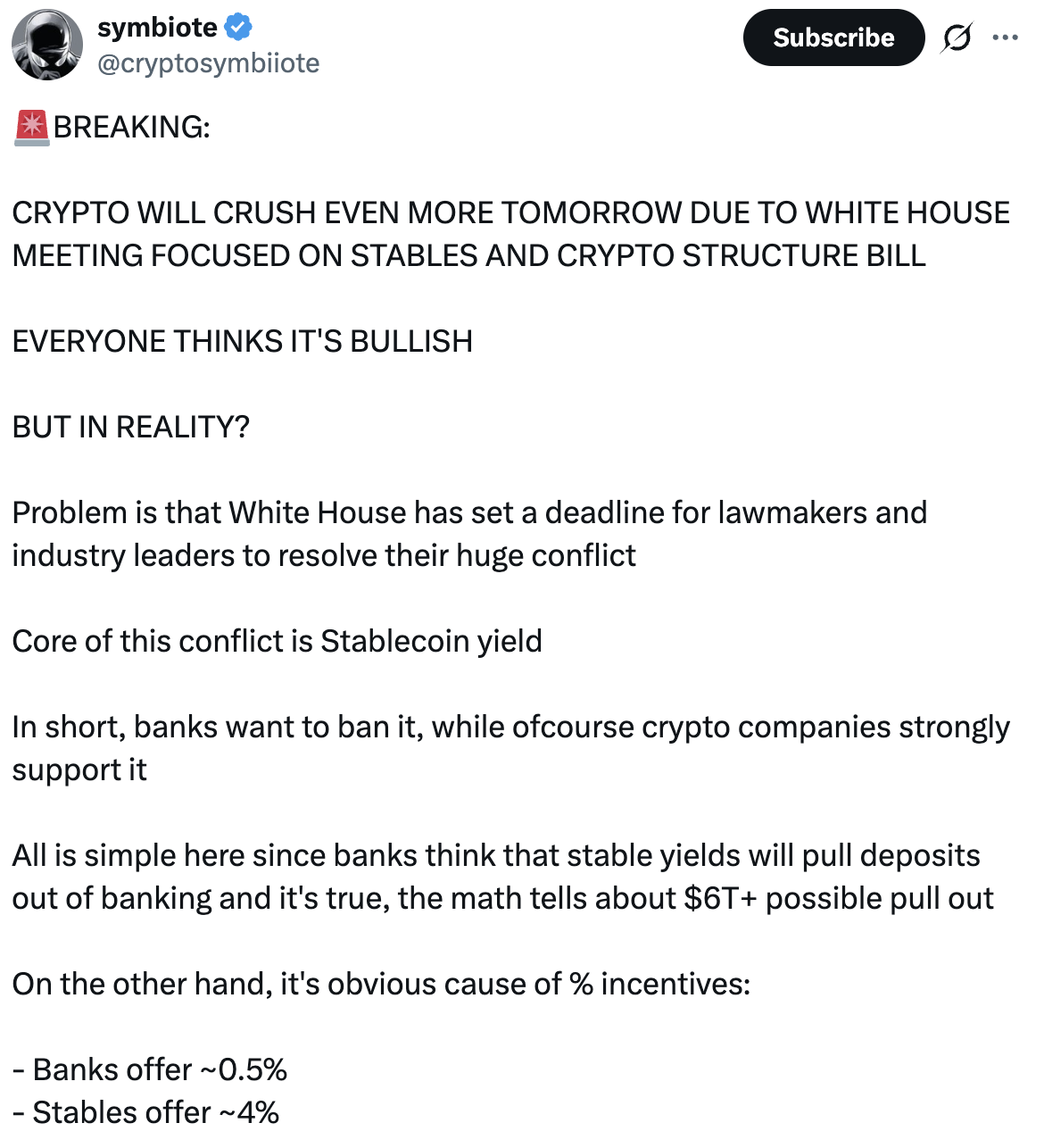
Stablecoin interest (yield) has become the central sticking point in U.S. crypto legislation. Traditional banks and crypto firms have sharply opposing views on this:
Banks’ Argument – Protect Deposits
Banking giants argue that interest-bearing stablecoins function like unregulated bank deposits, threatening to siphon massive amounts of money out of traditional banks.
With typical bank savings rates around 0.1-0.5%, versus 3-5% rewards on dollar-pegged stablecoins like USDC, consumers have a clear incentive to move funds into stablecoins.
The U.S. Treasury even modeled a scenario where up to $6.6 trillion in bank deposits could migrate to higher-yield stablecoin accounts under certain assumptions. Bankers warn such an exodus of deposits could shrink their lending capacity (for mortgages, small business loans, etc.) and pose a systemic risk to financial stability.
In their view, allowing stablecoin rewards without bank-like oversight gives crypto an unfair edge and could destabilize the banking system.
Crypto Industry’s Argument – Foster Innovation
Crypto companies like Coinbase and Circle counter that yield is crucial for competitiveness and user adoption. They note that stablecoin “rewards” (often ~3–4% APY on holdings) are funded through legitimate means – e.g. interest earned on reserves – and function as loyalty or rebate programs rather than risky leverage.
From their perspective, banning interest on stablecoins would “neuter” U.S. stablecoins and drive innovation offshore at a time when global crypto competition is heating up. They argue it’s anti-competitive to let banks pay interest but prohibit fintech and crypto platforms from doing so.
In short, prohibiting stablecoin yield would entrench banks’ dominance by regulation rather than merit, stifling a major use-case of programmable money.
BREAKING: Ripple will be at the White House on Feb 10 as officials meet with banks and crypto leaders to shape U.S. stablecoin rules.🎯
This clash has already stalled the progress of the CLARITY Act for months. Lawmakers find themselves caught between two powerful lobbies – banking associations on one side, and the blockchain/fintech industry on the other – each unwilling to budge on the yield issue. The result is a legislative stalemate that the White House is now attempting to mediate.
White House calls a meeting on crypto and the CLARITY Act. | Credit: Symbiote X profile
That said, yield is not optional for crypto companies. It is central to the value proposition of stablecoins and to the broader on-chain economy. Removing or severely restricting stablecoin yield would weaken DeFi, reduce demand for tokenized Treasuries, and blunt one of crypto’s strongest real-world use cases.
This is the core standoff: banks want limits or bans on stablecoin yield; crypto firms view those limits as existential.
Where the CLARITY Act Fits In
The CLARITY Act (H.R. 3633) is a comprehensive bill intended to establish clear federal rules for digital assets, after years of debate over how to regulate crypto markets.
It passed the House of Representatives in July 2025 with bipartisan support, and includes provisions to protect self-custody of crypto, delineate the roles of the SEC vs. CFTC, and even carve out certain DeFi activities from onerous regulation. In concept, CLARITY is meant to finally give crypto businesses and investors a solid legal framework, ending the patchwork of unclear guidelines.
However, since moving to the Senate, the bill has been bogged down by political and procedural snags – chiefly the fight over stablecoin interest. In mid-January 2026, the Senate Banking Committee postponed a markup session for the bill amid over 100 proposed amendments and rising objections from both sectors.
The most controversial amendment, backed by banks, sought to amend the already-passed GENIUS Act (a 2025 stablecoin law) to explicitly ban exchanges and platforms from paying interest on customers’ stablecoin holdings, even if the platform isn’t the issuer. Crypto firms vehemently opposed this move, as Coinbase even withdrew its support for CLARITY as long as such a prohibition was on the table. Facing an impasse, Senate leaders opted to delay the vote rather than let the bill fail then and there.
🇺🇸 COINBASE CEO:
BANKS ARE TRYING TO "KILL THEIR COMPETITION" WITH THE CRYPTO MARKET STRUCTURE LEGISLATION! 👀
"CRYPTO COMPANIES SHOULD BE ALLOWED TO COMPETE AND OFFER LOANS JUST LIKE BANKS!"
The White House has since stepped in to broker a compromise. President Trump’s administration, which views passing CLARITY as key to cementing U.S. leadership in digital assets, convened stakeholder meetings in early February. An initial closed-door session on Feb. 2 (staff-level) was described as “constructive” but ended “without agreement on stablecoin yield or rewards”.
Recognizing the deadlock, the White House scheduled a follow-up meeting on Feb. 10, raising the stakes with higher-level executives from both Wall Street and the crypto industry invited this time. Top executives from JPMorgan Chase and Bank of America are reportedly attending alongside leaders from major crypto firms, underscoring how critical this summit is.
Why Feb. 10 Matters
White House advisors have privately given both sides an end-of-February deadline to reach a deal. The Feb. 10 meeting is being framed as perhaps the last chance to “unfreeze” the CLARITY Act’s legislative progress.
If a compromise can be drafted that resolves the yield dispute, the Senate Banking Committee could reschedule its markup and move the bill forward.
If not, the bill could slip further into limbo. As Elliptic noted, failure to advance CLARITY before campaign season intensifies means the next window might only be after the November 2026 midterm elections – leaving the next Congress in 2027 to start over.
Lawmakers warn this “post-midterm delay” scenario creates significant doubt; the bill could be pushed to 2027–2028 or even die altogether if priorities change.
In short, markets are at a crossroads. The Feb. 10 summit could determine whether U.S. crypto regulation sees clarity in the near term or faces years more of uncertainty. The implications for markets are enormous.
Possible Outcomes: Compromise vs. Delay (Bullish or Bearish?)
Markets tend to price in certainty faster than they price in outcomes. A clean win or a clean loss is often less damaging than prolonged ambiguity. From that perspective, a delay of the CLARITY Act is problematic for several reasons.
First, regulatory uncertainty persists. Without a statute, U.S. crypto regulation continues to be shaped by enforcement actions, staff guidance, and court rulings. That environment is difficult for long-term capital, especially institutions that require predictable compliance frameworks.
Second, timing matters. If lawmakers fail to resolve the dispute now, the issue could be pushed past the 2026 midterm elections. That would mean a new Congress, new committee leadership, and potentially years before comprehensive crypto legislation resurfaces. Markets are forward-looking, and a multi-year delay effectively extends uncertainty indefinitely.
Third, stablecoins are not a side issue. They underpin liquidity across crypto markets. Any signal that stablecoin business models may be constrained, without clarity on what replaces them, can ripple outward, affecting DeFi activity, exchange volumes, and token valuations.
1. A Compromise and Path Forward (Bullish Case?):
The ideal outcome for the industry would be a negotiated compromise on stablecoin yields that unlocks the legislation. For example, stakeholders might agree to classify certain “rewards” as non-interest (e.g. as rebates or tied to usage/membership) while banning simple passive interest on idle balances. Such a middle-ground solution – essentially permitting some stablecoin reward programs with constraints – could appease enough senators to move CLARITY ahead.
If the Feb. 10 meeting yields a draft deal, we may see the Senate Banking Committee quickly re-calendar the markup in late February. Market Impact: In this scenario, regulatory clarity would be on the horizon at last, potentially a longer-term bullish development. Major U.S. exchanges and projects would finally know the rules of the road, likely boosting investment and innovation.
However, the short-term reaction might be mixed. If the compromise limits or eliminates certain stablecoin yields, some crypto users could be disappointed (U.S.DC holders, for instance, might lose their 3.5% rewards).
Yet, many analysts believe the removal of uncertainty and the establishment of clear lawful pathways (for stablecoins, custody, DeFi, etc.) would outweigh the loss of yield in the big picture. In essence, a deal that sacrifices a bit of yield to get the bill passed could still be net-positive for the market by averting years of regulatory limbo.
Crypto firms might initially adjust their products (shifting to reward structures that comply with the new definitions), but they’d do so knowing the U.S. is open for crypto business under defined rules.
2. No Deal – CLARITY Act Delayed (Bearish Case):
If the Feb. 10 meeting fails to produce an agreement and both sides remain entrenched, the legislation is poised to stall indefinitely. All signals point to this being a decidedly bearish outcome for the crypto market.
A delay past 2026 means regulatory uncertainty continues to hang over the industry. Companies will be forced to navigate a murky environment with the threat of unfavorable rules (or enforcement actions) still looming.
Key consequences of a prolonged impasse:
No clear rules = reduced investment: Institutional investors and big tech firms who have been waiting on regulatory clarity may continue to stay on the sidelines. New crypto ventures might launch outside the U.S. to avoid legal risk. This capital flight and innovation slowdown would deprive the market of bullish catalysts, potentially dragging prices lower over time.
Stablecoin strains: Ongoing uncertainty particularly hurts stablecoin issuers and holders. U.S.-based platforms might preemptively cut off stablecoin interest programs (Coinbase has already halted USDC yield rewards in certain regions due to regulatory changes abroad). If U.S. regulators take a hard line in absence of new law, they could even pressure banks and fintechs to limit stablecoin integrations, undermining liquidity. In a worst-case scenario, panic or confusion about stablecoins’ legal status could trigger runs or depegging events, as seen before when regulatory news spooked investors. (For example, past episodes like the brief USDC depeg in 2023 showed how quickly confidence can wobble when there are doubts about reserves or legal viability – an analogy that, while not identical, underscores the role of trust). Stablecoins thrive on certainty that $1 is $1; prolonged doubt erodes that confidence.
Crypto market slump: The broader crypto market would likely interpret a CLARITY Act delay as a sign that U.S. crypto policy is stuck in dysfunction. This comes at a time when other jurisdictions (Europe with MiCA, Hong Kong, etc.) are moving forward with frameworks. The U.S. falling behind could reduce global demand for U.S.-linked crypto assets. Price-wise, continued regulatory fear, coupled with no immediate positive catalyst, could extend the bear market. Even after a recent bounce, Bitcoin and majors have been in a drawdown of over 50% from their all-time highs, and some market observers warn a lack of clarity could deepen that to a 60–70% peak-to-trough retracement before a true bottom is found (i.e. significant further downside risk). Essentially, without progress, the market’s default mode may be “risk-off.”
It’s worth noting that some in the crypto community initially viewed the mere discussion of the CLARITY Act as bullish, hoping that any engagement meant eventual passage. However, the reality is that a delay or half-hearted compromise is bearish in the short-to-medium term. As one analyst put it, this fight isn’t just regulatory theater – it’s about “who gets to define money in the next decade”. If that question remains unanswered, markets will gravitate toward caution.
Broader Impact: Not Just Stablecoins, Entire Crypto Market in Focus
Importantly, the stakes go beyond stablecoins themselves. A delayed or adverse outcome would ripple across the crypto ecosystem:
Bitcoin (BTC) and Ethereum (ETH): The two largest cryptocurrencies often serve as a barometer for crypto market health. They don’t have direct ties to stablecoin yield, but regulatory uncertainty dampens institutional adoption of all digital assets. If U.S. lawmakers can’t provide clarity, large financial players could continue to limit exposure to BTC, ETH and others, fearing sudden regulatory changes. Moreover, if stablecoin growth is stunted, the liquidity available for trading major coins could drop (stablecoins are key trading pairs and on-ramps). Charts and technical signals already suggest the bear market isn’t over for BTC and ETH despite periodic rallies. A failure at the policy level could reinforce those bearish trends.
Ripple (XRP) and regulatory clarity: XRP, the cryptocurrency associated with Ripple, is directly impacted by the CLARITY Act’s definitions. Ripple has been embroiled in legal debates for years over whether XRP is a security or a payment token. According to CCN analysis, passage of the CLARITY Act would “finally codify the line between securities and payment tokens,” essentially providing the clarity Ripple has sought. If the Act stalls, XRP remains in regulatory limbo. This is one reason XRP’s price has struggled to sustain gains – after a big court win in 2025, it still entered a descending channel and bear-market structure amid the broader uncertainty. Without new law, that ambiguity persists, likely keeping XRP’s price “stalling” as analysts have noted. (Conversely, if CLARITY passes, XRP could be a relative winner, finally getting a green light that it’s not a security under U.S. law.)
Altcoins (SOL and others): A prolonged regulatory vacuum would likely see altcoins follow Bitcoin’s lead in terms of market direction. If the overall sentiment is bearish, high-beta assets like Solana (SOL) could sell off even harder. Furthermore, many altcoin projects rely on stablecoins for ecosystem liquidity (think DeFi protocols on Solana, etc.). If stablecoin usage is curtailed or innovation around them slows, these ecosystems might see reduced activity. On the other hand, if a regulatory framework comes, it might specify which categories different tokens fall into (commodity, security, utility token, etc.), which could suddenly clarify the status of many altcoins. In absence of that, every project remains a potential target for enforcement (as seen with past SEC actions). Thus, altcoin investors face an extended period of FUD (fear, uncertainty, doubt) if the legislative clarity is postponed.
Coinbase (COIN) and crypto companies: For U.S.-based crypto companies, the business landscape is on the line. Coinbase, for example, derives significant revenue from USDC interest (shared via its partnership with Circle) and from retail customers who earn stablecoin rewards. If stablecoin yields are banned, Coinbase’s interest income could take a hit, and it might lose some customers to offshore platforms with better rewards. Analysts are already cautious on Coinbase’s stock (ticker: COIN) – its price has been in a downward trend, and “unless the White House meeting yields explosive results,” COIN could continue to slide (potentially down to the mid-$100s per share). More broadly, U.S. exchanges and crypto service providers need the CLARITY Act for protection; without it, they remain exposed to regulatory crackdowns or have to spend heavily on lobbying and legal battles. That uncertainty can drag down valuations and growth prospects across the sector.
That said, the entire crypto market’s trajectory in 2026 could hinge on what happens with this policy showdown. It’s not just about stablecoin yields; it’s about whether the U.S. is going to nurture the crypto industry under clear rules or leave it in regulatory purgatory.
Macro Storm Clouds: Why the Timing Amplifies Bearish Risks
Complicating matters, this regulatory drama is unfolding against a backdrop of unfavorable macroeconomic trends – conditions that can magnify downside risk precisely when sentiment is already fragile. Even constructive crypto news would be fighting a stiff headwind.
Rising Global Interest Rates
After years of ultra-low borrowing costs, major economies are tightening. Japan’s bond market has been a focal point: yields have surged off the zero bound, forcing a rethink of global capital flows. Japan remains the largest foreign holder of U.S. Treasuries ($1.1 trillion), and the mere prospect that higher domestic yields could encourage repatriation has unsettled markets.
While most experts agree any selling would likely be gradual and self-correcting, rather than a sudden, destabilizing dump, the fear alone has lifted volatility. Late 2025 saw renewed swings in both Japanese and U.S. bond markets, a reminder that global financing conditions are tightening. For crypto, this matters because higher bond yields typically signal a risk-off regime: when safer assets offer decent returns, speculative allocations tend to shrink.
Tariffs and Geopolitics
U.S. trade policy is another source of uncertainty. The administration of Donald Trump has floated new tariffs on imports, ranging from steel to technology, and even broad “universal” tariffs that could rise toward 10–20% over time. The echoes of prior trade-war dynamics are hard to miss.
Tariffs raise costs, invite retaliation, and inject volatility into global markets. When similar ideas resurfaced in early 2025, equities sold off sharply, highlighted by a dramatic single-day plunge in Nvidia amid broader weakness, and Bitcoin initially fell in tandem before rebounding. Looking ahead to 2026, the prospect of renewed tariff skirmishes adds another headwind for risk assets just as crypto navigates its own regulatory crossroads.
Federal Reserve Leadership — The Warsh Factor
Monetary policy is also shifting. As of 2026, the Federal Reserve is under new leadership, with Kevin Warsh as Chair. Warsh is a monetary hawk and a hard-money advocate who prioritizes traditional financial stability.
Markets broadly expect that, when trade-offs arise, this leadership would side with banks over rapid fintech or crypto disruption. That assumption has already shaped positioning: traders are preemptively cautious, anticipating persistently high rates and continued quantitative tightening. In other words, crypto lacks the easy-money tailwinds that powered prior bull cycles. If the CLARITY Act falters, it would reinforce the perception that U.S. policy, both monetary and fiscal, remains a net negative for the sector.
Why This Timing Matters
Taken together, these macro forces leave the crypto market with a much thinner cushion. In a tight, tense backdrop, shocks travel faster and hit harder. A failed regulatory deal or an unfavorable policy signal could trigger an outsized sell-off precisely because investors are already on edge.
There is a silver lining: an enuine breakthrough on Feb. 10 could still surprise the upside. But it would be doing so against the grain of global trends. Until the macro clouds clear, or policy turns decisively supportive, caution is necessary.
However, the fact that banks and crypto firms are at the table together is historic in itself. The White House outcome will signal whether U.S. policymakers view stablecoins as a threat or as an innovation to regulate and foster. That signal, in turn, will influence everything from DeFi yields to institutional adoption going forward.
For crypto investors, the takeaway is clear: Brace for volatility around this event. If clarity triumphs, it could eventually strengthen the market’s foundation (after any initial adjustments). If it’s chaos and delay, the current crypto winter may deepen and lengthen before spring eventually arrives. In uncertain times like this, staying informed is crucial – the fate of stablecoins and much more is on the line.
Keep an eye on the Feb. 10 outcome, because the crypto market’s next major move may very well be decided in that conference room at the White House.
The Digital Asset Market CLARITY Act is a proposed U.S. law that aims to establish a clear federal framework for crypto regulation. It aims to define which digital assets fall under the SEC or the CFTC and to replace regulation by enforcement with written rules.
Why are stablecoins such a big issue in this debate?
Stablecoins are central to crypto trading, DeFi, and payments. The conflict centers on yield: crypto firms want stablecoins to offer interest-like returns, while banks argue that yield-bearing stablecoins resemble deposits and should face tighter restrictions.
Why do banks oppose stablecoin yield?
Banks worry that higher yields on stablecoins could pull deposits out of the traditional banking system. With stablecoins offering around 4% and bank deposits closer to 0.5%, large-scale deposit migration is a real concern.
Why would a delay in the CLARITY Act be bearish for crypto?
A delay prolongs regulatory uncertainty. Without clear rules, institutions hesitate to commit capital, enforcement actions continue to shape the market, and key sectors like stablecoins and DeFi remain exposed to sudden policy shifts.
Disclaimer:
The information provided in this article is for informational purposes only. It is not intended to be, nor should it be construed as, financial advice. We do not make any warranties regarding the completeness, reliability, or accuracy of this information. All investments involve risk, and past performance does not guarantee future results. We recommend consulting a financial advisor before making any investment decisions.
Giuseppe Ciccomascolo began his career as an investigative journalist in Italy, where he contributed to both local and national newspapers, focusing on various financial sectors.
Upon relocating to London, he worked as an analyst for Fitch's CapitalStructure and later as a Senior Reporter for Alliance News. In 2017, Giuseppe transitioned to covering cryptocurrency-related news, producing documentaries and articles on Bitcoin and other emerging digital currencies. He also played a pivotal role in establishing the academy for a cryptocurrency exchange website. Crypto remained his primary area of interest throughout his tenure as a writer for ThirdFloor.


 Easy
Easy