Key Takeaways
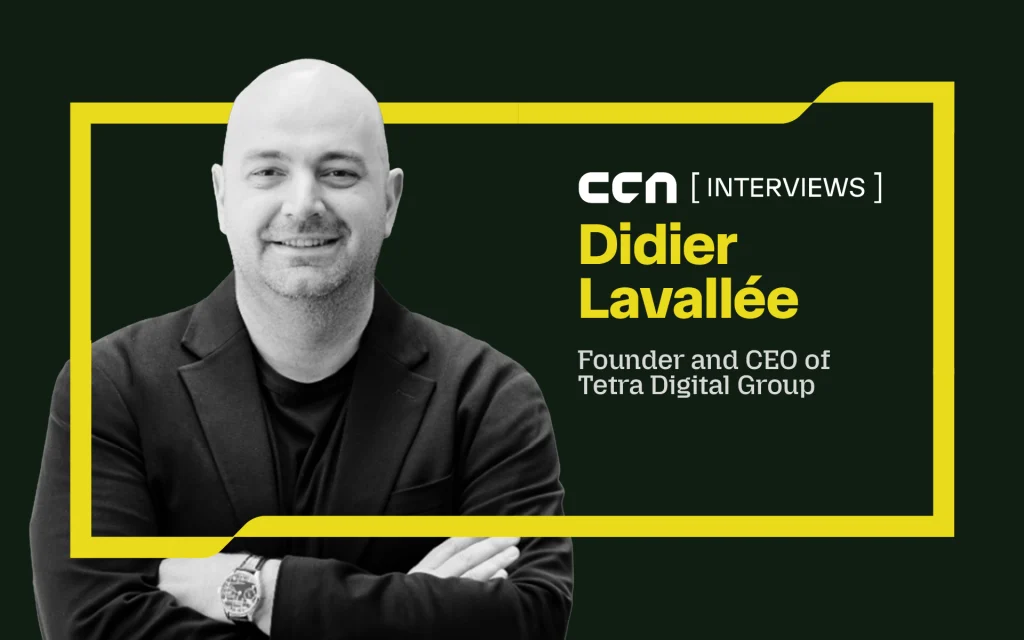
Canada’s financial system may need to leapfrog conventional payment modernization and move directly toward stablecoin infrastructure, according to Didier Lavallée, founder and CEO of Tetra Digital Group.
Speaking with CCN’s Dr. Guneet Kaur at the Blockchain Futurist Conference in Toronto, Lavallée argued that blockchain-based payments could complement domestic banking rails while solving persistent problems involving cross-border transfers, programmability and settlement speed.
Lavallée also discussed the lessons of the QuadrigaCX collapse, Tetra’s decision to launch its Canadian-dollar stablecoin across three blockchains and the emerging role of digital currencies in AI-powered commerce.
Tetra launched CADD, a stablecoin backed 1:1 by Canadian dollars and issued by Tetra Trust Company through CAD Digital. The token received approval from Alberta Treasury Board and Finance and is available on Ethereum, Base and Tempo. Its reserves are held in Canada and dedicated to redemptions.
Canada Has Reduced the Custody Risks Exposed by QuadrigaCX
The 2019 collapse of Canadian crypto exchange QuadrigaCX exposed significant weaknesses in the country’s digital asset custody infrastructure. However, Lavallée believes Canadian regulators have since addressed many of the risks that allowed platforms to control customer assets without sufficient safeguards.
“The whole regulatory construct was built around the QuadrigaCX failure,” he told CCN. “Crypto trading platforms that service retail users cannot self-custody anymore.”
Instead, regulated trading platforms must use qualified third-party custodians to protect client assets. According to Lavallée, this framework has substantially reduced the risk of another custody-related failure involving a regulated Canadian platform.
“I would say the same risk is low in market today just because of the regulatory construct that was created around QuadrigaCX,” he said.
Risks have not disappeared entirely, however. Lavallée noted that some non-custodial platforms continue operating outside the same regulatory structure, requiring customers to connect their own wallets. While this model limits the platform’s direct control over client assets, it introduces a different risk profile.
“The regulatory environment continues to evolve,” he said. “I think we’re well regulated in Canada, and safety and security of the consumer remains one of the driving forces around our construct.”
Why CADD Launched on Three Blockchains
Rather than testing CADD on a single network, Tetra introduced the stablecoin simultaneously on Ethereum, Base and Tempo.
Lavallée said each blockchain serves a distinct purpose. Ethereum acts as the industry’s primary reference network for tokenized assets, making it an essential part of the launch despite its relatively high transaction costs.
“Ethereum is the blockchain of record,” he said. “It is a reference point for us. So that was a must-do in terms of the launch, but ultimately Ethereum is still expensive to transact on at a layer-one level.”
Base, meanwhile, offers lower costs and faster transactions as an Ethereum layer-2 network. Tetra selected Tempo because of its focus on payments and the strategic opportunity to join the network as an early partner.
“We did three versus some that do six or seven,” Lavallée said. “We still think we operate within a narrow window, but every blockchain we’ve launched on has a specific use.”
The multichain approach could allow CADD to target institutional settlement on Ethereum, lower-cost transfers through Base and payment-specific applications on Tempo.
AI Agent Payments Are Still More Buzz Than Business
Stablecoins have emerged as a potential payment mechanism for autonomous AI agents, particularly as developers experiment with protocols that allow software to initiate blockchain transactions.
Lavallée, however, cautioned that most agentic payment applications remain at the proof-of-concept stage.
“I don’t think the real use cases at scale are here,” he said. “I think it’s proving out that the technology can work.”
The strongest argument for blockchain-based agent payments may involve micropayments.
Traditional payment systems struggle to process transactions worth less than one cent economically, especially at volumes involving thousands of transfers per second.
“What you’re proving out here is the blockchain is a far superior layer of infrastructure to do that activity than the traditional rails,” Lavallée said.
Nevertheless, he argued that AI agents still require considerable human prompting and oversight before completing transactions.
“Agents, in terms of payments, I think it’s buzzworthy,” he added. “It gains a lot of attention, but today there’s not a tremendous amount of use cases.”
Canadian Banks Could Leapfrog Payment Modernization
Canada clears roughly C$424 billion every business day, but parts of its retail payment infrastructure still depend on batch-based systems originating in the 1980s.
According to Lavallée, Canada remains the only G7 country that has not deployed a national real-time payment rail, despite working on the project for approximately nine years.
“The financial industry in Canada has yet to catch up with even what is standard infrastructure in today’s world,” he said.
Lavallée does not view stablecoins as direct competitors to domestic real-time payments.
Instead, he sees them as a complementary layer that could support international transactions, remittances and programmable payments.
“Even if you have the most modern payments infrastructure in Canada, you still need to be able to transact internationally,” he said. “You still have complications on remittances, cross-border and all of that activity. It’s also not programmable, which means you can’t automate any of that activity.”
Canada’s Stablecoin Act establishes a federal framework under which the Bank of Canada will supervise covered issuers, including requirements related to reserves, redemption, governance and risk management. Supporting regulations are expected to continue developing before the framework comes fully into force in 2027.
Tetra intends to transition from its current provincial structure to the federal regime once it becomes available. Lavallée said the company’s experience running a regulated trust business leaves it “well positioned,” although he stopped short of describing that position as a competitive advantage.
Over the next three to five years, Tetra aims to establish CADD as Canada’s leading privately issued stablecoin, measured by circulation and transaction volume.
The broader question, Lavallée said, is whether Canadian banks should spend years catching up with conventional payment systems or jump directly to blockchain infrastructure.
“Is there an argument to be made that the banks should be leapfrogging the modernization into stablecoin because they’re already behind?” he asked. “Why not just go straight to the superior technology?”
The information provided in this article is for informational purposes only. It is not intended to be, nor should it be construed as, financial advice. We do not make any warranties regarding the completeness, reliability, or accuracy of this information. All investments involve risk, and past performance does not guarantee future results. We recommend consulting a financial advisor before making any investment decisions.

Giuseppe Ciccomascolo began his career as an investigative journalist in Italy, where he contributed to both local and national newspapers, focusing on various financial sectors.
Upon relocating to London, he worked as an analyst for Fitch's CapitalStructure and later as a Senior Reporter for Alliance News. In 2017, Giuseppe transitioned to covering cryptocurrency-related news, producing documentaries and articles on Bitcoin and other emerging digital currencies. He also played a pivotal role in establishing the academy for a cryptocurrency exchange website. Crypto remained his primary area of interest throughout his tenure as a writer for ThirdFloor.

Dr. Guneet Kaur is a senior editor at CCN.com and a Science Fellow at Exponential Science. She is a fintech and blockchain expert with extensive experience in digital finance education, blockchain ecosystems, and cryptocurrency markets. She has worked with global media such as Cointelegraph, as well as education and blockchain platforms, to design and lead strategic content and learning initiatives. As an educator and assessor for top-tier executive programs, she bridges real-world fintech trends with academic insight.
Dr. Kaur is also a published researcher and peer reviewer across fintech and data science journals, including Financial Innovation Journal and International Journal of Big Data Intelligence and Applications. Her work spans data-driven analysis, Web3 innovation, and technical content development. With a strong foundation in both industry and academia, she translates complex financial technologies into practical applications, empowering learners, professionals, and institutions across the rapidly evolving digital finance landscape.