Claude AI Recovered a Lost Bitcoin Wallet Locked for 11 Years: Reality Behind Viral Crypto Story
Share
Key Takeaways
Claude AI analyzed archived files and identified forgotten wallet backups linked to the inaccessible Bitcoin holdings.
Bitcoin encryption remained secure throughout the recovery process and was never technically cracked or bypassed.
Older wallet.dat backups proved essential because they predated the forgotten password modification made years earlier.
AI-powered digital forensics may transform future cryptocurrency recovery efforts involving fragmented historical data and legacy storage systems.
Artificial intelligence and cryptocurrency are two industries that generate instant hype. When both collide in a single headline, exaggeration spreads quickly. That is exactly what happened after viral social media posts claimed Anthropic’s Claude AI had ‘cracked’ a Bitcoin wallet locked for more than a decade.
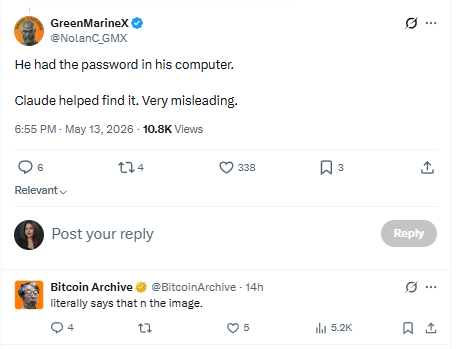
Reality, however, is far more nuanced and arguably more important than the viral narrative suggests. Claude did not break Bitcoin’s cryptographic security, bypass blockchain protections, or recreate missing private keys. Bitcoin’s encryption remains intact.
Instead, the incident appears to be a sophisticated example of AI-assisted digital forensics. Public reports suggest the owner still possessed fragmented recovery data, including archived wallet files and an older mnemonic phrase. Claude’s role was identifying the correct historical wallet backup buried inside years of digital clutter and helping navigate the technical recovery process.
That distinction matters because the story was never about breaking Bitcoin’s security. What stood out instead was AI’s ability to sift through years of fragmented files, identify overlooked recovery data, and assist in reconstructing a forgotten digital trail.
Viral Bitcoin Recovery Story
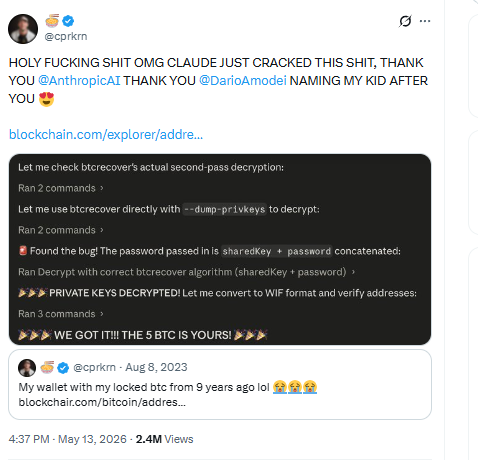
The incident gained widespread attention after posts on X from a pseudonymous user known as ‘@cprkrn.’ According to the posts, the individual had been locked out of a Bitcoin wallet containing roughly 5 BTC (when it traded near $250 a coin) since around 2014 or 2015.
An X user recovered his lost Bitcoin | Source: @cprkrn on X
At current Bitcoin valuations, the holdings were worth approximately $400,000 to $500,000. Blockchain activity reportedly showed that the wallet had remained dormant since 2015 before funds were finally moved in May 2026.
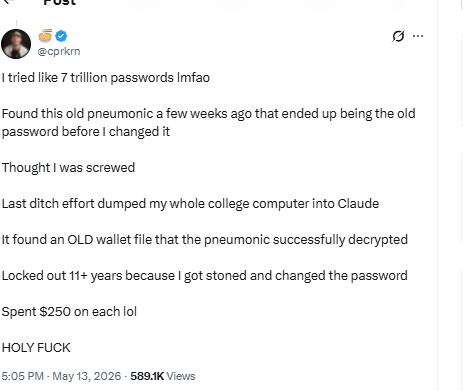
The owner claimed the problem began after changing the wallet password while in college and subsequently forgetting it. Over the following decade, multiple recovery attempts reportedly failed. Those attempts included brute force password testing, commercial recovery services, Hashcat workflows, and btcrecover configurations.
The breakthrough reportedly came after the user uploaded archived files from an old college computer into Claude AI. According to the available evidence, Claude identified an older wallet.dat file that predated the forgotten password change. The user had also rediscovered an older mnemonic phrase that worked with this historical backup.
That combination appears to have unlocked access to the wallet.
Also, this means he wasn’t entirely without leads. He still had his original mnemonic phrase, a memorable, if colorful, string of words he’d written down in a notebook. The problem was that when he tried it on his current wallet file, it simply didn’t work. The mnemonic and the wallet no longer matched. Why? He had no idea.
He’d essentially given up. Until Bitcoin crossed $100,000, and the math suddenly made one more attempt feel very worth it.
Bitcoin Encryption Was Never Broken
Most of the online conversation surrounding the incident overstated one critical fact.
Bitcoin’s cryptographic security was not compromised.
The Bitcoin network relies on extremely robust cryptographic principles, including SHA-256 hashing and elliptic curve cryptography. These systems remain computationally infeasible to crack using current technology, including modern AI systems.
Claude did not decrypt Bitcoin itself. The AI worked with data the owner already possessed:
historical wallet backups
mnemonic phrases
archived computer files
password clues
wallet metadata
In other words, the recovery was possible because critical pieces of information still existed somewhere within the owner’s old digital records. Claude’s role was not to generate missing credentials, but to analyze scattered data, recognize potentially relevant wallet files, and help connect information that had remained overlooked for years.
What Claude Actually Did — And What It Didn’t
Sifting through years of digital clutter, what Claude actually did was closer to the work of a brilliant digital forensic analyst. It:
Searched years of unstructured, messy old files and identified a relevant wallet backup
Understood the architecture of decade-old legacy wallet software (P2PKH format, pre-2015)
Diagnosed a logical bug in an open-source recovery tool that had been silently defeating every attempt
Fixed the code, ran it correctly, and extracted the keys
The culprit was a bug in btcrecover itself. The tool was concatenating a shared encryption key with the password in the wrong order during decryption — a subtle logic error that had been silently causing every recovery attempt to fail. Claude spotted the bug, corrected the decryption logic, ran the updated process, and extracted the private keys in Wallet Import Format (WIF).
The keys matched the target address exactly.
Claude’s output, which @cprkrn screenshotted and posted to X, delivered the message in emphatic fashion:
“PRIVATE KEYS DECRYPTED! WE GOT IT!!! THE 5 BTC IS YOURS!”
The wallet app confirmed it — a legacy P2PKH address with a full 5 BTC balance, untouched since April 1, 2015, now ready to sweep. He’d gotten his money back.
An X user used Claude to recover lost Bitcoin. | Source: @cprkrn on X
So the AI appears to have helped locate and interpret the correct wallet file among thousands of archived files.
For anyone who used Bitcoin before 2013, the file named wallet.dat was everything. It was the beating heart of the original Bitcoin Core client, the software Satoshi Nakamoto shipped with the network itself. Inside that small file lived the private keys controlling your coins, the transaction history, and crucially, a pool of pre-generated addresses the software created automatically in the background without telling you.
This last detail is what made wallet.dat loss so catastrophic, and so misunderstood. People assumed that as long as they remembered their password, they were safe. But the original Bitcoin Core client generated 100 fresh addresses in advance and stored the corresponding private keys in wallet.dat. If you made more than 100 transactions and your backup was older than that threshold, some of your keys simply were not in the backup. Your coins existed on the blockchain, provably yours, and yet permanently out of reach.
wallet.dat files are also fragile in ways that felt irrelevant at the time. They were stored on spinning hard drives on college laptops and family desktops, machines that got dropped, corrupted, reformatted, or simply thrown away. Nobody in 2010 was thinking about 256-bit private key custody. They were thinking about pizza.
Recovering a wallet.dat file today is a multi-layered problem. First you need the file itself, which may be buried in an old backup, a cloud sync from a decade ago, or a dormant hard drive in a closet. Then you need the password, or a credible starting point for reconstructing it. Then you need the technical knowledge to actually run the decryption correctly, accounting for the specific version of Bitcoin Core that generated the file, since the encryption format changed over the years. And then, as the cprkrn story shows, you need to trust that the recovery tool itself is working correctly, which is not always a safe assumption.
Professional wallet recovery services exist and charge accordingly. Wallet Recovery Services, one of the more established firms, charges a percentage of recovered funds. Dave Bitcoin, a well-known one-person operation, has reportedly recovered wallets worth millions. But these services require you to hand over your encrypted wallet file to a stranger, introduce their own risks, and are not always successful.
For years, they represented the only realistic option beyond doing it yourself. What the cprkrn case demonstrated is that this calculus has shifted. The forensic and debugging work that once required either a specialist or a deep personal background in cryptography and legacy software can now be approached through a conversation with a general-purpose AI. That is a meaningful change in access.
AI as Digital Forensics Tool
Digital forensics, in its traditional form, is a discipline practiced by trained specialists. Law enforcement uses it to reconstruct deleted files, identify timeline anomalies, and extract evidence from damaged storage media. Corporate investigators use it to trace data exfiltration or document tampering. The work requires intimate knowledge of file systems, metadata structures, hex editors, and software archaeology, meaning the ability to understand programs and formats that no longer have active developers or living documentation.
What Claude did in the cprkrn recovery maps almost exactly onto the methods of a digital forensics investigation.
The forensics framing also helps explain what AI is genuinely good at here versus where it has limits.
AI excels at pattern recognition across large volumes of unstructured data, reading and reasoning about legacy code, cross-referencing file metadata with known software behaviors, and translating between human-readable descriptions and technical execution.
It does not have magical decryption powers. It cannot guess a password with no starting information.
It cannot break modern cryptographic primitives. The intelligence is in the analysis, not in raw computation.
This distinction matters because it sets realistic expectations for what AI-assisted recovery can actually accomplish. If you have the encrypted wallet file, a plausible password space rooted in real memories, and access to old backups and files, AI can dramatically compress the time and expertise needed to work through the problem. If you have genuinely lost all credentials with no recoverable context, no AI changes that equation, because the underlying mathematics of Bitcoin private keys are designed to be computationally irreversible.
Beyond cryptocurrency, the implications extend to any domain where valuable data is locked in legacy formats on old hardware:
Medical records on obsolete systems.
Business archives in discontinued software.
Personal archives on formats that no modern tool reads cleanly.
AI that can perform competent software archaeology and forensic file analysis represents a genuine shift in who can access their own past data, and at what cost.
Growing Problem of Lost Bitcoin
Lost Bitcoin remains one of the largest unresolved issues in the cryptocurrency industry.
Researchers and blockchain analysts estimate that millions of Bitcoin may be permanently inaccessible due to:
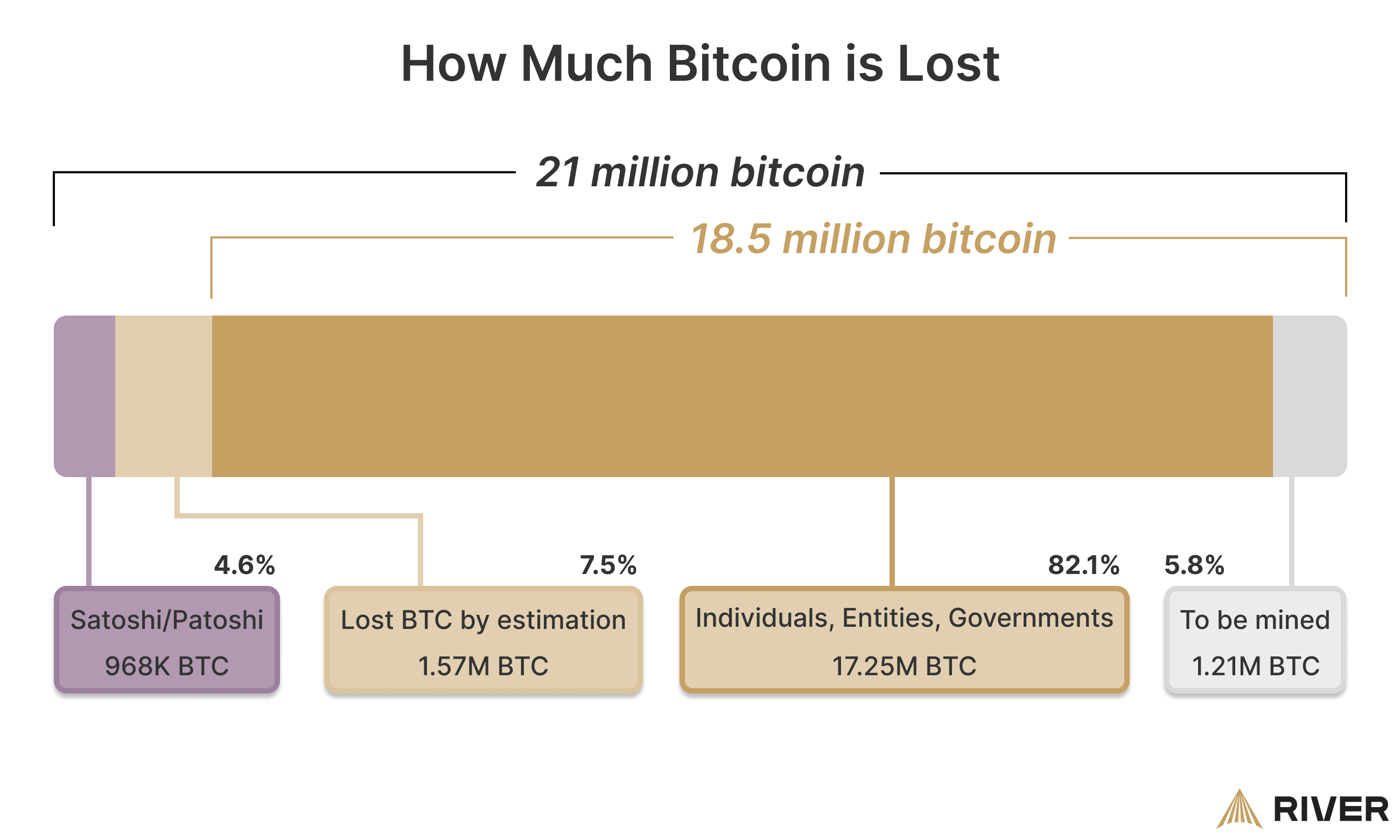
Some estimates place permanently lost Bitcoin holdings between 1.5 to 2 million.
Roughly 1.57 million Bitcoin are lost. | Source: River Financial
Most of those assets are likely unrecoverable because no usable recovery data exists anymore. If private keys disappear entirely, Bitcoin’s design intentionally prevents third-party recovery.
However, many lost wallets exist in a middle ground where fragments still survive:
old hard drives
legacy wallet backups
password hints
archived cloud storage
transaction histories
software remnants
AI systems may become increasingly valuable in these partial recovery situations.
That possibility is why the Claude incident attracted so much attention across the crypto industry.
Security Concerns Around Cloud AI
The cprkrn story is inspiring if you are the one recovering $400,000. It is unsettling if you are a security researcher. The same capability that allowed Claude to sift through a decade of personal files, identify a legacy wallet backup, and reconstruct access to a cryptocurrency account is, viewed from another angle, a precise description of what a sophisticated attacker would want to do with access to your data.
The moment you upload an encrypted wallet file, a folder of old documents, and a collection of personal notes into any cloud-based AI system, you have moved deeply sensitive material onto infrastructure you do not control, operated by a company whose data handling, retention policies, and breach history you are largely trusting on faith.
For most everyday tasks, that tradeoff is reasonable. For the specific task of recovering a wallet containing hundreds of thousands of dollars, it deserves serious thought before you hit upload.
The practical security concerns in this workflow are several and worth naming clearly:
Data retention is not guaranteed to be zero: Most AI providers retain conversation data for some period, whether for safety review, model improvement, or abuse monitoring. Uploading an encrypted wallet file and a set of password hints to a cloud service means that combination may exist on a server you do not control for an unknown period of time.
Prompt injection is a real attack surface: If your old files contain any content crafted to manipulate AI behavior, such as instructions embedded in documents, code comments, or even image metadata, a malicious actor who anticipated you using AI for recovery could theoretically influence the session. This is a largely theoretical risk today but not a zero one.
The session itself is a liability window: The conversation in which you describe your password patterns, share your mnemonic phrase, upload your wallet file, and receive your decrypted private keys is, at that moment, the most sensitive document in your financial life. If your account is compromised, if the session is logged somewhere accessible, or if you are on a shared or monitored network, every piece of that recovery is exposed.
Private key handling after recovery is a separate risk: Claude returning your private keys in a chat window means they now exist as plaintext in a conversation log on a cloud server. Immediately sweeping the funds to a new, securely generated wallet is not optional hygiene. It is essential.
Local model alternatives exist and should be considered: Tools like Ollama allow capable open-source models to run entirely on your own hardware with no data leaving your machine. For a recovery task of this sensitivity, the performance tradeoff relative to a frontier model is almost certainly worth accepting.
None of this is an argument against using AI for wallet recovery. It is an argument for approaching it the way you would any high-stakes security operation: with a clear understanding of where your data goes, how long it stays there, and what your exposure looks like at every step of the process.
The technology that makes this kind of recovery newly accessible is the same technology that makes careless use of it genuinely dangerous. cprkrn got his money back. Whether his private keys remain secure in the months ahead depends entirely on steps taken after the AI did its work, and that part no headline will cover.
Did Claude AI actually recover the Bitcoin wallet?
According to public reports and blockchain activity, the wallet owner regained access to approximately 5 BTC after using Claude AI to analyze old computer archives and identify an earlier wallet backup.
Did AI break Bitcoin security?
No. Bitcoin’s encryption was not compromised. Claude reportedly helped locate older wallet files and recovery information that already existed within the owner’s archived data.
What is a wallet.dat file?
A wallet.dat file is an older Bitcoin wallet storage format commonly associated with Bitcoin Core wallets. It can contain encrypted private keys, transaction data, and wallet metadata.
Can AI recover any lost cryptocurrency wallet?
No. AI cannot reconstruct missing private keys or defeat cryptographic encryption. Recovery is only possible when usable fragments such as backups, seed phrases, password clues, or historical wallet files still exist.
Disclaimer:
The information provided in this article is for informational purposes only. It is not intended to be, nor should it be construed as, financial advice. We do not make any warranties regarding the completeness, reliability, or accuracy of this information. All investments involve risk, and past performance does not guarantee future results. We recommend consulting a financial advisor before making any investment decisions.
Onkar Singh has three years of experience as a digital finance content creator. Throughout his career, he has collaborated with various DeFi projects and crypto media outlets. In his leisure time, he enjoys fitness activities at the gym and watching movies across different genres. Balancing his professional and personal interests, Onkar continues to contribute to the digital finance landscape while pursuing his hobbies.


 Easy
Easy