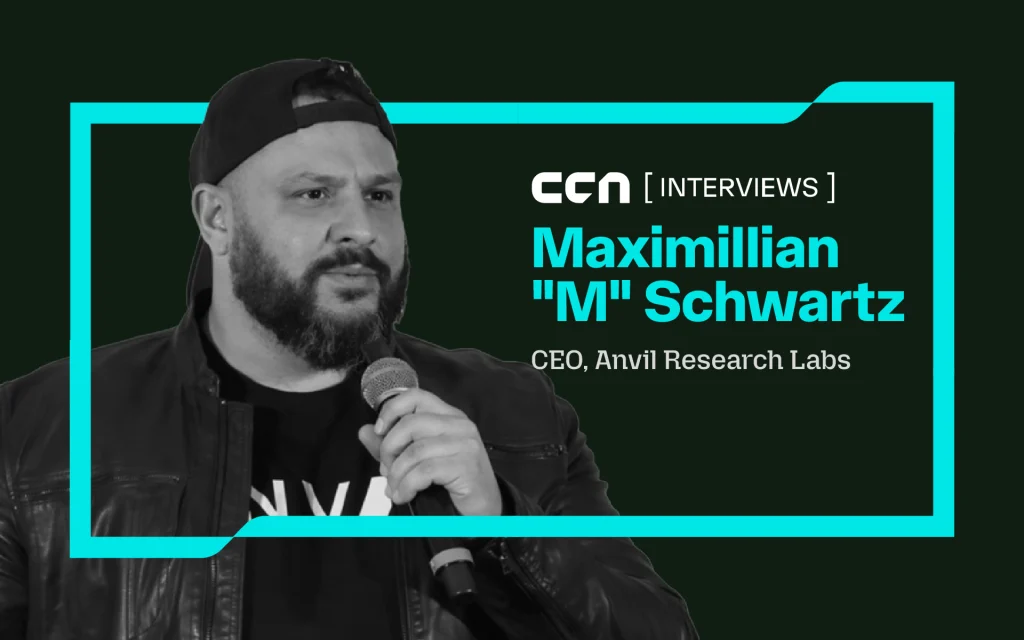
Anvil Research Labs CEO Maximillian Schwartz believes blockchain-based letters of credit could give businesses a safer alternative to unsecured lending without forcing borrowers to sell their digital assets.
In an interview with CCN’s Dr. Guneet Kaur at the Blockchain Futurist Conference in Toronto, Schwartz explained how Anvil uses overcollateralization and automated liquidations to maintain credit promises even when volatile assets such as Ether fall sharply.
The protocol aims to modernize letters of credit, a longstanding financial instrument that typically requires banks, extensive documentation, and sizeable fees.
“There’s this mechanism that’s actually really important to international commerce and is core to our financial system, but it’s not available to everybody,” Schwartz told CCN.
However, Anvil’s ambitions extend beyond improving an established banking product. Schwartz argues that its infrastructure could enable merchants to offer secure buy now, pay later services while abstracting most of the blockchain’s complexity from customers.
What Happens When Crypto Collateral Crashes?
Anvil allows users to issue letters of credit backed by digital assets. Those assets remain in a collateral position, enabling users to retain exposure to potential price appreciation and, where applicable, continue earning yield.
That structure raises an obvious problem: crypto prices can collapse at any hour.
“It’s the pros and cons of having a market that’s open 24/7, 365,” Schwartz said.
Anvil addresses this risk by separating the asset promised to the recipient from the asset used as collateral.
For example, a company could receive a letter of credit worth 10,000 USDC even though the issuer backs it with Lido-wrapped staked Ether. The recipient does not need to assess Ether’s volatility because the protocol is designed to preserve the USDC-denominated promise.
“You can actually use these more volatile assets to secure that promise,” Schwartz explained. “The recipient of the letter of credit doesn’t have to care about how you collateralize it.”
A user cannot, however, secure a 10,000-USDC obligation with exactly $10,000 worth of Ether.
“You can’t have $10,000 worth of Lido staked wrapped Ether to make a $10,000 USDC promise,” Schwartz said. “What you have to do is overcollateralize.”
Anvil’s approach draws on a risk-management model already widely used by DeFi lending platforms such as Aave and Compound.
“Collateral factors and how we overcollateralize are not revolutionary,” Schwartz acknowledged. “This is very well-trodden territory in DeFi.”
However, he argued that Anvil can maintain wider buffers because it is not trying to maximize how much users can borrow against their collateral.
“We’re not a lender that’s trying to see how much you can borrow,” he said. “We want to make sure our promises are solvent at all times.”
How Anvil’s Automatic Liquidations Work
Depending on the collateral pair, Anvil may require an additional buffer of around 35% to 40%. Governance determines the requirements for each asset combination, taking into account factors such as historical volatility and liquidity.
“What Lido staked wrapped Ether to USDC is might be different from what wrapped Bitcoin to USDT is,” Schwartz said. “We look at the history of its volatility, how liquid it is and all those kinds of things.”
If the collateral value falls below the required threshold, the protocol automatically allows enough of it to be sold to obtain the asset specified in the letter of credit.
“The second you breach that collateral factor, it becomes risky,” he explained. “It will automatically sell the requisite amount of collateral to produce the credited amount and keep that guarantee in place.”
In the previous example, Anvil would convert the necessary amount of wrapped staked Ether into 10,000 USDC. The stablecoins would remain locked rather than be transferred to the recipient immediately, who could redeem them under the original agreement.
“It doesn’t mean you automatically get the credit value,” Schwartz said. “It converts the form of it, so there’s always 10,000 USDC there to produce the credited amount.”
Static Letters of Credit Role
Anvil also offers static letters of credit, where the credited and collateral assets are identical.
“If I’m going to promise you 10,000 USDC and collateralize it with 10,000 USDC, that’s not risky,” Schwartz said. “There’s literally 10,000 USDC in the vault being held for you.”
Issuers can add collateral when their position approaches liquidation or withdraw excess collateral when its value rises, provided the remaining position retains the required buffer.
“If the price starts depreciating, they always have the option to add more,” Schwartz said. “Conversely, if Ether goes to the moon, you might say, ‘I’m way too overcollateralized,’ and remove some collateral.”
Automated liquidation may reduce market risk, but it cannot eliminate all sources of risk. The model still depends on smart contract security, reliable price data, sufficient liquidity, stablecoin integrity, and appropriate governance parameters.
Anvil Takes Aim at Buy Now, Pay Later
Schwartz sees buy now, pay later, or BNPL, as one of the clearest applications for Anvil’s technology.
Traditional BNPL providers such as Klarna, Affirm, and Afterpay generally assess customers using credit data but cannot guarantee repayment. Their pricing must therefore account for defaults and collection costs.
“They might do a soft credit check on your credit score, but that’s it,” Schwartz said. “They have no guarantee they’re going to get repaid.”
By contrast, Anvil requires borrowers to secure their obligations with digital assets. If they fail to pay, the merchant can claim the pledged value.
“Everything with Anvil is fully secured,” Schwartz said. “You’ve made it virtually default-proof. You’re going to get paid.”
That description refers specifically to collateral covering the borrower’s obligation. It does not eliminate risks such as smart contract exploits, stablecoin depegging or inadequate market liquidity.
According to Schwartz, the more significant change is that merchants would no longer need a dedicated BNPL company to assume the credit risk.
“Any merchant, anyone that accepts payments, can be the BNPL,” he said. “They can be their own bank.”
A merchant could let a customer pay later because the smart contract already holds sufficient collateral.
“Even if you walk away, disappear and ghost us, they can always claim that value,” Schwartz said.
Borrowers Keep Their Crypto Exposure
At checkout, customers could pledge crypto rather than sell it to fund a purchase. They would retain economic exposure to the position while agreeing to settle the bill later.
“You get to keep your position,” Schwartz said. “You get to keep all the accrual of interest or upside appreciation and pay on your own terms.”
For merchants, the collateral could reduce the uncertainty associated with lending. Schwartz argued that secured obligations may eventually allow businesses to undercut conventional credit providers.
“Everybody else is pricing in the risk of default,” he added. “We know for sure that we have it, so we can lend for less than anyone else.”
The model nevertheless comes with a clear trade-off. Customers must already own enough crypto to overcollateralize the purchase, while a sharp decline could force the protocol to sell its assets at an unfavorable time.
Secured crypto credit, therefore, serves a different customer profile from conventional BNPL. It may suit asset holders seeking liquidity without immediately exiting their positions, but it does not expand purchasing power for consumers who lack collateral.
Why Banks Haven’t Built It Yet
Financial institutions have spent years experimenting with tokenization and blockchain settlement, but few have translated that work into consumer-facing collateral products.
Schwartz attributed the slow progress partly to regulatory uncertainty and partly to banks’ existing business models.
“They’re trying to figure out the rules of the road,” he said. “But it’s not something that’s off their radar.”
Traditional institutions already operate valuable infrastructure and must integrate new technologies into complex compliance systems.
“When I talk to some of these traditional finance guys, their eyes light up because they see the potential,” Schwartz said. “They realize how much inefficiency is built into it.”
He also argued that large banks often focus on institutional infrastructure rather than consumer experience.
“The problem with traditional banks or merchant banks like JPMorgan is that they build for institutions, not for the end user,” he said.
Making Onchain Credit Look Like Ordinary Software
Anvil Research Labs is developing software that resembles conventional enterprise platforms. The goal is to let businesses manage letters of credit at scale without requiring employees or customers to understand wallets or smart contracts.
“We’re building enterprise tooling that allows you to manage these LOCs at scale,” Schwartz said. “It looks and feels like the existing enterprise-grade SaaS that they’re used to working with.”
The protocol’s modular design means the same infrastructure could support both business-to-business and business-to-consumer applications.
“Digital letters of credit can be used by institutions in a B2B way, or they can be used in a B2C way,” Schwartz said.
Anvil describes itself as a system of Ethereum-based smart contracts for managing collateral and issuing fully secured credit. Its letters of credit function as verifiable payment guarantees comparable to bank checks.
“If we can abstract away the crypto stuff as much as possible, you don’t need to be a crypto expert to take advantage of it,” Schwartz added.
This abstraction could prove crucial for enterprise adoption. Businesses may be interested in faster settlement and programmable collateral without redesigning their operations around crypto-native interfaces.
Success Means Users Stop Noticing the Blockchain
Schwartz is less interested in chasing total value locked, or TVL, than in seeing businesses adopt Anvil as part of their normal operations.
“There are a lot of different metrics you can chase in a decentralized protocol,” he said. “A lot of people go to TVL, but TVL can be somewhat misleading.”
TVL can show how much capital sits inside a protocol, but it does not necessarily reveal whether people actively use the product or whether it has found a sustainable business case.
“It’s really easy to game, and it doesn’t show anything about scale,” Schwartz said.
For Anvil, the more meaningful measures will be enterprise integrations and the ability to serve customers with little crypto knowledge.
“Success looks like having major enterprises integrate this into their workflow,” Schwartz said, “and having the end user not have to be crypto-literate to utilize it.”
That is ultimately Anvil’s central bet: mainstream adoption will arrive when blockchain becomes infrastructure rather than a product’s main selling point.
“You don’t need to know or care about crypto to take advantage of the efficiency of blockchain technology,” Schwartz said.
Just as bank customers do not need to understand the systems behind a wire transfer, future borrowers may not know, or care, that smart contracts manage their collateral and Ethereum settles their transactions.
“When you wire money to another bank, do you know how that process works?” Schwartz asked. “No, you don’t care. It just works.”
If Anvil succeeds, its biggest achievement may be making onchain credit feel like an ordinary financial service.
“You can do the conversion to crypto in the background and settle onchain,” Schwartz concluded. “The user doesn’t have to worry about it.”
The information provided in this article is for informational purposes only. It is not intended to be, nor should it be construed as, financial advice. We do not make any warranties regarding the completeness, reliability, or accuracy of this information. All investments involve risk, and past performance does not guarantee future results. We recommend consulting a financial advisor before making any investment decisions.

Giuseppe Ciccomascolo began his career as an investigative journalist in Italy, where he contributed to both local and national newspapers, focusing on various financial sectors.
Upon relocating to London, he worked as an analyst for Fitch's CapitalStructure and later as a Senior Reporter for Alliance News. In 2017, Giuseppe transitioned to covering cryptocurrency-related news, producing documentaries and articles on Bitcoin and other emerging digital currencies. He also played a pivotal role in establishing the academy for a cryptocurrency exchange website. Crypto remained his primary area of interest throughout his tenure as a writer for ThirdFloor.

Dr. Guneet Kaur is a senior editor at CCN.com and a Science Fellow at Exponential Science. She is a fintech and blockchain expert with extensive experience in digital finance education, blockchain ecosystems, and cryptocurrency markets. She has worked with global media such as Cointelegraph, as well as education and blockchain platforms, to design and lead strategic content and learning initiatives. As an educator and assessor for top-tier executive programs, she bridges real-world fintech trends with academic insight.
Dr. Kaur is also a published researcher and peer reviewer across fintech and data science journals, including Financial Innovation Journal and International Journal of Big Data Intelligence and Applications. Her work spans data-driven analysis, Web3 innovation, and technical content development. With a strong foundation in both industry and academia, she translates complex financial technologies into practical applications, empowering learners, professionals, and institutions across the rapidly evolving digital finance landscape.