Crypto-backed lending still carries the scars left by Celsius, BlockFi, and the wave of failures that swept through the industry in 2022.
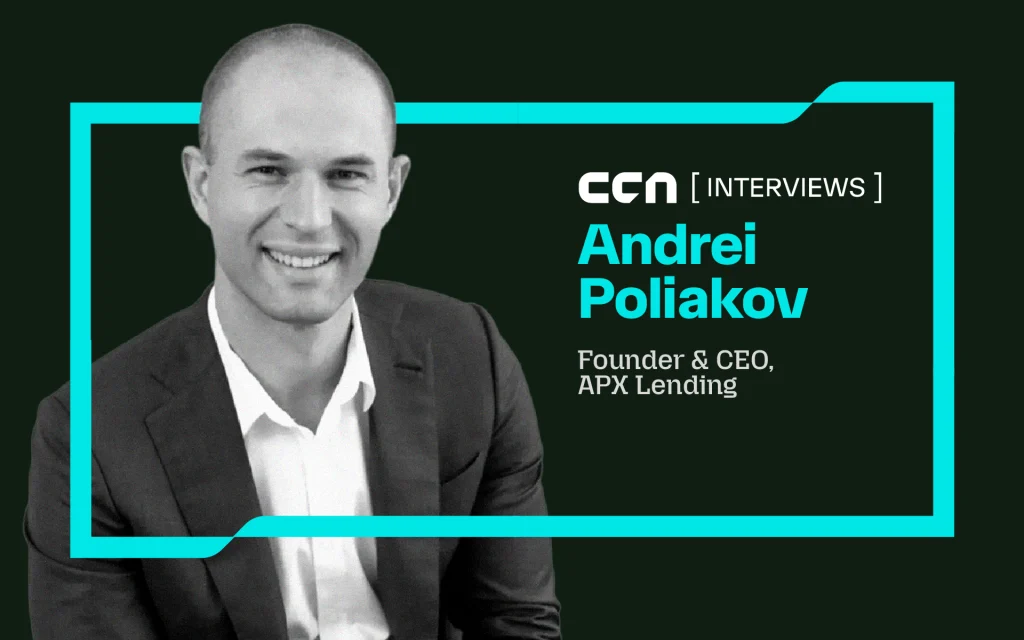
APX Lending founder and CEO Andrei Poliakov believes the answer is not to abandon the model but to rebuild it around regulated operations, segregated custody, and a ban on rehypothecation.
Speaking to CCN’s Dr. Guneet Kaur at the Blockchain Futurist Conference, Poliakov explained how APX lets Bitcoin and Ethereum holders access cash without selling their assets, and why he believes its structure avoids the interconnected risks that brought down earlier lenders.
“We need regulatory frameworks in order for this industry to move forward,” Poliakov said. “I’ve been working on the very boring, regulated end of crypto for the better part of the last decade.”
Borrowing Against Bitcoin Without Selling It
APX describes itself as a regulated digital asset credit infrastructure company. Its consumer-facing business allows customers to pledge Bitcoin or Ethereum as collateral and borrow Canadian dollars or USDC.
“If you have $100,000 of Bitcoin, you can borrow against that Bitcoin the way you borrow against your house when you get a mortgage,” Poliakov said.
The borrower transfers the crypto to custody and receives a cash or stablecoin loan. They pay interest, repay the principal, and receive their collateral back at the end of the agreement.
“You pledge that Bitcoin as security for the loan, and we give you cash,” Poliakov explained. “You return the loan, and we give you back the crypto.”
The model targets long-term holders who need liquidity but do not want to sell their assets, potentially sacrificing future price appreciation or incurring capital gains taxes.
However, unlike a mortgage, the value of crypto collateral can change rapidly. A sharp decline in Bitcoin or Ether prices can push a loan toward liquidation within days rather than years.
APX Also Wants to Power Bank Loans
Direct lending represents only one part of APX’s strategy.
The company also offers lending-as-a-service infrastructure that banks, credit unions, exchanges, fintech companies, and neobanks can integrate into their existing products.
Its technology covers customer onboarding, underwriting, collateral management, regulatory reporting, and the full loan lifecycle.
“Building this in-house is very complex,” Poliakov said. “The regulatory aspect takes many years, and it’s very expensive.”
According to the CEO, a partner can introduce a crypto-backed lending product through APX in fewer than 60 days.
“They can plug it into their existing software,” he said. “We take care of the regulatory requirements, the credit risk, and the capital.”
Banks and fintech companies can place their own branding over the service while APX operates the underlying infrastructure. Poliakov said the arrangement allows institutions to offer crypto loans without immediately committing their own balance sheets or building specialist compliance teams.
“It’s APX underwriting the loan,” he said. “We provide the capital, so they can offer this without taking balance-sheet risk.”
APX is also open to co-lending arrangements for partners that want to provide part of the capital themselves.
Who Holds the Collateral?
The custody model sits at the heart of APX’s attempt to separate itself from failed centralized lenders.
When borrowers pledge Bitcoin or Ethereum, APX says the assets move into insured cold storage with a qualified third-party custodian. Each loan receives its own wallet rather than being pooled into a single account.
“If you take three loans with us, each one of those loans has its collateral sitting in its own wallet,” Poliakov said.
Borrowers can monitor those wallets onchain throughout the lifetime of the loan.
“You can check 24/7 that your collateral is in that wallet,” he added. “It hasn’t been moved or played around with.”
APX says it uses BitGo Trust for custody and Fireblocks for asset transfers. Its documentation states that BitGo provides up to $250 million in insurance coverage, while Fireblocks offers an additional $35 million of coverage during transit. Those figures describe overall insurance policies and should not be interpreted as guaranteeing that every borrower would recover all losses under every scenario.
The structure offers greater visibility than the opaque balance sheets of other crypto lenders. Nevertheless, borrowers still face counterparty, custody, and liquidation risks after transferring control of their assets.
Bitcoin Prices Are Checked Every 15 Seconds
APX manages volatility by continuously monitoring each loan’s ratio to the value of its collateral.
Poliakov offered the example of a customer borrowing $60,000 against $100,000 of Bitcoin, resulting in an initial loan-to-value ratio (LTV) of 60%.
“Our technology evaluates the value of that collateral every 15 seconds,” he said. “It was $100,000, now it’s $101,000, now it’s $99,999. We just keep evaluating it.”
As the collateral loses value, APX begins sending notifications encouraging the borrower to deposit more crypto or repay part of the loan.
If the LTV reaches 90%, APX sells a portion of the collateral to reduce the ratio to approximately 88%.
“We sell a small portion of that collateral just to bring your LTV back down,” Poliakov said. “Our goal is to make sure you preserve as much of your Bitcoin as possible during market volatility.”
In his example, the liquidation threshold would be reached when the collateral fell from $100,000 to roughly $66,666, while the outstanding loan remained $60,000 ($60,000/$66,666 = 90%).
Rather than closing the entire position immediately, APX would make an incremental sale to bring the loan LTV down to 88% and continue monitoring it. Further declines could trigger additional liquidations.
The system can limit the lender’s exposure, but borrowers remain vulnerable to losing part, or potentially most, of their crypto during a severe and sustained market crash.
“We don’t pretend the risk doesn’t exist,” Poliakov said. “We developed our solution to address that risk and incorporate it into our business model.”
Why APX Says It Is Different From Celsius
Kaur challenged Poliakov on language frequently used by crypto lenders: helping customers “unlock liquidity” from otherwise idle assets without selling them.
Celsius and BlockFi made similar pitches before their failures left customers unable to access billions of dollars.
Poliakov argued that “crypto lending” covers fundamentally different business models and risk profiles.
“Crypto lending is not just one word that explains everything,” he said. “Celsius reinvesting collateral into risky endeavors is very different from DeFi lending which is different from regulated centralized platforms.”
Celsius promised customers yield and deployed their deposits elsewhere in search of returns. That created exposure to leveraged counterparties and investments that depositors could not readily inspect.
APX says it does not reinvest, lend out or rehypothecate borrower collateral.
“The collateral is not rehypothecated, and it is visible to the borrowers,” Poliakov said. “If that collateral moves, the borrower can sound the alarm and go to the regulators.”
The company’s documentation confirms that collateral remains in cold storage unless a liquidation threshold is reached.
Poliakov said this design removes the chain of hidden exposures that allowed failures at Three Arrows Capital, Celsius, and other firms to spread across the market.
“Non-rehypothecated collateral provides a safer borrower experience,” he said. “It eliminates the possibility of us having invested in somebody like Three Arrows Capital that imploded.”
The trade-off is cost. Because APX does not deploy collateral to generate additional returns, it cannot use those earnings to subsidize lower borrowing rates.
“What’s the use of lowering your interest rate by a couple of percentage points if you lose all your collateral?” Poliakov asked.
Avoiding rehypothecation removes a major source of risk, but it does not make crypto-backed lending risk-free. Borrowers must still consider price volatility, forced sales, custody arrangements, operational failures and the lender’s financial health.
Does Regulation Create a Competitive Moat?
Before launching APX, Poliakov co-founded Canadian crypto exchange Coinberry, which was later acquired by WonderFi.
He said the experience taught him that working with regulators could create more durable infrastructure, even if the process demanded considerable time and money.
APX spent more than two years working with Canadian securities regulators to develop a framework for crypto-backed loans, he said.
In April 2025, Canadian regulators granted the company exemptive relief from certain securities registration and prospectus requirements. The time-limited relief includes conditions covering custody, auditing, recordkeeping, disclosures and regulatory reporting.
“It’s all about borrower protection,” Poliakov said. “Because you’re giving me more Bitcoin than I’m giving you in loans, how do you make sure I don’t run away with it?”
The framework requires safeguards including segregated collateral and restrictions on its use. Poliakov believes complying with those conditions has produced a stronger business rather than merely creating additional costs.
“Doing that work with regulators gives us a competitive advantage because it helps us build a more robust business,” he said.
It has also become a selling point outside Canada. According to Poliakov, prospective partners in Europe and the US respond more positively to infrastructure already operating under oversight than to an untested crypto lending product.
“When we say this technology is live in Canada and overseen by regulators, that really opens doors for us,” he added.
What Happens When Banks Build Their Own Products?
The success of crypto lending could eventually create another challenge for APX.
If banks begin offering Bitcoin-backed loans directly, they may no longer need a white-label provider to assume the compliance burden or supply the capital.
Poliakov said APX intends to remain relevant by becoming the underlying infrastructure layer, even when financial institutions operate loans using their own teams and balance sheets.
“We know banks, financial institutions, and credit unions are going to start offering crypto-related products and services,” he said. “Lending will probably be the first because it’s closest to what they already do.”
In that scenario, APX could provide only the technology, allowing a bank to handle compliance, underwriting, and funding independently.
Poliakov argued that APX’s intellectual property lies in its collateral management and loan lifecycle systems, combined with its experience operating in volatile markets.
“We have our own loan book in live market conditions that has performed with zero losses,” he claimed. “Being able to show that live to a bank executive makes all the difference.”
Ultimately, APX is betting that banks will prefer to buy proven infrastructure rather than spend years building it internally.
“If anybody in a bank or credit union is thinking about building or buying, it’s a no-brainer,” Poliakov concluded. “You have battle-tested technology and a team that has been doing it for many years.”
The information provided in this article is for informational purposes only. It is not intended to be, nor should it be construed as, financial advice. We do not make any warranties regarding the completeness, reliability, or accuracy of this information. All investments involve risk, and past performance does not guarantee future results. We recommend consulting a financial advisor before making any investment decisions.

Giuseppe Ciccomascolo began his career as an investigative journalist in Italy, where he contributed to both local and national newspapers, focusing on various financial sectors.
Upon relocating to London, he worked as an analyst for Fitch's CapitalStructure and later as a Senior Reporter for Alliance News. In 2017, Giuseppe transitioned to covering cryptocurrency-related news, producing documentaries and articles on Bitcoin and other emerging digital currencies. He also played a pivotal role in establishing the academy for a cryptocurrency exchange website. Crypto remained his primary area of interest throughout his tenure as a writer for ThirdFloor.

Dr. Guneet Kaur is a senior editor at CCN.com and a Science Fellow at Exponential Science. She is a fintech and blockchain expert with extensive experience in digital finance education, blockchain ecosystems, and cryptocurrency markets. She has worked with global media such as Cointelegraph, as well as education and blockchain platforms, to design and lead strategic content and learning initiatives. As an educator and assessor for top-tier executive programs, she bridges real-world fintech trends with academic insight.
Dr. Kaur is also a published researcher and peer reviewer across fintech and data science journals, including Financial Innovation Journal and International Journal of Big Data Intelligence and Applications. Her work spans data-driven analysis, Web3 innovation, and technical content development. With a strong foundation in both industry and academia, she translates complex financial technologies into practical applications, empowering learners, professionals, and institutions across the rapidly evolving digital finance landscape.