Democrats Threaten to Sink CLARITY Act Over Trump's $1.4B Crypto Windfall
Share
Key Takeaways
Senate Democrats say they will block the CLARITY Act unless the bill addresses Trump’s $1.4 billion in 2025 crypto income.
Republicans hold 52 seats, needing at least seven Democrats to clear the 60-vote filibuster threshold.
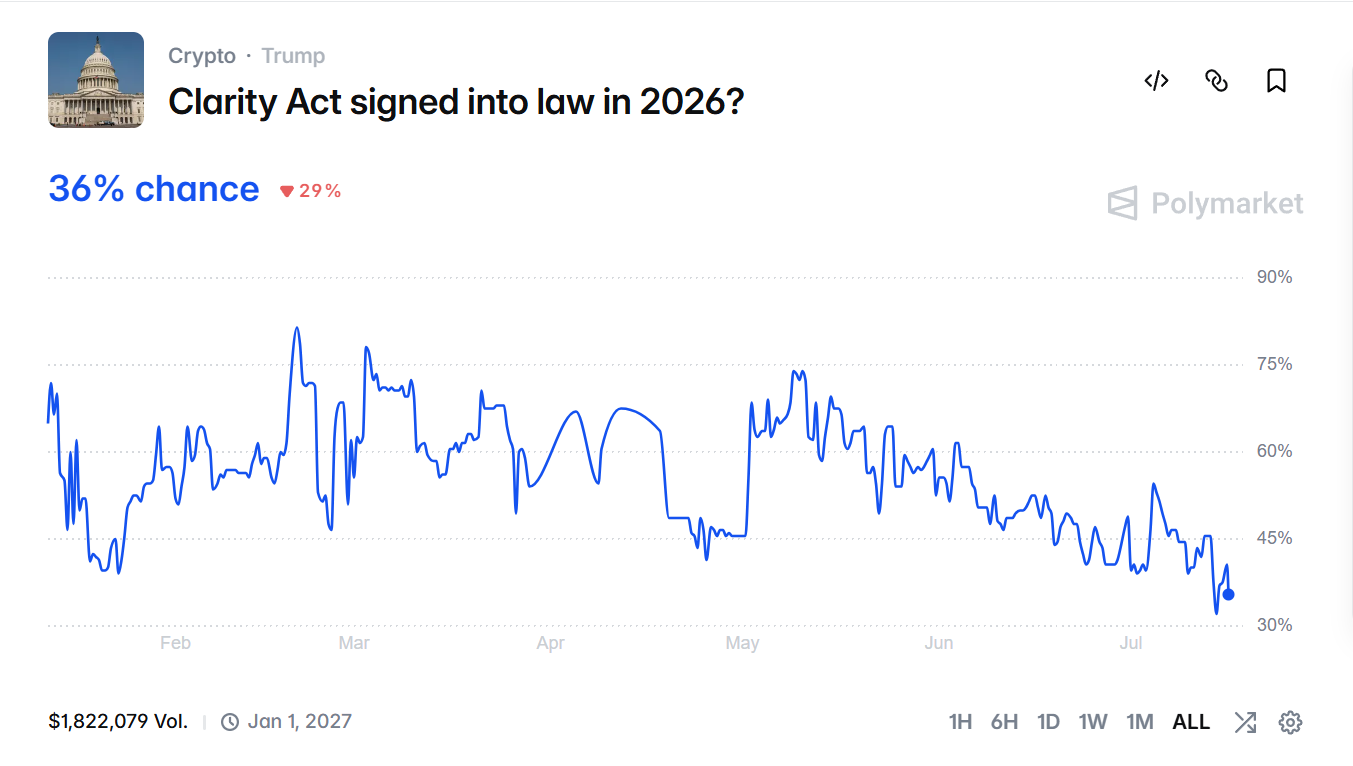
Polymarket odds on 2026 passage sit near 48%, down from 82% in February, tracking rising skepticism.
A group of Senate Democrats moved Tuesday to block the Digital Asset Market Clarity Act unless it addresses what they described as ongoing conflicts of interest tied to President Donald Trump‘s personal crypto ventures, complicating a floor vote that Senate Majority Leader John Thune has pledged will happen before the August 10 recess.
Speaking at a Washington press conference alongside Americans for Financial Reform, Indivisible, and actor Ben McKenzie, Senators Chris Murphy, Jeff Merkley, and Chris Van Hollen argued that passing the market-structure framework without ethics guardrails would legitimize the president’s crypto business rather than regulate it.
Democrats held a press conference on Capitol Hill to discuss the dangers of the CLARITY Act. | Source: ourfinancialsecurity.org
“There is no reason to pass a new regulatory system for crypto if this system does not stop Trump’s corruption of the entire industry,” Murphy said. “This bill is worthless if it protects Trump’s dominance over an industry that he will have more control to regulate.”
His characterization goes beyond a policy objection: it notes that the CLARITY Act itself would codify, rather than curb, presidential access to a market the White House influences.
Industry voices pushed back on this directly. Lauren Belive, global co-head of public policy and government affairs at Ripple, argued the opposition read the politics backward.
“Voting no on the Clarity Act isn’t being against the crypto industry, it’s anti-consumer,” she wrote. “It’s a vote to leave crypto holders exposed to bad actors playing regulatory arbitrage. The bipartisan Clarity Act is now advancing towards a vote on the Senate floor, and it is a vote for consumer protection,” Belive said.
The counterargument places the cost of inaction on retail holders rather than on the president, an inversion of the Democratic narrative.
Try Our Recommended Crypto Exchanges
Sponsored
Disclosure
We sometimes use affiliate links in our content, when clicking on those we might receive a commission at no extra cost to you. By using this website you agree to our terms and conditions and privacy policy.
The math forces the issue. CLARITY needs 60 votes to clear a filibuster, and Republicans hold 52 seats after the death of Senator Lindsey Graham this weekend, dropping to as few as 51 if Senator Mitch McConnell remains hospitalized during the vote.
That gap makes at least seven or eight Democratic defections mandatory, and Murphy, Merkley, Van Hollen, and Senator Elizabeth Warren, who called the situation “brazen financial corruption,” have now built a public opposition bloc large enough to sink the bill if it moves without carve-out language.
The pressure point is a specific number. Trump’s 2025 financial disclosure showed roughly $1.4 billion in cryptocurrency-related income last year, including licensing revenue from the $TRUMP memecoin and token sales tied to World Liberty Financial. Democrats have argued that a framework legalizing token classification without addressing officeholder holdings effectively hands regulatory legitimacy to businesses that the president continues to profit from.
Senator Cynthia Lummis, one of CLARITY’s leading proponents, has cast the fight in ideological rather than partisan terms. “Financial freedom is an American value. Digital assets are its newest expression,” she wrote on X. “Congress should be protecting that, not ignoring it.”
Her perspective sidesteps the ethics dispute entirely, positioning the vote as a test of principle rather than a referendum on Trump’s personal holdings.
What CLARITY Carries Into the Fight
The bill remains under negotiation. Senator Cynthia Lummis said Monday that lawmakers would release final text within days, though as of Tuesday, the Senate calendar showed no scheduled vote date.
Two law enforcement groups, the National Organization of Black Law Enforcement Executives and the Federal Law Enforcement Officers Association, have endorsed the bill on the grounds it would improve digital asset crime enforcement, a counterweight Republicans are likely to lean on during floor debate.
REPORT: The Federal Law Enforcement Officers Association and the National Organization of Black Law Enforcement Executives have endorsed the CLARITY Act.
“FLEOA commends the Committee for its efforts to establish a clear regulatory framework for digital assets that promotes… pic.twitter.com/2iFJZsR0zX
— Conservative War Machine (@WarMachineRR) July 15, 2026
Trump himself intensified the pressure Monday, urging senators to pass the bill “in honor of” Graham, whom he described as a supporter of the legislation, though public records do not appear to show Graham having made statements directly endorsing CLARITY.
President Trump on CLARITY Act passage. | Source: @SenLummis
The dispute now heads directly to the White House. Trump is expected to meet with senators on Thursday to negotiate the ethics provisions Democrats are demanding, with talks focused on language that could bar senior officials, including the president himself, from holding personal crypto business interests.
Trump has publicly urged Congress to pass the CLARITY Act, but has not said whether he would sign a version that restricts his own ties to the industry, a signal that could determine whether Republican negotiators have room to compromise or whether the ethics language becomes a poison pill.
BREAKING: President Trump is expected to meet with U.S. senators on Thursday to negotiate the Clarity Act's ethics rules.
The talks will focus on a provision that could restrict senior government officials, including Trump, from having personal crypto business interests.… pic.twitter.com/CMdW19wlpM
For crypto assets whose valuations rest partly on the bill’s passage, the delay has already shown up in positioning.
US spot Bitcoin ETFs recorded $197 million in net inflows during the week of July 6 to 10, snapping an eight-week streak of net outflows and signaling renewed institutional demand after months of persistent withdrawals.
Spot Ethereum ETFs also returned to positive territory with $84.42 million in net inflows, ending their own eight-week outflow streak.
Elsewhere, spot Solana ETFs attracted $930,400, HYPE ETFs added $10.36 million, while spot XRP ETFs bucked the broader trend, recording $7.18 million in net outflows, making XRP the only major US spot crypto ETF category to see investors pull capital during the week.
Standard Chartered cut its 2026 XRP target by 65% to $2.80 earlier this year, citing institutional capital that has not arrived in the expected size, an outcome market participants have linked to CLARITY’s stalled timeline.
Polymarket odds on 2026 passage have compressed toward 36%, down from 82% in February, tracking the same skepticism that Democratic opposition now formalizes.
Polymarket Odds on CLARITY Act passage. | Source: Polymarket
The next test is whether Lummis and Thune can produce a compromise text that satisfies at least seven Democrats, or whether the ethics amendment Warren and Van Hollen have demanded reappears on the Senate floor in a form Republicans refuse to accept.
Disclaimer:
The information provided in this article is for informational purposes only. It is not intended to be, nor should it be construed as, financial advice. We do not make any warranties regarding the completeness, reliability, or accuracy of this information. All investments involve risk, and past performance does not guarantee future results. We recommend consulting a financial advisor before making any investment decisions.
Dr. Guneet Kaur is a senior editor at CCN.com and a Science Fellow at Exponential Science. She is a fintech and blockchain expert with extensive experience in digital finance education, blockchain ecosystems, and cryptocurrency markets. She has worked with global media such as Cointelegraph, as well as education and blockchain platforms, to design and lead strategic content and learning initiatives. As an educator and assessor for top-tier executive programs, she bridges real-world fintech trends with academic insight.
Dr. Kaur is also a published researcher and peer reviewer across fintech and data science journals, including Financial Innovation Journal and International Journal of Big Data Intelligence and Applications. Her work spans data-driven analysis, Web3 innovation, and technical content development. With a strong foundation in both industry and academia, she translates complex financial technologies into practical applications, empowering learners, professionals, and institutions across the rapidly evolving digital finance landscape.