Ether is consolidating after a 12% weekly surge as traders watch key support, ETF flows, technical indicators, and upcoming Fed move. | Credit: CCN.com
Share
Key Takeaways
U.S.-listed Ethereum ETFs have lost more than $10 billion in assets in 2026, driven by both investor outflows and a roughly 45% decline in ETH’s price since January.
The nine SEC-approved spot Ethereum ETFs collectively shed over 953,000 ETH, reducing total holdings from 6.14 million to 5.19 million.
Ethereum’s performance in the coming weeks will likely determine whether ETF outflows stabilize or continue.
The US spot Ethereum ETF market has suffered a dramatic reversal in 2026, losing more than $10 billion in assets under management amid Ethereum’s prolonged price decline, which continues to weigh on institutional demand.
While spot Ethereum ETFs were once viewed as a major catalyst for mainstream adoption, recent data shows that investors have pulled back significantly amid a weakening macro environment and persistent bearish momentum in ETH.
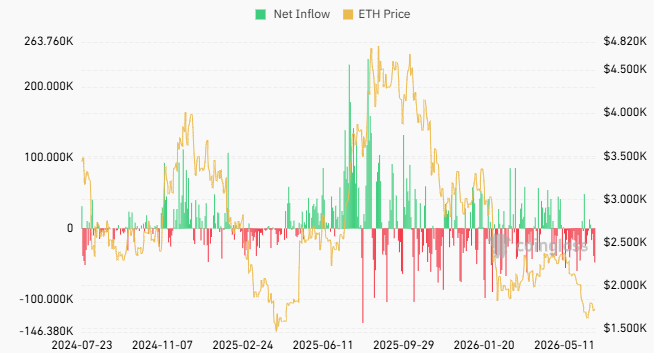
According to Dune Analytics data, the nine SEC-approved US spot Ethereum ETFs have collectively shed more than 953,000 ETH since January.
At the same time, Ethereum’s price has fallen roughly 45% from around $3,120 in late January to approximately $1,656 in June, amplifying the decline in ETF assets.
Despite the downturn, BlackRock has further strengthened its position as the dominant player in the Ethereum ETF market, highlighting a growing concentration of institutional crypto exposure among the largest asset managers.
Try Our Recommended Crypto Exchanges
Sponsored
Disclosure
We sometimes use affiliate links in our content, when clicking on those we might receive a commission at no extra cost to you. By using this website you agree to our terms and conditions and privacy policy.
The scale of the contraction has been significant. At the beginning of 2026, the nine spot Ethereum ETFs collectively held 6.14 million ETH worth approximately $18.57 billion.
Today, those holdings have fallen to 5.19 million ETH, reflecting both investor outflows and the sharp decline in Ethereum’s market value.
Total Ethereum spot ETF net inflow. | Credit: Coinglass
The reduction in assets comes as Ethereum struggles to regain momentum following months of selling pressure. While ETF issuers continue to hold substantial amounts of ETH, the broader trend suggests that institutional investors have become more cautious toward the asset class.
Yet despite the decline, Ethereum ETFs remain a major force in the market. The report notes that ETF issuers collectively control approximately 4.3% of Ethereum’s circulating supply.
Of the network’s 120.68 million ETH currently in circulation, more than 5.19 million are held in ETF products.
That figure underscores how quickly regulated investment vehicles have become a meaningful part of Ethereum’s ecosystem, less than two years after the SEC approved spot Ethereum ETFs.
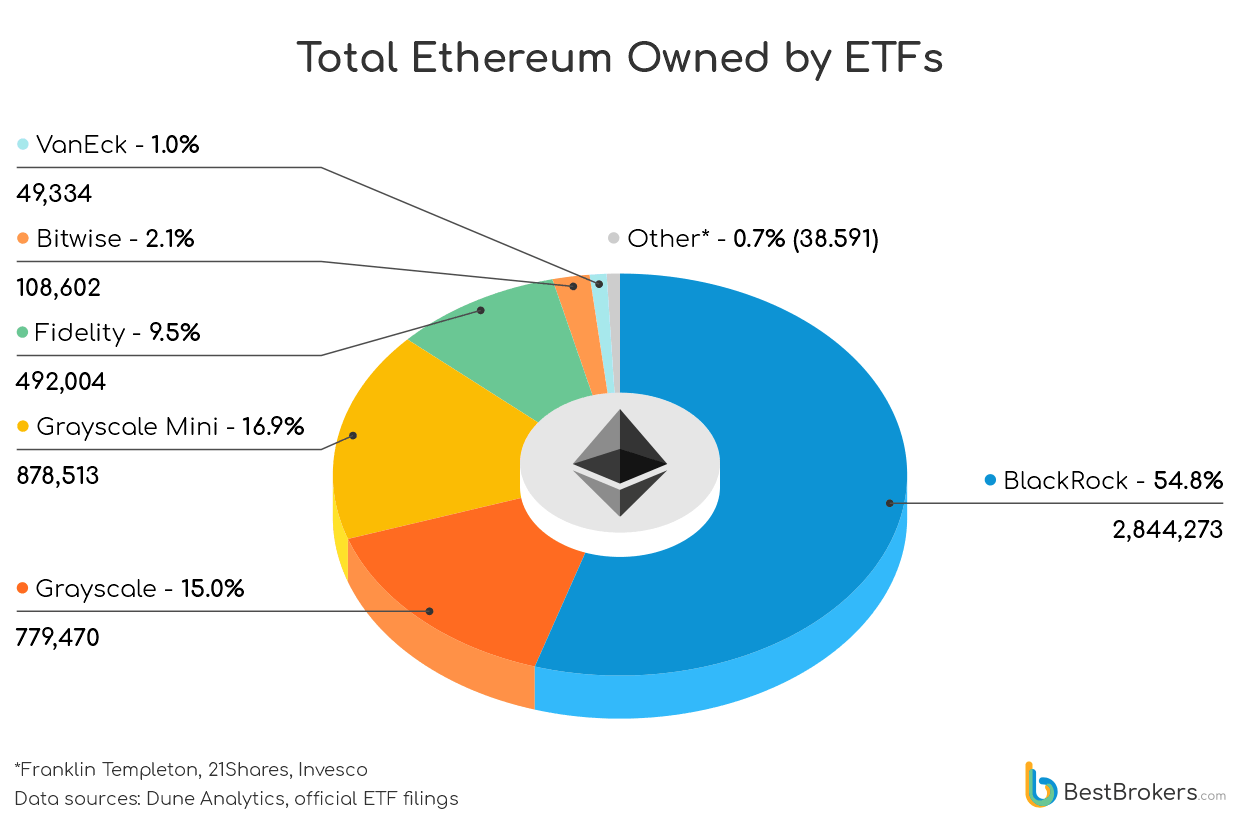
As of June 2026, the fund holds approximately 2.84 million ETH, valued at more than $4.7 billion, representing nearly 55% of all Ethereum held across US-approved spot ETFs.
BlackRock’s holdings alone exceed the combined reserves of Grayscale Ethereum Trust, Grayscale Mini Ethereum Trust, and Fidelity’s Ethereum ETF.
The next-largest ETF, Grayscale Mini, holds roughly 878,500 ETH, followed by Grayscale’s flagship Ethereum Trust, which holds approximately 779,500 ETH. Fidelity ranks fourth with about 492,000 ETH under management.
Interestingly, Grayscale Mini emerged as one of the few winners during the downturn.
While the broader ETF market lost nearly one million ETH this year, the fund increased its holdings by almost 116,000 ETH, allowing it to surpass Grayscale’s flagship product and become the second-largest spot Ethereum ETF in the US.
According to Alan Goldberg, market analyst at BestBrokers, the trend suggests that investors increasingly favor larger, more liquid issuers during periods of market stress.
“Market downturns often reveal where investor conviction is strongest,” Goldberg said, noting that BlackRock has not only maintained its lead but expanded its market share despite industry-wide outflows.
Technical Indicators Point to Further Downside Risk
The ETF market’s struggles coincide with deteriorating technical conditions for Ethereum itself.
ETH recently fell below its 200-hour Simple Moving Average (SMA), a widely watched indicator that often signals weakening bullish momentum.
The breakdown pushed the cryptocurrency from around $1,720 to the mid-$1,600 range, heightening concerns that sellers remain firmly in control.
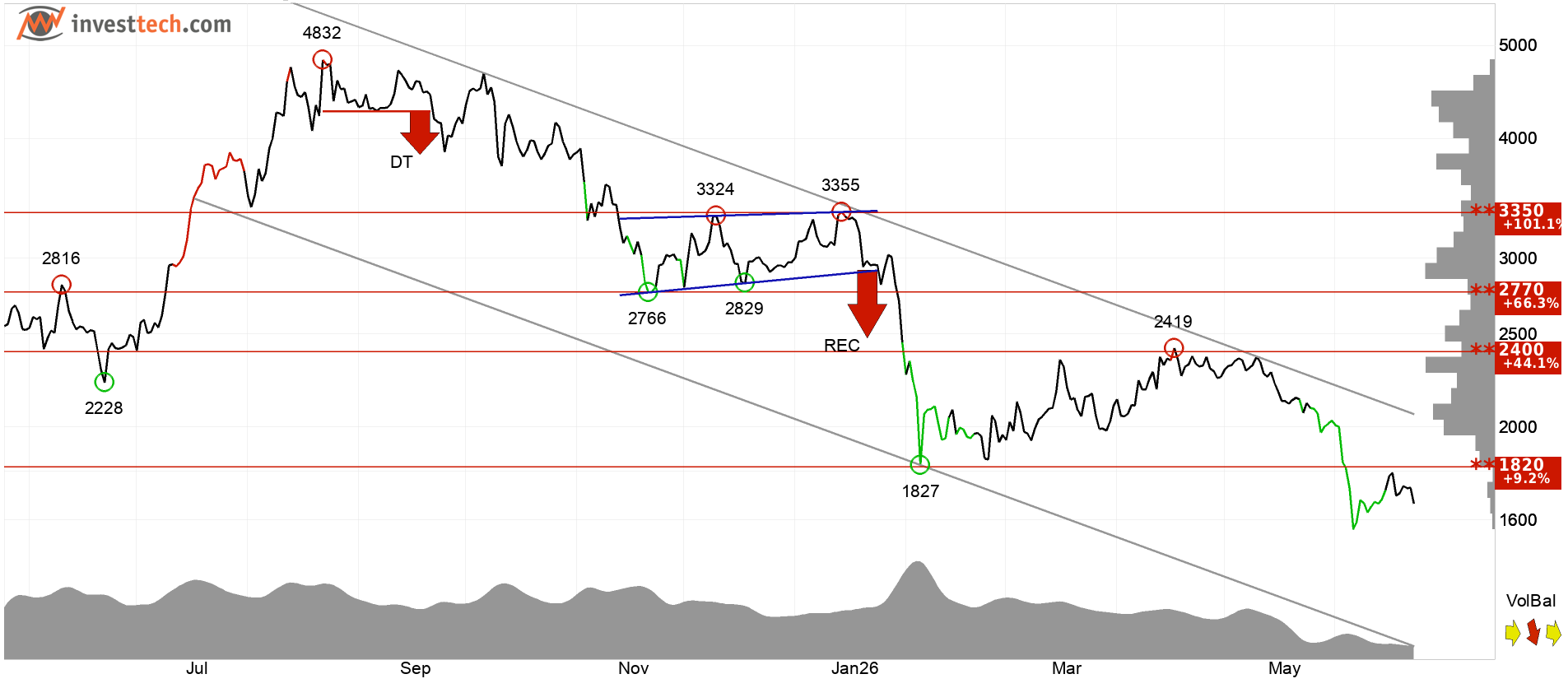
Ethereum is in a falling trend channel. | Credit: InvestTech
Technical indicators continue to paint a cautious picture. The Moving Average Convergence Divergence (MACD) and Chaikin Money Flow (CMF) indicators suggest ongoing selling pressure, while the Relative Strength Index (RSI) is approaching oversold territory.
Analysts now identify the $1,580 level as a critical support zone. If ETH fails to hold above that level, the next downside target could emerge near $1,514. Conversely, a recovery back above the 200-hour SMA could signal renewed buying interest and potentially stabilize sentiment.
For now, however, Ethereum faces pressure on multiple fronts. ETF assets continue to decline, institutional flows remain uneven, and technical indicators point toward further weakness.
Disclaimer:
The information provided in this article is for informational purposes only. It is not intended to be, nor should it be construed as, financial advice. We do not make any warranties regarding the completeness, reliability, or accuracy of this information. All investments involve risk, and past performance does not guarantee future results. We recommend consulting a financial advisor before making any investment decisions.
Giuseppe Ciccomascolo began his career as an investigative journalist in Italy, where he contributed to both local and national newspapers, focusing on various financial sectors.
Upon relocating to London, he worked as an analyst for Fitch's CapitalStructure and later as a Senior Reporter for Alliance News. In 2017, Giuseppe transitioned to covering cryptocurrency-related news, producing documentaries and articles on Bitcoin and other emerging digital currencies. He also played a pivotal role in establishing the academy for a cryptocurrency exchange website. Crypto remained his primary area of interest throughout his tenure as a writer for ThirdFloor.