Why isn’t ETH pumping after massive buys? | Credit: Hameem Sarwar
Share
Key Takeaways
Heavy ETH accumulation failed to trigger a price breakout.
On-chain metrics show sellers remain far from exhaustion.
Bearish derivatives and weak momentum cap ETH upside.
On paper, the signal looked strong as Tom Lee’s BitMine Immersion accumulated nearly 100,000 ETH last week.
However, in reality, the impact on Ethereum’s price has been negligible, leaving the market wondering why.
But it is not the first time that a high-profile accumulation has failed to ignite momentum. In this case, many had hoped that the consistency in buying should have triggered a breakout.
However, that is not the whole story, as this analysis revealed why ETH’s price has failed to surge despite the heavy accumulation.
BitMine Buys, Ethereum Stalls
For weeks, the Tom Lee-led firm has been accumulating ETH. Yet, Ethereum’s price did not reach its all-time high.
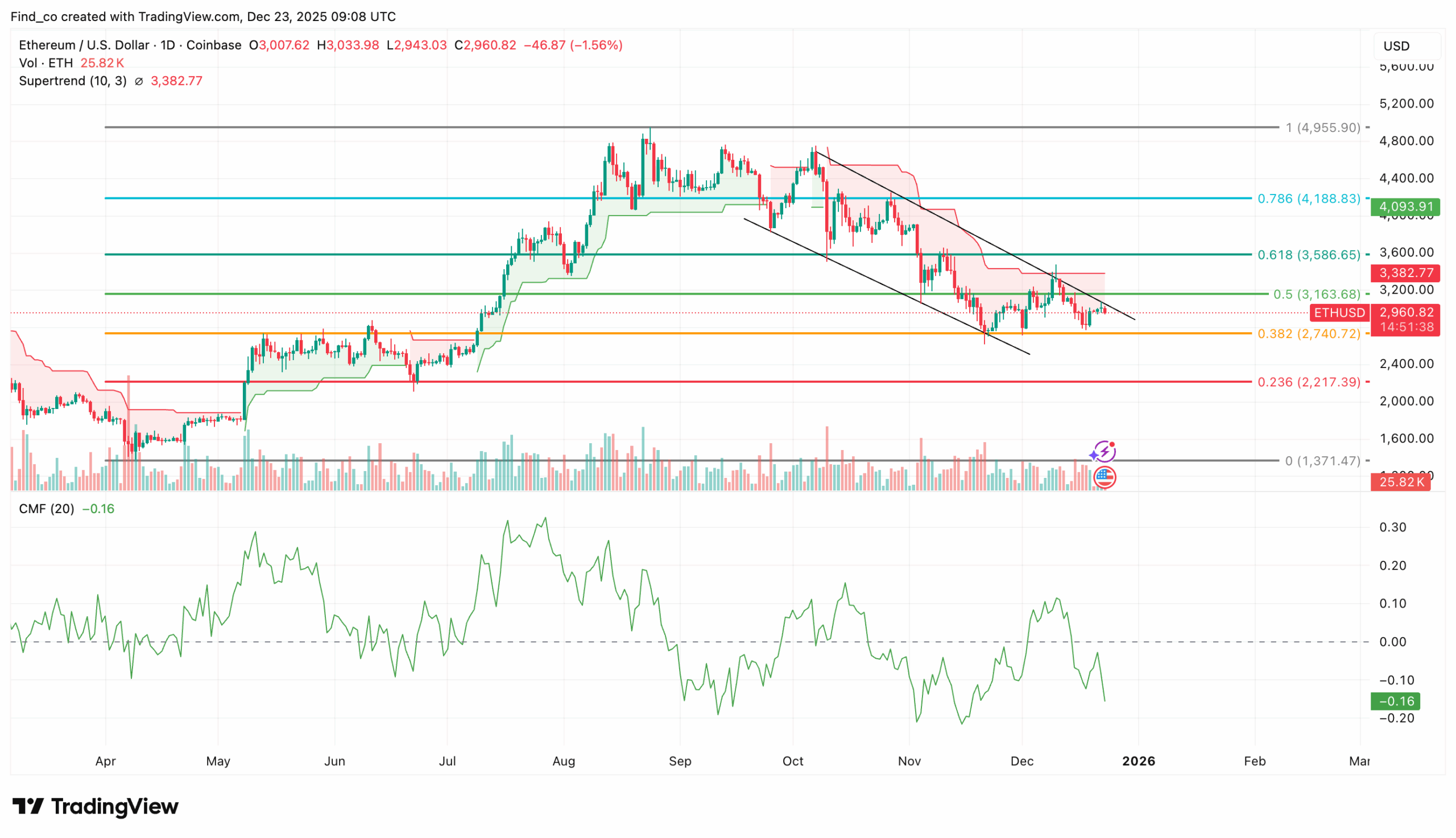
Instead, the market value of the cryptocurrency has struggled to hold above $3,000. Last week, BitMine added more, with Lee saying that the firm’s goal is to own 5% of the total ETH supply.
“Bitmine continues to add steadily to its ETH holdings, adding 98,852 ETH in the past week, and Bitmine holdings now exceed the crucial 4 million ETH tokens. This is a tremendous milestone achieved after just 5.5 months,” Thomas “Tom” Lee of Fundstrat, Chairman of Bitmine said.
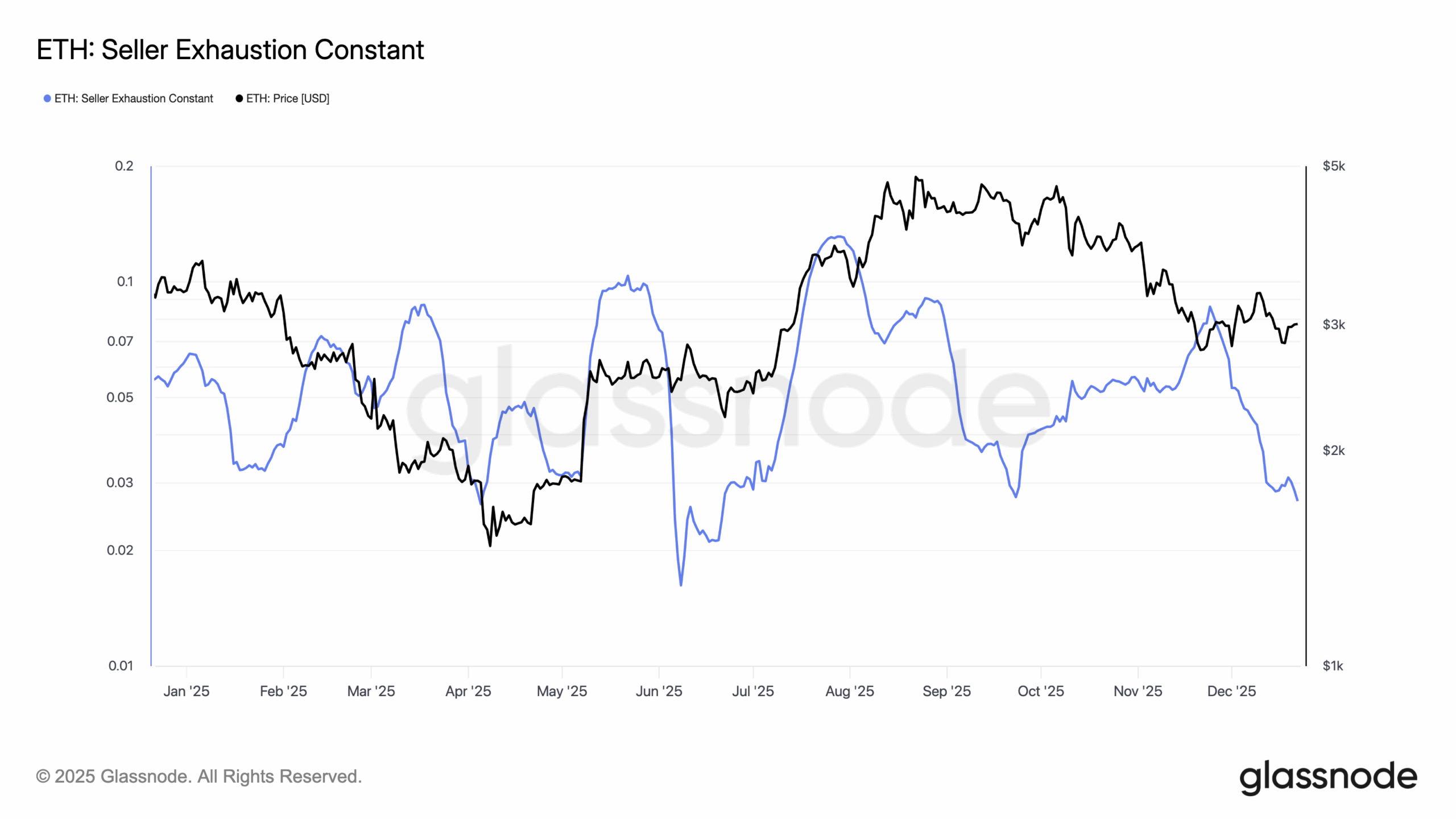
According to CCN’s analysis, Ethereum’s lack of upside follow-through has coincided with a decline in its Seller Exhaustion Constant.
For context, the Seller Exhaustion Constant is an on-chain metric used to gauge whether selling pressure is nearing depletion.
At the time of this release, the indicator has fallen to 0.027, its lowest reading since June.
ETH Seller Exhaustion Constant | Credit: Glassnode
Such a low value suggests that sellers have not yet reached a point of exhaustion, meaning supply continues to meet—or outweigh—demand.
Should this trend persist in the days to come, Ethereum’s price may struggle to trade higher.
Aggressive Bears in Control
Beyond seller exhaustion, derivatives positioning is also weighing on Ethereum’s price action.
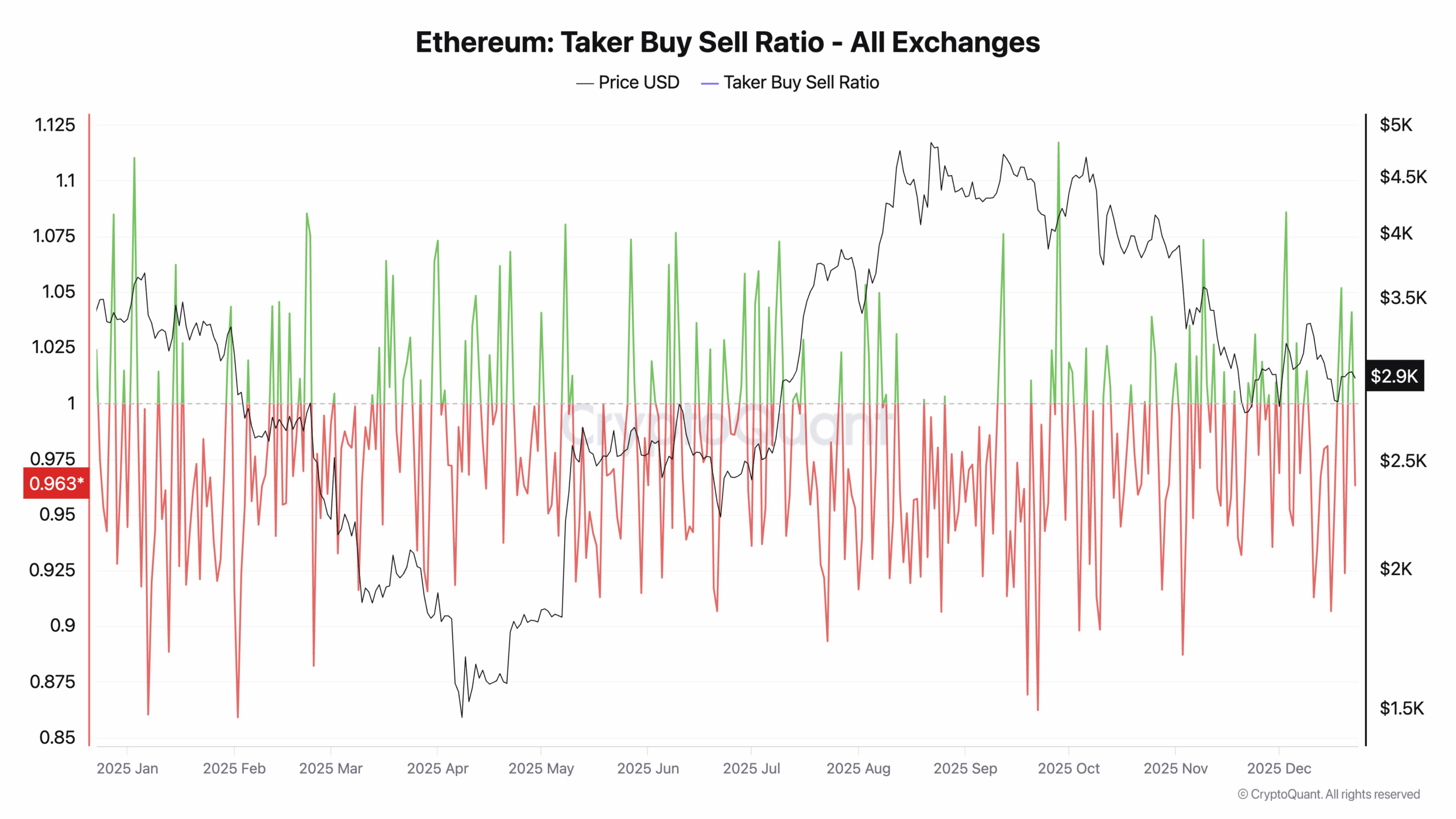
In particular, the Taker Buy/Sell Ratio continues to reflect a cautious-to-bearish bias.
At press time, CryptoQuant data indicate that the metric has slipped to 0.96, suggesting that sell-side taker volume is now outweighing buy-side activity in perpetual futures markets.
The Taker Buy/Sell Ratio measures the proportion of aggressive buy orders relative to aggressive sell orders.
Readings above 1 typically signal bullish dominance, while values below 1 suggest sellers are in control.
However, a slowdown in selling pressure, particularly if sellers begin to show signs of exhaustion, could allow Ethereum’s price to reassert itself above the upper boundary of the descending channel.
Disclaimer:
The information provided in this article is for informational purposes only. It is not intended to be, nor should it be construed as, financial advice. We do not make any warranties regarding the completeness, reliability, or accuracy of this information. All investments involve risk, and past performance does not guarantee future results. We recommend consulting a financial advisor before making any investment decisions.
Victor Olanrewaju is a crypto analyst and reporter at CCN with deep roots in on-chain research and technical analysis. His crypto journey began in 2017, but it was the 2020 Uniswap airdrop that sparked a full-time pivot into the space.
With a foundation in copywriting, Victor honed his craft creating high-converting content for leading crypto brokers — most notably an XRP price prediction that ranked #1 on Google during the 2021 bull run.
He later joined AMBCrypto in 2022, where he combined storytelling with technical and on-chain analysis to cover key market narratives.
In 2024, he expanded his expertise at BeInCrypto, collaborating with analysts and using tools like Glassnode, Santiment, and IntoTheBlock to break down Bitcoin and altcoin trends.
At CCN, Victor covers the top cryptocurrencies, memecoins, macro shifts, blending real-time insights with deep-dive metrics.
He holds a Bachelor’s degree in Physics from the University of Ibadan, equipping him to simplify complex data for a wide audience. Follow his work or connect on LinkedIn or X.