Peter Schiff Challenges Trump to Debate Over Inflation and Economic Policy — Here’s What’s at Stake
Share
Key Takeaways
The Federal Reserve’s 25 bps rate cut to a 3.75%–4.00% range injects fresh liquidity into markets, a tailwind that historically supports Bitcoin and other risk assets.
Lower rates pressure the U.S. dollar, boosting Bitcoin’s appeal as a hedge against currency debasement and reinforcing its “digital gold” narrative amid loose monetary policy.
Evidence shows Bitcoin’s price reacts more strongly to global liquidity and real yields than to inflation itself, behaving as a high-beta, liquidity-sensitive asset.
While easing supports crypto, Bitcoin remains correlated with tech equities. The true trajectory depends on Fed forward guidance, QT policy shifts, and institutional ETF inflows.
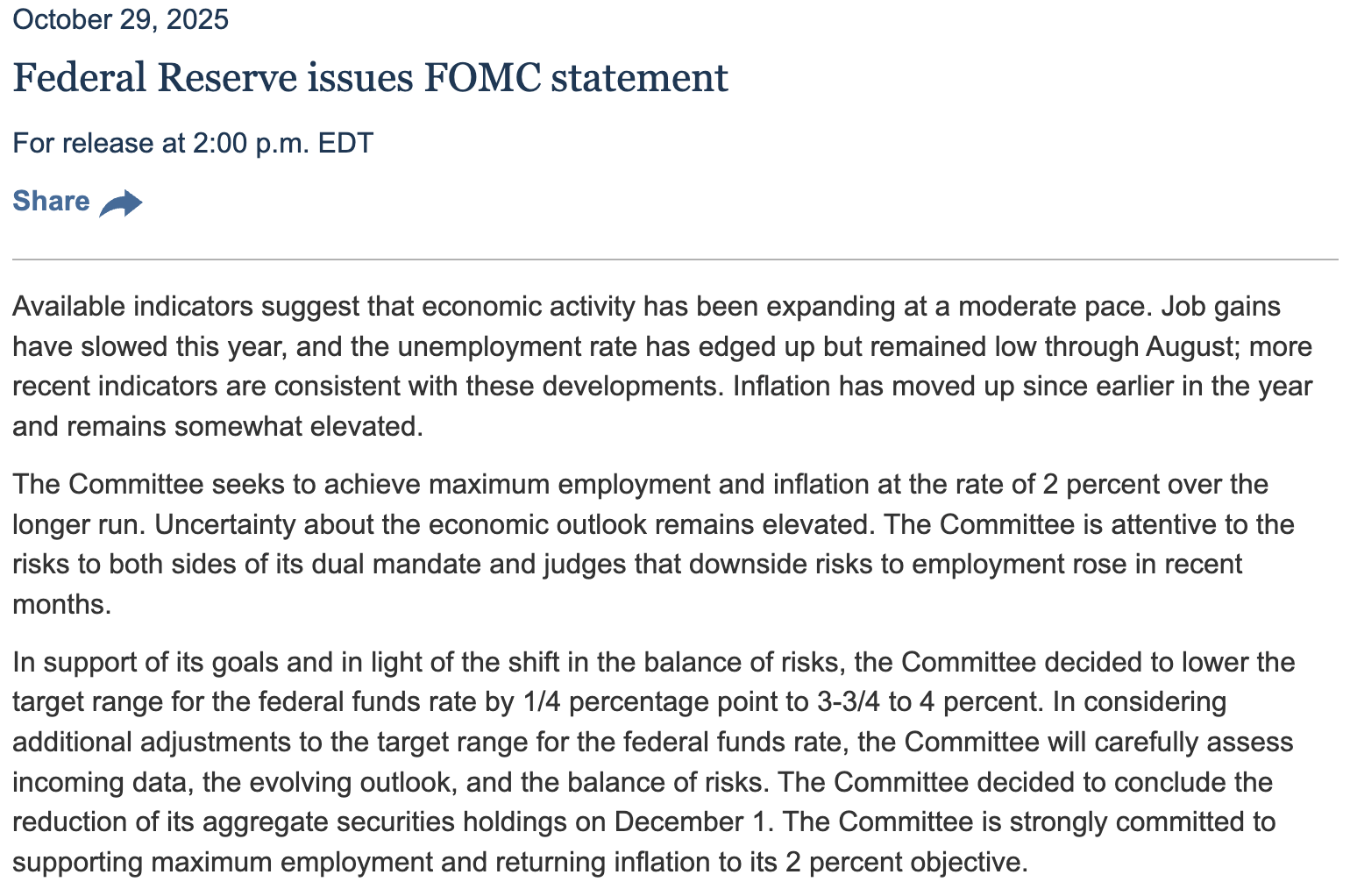
As the Federal Reserve announces another expected 25 basis point (bps) rate cut on Oct. 29, 2025, bringing the federal funds rate target to an anticipated 3.75%-4.00%, the spotlight swings back to the crypto world.
The decision was made in response to rising downside risks to employment and persistent inflation pressures, which remain above the Fed’s long-term 2% goal.
The decision to lower the federal funds rate by 25 basis points was supported by a majority of FOMC members, including Chair Jerome Powell and Vice Chair John Williams. However, two members dissented. Stephen I. Miran voted in favor of a more aggressive 50-basis-point cut, citing heightened risks to employment. In contrast, Jeffrey R. Schmid preferred to leave the rate unchanged, likely reflecting concerns about persistent inflation or financial stability.
Specifically, how does a looser monetary policy affect the foundational narrative that Bitcoin (BTC) is a vital inflation hedge?
The widely anticipated move, which follows a September 2025 cut, comes as the Fed balances a softening labor market (with unemployment edging up to 4.3% in August) against stubbornly elevated inflation, which was at 3.0% year-over-year in September 2025, according to the CPI.
This unique economic backdrop makes the impact of the rate cut on the “digital gold” narrative more complex and, ultimately, more interesting for investors.
The U.S. Federal Reserve cut its rates by 25 points on Oct. 29. | Credit: Federal Reserve
Why Lower Rates Boost the Bitcoin Price: The Liquidity Effect
The immediate market response has been positive, with the Bitcoin price consolidating between $113,000 and $115,000 as of Oct. 29, 2025. The core driver of this bullish sentiment is the infusion of global liquidity.
Cheaper capital: Lower interest rates make borrowing less expensive for businesses and investors. This expanded money supply pushes capital into riskier assets, where the potential for higher returns outweighs the dwindling yield from safer investments like government bonds.
The weaker US dollar: Rate cuts tend to devalue the U.S. dollar on the global stage. Since Bitcoin is priced in USD, a softer dollar makes the digital asset more appealing to international buyers seeking a defense against currency debasement.
Fed Cuts Rate, For Brown It’s “Run-It-Hot” Strategy
Michael Brown, analyst at Pepperstone, told CCN the Fed cut represents a “run-it-hot” strategy.
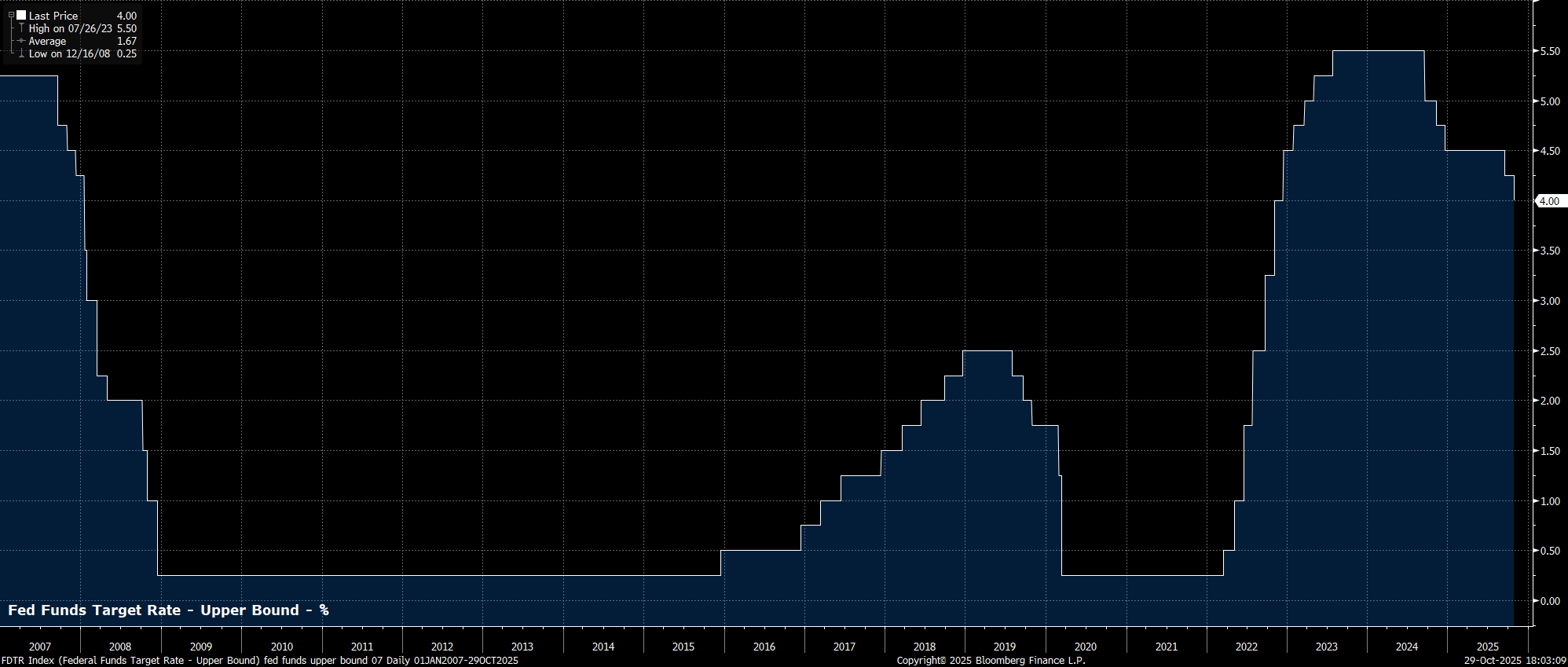
“Such a move marks the second straight rate cut from the Fed, following an equal move in September, and leaves the fed funds rate at its lowest level since the summer of 2022, as policymakers seek to prop up a stalling US labour market, and as tariffs produce a lesser degree of upside inflation risks than had been anticipated a few months ago,” he said.
Fed funds target rate. | Credit: Pepperstone
“Once more, however, the decision to deliver such a cut was not a unanimous one, with Governor Miran dissenting in favour of a larger 50bp move, in what was again a reflection of what appears to be a politically-skewed view of how low the neutral rate (aka r*) may lie.”
According to Brown, in something of a surprise dissent, Schmid preferred keeping the fed funds rate unchanged, perhaps a signal that the Committee will become increasingly divided from here on in.
“My base case remains that a 25bp cut will indeed be delivered at the December meeting, with the Fed’s ‘run it hot’ approach likely leading to further such cuts at the first couple of meetings next year as well. Of course, this move back towards a more neutral rates and balance sheet approach strengthens the ‘Fed put’ structure, tilting the path of least resistance even further to the upside for risk assets,” Brown added.
Bitcoin’s Scarcity vs. Central Bank Policy
The debate around Bitcoin as an inflation hedge gains significant traction when juxtaposed against central bank actions. Unlike the fiat money supply, which the Fed can expand through rate cuts and other easing programs, Bitcoin’s supply is hard-capped at 21 million coins. The most recent halving occurred on April 20, 2024 (block 840,000), reducing the block subsidy from 6.25 to 3.125 BTC and reinforcing the asset’s structural scarcity.
By contrast, fiat supply and its price (the policy interest rate) are set by central banks. The Federal Reserve holds scheduled policy meetings and can tighten or ease via rate changes and balance-sheet tools (QE/QT).
In an economy where the real interest rate (the nominal rate minus inflation) remains low, holding cash loses purchasing power. This structural scarcity, often referred to as digital gold, is Bitcoin’s main strength. Investors often seek a store of value that cannot be diluted by monetary policy and are increasingly turning to BTC to hedge against inflation and currency risk.
Implication: Bitcoin’s supply trajectory is pre-committed and inelastic; fiat money and real yields respond to macro conditions and policy choices. That structural contrast underpins Bitcoin’s “digital gold” narrative.
Is Bitcoin an Inflation Hedge? The Evidence is Mixed
Several studies find positive BTC returns after inflation/CPI shocks, but the effect varies by period and metric (e.g., stronger for CPI than other indices; more evident in earlier samples).
Other papers argue BTC and ETH do not consistently hedge forward inflation expectations; instead, they trade more like risk assets.
High-frequency evidence suggests BTC appreciates with inflation shocks but falls with financial uncertainty, unlike gold’s safe-haven behavior.
So, Bitcoin can act as an inflation hedge in some regimes, but results are time-varying and sensitive to how “inflation” is measured.
Liquidity and Real Yields: The Stronger, More Persistent Link
A growing body of industry and empirical analysis points to global liquidity and real interest rates as dominant drivers:
BTC shows a strong inverse relationship with interest rates/real yields and tends to rise when policy eases and liquidity expands. S&P Global found an inverse relationship between crypto indexes and rates (−0.33 since 2017, more negative after 2020).
Multiple analyses (sell-side and data providers) show high correlations with global M2/liquidity (often cited around 0.9 on long samples), with shorter-window correlations that ebb and flow.
Commentaries describing BTC as a “global liquidity barometer” have proliferated, consistent with observed cycle behavior (rising with QE/liquidity waves, falling with tightening).
New York Fed research finds a limited, sometimes weak link between BTC and conventional macro surprises at intraday horizons, underscoring that broad liquidity and risk conditions often matter more than single data prints.
Mechanism: Easing lowers discount rates, weakens the dollar’s pressure, and pushes flows toward higher-beta assets. Crypto, especially BTC and altcoins, tends to benefit when the cost of capital falls and system liquidity rises.
Policy Cycles and Bitcoin Performance
Bitcoin’s price history has closely mirrored the Federal Reserve’s monetary policy cycles, underscoring its sensitivity to liquidity conditions and real interest rates. During easing phases, such as the 2020–2021 zero-rate and quantitative easing period, abundant liquidity and a weaker dollar fueled massive inflows into Bitcoin, driving prices from under $10,000 to record highs.
Conversely, the Fed’s aggressive tightening campaign in 2022 drained liquidity and triggered a broad risk-asset selloff, sending Bitcoin tumbling alongside tech stocks. As 2025 marks the return of rate cuts and a potential end to quantitative tightening, investors once again see the makings of a liquidity-driven upswing, reinforcing Bitcoin’s reputation as a high-beta asset that thrives when monetary policy turns accommodative.
1) 2020–2021: Quantitative Easing and Zero Rates
The Federal Reserve cut its benchmark rate to near zero in March 2020 and launched large-scale quantitative easing programs.
These measures expanded the Fed’s balance sheet and increased the overall money supply, injecting massive liquidity into global markets.
As liquidity surged, Bitcoin rose from below $10,000 in early 2020 to a series of record highs in 2021.
The move aligned with rallies in other liquidity-sensitive assets such as technology stocks and commodities, highlighting Bitcoin’s sensitivity to loose monetary conditions.
Subsequent market research confirmed that crypto prices moved inversely with bond yields and in strong correlation with money supply growth.
2) 2022: Aggressive Tightening and Market Drawdown
The Federal Reserve began its fastest rate-hiking cycle in decades to combat inflation, raising borrowing costs and starting quantitative tightening.
As interest rates climbed and liquidity was withdrawn from the financial system, risk appetite collapsed across global markets.
Bitcoin and other cryptocurrencies experienced steep declines, moving in tandem with high-beta equities and other risk assets.
3) 2024: Structural Demand Meets Halving
On Jan. 10, 2024, the U.S. Securities and Exchange Commission approved 11 spot Bitcoin exchange-traded funds (ETFs), marking a pivotal moment for institutional access to the asset.
The ETFs began trading the next day, creating new channels for mainstream investment and bringing Bitcoin exposure to traditional brokerage platforms.
On April 20, 2024, the Bitcoin network underwent its scheduled halving, reducing the block reward from 6.25 to 3.125 BTC and tightening new supply.
The combination of steady ETF inflows and reduced issuance created a supportive backdrop for Bitcoin’s market performance through the rest of 2024.
By late 2024, BlackRock’s iShares Bitcoin Trust (IBIT) became one of the most successful ETF launches in history, surpassing $50 billion in assets under management and approaching $92 billion by October 2025.
2025: Fed Easing Cycle and Renewed Liquidity Support
In 2025, the Federal Reserve shifted from its previous tightening stance toward a gradual easing cycle as inflation moderated and the labor market showed signs of cooling.
The first 25-basis-point rate cut came in September 2025, followed by another identical reduction on Oct. 29, 2025. These moves marked the first sustained easing phase since the pandemic period.
The cuts signaled a clear pivot toward supporting growth and financial stability, after nearly three years of restrictive policy.
Lower policy rates reduced real yields and increased global risk appetite, prompting capital flows back into equities, digital assets, and other liquidity-sensitive markets.
Bitcoin and major altcoins responded positively, benefiting from a softer dollar, improved liquidity conditions, and renewed institutional inflows through spot ETFs.
Market analysts highlighted that the return to easier policy reinforced Bitcoin’s “liquidity-driven asset” behavior, performing strongly when the cost of capital falls and liquidity expands.
Navigating Market Volatility: The Risk-Asset Caveat
While the rate cut is a strong fundamental tailwind, investors must exercise caution. The relationship between monetary policy and Bitcoin is not always straightforward.
Correlation with tech sector: Bitcoin continues to exhibit high correlation with traditional risk assets, particularly the technology-heavy Nasdaq. If the rate cut is perceived as a sign that the economy is heading toward a deeper slowdown, a broad market sell-off could negate the liquidity benefits for Bitcoin.
The forward guidance factor: The market has largely “priced in” the 25 bps cut. The true market impact will depend entirely on the Fed’s accompanying statement and Chairman Jerome Powell’s clues about the future path of interest rates. A strong hint at further easing will likely ignite a sustained Bitcoin rally, whereas a cautious, one-and-done tone could lead to consolidation or a pullback.
The October 2025 rate cut solidifies the narrative: loose monetary policy is fundamentally bullish for Bitcoin. It increases liquidity, weakens the traditional reserve currency, and highlights the intrinsic value of digital scarcity in a world of persistent fiat inflation.
What Bitcoin and Crypto Investors Should Watch Next
With the Federal Reserve’s rate cut now factored into the market, the short-term focus shifts from the initial announcement to the follow-through, both from policymakers and the wider crypto ecosystem.
Here are the key events and drivers for crypto investors to monitor through the remainder of Q4 2025 and into 2026:
End of Quantitative Tightening (QT)
This is arguably the most bullish catalyst on the near-term horizon. QT is the process of the Fed shrinking its balance sheet by allowing assets to mature without reinvestment, which effectively removes liquidity (cash) from the banking system.
Pivot watch: The Fed announced an end to QT soon by Dec. 1, 2025 due to rising liquidity concerns in the money markets.
The mechanism: Halting QT reverses the cash drain, stabilizing or even increasing bank reserves. This major shift from monetary contraction to neutrality is seen as a precursor to renewed quantitative easing. Historically, these liquidity pivots have coincided with the start of significant Bitcoin and altcoin rallies.
2. Fed’s Forward Guidance on Rates
The market has priced in the 25 bps cut. Now, the focus is on future policy.
Dovish signal: Investors must closely monitor Chairman Powell’s commentary for hints of an extended easing cycle (i.e., more cuts in early 2026). A decidedly dovish tone will reinforce the risk-on trade, pushing capital from low-yielding assets into high-growth, high-volatility assets like crypto.
The data blackout risk: Due to the US government shutdown, the Fed is flying blind without fresh, critical jobs and PCE inflation data. This information gap increases the risk of a policy error, leading to increased market volatility that Bitcoin traders may try to capitalize on.
3. Institutional Flows and ETF Demand
The continuous institutionalization of Bitcoin and Ethereum remains a dominant demand driver.
Sustained ETF inflows: Watch for daily net inflow figures for the US-listed spot Bitcoin and Ethereum and other altcoin ETFs. Consistent, large-scale institutional purchasing provides a crucial demand floor and validates the long-term adoption narrative.
Altcoin rotation: Should Bitcoin remain strong, capital is expected to rotate into other sectors. Key thematic areas to watch include:
Layer-2 growth: Continued scaling solutions building on Ethereum and other major chains.
The Federal Reserve emphasized that future policy decisions will remain data-dependent, guided by changes in the economic outlook and the evolving balance of risks. The Committee reaffirmed its strong commitment to achieving its dual mandate of maximum employment and stable inflation, targeting a long-run inflation rate of 2%. It also signaled flexibility, noting that it stands ready to adjust the stance of monetary policy if emerging risks threaten progress toward its goals.
The current environment provides a powerful structural tailwind for the inflation hedge narrative. However, the lack of data and the ongoing policy uncertainty require investors to be disciplined, diversified, and highly attuned to the Fed’s forward-looking statements.
How does the Fed's rate cut affect Bitcoin's correlation with the US Dollar (DXY)?
Historically, Bitcoin and the US Dollar Index (DXY), which measures the dollar’s strength against a basket of currencies, have shown a strong inverse correlation. When the Fed cuts rates, it generally weakens the dollar (bearish for DXY) because US assets yield less. This environment is typically bullish for Bitcoin as investors seek an alternative store of value against a devaluing fiat currency, reinforcing the “digital gold” narrative. A committed easing cycle suggests continued downward pressure on the DXY, which serves as a major fundamental tailwind for the Bitcoin price.
Is Bitcoin acting as a safe-haven asset during the current US government shutdown?
Yes, in the context of fiscal instability, Bitcoin is increasingly viewed as a temporary safe-haven or “flight-to-quality” asset. The ongoing US government shutdown creates a data blackout and highlights uncertainty in traditional finance and government debt. This uncertainty drives institutional investors toward non-sovereign assets with verifiable scarcity. The market action around the Fed’s decision, where capital flows into assets like Bitcoin and gold, suggests that investors are hedging against political dysfunction and the risk of policy missteps caused by the lack of official economic data.
What is the predicted impact of the end of Quantitative Tightening (QT) on altcoins?
The end of Quantitative Tightening (QT), the Fed’s program to shrink its balance sheet, is expected to be a major catalyst for altcoins. QT removal signals the return of systemic liquidity to financial markets. While Bitcoin typically benefits first from this increased liquidity, a sustained flood of capital eventually triggers a “liquidity cascade.” This cascade sees money rotate from Bitcoin into Ethereum, and then into smaller-cap, higher-risk altcoins, potentially igniting the long-anticipated “AltSeason” with the most significant percentage gains concentrated in utility-driven tokens (like those in DeFi, RWA, and AI sectors).
Does the Fed’s easing cycle confirm a new, multi-year Bitcoin bull market?
The rate cut cycle provides essential fuel, but does not guarantee a new bull market. The current environment is characterized by macro-liquidity expansion (lower rates, potential end to QT), which has historically driven major rallies. However, some analysts argue that Bitcoin may be near the peak of its historical four-year cycle, which typically occurs about 18 months after a halving event (the last was in April 2024). The most reasonable view is that the macro backdrop is highly supportive, but the full extent of the rally will depend on sustained institutional ETF demand and the avoidance of a severe, global economic recession that would override the liquidity effect.
Disclaimer:
The information provided in this article is for informational purposes only. It is not intended to be, nor should it be construed as, financial advice. We do not make any warranties regarding the completeness, reliability, or accuracy of this information. All investments involve risk, and past performance does not guarantee future results. We recommend consulting a financial advisor before making any investment decisions.
Dr. Guneet Kaur is a senior editor at CCN.com and a Science Fellow at Exponential Science. She is a fintech and blockchain expert with extensive experience in digital finance education, blockchain ecosystems, and cryptocurrency markets. She has worked with global media such as Cointelegraph, as well as education and blockchain platforms, to design and lead strategic content and learning initiatives. As an educator and assessor for top-tier executive programs, she bridges real-world fintech trends with academic insight.
Dr. Kaur is also a published researcher and peer reviewer across fintech and data science journals, including Financial Innovation Journal and International Journal of Big Data Intelligence and Applications. Her work spans data-driven analysis, Web3 innovation, and technical content development. With a strong foundation in both industry and academia, she translates complex financial technologies into practical applications, empowering learners, professionals, and institutions across the rapidly evolving digital finance landscape.
Giuseppe Ciccomascolo began his career as an investigative journalist in Italy, where he contributed to both local and national newspapers, focusing on various financial sectors.
Upon relocating to London, he worked as an analyst for Fitch's CapitalStructure and later as a Senior Reporter for Alliance News. In 2017, Giuseppe transitioned to covering cryptocurrency-related news, producing documentaries and articles on Bitcoin and other emerging digital currencies. He also played a pivotal role in establishing the academy for a cryptocurrency exchange website. Crypto remained his primary area of interest throughout his tenure as a writer for ThirdFloor.


 Easy
Easy