Key Takeaways
Ethereum co-founder Vitalik Buterin has unveiled a new proposal that could dramatically reshape the blockchain’s consensus layer by making it significantly more efficient while introducing stronger privacy guarantees for validators.
In a research post titled “The Extremely Lean Chain,” Buterin outlined a roadmap for reducing the amount of state the Ethereum Beacon Chain needs to maintain, replacing much of today’s on-chain accounting with zero-knowledge proofs and STARK-based cryptography.
The proposal forms part of Ethereum’s broader “Lean” roadmap, which also includes technologies such as single-slot finality and quantum-resistant signature aggregation.
If implemented, the design could allow Ethereum to support millions of validators while reducing computational overhead and making validator identities substantially more private.
+87
Bitcoin
Ethereum
Tether
Wrapped BNB
USD Coin
Solana
Ripple
Dogecoin
Cardano
Shiba Inu
Avalanche
TRON
Chainlink
Polygon Ecosystem Token
Polkadot
Wrapped Bitcoin
Litecoin
Dai
NEAR Protocol
Bitcoin Cash
Stellar
Cosmos
Filecoin
Ethereum Classic
Aptos
Hedera Hashgraph
Immutable
Optimism
Arbitrum
VeChain
The Sandbox
Decentraland
Axie Infinity
Injective Protocol
Render Token
The Graph
Maker
Aave
Chiliz
Helium
PAX Gold
Compound
Lido DAO Token
Sui
Lido Staked ETH
Bitget Token
Wrapped Ethereum
OKB
Uniswap
Pepe
Ondo
Mantle
First Digital USD
Kaspa
Jupiter
Worldcoin
PayPal USD
Bonk
Rocket Pool ETH
Flare
Tether Gold
Sei
JITO
JasmyCoin
PancakeSwap
Core
Floki Inu
Ethereum Name Service
SushiSwap
Kava.io
1inch Network
Tezos
Trust Wallet Token
Curve DAO Token
KuCoin Token
MultiversX
GateToken
Zcash
Basic Attention Token
Enjin Coin
Frax
Ethena USDe
Ethena Staked USDe
BlackRock USD Institutional Digital Liquidity Fund
Fasttoken
Algorand
Flow
Monero
XDC Network
Bittensor
Ethena
Artificial Superintelligence Alliance
+68
Bitcoin
Ethereum
Tether
Wrapped BNB
Solana
Ripple
Dogecoin
Cardano
Toncoin
Avalanche
TRON
Polkadot
Wrapped Bitcoin
Litecoin
NEAR Protocol
Bitcoin Cash
Stellar
Cosmos
Filecoin
Ethereum Classic
Hedera Hashgraph
Immutable
VeChain
The Sandbox
Render Token
The Graph
Maker
Aave
Chiliz
Helium
PAX Gold
Compound
Lido DAO Token
Sui
Lido Staked ETH
Bitget Token
Wrapped Ethereum
OKB
Uniswap
Pepe
Mantle
Bittensor
Kaspa
XDC Network
Artificial Superintelligence Alliance
Jupiter
Quant
Worldcoin
PayPal USD
Rocket Pool ETH
Flare
Tether Gold
Sei
JITO
JasmyCoin
PancakeSwap
Core
Floki Inu
Ethereum Name Service
Kava.io
1inch Network
Tezos
Trust Wallet Token
Curve DAO Token
Zcash
Basic Attention Token
Enjin Coin
Ethena USDe
USD Coin
Chainlink
Arbitrum
GateToken
IOTA
At the heart of Buterin’s proposal is a significant redesign of how Ethereum tracks validator data.
Currently, the Beacon Chain stores multiple pieces of information for every validator, including public keys, withdrawal credentials, balances, slashing status, and various epoch counters.
Maintaining and updating that information requires extensive processing at the end of every epoch, creating a growing burden as the validator set expands.
Buterin proposes dramatically shrinking that state.
If we want to make the Lean Ethereum consensus chain aggressively more "lean", and add strong validator privacy (ZK-unlink deposit from staking activity from withdrawal, and re-anonymize stakers every day), here is a path:https://t.co/Gdee7tE53R
— vitalik.eth (@VitalikButerin) July 6, 2026
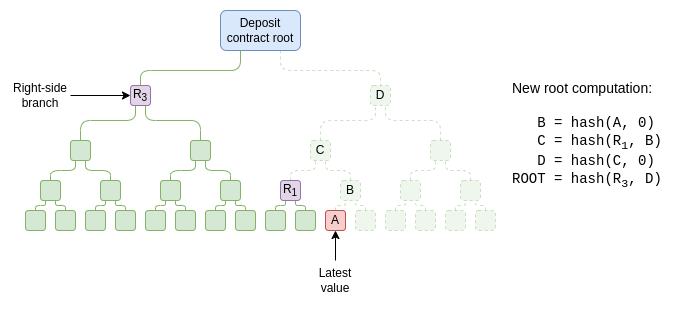
Instead of storing a validator’s entire public key, Ethereum would only keep a compact index pointing to its original deposit in the deposit tree.
Signature verification would rely on STARK-based cryptography and Merkle proofs rather than permanently storing validator public keys inside Beacon Chain state.
The proposal also removes much of today’s reward-and-penalty accounting from the consensus layer itself.
Rather than continuously updating balances, validators would generate a daily STARK proof demonstrating their participation in the previous period. That proof would calculate rewards, penalties, and updated balances off-chain before submitting the result back to Ethereum.
Under the proposed system, the amount of permanent validator state would be reduced to only two fields:
Everything else could be reconstructed through cryptographic proofs.
According to Buterin, this approach would substantially reduce state growth while making end-of-epoch processing far less computationally expensive.
Beyond efficiency gains, the proposal introduces one of Ethereum’s most ambitious validator privacy concepts to date.
The second phase replaces today’s long-lived validator identities with rotating daily identities generated through zero-knowledge proofs.
Instead of using the same validator key indefinitely, validators would register a fresh public key every day.
From the network’s perspective, validators would effectively appear as new participants each day while privately proving continuity through a chain of zero-knowledge proofs.

Because those proofs would reveal only limited information, primarily updated balances and whether a validator had been slashed, they would prevent observers from linking deposits, staking activity, and withdrawals together.
Buterin also proposes hiding withdrawal addresses at the time of deposit by replacing them with cryptographic commitments. The protocol would reveal the withdrawal address only when validators withdraw their funds. This would prevent observers from connecting deposits with future staking activity.
The proposal could therefore provide significantly stronger validator anonymity while preserving Ethereum’s security guarantees.
In addition, the design naturally enables Single Secret Leader Election (SSLE), a long-discussed mechanism that prevents block proposers from being publicly identifiable before they produce a block. It will then reduce opportunities for censorship and denial-of-service attacks.
One of the proposal’s primary goals is to enable Ethereum’s proof-of-stake system to support a far larger validator set.
Buterin argues that shifting balance calculations away from the consensus layer dramatically reduces computational requirements. This would make it feasible to scale to millions of validators if necessary.
Although each validator would generate a daily STARK proof, those proofs could be aggregated before submission on-chain, much as today’s signature aggregation process.
According to the proposal, proving validator participation would remain practical even on consumer hardware.
A validator would need to generate proofs covering approximately 5,400 Merkle branches per day under current assumptions. This is a workload that Buterin says modern laptops can complete comfortably within an hour using STARK technology.
The proposal also introduces flexibility for validators. Missing a balance update proof would not immediately result in slashing or removal from the network. Instead, validators must submit the required proof before they can attest again.
While the research remains an early design proposal rather than a finalized Ethereum Improvement Proposal (EIP), it reflects Ethereum’s continued focus on balancing scalability, decentralization, and privacy as the network evolves.
If adopted in future protocol upgrades, the “Extremely Lean Chain” could fundamentally change how Ethereum manages validator participation.
It will reduce state requirements, improve scalability, and bring zero-knowledge privacy deeper into the core of the blockchain’s consensus mechanism.
Giuseppe Ciccomascolo began his career as an investigative journalist in Italy, where he contributed to both local and national newspapers, focusing on various financial sectors.
Upon relocating to London, he worked as an analyst for Fitch's CapitalStructure and later as a Senior Reporter for Alliance News. In 2017, Giuseppe transitioned to covering cryptocurrency-related news, producing documentaries and articles on Bitcoin and other emerging digital currencies. He also played a pivotal role in establishing the academy for a cryptocurrency exchange website. Crypto remained his primary area of interest throughout his tenure as a writer for ThirdFloor.
You’re All Set!
Thanks for signing up. We’ll be in touch soon with the latest insights.