Solana's network activity is hitting record highs, but SOL remains under pressure. Here's why analysts say the token could still fall toward $60. | Credit: CCN.com
Share
Key Takeaways
ChatGPT was the most bullish AI model on Solana, projecting a potential bull-case scenario of $300-600 for SOL by the end of 2026.
Grok forecasted SOL at $100–$250, with a base-case target of $150–$200, citing strong ecosystem activity, DeFi growth, and rising on-chain usage.
Competition remains a key risk, particularly from Ethereum’s Layer-2 ecosystem and emerging Layer-1 rivals such as Sui and Aptos.
Solana (SOL) remains one of the most closely watched cryptocurrencies, with investors eager to see where the blockchain’s native token could be headed next.
The results reveal a wide range of expectations, from cautious neutrality to forecasts that suggest a substantial rally could be on the horizon.
New Trending Crypto Wallet Offers
Sponsored
Disclosure
We sometimes use affiliate links in our content, when clicking on those we might receive a commission at no extra cost to you. By using this website you agree to our terms and conditions and privacy policy.
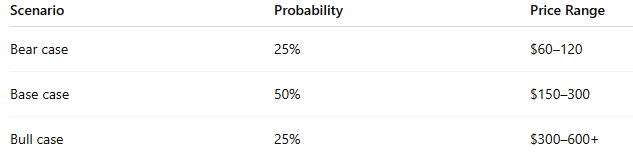
Among the four AI models, ChatGPT delivered the most bullish outlook. While emphasizing that cryptocurrency forecasting remains highly uncertain, the model assigned a base-case range of $150 to $300 for SOL by the end of 2026 and identified $300 as its central estimate.
More notably, ChatGPT outlined a bull-case scenario where SOL could trade between $300 and $600, representing a massive increase from current levels.
ChatGPT prediction on SOL price. | Credit: ChatGPT
According to the model, several factors could drive such gains, including growing institutional adoption, increasing demand from spot Solana ETFs, and major network upgrades such as Firedancer and Alpenglow.
ChatGPT also highlighted Solana’s strong position in key blockchain sectors, including stablecoin payments, DeFi, tokenized assets, consumer crypto applications, and decentralized physical infrastructure networks (DePIN).
However, the model warned that competition from Ethereum’s Layer-2 ecosystem, tighter liquidity conditions, and slowing network growth could limit upside potential.
Gemini Offers a More Conservative View
Google’s Gemini took a more measured approach, citing the difficulty of accurately predicting cryptocurrency prices.
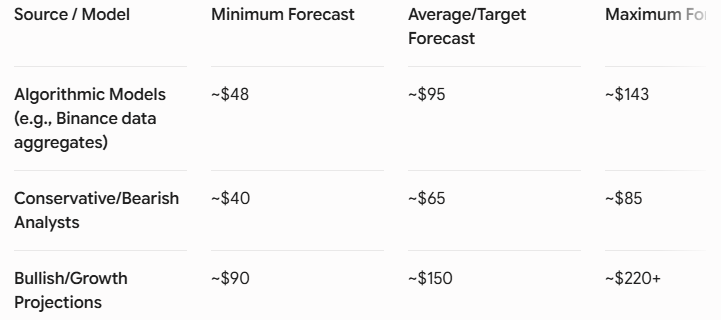
The model pointed to a broad range of market forecasts for 2026, with conservative estimates ranging from $40 to $85, while more optimistic projections suggest SOL could reach $150 to $220 or higher.
Gemini forecast on SOL. | Credit: Gemini
Gemini identified network stability, competition from rival Layer-1 blockchains such as Sui and Aptos, and the broader macroeconomic environment as the most important variables influencing Solana’s future performance.
The AI noted that successful upgrades aimed at improving reliability and reducing congestion could strengthen investor confidence and support higher valuations.
Claude Refuses to Predict a Price
Anthropic’s Claude stood apart from the other models by declining to set a specific price target.
Instead, the AI emphasized that cryptocurrency markets are inherently unpredictable and that any precise forecast would amount to speculation rather than meaningful analysis.
Claude focused on the key factors likely to influence SOL’s value over time, including ecosystem growth, DeFi activity, NFT adoption, institutional demand, and network technical improvements.
The model also highlighted potential risks, including regulatory uncertainty, macroeconomic pressures, competition from rival blockchain networks, and the possibility of network outages or security incidents.
While offering no numerical forecast, Claude’s response underscores the significant uncertainty that continues to surround long-term crypto valuations.
Grok Predicts SOL Could Reach $250
Elon Musk’s Grok landed between ChatGPT’s optimism and Gemini’s caution.
The model projected a base-case range of $100 to $250 by the end of 2026, with a midpoint estimate of approximately $150 to $200.
Grok view for SOL price for the rest of the year. | Credit: Grok
Grok cited strong ecosystem activity, rising on-chain volumes, DeFi adoption, meme coin trading, and continued developer growth as major bullish catalysts. The AI also pointed to institutional adoption and potential ETF-related demand as factors that could significantly boost SOL’s price.
Under particularly favorable market conditions, Grok suggested that SOL could climb into the $300 to $500 range, though it stressed that such outcomes would depend on continued execution, network upgrades, and broader crypto market strength.
While the four AI models differ significantly in their forecasts, a common theme emerges: Solana’s future will largely depend on adoption, institutional interest, network performance, and the overall direction of the cryptocurrency market.
ChatGPT delivered the most aggressive outlook, envisioning a scenario where SOL could surpass $600, while Gemini and Grok projected more moderate gains. Claude, meanwhile, chose to focus on fundamentals rather than price targets.
For investors, the contrasting predictions highlight both the opportunities and risks associated with one of crypto’s most prominent Layer-1 blockchains as the market looks toward 2026.
Giuseppe Ciccomascolo began his career as an investigative journalist in Italy, where he contributed to both local and national newspapers, focusing on various financial sectors.
Upon relocating to London, he worked as an analyst for Fitch's CapitalStructure and later as a Senior Reporter for Alliance News. In 2017, Giuseppe transitioned to covering cryptocurrency-related news, producing documentaries and articles on Bitcoin and other emerging digital currencies. He also played a pivotal role in establishing the academy for a cryptocurrency exchange website. Crypto remained his primary area of interest throughout his tenure as a writer for ThirdFloor.