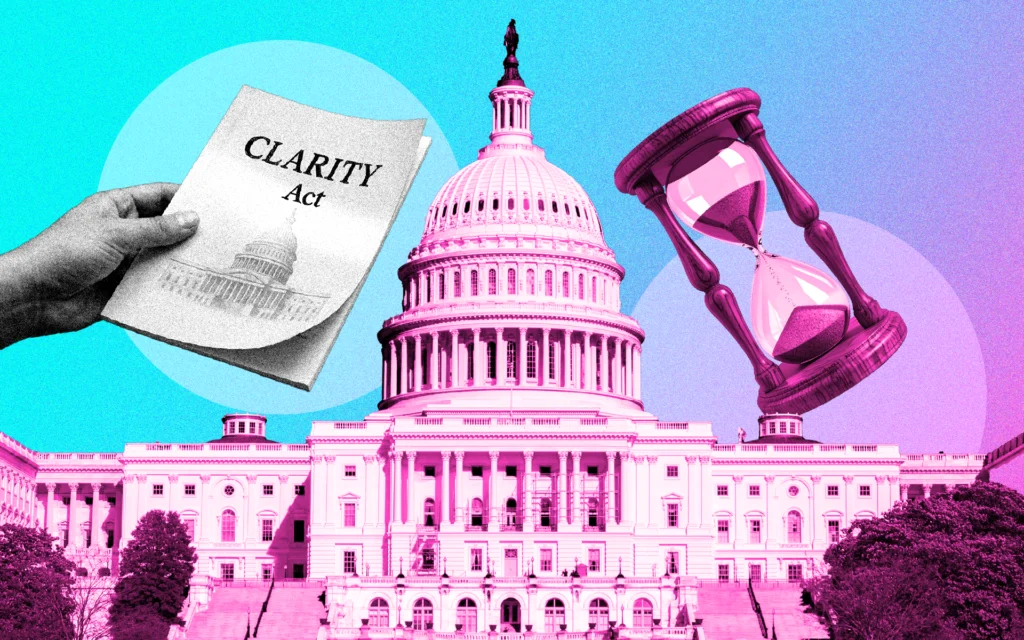
What would happen to XRP if the CLARITY Act falls through? | Source: CCN.
Share
Key Takeaways
The CLARITY Act faces a tight deadline in the Senate.
Analysts warn that prolonged regulatory uncertainty could push XRP as low as $0.29.
ChatGPT, Claude, and Grok expect a failed CLARITY Act to pressure XRP in the near term.
The fate of the CLARITY Act has become one of the biggest political risks facing XRP’s price, with lawmakers running out of time to advance landmark crypto legislation before the U.S. Senate breaks for its August recess.
While supporters argue the bill would finally provide long-awaited regulatory certainty for digital assets, growing political opposition has fueled fears it could be delayed well into next year — or fail altogether.
New Trending Crypto Wallet Offers
Sponsored
Disclosure
We sometimes use affiliate links in our content, when clicking on those we might receive a commission at no extra cost to you. By using this website you agree to our terms and conditions and privacy policy.
Senate Faces Tight Deadline as CLARITY Clock Ticks Down
The Senate returns Monday with roughly 20 working days before lawmakers leave for the August recess, leaving what many industry observers view as the last realistic opportunity to advance the CLARITY Act this summer.
Although senators are expected to circulate a revised draft as early as next week, negotiations remain unresolved, and Democrats have yet to rally behind the legislation.
The increasingly compressed timetable has raised concerns that the bill could slip beyond the recess.
This would force lawmakers to revisit the issue later in the year when attention shifts toward the 2026 midterm elections and other legislative priorities.
Many analysts argue that every delay increases uncertainty for the US crypto industry, which has spent years seeking clearer rules.
Ethics Dispute Deepens Political Divide
The legislation has become increasingly entangled in a broader political battle over President Donald Trump’s growing crypto interests.
Republican Senator Cynthia Lummis has repeatedly argued that delaying digital asset legislation risks allowing competing jurisdictions to dictate the future of crypto regulation.
“Every month without clear digital asset rules is a month another country writes them for us,” Lummis wrote this week.
She later described the current negotiations as “likely our last chance to get real legislation for digital assets on the books before 2030.”
Every month without clear digital asset rules is a month another country writes them for us. That’s not a risk. It’s already happening.
— Senator Cynthia Lummis (@SenLummis) July 9, 2026
Democratic Senator Elizabeth Warren has taken the opposite position, arguing the legislation, in its current form, could weaken safeguards against illicit finance and sanctions evasion.
The disagreement has become one of the central obstacles preventing bipartisan agreement.
Several market participants argue that increased attention on the President’s crypto interests could make it harder for Democratic lawmakers to support the legislation.
Thinking Crypto founder Tony Edward said the timing of recent financial disclosures could strengthen Democrats seeking to slow the bill.
“This info could further strengthen the Dems who are using ethics to roadblock the CLARITY Act,” he wrote on X.
SkyBridge Capital founder Anthony Scaramucci similarly argued that Trump’s crypto exposure could become “one of the main reasons” cited if the legislation ultimately fails.
Polymarket Traders Turn Increasingly Bearish
Prediction market traders have also grown more pessimistic about the legislation’s chances.
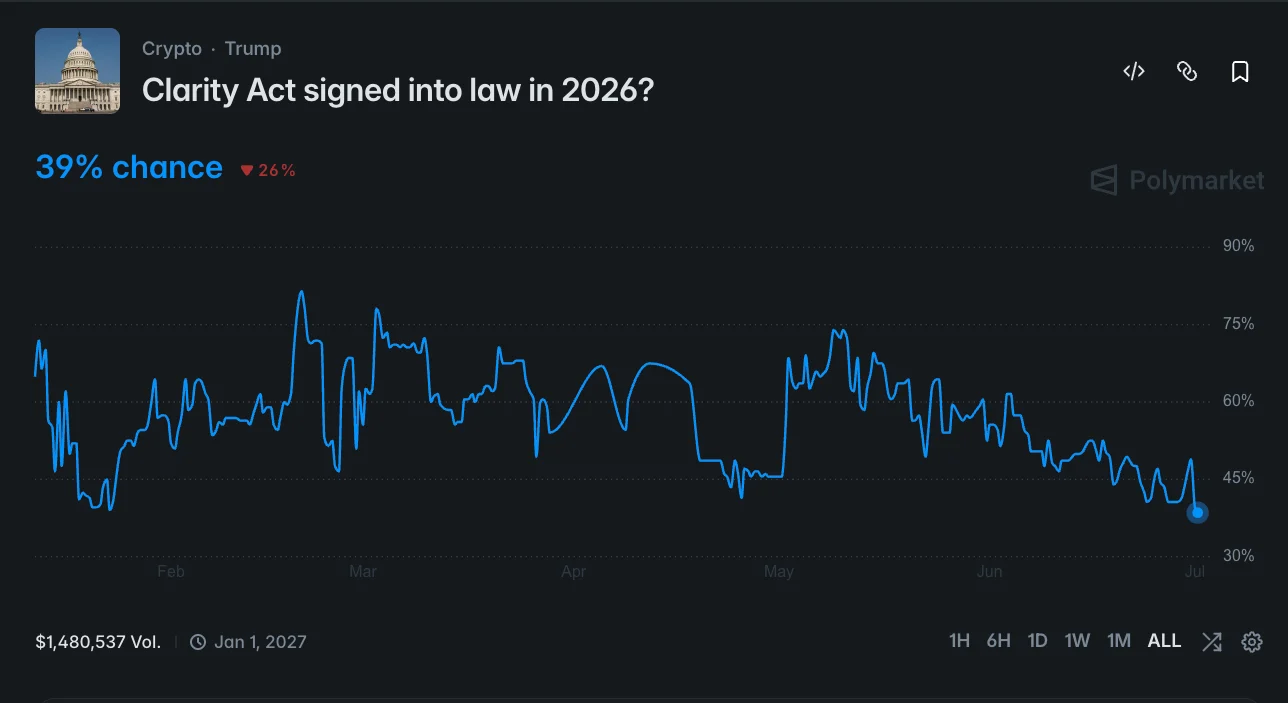
Polymarket bettors currently assign roughly a 39% probability that the CLARITY Act becomes law before the end of 2026, down sharply from more than 60% earlier this year.
Polymarket CLARITY Act odds are falling | Source: Polymarket
Galaxy Research has also become more cautious.
The firm’s Head of Research, Alex Thorn, recently lowered Galaxy’s estimate for the bill becoming law in 2026 to 50% from 60%.
Thorn warned that without rapid progress, the legislation risks slipping into September, when the legislative calendar becomes increasingly constrained.
Analyst Warns XRP Price Could Fall to $0.29
Some analysts believe prolonged delays could weigh directly on the XRP price.
Damian Chmiel, senior analyst and editor at Finance Magnates, argues that regulatory uncertainty remains one of several factors limiting upside.
According to Chmiel, four themes continue to pressure XRP:
CLARITY Act delays
Weakness across the market
Softer institutional sentiment
Ongoing dependence on Bitcoin
Based on those conditions, Chmiel said XRP could revisit $0.67, then $0.47, before potentially falling as low as $0.29 if it loses the psychologically important $1 support level.
To assess what this could mean for XRP, CCN asked ChatGPT, Claude, Grok, and Gemini whether the token would rise or fall if the legislation ultimately dies.
ChatGPT: Regulatory Delay Would Likely Pressure XRP Price
ChatGPT said the failure of the CLARITY Act would most likely weigh on the XRP price in the
“A failed CLARITY Act would prolong regulatory uncertainty for U.S. digital assets, and XRP price has historically been one of the most sensitive to regulatory developments,” it said.
The AI argued that investors could become more cautious if hopes for legislative clarity disappear.
“Capital generally avoids uncertainty. If the bill collapses without an alternative framework, XRP could underperform the broader market despite Ripple’s international expansion.”
However, ChatGPT said any weakness may prove temporary.
“Long-term adoption will still depend more on payment utility, institutional demand and macro liquidity than a single piece of legislation.”
“The market would likely interpret the failure as another setback for U.S. crypto regulation, leading to negative sentiment across digital assets, particularly XRP,” Claude said.
However, it argued the longer-term impact may prove limited.
“Ripple’s business increasingly operates outside the US. European expansion, Middle Eastern partnerships and broader institutional adoption could eventually offset domestic political disappointment.”
Claude added that markets often recover once regulatory uncertainty becomes fully priced in.
Grok: XRP Price Isn’t Entirely Dependent on Washington
Elon Musk’s Grok was less pessimistic.
“If the CLARITY Act dies, expect plenty of dramatic headlines predicting XRP’s collapse,” it said.
“But crypto isn’t powered entirely by Capitol Hill.”
Grok argued that while regulatory clarity would help sentiment, XRP’s performance still depends heavily on Bitcoin and broader market liquidity.
“If Bitcoin is rallying and institutional money keeps flowing into crypto, XRP can still climb even without Congress delivering the perfect regulatory package.”
The chatbot added that investors often overestimate the immediate impact of legislation.
Gemini: Short-Term Rally Possible
Google’s Gemini offered the most surprising assessment.
Rather than predicting a sustained decline, Gemini argued that a failed bill could eventually produce a relief rally under certain conditions.
“The initial reaction would likely be negative,” Gemini said.
“However, markets frequently price in expected political outcomes well before they occur.”
According to Gemini, if investors begin treating legislative failure as fully priced in while Bitcoin continues strengthening and Ripple expands internationally, XRP’s price could outperform expectations.
“Market participants may ultimately shift their focus away from Washington and back toward adoption, cross-border payments and institutional partnerships.”
Gemini concluded that regulatory clarity remains a positive catalyst, but “its absence alone does not guarantee lower prices.”
Disclaimer:
The information provided in this article is for informational purposes only. It is not intended to be, nor should it be construed as, financial advice. We do not make any warranties regarding the completeness, reliability, or accuracy of this information. All investments involve risk, and past performance does not guarantee future results. We recommend consulting a financial advisor before making any investment decisions.
Kurt Robson is a London-based reporter at CCN, specialising in the fast-moving worlds of crypto and emerging technology. He began his career covering local news in Cornwall after graduating from Falmouth University with First Class Honours in Journalism. There, he cut his teeth on everything from council meetings to missing swans.
He quickly rose through the ranks to become a frontline journalist at several of the UK’s leading national newspapers. Over the years, he has interviewed musicians and celebrities, reported from courtrooms and crime scenes, and secured multiple front-page exclusives.
Following the upheaval of the COVID-19 pandemic, Kurt shifted his focus to technology journalism—just ahead of the AI boom. With a natural curiosity and a trained eye for emerging trends, he has found a new rhythm in reporting on innovation.
At CCN, Kurt's work focuses on the cutting edge of crypto, blockchain, AI, and the evolving digital world. Drawing on his background in people-first reporting and his deep interest in disruptive tech, Kurt delivers stories that are insightful, entertaining, and human-centric.