DEX vs DeFi Aggregators: Which Offers Better Crypto Prices?
Share
Key Takeaways
DeFi in 2026 is bigger, more global, and far more complex, driven by RWAs, institutional capital, AI automation, and cross-chain interoperability.
Aggregator platforms have become essential infrastructure, simplifying decision-making across thousands of protocols and dozens of blockchains.
User activity is surging: 1inch alone routed nearly $29 billion in mid-2025 and now captures over 59% of EVM DEX market share.
Yield aggregators remain resilient, with Yearn generating over $2 million in annualized fees.
Decentralized finance in 2026 is a different world from the early days of experimental lending pools and yield farms.
What began as an alternative financial system has become a global economic force, integrating real-world assets, institutional capital, AI-powered automation, and cross-chain interoperability. Yet even as DeFi grows more powerful, it also becomes more complex.
With thousands of protocols, dozens of chains, and constantly shifting yields, navigating the ecosystem manually is more complex than ever.
This complexity is precisely why DeFi aggregators have emerged as one of the most important and underappreciated pillars of the decentralized economy.
They sit quietly above the rest of DeFi, stitching together liquidity, yields, and strategies into a streamlined user experience. And in many ways, they’re changing how DeFi is accessed, how liquidity flows, and how everyday users benefit from the broader on-chain financial system.
The New DeFi Environment Behind Aggregator Growth
The rise of aggregators becomes easier to understand when you zoom out and look at the significant trends shaping DeFi in 2025.
Decentralized finance is now supported by developments such as:
Cross-chain interoperability solutions that reduce blockchain silos.
Institutional participation through permissioned pools and compliance tools.
Smarter, more secure smart contracts enabling automated financial workflows.
AI-driven risk modeling and strategy optimization.
Regulatory clarity from countries like Singapore and the UAE.
Mobile-first onboarding for the unbanked across emerging markets.
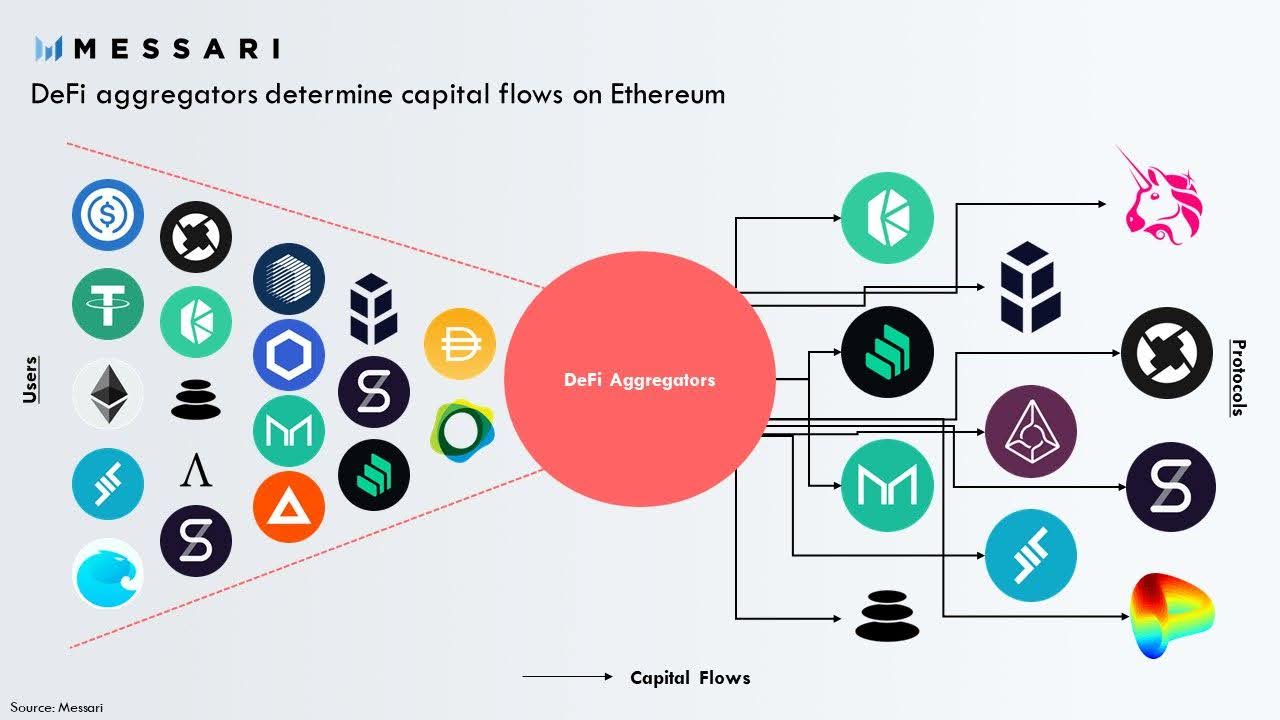
DeFi aggregators determine capital flows on Ethereum. | Credit: Messari
All of these innovations push DeFi forward, but they also multiply choice and complexity. The average user cannot track interest rates across ten lending platforms or navigate half a dozen blockchain networks.
DEX aggregators, like 1inch, ParaSwap, and Jupiter, search across dozens of decentralized exchanges to find the best possible swap price. These platforms calculate:
Yield aggregators, on the other hand, manage deposits across lending, farming, and staking protocols. Yearn Finance, Idle, and Aera are examples. They operate more like automated on-chain asset managers, continually moving user funds to wherever returns are most substantial while reducing manual effort.
For many users, these platforms serve as a bridge between seeking passive returns and lacking the time or expertise to manage them actively.
A Practical Look: How a DeFi Aggregator Works in Real Life
To understand why these tools have become essential, consider a simple use case.
Imagine someone with 1,000 USDC who wants passive income without constantly monitoring lending rates or bouncing between platforms like Aave, Curve, Compound, and Morpho.
https://www.youtube.com/watch?v=DYpbDvsxXbA
On Yearn Finance, this person would:
Connect their wallet on yearn.fi.
Choose the USDC vault, reviewing APY, historical performance, and strategy details.
Deposit their assets after the contract is approved.
Allow the platform’s smart contracts to automatically.
Allocate funds to the highest-yielding stablecoin opportunities.
Rebalance as market conditions change.
Reinvest earnings regularly.
Reduce network fees through batch transactions.
Instead of micromanaging strategies, users receive an automated and optimized experience. This convenience is one of the primary forces behind aggregator adoption in 2025.
Why Aggregators Are Outperforming the Market
Although overall DeFi indexes have struggled in 2025, aggregators have shown unexpected strength in both usage metrics and, at times, token performance. Several underlying factors have fueled this growth.
Market share of EVM DEX volume jumped from 32.5% to over 59%.
The daily average trading volume reached approximately $848 million.
Lifetime trading volume on Ethereum alone surpassed $ 500 billion later in the year.
ParaSwap also reported more than $12 billion in Q3 2025 trading volume and has surpassed $ 100 billion in historical volume.
Yield aggregators show a similar trend. Yearn Finance, for example, maintains a total value locked of around $629 million and generates over $13.7 million in annualized fees, a sign that users and DAOs continue to rely on vaults for automated yield generation.
Short-Term Token Performance Spikes
While most DeFi governance tokens are far below their 2021 peaks, aggregator tokens stand out for their strong short-term rebounds.
During several market upswings in 2025, 1inch posted single-day gains above 60 percent. These tokens are high-volume trading assets due to their connection to real, ongoing protocol activity.
Expansion Across Chains
With interoperability improving, aggregators are increasingly serving as multi-chain routers. They simplify complex cross-chain actions:
Bridging.
Swapping across networks.
Migrating liquidity.
Sourcing yield wherever conditions are best.
As cross-chain traffic increases, aggregators become even more crucial, acting as the user interface for a fragmented but interconnected financial system.
The Rise of AI-Powered Aggregators
Some of the newest aggregators incorporate artificial intelligence directly into their strategies. ARMA by Giza is an example of this shift. It uses AI agents to execute real-time strategy decisions across protocols like Morpho and Aave, providing:
Adaptive strategies.
Intent-based execution.
Smart account automation.
Highly customizable vaults.
Other platforms evolve differently. Yearn v3 offers modular strategy design, Idle Finance targets conservative risk pools, and Aera focuses on treasury management for DAOs.
This diversity demonstrates how aggregators are expanding to cater to various user types, ranging from casual investors to complex institutional needs.
Benefits of DeFi Aggregators That Explain the Momentum
Part of the quiet rise of DeFi aggregators stems from the strength of the advantages they offer.
They secure better yields by constantly monitoring multiple protocols.
They reduce gas usage through optimized or batched transactions.
They auto-compound earnings, which significantly increase long-term returns.
They diversify across platforms, thereby lowering the risk associated with any single strategy.
For many users, aggregators make modern DeFi feel as easy as using a traditional fintech app.
But the Risks Still Matter
As power aggregators gain more power, the importance of understanding the associated risks increases. The primary concern is exposure to smart contract risks.
Because aggregators connect to multiple protocols, every new integration adds another potential attack surface.
Even if the aggregator’s own code is secure, an exploit in one of its partner protocols can ripple outward.
Impermanent loss when strategies involve liquidity pools.
Due diligence is essential. Audits, transparency, and conservative allocation sizes help manage exposure.
What DeFi Aggregators’ Rise Means Heading Into 2026
When you combine the user growth, rising volumes, cross-chain expansion, and institutional interest, the picture becomes clear.
DeFi aggregators are becoming the default entry point for many users navigating the decentralized finance space. And while DeFi indexes have struggled this year, aggregators continue to capture increasing amounts of flow, liquidity, and attention.
This shift raises a new kind of question. For years, people asked which DEX or yield farm they should use. In 2026 and beyond, a better question may be: Which aggregator is routing my trade, and how much influence does it already have over the market?
As aggregators quietly consolidate liquidity and simplify on-chain finance, they’re emerging as the real power centers of DeFi, both enabling and shaping the direction of decentralized markets.
A DeFi aggregator is a platform that combines multiple decentralized finance protocols into a single interface. It can automatically optimize trading, lending, borrowing, and yield strategies across various networks, providing users with the best possible returns with minimal manual effort.
Why have DeFi aggregators grown in importance in 2025?
The DeFi ecosystem has become highly complex, with thousands of protocols, cross-chain operations, and shifting yields.
Are aggregator tokens performing well compared to other DeFi tokens?
Yes. While many DeFi governance tokens remain below their 2021 highs, aggregator tokens like 1inch have shown strong short-term performance, often posting high-volume spikes during market upswings.
Why are DeFi aggregators considered the “entry point” for new users in 2026?
As DeFi grows more complex with institutional integration, cross-chain activity, and AI-driven strategies, aggregators simplify access. Users no longer need to select individual protocols manually; instead, the aggregator handles routing, optimization, and risk management, making it the default entry point into decentralized finance.
Disclaimer:
The information provided in this article is for informational purposes only. It is not intended to be, nor should it be construed as, financial advice. We do not make any warranties regarding the completeness, reliability, or accuracy of this information. All investments involve risk, and past performance does not guarantee future results. We recommend consulting a financial advisor before making any investment decisions.
Giuseppe Ciccomascolo began his career as an investigative journalist in Italy, where he contributed to both local and national newspapers, focusing on various financial sectors.
Upon relocating to London, he worked as an analyst for Fitch's CapitalStructure and later as a Senior Reporter for Alliance News. In 2017, Giuseppe transitioned to covering cryptocurrency-related news, producing documentaries and articles on Bitcoin and other emerging digital currencies. He also played a pivotal role in establishing the academy for a cryptocurrency exchange website. Crypto remained his primary area of interest throughout his tenure as a writer for ThirdFloor.


 Easy
Easy