Claude AI Recovered a Lost Bitcoin Wallet Locked for 11 Years: Reality Behind Viral Crypto Story
Share
Key Takeaways
Three major AI models were asked to predict Bitcoin’s price five days ahead to test claims that AI can outperform human financial advisors.
None of the models predicted the exact price, but all three expected Bitcoin to stay within a broad range near $68,000-$74,000, which roughly matched the market’s actual movement.
Gemini gave the most specific prediction, estimating Bitcoin would reach about $72,400, based on recent trading patterns, support and resistance levels, and macroeconomic factors.
The experiment shows that AI is better at explaining market context than predicting exact prices, using logic based on trends, volatility, and potential catalysts.
Artificial intelligence tools are increasingly being promoted as powerful assistants for investors. Across social media and trading forums, it is common to see claims that AI can outperform human financial advisors if you just use the right prompt.
Curious about this claim, CCN ran a simple experiment.
Five days ago, we asked three major AI chatbots, i.e., OpenAI’s ChatGPT, Google’s Gemini, and Anthropic’s Claude, the same question: What will Bitcoin’s price be in five days?
Users on X say Claude, ChatGPT, and Gemini can be better than human financial advisors. | Credit: Nav Toor X profile
The results proved revealing.
Today, on Mar. 11, Bitcoin is trading around $70,000, and the predictions from the three AIs show both the strengths and limitations of AI in financial forecasting.
Gemini Bitcoin Price Prediction: What OpenAI’s AI Forecasted
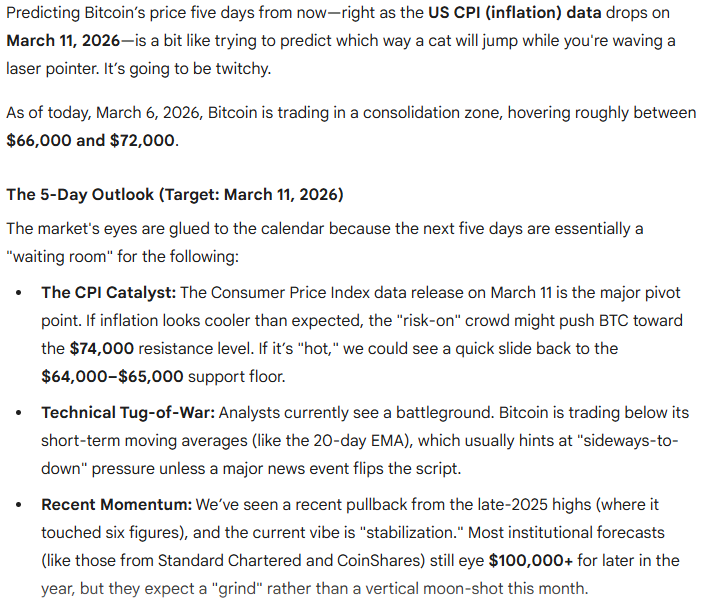
The response from Gemini approached the question with caution and relied heavily on context and probability.
The model emphasized that predicting Bitcoin’s price over such a short time frame is extremely difficult. It compared the task to predicting which way a cat will jump while you’re waving a laser pointer, a humorous but accurate description of short-term crypto volatility.
Gemini explained that Bitcoin was trading in a consolidation range of roughly $70,800 to $71,000 at the time of the prediction. Because of that, it expected the price to remain within a similar band over the next few days unless a major catalyst occurred.
Gemini was more balanced with its prediction. | Credit: Gemini
One such catalyst mentioned was the U.S. Consumer Price Index (CPI) inflation report, scheduled for release during the forecast period. The model outlined two possible scenarios:
If inflation data came in cooler than expected, Bitcoin could rise toward $74,000.
If inflation came in hot, BTC could drop toward $64,000-$65,000.
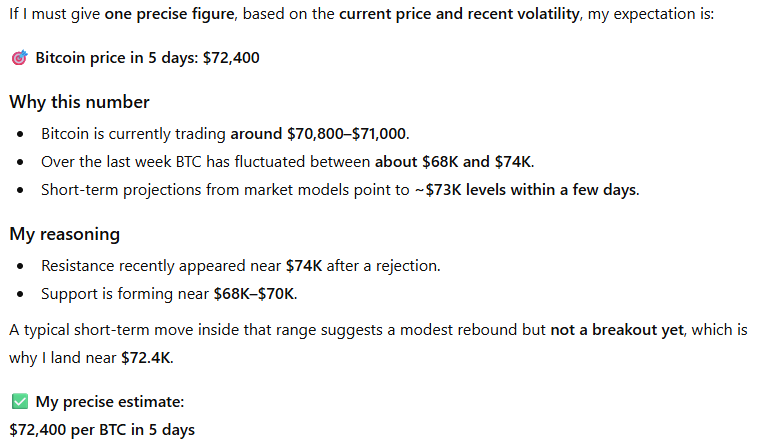
ChatGPT ultimately gave a specific estimate of about $72,400 in five days, based on recent trading patterns and technical levels.
The reasoning included:
Bitcoin trading around $70,800-$71,000
A weekly range between $68K and $74K
Resistance near $74K and support around $68K–$70K
ChatGPT Bitcoin Price Forecast: AI Range Prediction for BTC
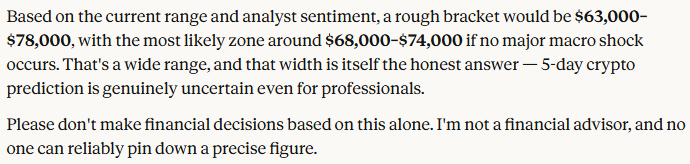
OpenAI’s ChatGPT provided a similar response style but emphasized uncertainty even more strongly.
Rather than focusing on a single price, ChatGPT presented a broader range of possible Bitcoin prices.
Based on analyst sentiment and recent volatility, ChatGPT suggested Bitcoin would likely trade between $63,000 and $78,000, with the most likely zone being $68,000 to $74,000 if no major macroeconomic shock occurred.
ChatGPT got closer to the actual Bitcoin’s price. | Credit: ChatGPT
The model explicitly acknowledged that the wide range reflected reality.
According to ChatGPT, short-term crypto predictions are inherently uncertain, even for professionals. The model also included a clear disclaimer advising readers not to make financial decisions based solely on the forecast.
This approach highlighted a key characteristic of modern AI models: they tend to avoid strong claims when dealing with highly uncertain systems.
Claude Bitcoin Price Prediction: Anthropic’s AI Analysis of BTC Trends
Anthropic’s Claude took a slightly different approach by focusing more on market structure and recent momentum.
Claude noted that Bitcoin had recently pulled back from late-2025 highs and was entering a short-term stabilization period.
It also noted that BTC was trading below some short-term moving averages, suggesting sideways or slightly downward pressure unless a major event changed market sentiment.
Claude was hailed on X as one of the best financial advisors. | Credit: Claude
Claude also referenced institutional forecasts from firms such as Standard Chartered and CoinShares, which have previously predicted Bitcoin could reach $100,000 or more later in the year.
However, the model stressed that such moves would likely occur gradually rather than through a sudden breakout.
In other words, Claude suggested that while the long-term outlook might remain bullish, the immediate five-day period was likely to be range-bound.
Bitcoin Price After 5 Days: Comparing AI Predictions vs Reality
None of the models predicted the exact price. However, all three forecasts correctly anticipated range-bound movement within the broader $68,000-$74,000 region.
This highlights an important distinction: while AI models struggled with precise numbers, they were fairly effective at identifying the broader market structure.
Why Bitcoin Price Predictions Are Difficult Even for AI
The experiment reinforces a basic reality of financial markets: short-term price predictions are extremely hard.
Bitcoin’s price is influenced by a constantly changing mix of factors, including:
Macroeconomic data: Events such as inflation reports, interest rate decisions, and employment data can shift investor sentiment rapidly.
Liquidity and leverage: Crypto markets are highly sensitive to liquidations and derivatives activity. A sudden cascade of leveraged positions can move prices dramatically.
Market psychology: Narratives and sentiment often drive crypto markets just as much as fundamentals. Viral posts, memes, and rumors can influence short-term price movements.
Unexpected news: Regulatory announcements, exchange issues, or geopolitical events can instantly change market direction. Because of these variables, even sophisticated hedge funds struggle to make reliable short-term predictions.
How AI Generates Crypto Price Predictions: Another important takeaway from this experiment is that AI chatbots are not true forecasting engines.
When ChatGPT, Gemini, or Claude generate predictions, they are not running real-time financial models. Instead, they analyze patterns in the training data and apply logical reasoning to the current information.
Assumed the price would remain within that range unless a major catalyst appeared.
This type of reasoning is useful, but it is fundamentally different from quantitative trading algorithms used by hedge funds.
Can AI Replace Financial Advisors for Crypto Investing?
The biggest lesson from the experiment is that AI should not be treated as a financial advisor.
Even the models themselves often acknowledge this limitation.
In the responses generated during the test, the AIs explicitly warned that no one can reliably predict exact price levels and that financial decisions should not be based solely on AI-generated forecasts.
Human advisors consider factors that AI cannot easily evaluate, including:
All three models recognized that Bitcoin was likely to remain within a broad trading range, but none could accurately predict the exact price five days later.
Rather than replacing human expertise, AI currently works best as a research assistant, helping investors understand markets rather than predict them perfectly.
For traders and investors, the future may not be AI versus humans, but AI working alongside human judgment to navigate increasingly complex financial markets.
Not reliably. AI models like ChatGPT, Gemini and Claude can analyze trends, recent price ranges and macroeconomic factors, but they cannot predict exact short-term price movements. Crypto markets are influenced by many unpredictable factors such as macro data, market sentiment and sudden news events.
What price did the AI models predict for Bitcoin?
In the experiment, ChatGPT estimated Bitcoin could reach about $72,400, while Google’s Gemini suggested a broader range of $63,000-$78,000, with a likely zone between $68,000 and $74,000. Anthropic’s Claude also suggested Bitcoin would likely trade within a consolidation range rather than making a major move.
What was Bitcoin’s actual price after five days?
Five days after the predictions were made, Bitcoin was trading just under $70,000. While none of the AI models predicted the exact price, they did correctly anticipate that Bitcoin would remain within a similar trading range.
Can AI replace financial advisors for crypto investing?
No. AI tools can help summarize information and explain market dynamics, but they cannot replace financial advisors. Human advisors consider personal financial goals, risk tolerance, taxes and long-term investment strategies, factors that AI cannot fully evaluate.
Disclaimer:
The information provided in this article is for informational purposes only. It is not intended to be, nor should it be construed as, financial advice. We do not make any warranties regarding the completeness, reliability, or accuracy of this information. All investments involve risk, and past performance does not guarantee future results. We recommend consulting a financial advisor before making any investment decisions.
Giuseppe Ciccomascolo began his career as an investigative journalist in Italy, where he contributed to both local and national newspapers, focusing on various financial sectors.
Upon relocating to London, he worked as an analyst for Fitch's CapitalStructure and later as a Senior Reporter for Alliance News. In 2017, Giuseppe transitioned to covering cryptocurrency-related news, producing documentaries and articles on Bitcoin and other emerging digital currencies. He also played a pivotal role in establishing the academy for a cryptocurrency exchange website. Crypto remained his primary area of interest throughout his tenure as a writer for ThirdFloor.


 Easy
Easy