USDC Beats USDT With 67% Share as Stablecoin Payments Hit Record $1.79T: Visa Data
Share
Key Takeaways
USDC now accounts for roughly 67% of adjusted stablecoin transaction volume, overtaking USDT.
Base and Solana are driving a shift toward faster, lower-cost stablecoin payment infrastructure.
Visa’s retail payment data suggests stablecoins are increasingly being used as money, not just trading tools.
Something significant has shifted in the stablecoin market’s volume distribution, and the numbers from Visa’s onchain analytics dashboard, powered by Allium, make it impossible to miss.
Adjusted stablecoin transaction volume, which strips out bot activity, internal reshuffling and other artificial inflation, reached $1.8 trillion in the last 30 days.
Total unadjusted volume over the same period hit $7.0 trillion, with 1.6 billion total transactions and 200.2 million adjusted transactions.
Retail-sized transactions, which Visa defines as sub-threshold consumer-scale payments, accounted for $6.8 billion in volume across 136 million transactions during the same period.
Adjusted Stablecoin Volume Hits Record $1.79T in June, Up 63% from May
According to Visa Onchain Analytics, adjusted stablecoin transaction volume reached a record $1.79 trillion in June, up 63% from $1.10 trillion in May and surpassing the previous high of $1.78 trillion set… pic.twitter.com/r9kfkREf9A
The headline that those numbers contain is which stablecoin is processing the most. USDC on Ethereum alone accounts for $3.7 trillion in cumulative adjusted volume, ahead of USDT on Tron at $3.3 trillion.
USDC on Solana adds another $2.3 trillion, and USDC on Base contributes $1.6 trillion.
Adding USDC volumes across its top chains produces a figure that substantially exceeds USDT’s combined volume across its primary networks.
Across the adjusted dataset, USDC commands roughly 67 percent of transaction volume, a complete reversal from the market structure that prevailed as recently as 2023, when USDT’s 85 percent dominance was widely treated as permanent.
That reversal has both regulatory and infrastructure explanations, and they reinforce each other. USDT is not MiCA-compliant, and Tether chose not to seek EU authorization, prompting European-regulated platforms to delist it by July 1, 2026.
USDC holds full MiCA authorization through Circle’s Irish entity. In the US, the GENIUS Act’s implementing regulations, due by mid-2026, establish a payment stablecoin licensing framework that Circle is structurally positioned to operate under, whereas Tether is not.
Regulated venues, institutional payment flows, and enterprise treasury operations are migrating toward the compliant option by default.
Try Our Recommended Crypto Exchanges
Sponsored
Disclosure
We sometimes use affiliate links in our content, when clicking on those we might receive a commission at no extra cost to you. By using this website you agree to our terms and conditions and privacy policy.
Base and Solana Are Reshaping Where Volume Settles
The infrastructure explanation shows up in the chain distribution data. USDC on Base, Coinbase’s Ethereum layer-2, has accumulated $1.6 trillion in adjusted volume, a figure that did not exist two years ago.
Base launched in August 2023 and has become one of the fastest-growing stablecoin settlement networks globally, handling USDC volume that would have settled on the Ethereum mainnet or through centralized exchange pipes in earlier periods.
Solana’s USDC volume of $2.3 trillion reinforces the same point: settlement is migrating toward cheaper, faster layer-1 and layer-2 infrastructure rather than concentrating on the Ethereum mainnet, where gas costs make small-value payments uneconomical.
Retail Transaction Data Shows Stablecoins Functioning as Money
The retail transaction data is perhaps the strongest evidence that stablecoins are evolving beyond trading instruments toward functioning as money.
Visa’s methodology identifies retail-sized transfers as the category that most closely resembles consumer payment behavior.
In the last 30 days, users conducted $6.8 billion in retail payments across 136 million transactions, equivalent to roughly 4.5 million retail-scale stablecoin payments per day.
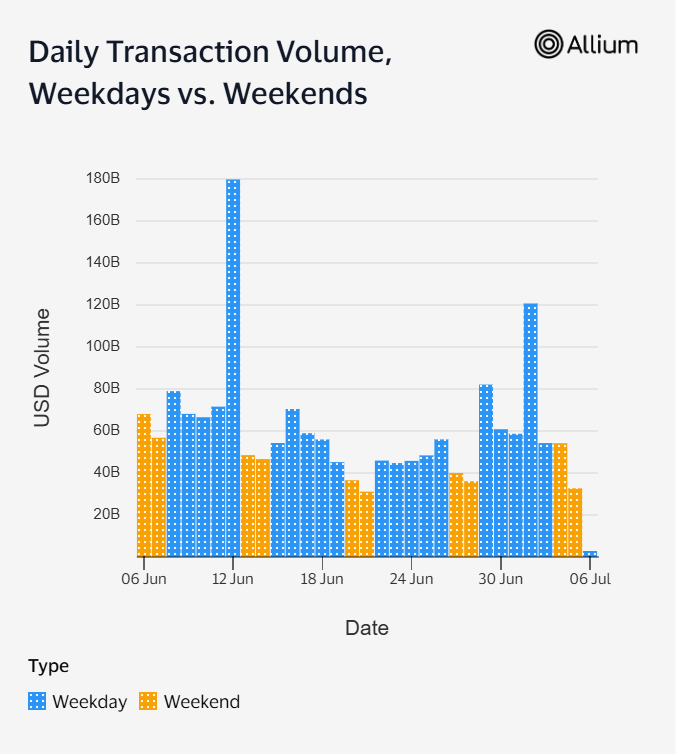
Weekend activity reinforces the trend: Visa recorded $32.7 billion in weekend transaction volume compared with $2.9 billion on weekdays, a pattern more consistent with consumer spending than institutional trading.
Those findings align with the conclusions of the 2022 paper Stablecoins’ Quest for Money: Who is Afraid of Credit? by Mathieu Chanson and Richard Senner. The authors argued that fiat-backed stablecoins such as USDC and USDT can evolve into a blockchain-based payment layer, while broader monetary status depends on sustained real-world economic use, regulatory compliance, and integration with the wider economy.
Visa’s data suggests that the transition is already underway. Rather than forecasting future adoption, the analytics measure existing payment behavior, showing stablecoin usage expanding, USDC leading transaction volume, and blockchain-based payments increasingly operating as a monetary layer.
Disclaimer:
The information provided in this article is for informational purposes only. It is not intended to be, nor should it be construed as, financial advice. We do not make any warranties regarding the completeness, reliability, or accuracy of this information. All investments involve risk, and past performance does not guarantee future results. We recommend consulting a financial advisor before making any investment decisions.
Dr. Guneet Kaur is a senior editor at CCN.com and a Science Fellow at Exponential Science. She is a fintech and blockchain expert with extensive experience in digital finance education, blockchain ecosystems, and cryptocurrency markets. She has worked with global media such as Cointelegraph, as well as education and blockchain platforms, to design and lead strategic content and learning initiatives. As an educator and assessor for top-tier executive programs, she bridges real-world fintech trends with academic insight.
Dr. Kaur is also a published researcher and peer reviewer across fintech and data science journals, including Financial Innovation Journal and International Journal of Big Data Intelligence and Applications. Her work spans data-driven analysis, Web3 innovation, and technical content development. With a strong foundation in both industry and academia, she translates complex financial technologies into practical applications, empowering learners, professionals, and institutions across the rapidly evolving digital finance landscape.