Meet the Top 101 in Crypto

CLARITY Act Could End ‘Coin Flip’ Crypto Enforcement, Helium Legal Chief Says

Published 17 July 2026
Giuseppe Ciccomascolo
Authors

Key Takeaways

  • Nova Labs’ legal chief said the CLARITY Act could stop crypto regulation from reversing whenever US political leadership changes.
  • The SEC dismissed its digital asset claims against Nova Labs with prejudice in April 2025, three months after suing the company over HNT distributions.
  • CLARITY could classify programmatically distributed tokens such as HNT as digital commodities rather than securities.

The CLARITY Act could replace politically driven crypto enforcement with durable rules determining when network tokens qualify as commodities rather than securities, according to Sarah Aberg, chief legal officer at Nova Labs, the company behind the Helium Network.

Nova Labs experienced that regulatory uncertainty firsthand. The US Securities and Exchange Commission (SEC) sued the company on January 17, 2025, alleging that its sales of wireless hardware distributing HNT rewards constituted an unregistered securities offering.

The regulator also targeted Helium Mobile’s Discovery Mapping feature, through which subscribers could earn digital assets for sharing network coverage data. However, on April 24, 2025, the SEC dismissed every digital asset claim with prejudice.

A separate claim alleging negligent misrepresentations during a preferred stock placement was resolved through a consent judgment and $200,000 civil penalty, without Nova Labs admitting or denying the allegation.

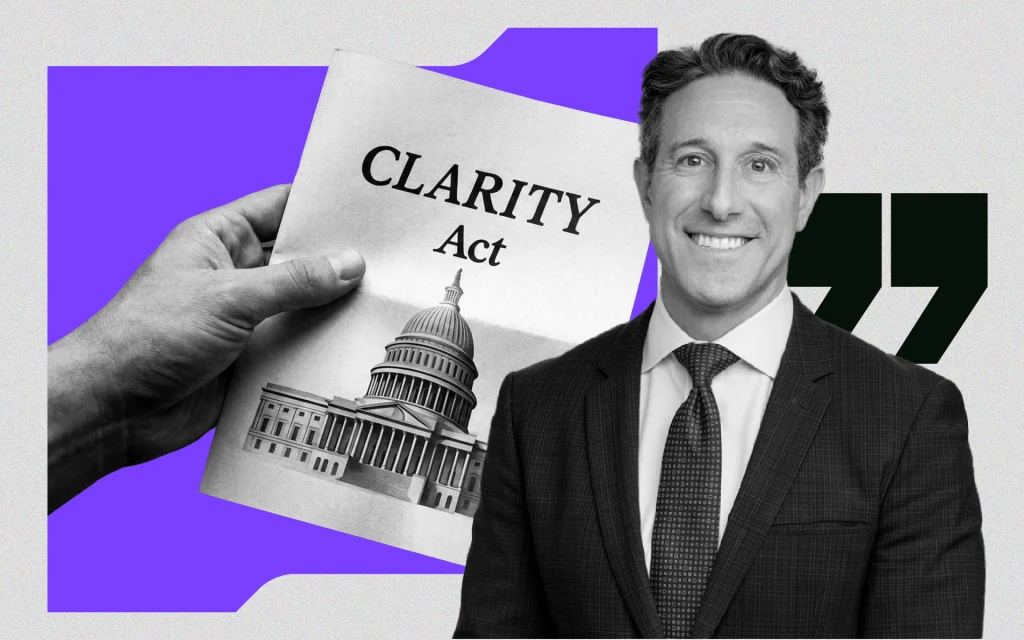
“Same company, same conduct, same facts, opposite outcome,” Aberg told CCN. “That is not a regulatory framework. It is a coin flip.”

Try Our Recommended Crypto Exchanges
Sponsored
Disclosure
Opened in 2018
Promotions
Deposit $100, Get an Extra $300 in GOLD!
Coins
Shiba Inu Bitcoin PAX Gold Ampleforth Ethereum +70
Promotions
Receive up to $100,000 worth of exclusive gifts for newcomers upon registration.
Coins
Bitcoin Ethereum Tether USD Coin Solana +76
Opened in 2017
Promotions
Experience a 1-minute swap on a non-custodial platform.
Coins
Bitcoin Ethereum Tether Build'N'Build USD Coin +217
Show More

CLARITY Would Treat HNT Rewards as Network Activity

Aberg said the CLARITY Act would have prevented the SEC from pursuing the digital asset theory underpinning its case.

Proposed Section 4B of the Securities Act, introduced by Section 102 of CLARITY, creates a presumption that certain gratuitous network-token distributions are not securities transactions. To qualify, distributions must be broad, equitable and non-discretionary, including those generated programmatically through network activity.

Helium’s HNT rewards fit that description, Aberg argued. The protocol automatically compensates hotspot operators for providing verified wireless coverage, transferring carrier data and contributing mapping information.

HNT sits on the commodity side of that line,” she said, describing the distinction CLARITY draws between investment contracts overseen by the SEC and digital commodities used within functional networks.

The Helium Network has operated since 2021, while Nova Labs has never held a controlling share of HNT’s supply. According to Aberg, the token derives its value from measurable wireless services rather than a capital-raising transaction.

CLARITY would therefore make HNT’s treatment a matter of statute instead of forcing a company to establish its token’s status through litigation.

Regulatory Ambiguity Diverts Money From Infrastructure

Helium currently has approximately 140,000 independently operated hotspots and serves millions of daily users through carrier partnerships with T-Mobile and AT&T.

The Helium Foundation is also in early discussions with public housing authorities in New York and California, including the Housing Authority of the County of San Bernardino, regarding broadband pilots.

Aberg declined to identify any potential counterparty that had refused to deploy Helium because of regulatory uncertainty. She instead pointed to the resources Nova Labs spent defending claims that regulators ultimately abandoned.

Those resources could have supported new hotspot deployments, emergency communications systems and broadband access for underserved communities, she said.

“Public-sector partners move at the speed of their confidence in the rules,” Aberg added. “CLARITY accelerates that.”

Without legislation, a change in administration could again alter how regulators treat the same conduct. That uncertainty follows Nova Labs into discussions with carriers, public bodies and institutional investors.

“Regulatory ambiguity is not sustainable,” Aberg said. “It turns compliance into guesswork, it penalizes good actors and does nothing to deter bad ones.”

Smaller DePIN Startups Face the Greatest Risk

Aberg said CLARITY could have an even greater effect on smaller decentralized physical infrastructure, or DePIN, projects.

Nova Labs had sufficient resources to defend itself until the SEC dismissed its claims. Many early-stage companies, however, cannot survive a “bet-the-company enforcement action,” she said.

Aberg also supported legal protections for non-controlling developers under Section 604, provided they do not become blanket immunity. Developers who knowingly facilitate or profit from illegal conduct should remain liable.

While those taking reasonable precautions should not automatically face responsibility when third parties misuse their technology.

For smaller projects, the legislation’s central benefit would be knowing which regulator has jurisdiction and what requirements must be satisfied before launching.

“Our dismissal with prejudice of the digital asset claims resolved the question for us,” Aberg said. “A statute resolves it for everyone who comes next.”

Disclaimer: The information provided in this article is for informational purposes only. It is not intended to be, nor should it be construed as, financial advice. We do not make any warranties regarding the completeness, reliability, or accuracy of this information. All investments involve risk, and past performance does not guarantee future results. We recommend consulting a financial advisor before making any investment decisions.
Giuseppe Ciccomascolo

Giuseppe Ciccomascolo began his career as an investigative journalist in Italy, where he contributed to both local and national newspapers, focusing on various financial sectors.

Upon relocating to London, he worked as an analyst for Fitch's CapitalStructure and later as a Senior Reporter for Alliance News. In 2017, Giuseppe transitioned to covering cryptocurrency-related news, producing documentaries and articles on Bitcoin and other emerging digital currencies. He also played a pivotal role in establishing the academy for a cryptocurrency exchange website. Crypto remained his primary area of interest throughout his tenure as a writer for ThirdFloor.

Related

Survey Icon
Help us improve
1 of 4
Is this your first time here?
What brought you here today?
What are you most interested in?
Would you be interested in:
Thank you icon
Thank you for your feedback!
DMCA.com Protection Status