Traditional clearing houses reduce the amount of money financial institutions must move between themselves, but they also concentrate counterparty risk within a small number of systemically important organizations.
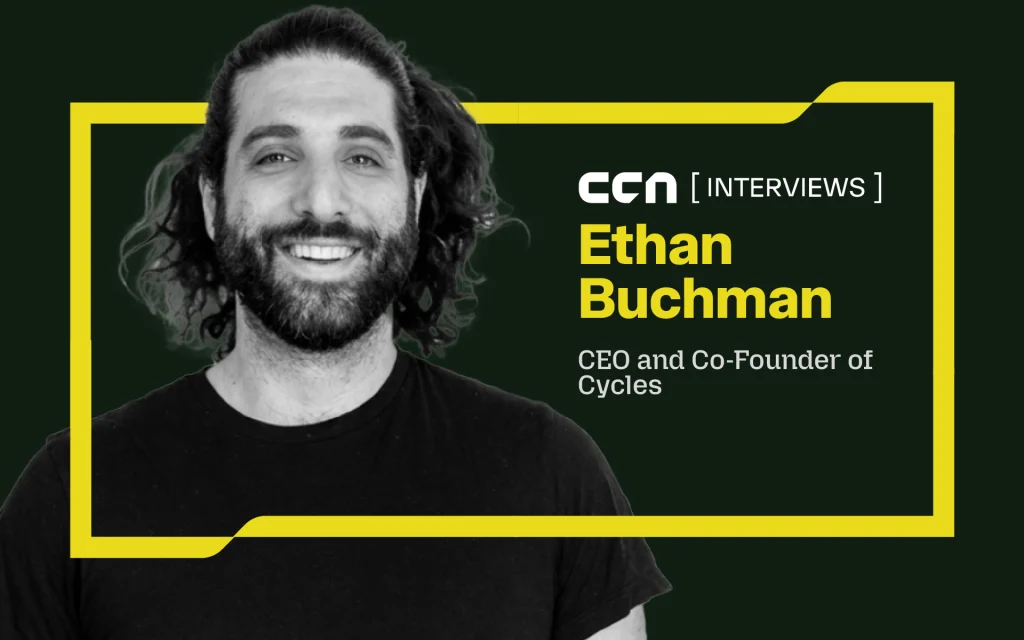
Cycles CEO and Cosmos co-founder Ethan Buchman believes modern cryptography can separate those functions, allowing businesses to offset obligations without introducing a central counterparty.
In an interview with CCN’s Dr. Guneet Kaur at the Blockchain Futurist Conference, Buchman explained how Cycles uses multilateral netting, zero-knowledge proofs, and graph algorithms to uncover liquidity hidden inside networks of debt.
“The real challenge is to cross silos,” Buchman said. “It’s a network-effect problem of bringing diverse firms into a common network.”
Why Cycles Is Starting With Crypto
Cycles is initially targeting crypto’s over-the-counter trading market, where exchanges, market makers, prime brokers, and liquidity providers transact with one another repeatedly.
“Every day, they’re settling millions of dollars’ worth of assets across dozens of currencies,” Buchman said. “There’s no clearing facility for them, so they’re using way more inventory than they need.”
Without a shared clearing layer, firms must hold cash, stablecoins, and digital assets across multiple venues to settle obligations individually.
Cycles Prime aims to reduce those gross obligations before settlement, releasing capital that would otherwise remain fragmented.
The company has named Lynq and FalconX as anchor partners for its pilot. In May, Cycles raised $6.4 million, bringing its total funding to $8.7 million.
Starting with sophisticated crypto firms also avoids the educational challenge of immediately targeting smaller businesses.
“They understand the value of clearing,” Buchman said. “We can immediately get started and be clearing millions of dollars a day.”
Clearing Without Assuming Everyone’s Risk
Clearing houses traditionally become the buyer to every seller and the seller to every buyer through a process known as novation.
“The main thing clearing houses do actually isn’t netting,” Buchman said. “It’s underwriting everyone’s counterparty risk.”
Cycles takes a different approach. It does not replace existing counterparties or guarantee their obligations.
“We don’t mutate the risk, and we don’t mutualize the risk,” Buchman said. “We leave all the risk exactly how it was.”
Instead, the protocol identifies debts that can cancel each other while preserving the original bilateral relationships.
“We can net out the debts without changing anybody’s counterparties,” he added.
That means Cycles cannot reimburse a creditor when a debtor defaults. Its purpose is limited to reducing the outstanding amount before settlement.
Buchman, therefore, views Cycles as complementary to clearing houses rather than a replacement.
“Underwriting credit risk is a critical function in the global financial system,” he said. “We’re not trying to change that.”
How Multilateral Netting Works
Buchman illustrated the concept using three connected debts.
Suppose he owes one participant $100. That participant owes Bob $80, while Bob owes Buchman $60.
If everyone settles separately, $60 effectively travels around the entire circle before returning to its starting point.
“There’s a closed loop of obligations,” Buchman said. “The money is just going to move around a circle.”
Cycles could remove $60 from each debt. Buchman’s obligation would fall from $100 to $40, the second participant’s debt would drop from $80 to $20 and Bob’s $60 obligation would disappear.
“Sixty dollars off all those debts can be discharged instantly,” he said. “There’s no counterparty stepping in.”
The same method can apply to far larger networks.
“It could be four participants, five, 10 or 20,” Buchman explained. “The liquidity is hidden in the structure of the graph.”
Why Clearing Has Remained Exclusive
Kaur asked whether regulators restricted access to clearing for stability reasons rather than merely to protect large institutions.
Buchman said those barriers exist because conventional clearing combines netting with centralized risk underwriting.
“You can’t open that up to everyone because a central counterparty can’t underwrite the risk of millions of businesses,” he said.
Cycles attempts to lower that burden by avoiding novation, collateral pooling, and loss mutualization.
“There are no new counterparties,” Buchman said. “Everyone is already governed by legal agreements and already underwriting their counterparties.”
However, the model may still require clear contractual recognition across jurisdictions, particularly during insolvency proceedings when creditors compete for repayment.
Buchman also acknowledged that cryptography is not the only obstacle.
“Scaling to millions is certainly a technical challenge,” he said. “But right now, the bottleneck is bringing those millions of businesses onboard.”
Zero-Knowledge Proofs Keep Obligations Private
Companies are unlikely to disclose their full trading positions, receivables, or credit exposures on a public network.
Cycles therefore combines zero-knowledge proofs, trusted execution environments, and graph algorithms to identify clearing opportunities without publicly revealing the complete network of obligations.
Its Cycles Prime product operates before final settlement and does not require firms to contribute collateral or place assets in escrow.
Even so, the network must attract enough interconnected participants to create meaningful savings. A technically effective system with only a few unrelated firms would find limited opportunities for netting.
Trade Credit Could Be the Bigger Opportunity
Buchman believes Cycles could eventually expand beyond crypto and connect trade credit across millions of businesses.
“It’s a massive, untapped, informal source of financing,” he said. “It’s trapped liquidity because no one knows what to do with it.”
Companies frequently owe money to suppliers while waiting for customers to pay their own invoices. Some of those obligations may form loops that could be offset without borrowing new money or moving additional reserves.
“Everyone’s concerned about liquidity, but the framing is about how many reserves you have,” Buchman said. “There’s a deeper framing: what is the structure of the network in which the debts exist?”
For smaller businesses, Cycles would likely appear first as part of a payments, invoicing, or credit product rather than as a standalone clearing service.
“Clearing shows up as a superpower that supercharges the network,” Buchman said.
Success Means Billions in Cleared Obligations
Buchman ultimately wants Cycles to connect financial obligations across crypto firms, banks, clearing houses, and business payment networks.
“There’s never going to be one clearing house sitting above all the others,” he said. “Something like Cycles can clear across a network of clearing houses and banks.”
The project’s success will depend on adoption, legal recognition, privacy guarantees, and firms’ willingness to submit obligations to a shared system.
For Buchman, the target is clear.
“Success looks like many billions of dollars cleared and millions of businesses benefiting from cash-flow relief,” he concluded.
The information provided in this article is for informational purposes only. It is not intended to be, nor should it be construed as, financial advice. We do not make any warranties regarding the completeness, reliability, or accuracy of this information. All investments involve risk, and past performance does not guarantee future results. We recommend consulting a financial advisor before making any investment decisions.

Giuseppe Ciccomascolo began his career as an investigative journalist in Italy, where he contributed to both local and national newspapers, focusing on various financial sectors.
Upon relocating to London, he worked as an analyst for Fitch's CapitalStructure and later as a Senior Reporter for Alliance News. In 2017, Giuseppe transitioned to covering cryptocurrency-related news, producing documentaries and articles on Bitcoin and other emerging digital currencies. He also played a pivotal role in establishing the academy for a cryptocurrency exchange website. Crypto remained his primary area of interest throughout his tenure as a writer for ThirdFloor.