How the Fed's Interest Rate Decision Affects Bitcoin
Share
Key Takeaways
Bitcoin now reacts to Fed policy far more than it did before 2020, with interest rates, liquidity, and the US dollar becoming major drivers of price action.
Research shows Bitcoin often falls on hawkish Fed surprises, while even the tone of policymakers’ comments can move prices without an actual rate change.
The Fed’s July rate hold extended policy uncertainty, leaving Bitcoin increasingly sensitive to inflation data, Treasury yields, and expectations for September.
Some analysts argue ETF inflows, onchain activity, and emerging-market demand are gradually reducing Bitcoin’s dependence on Federal Reserve policy.
Bitcoin was designed to operate outside central banking, yet no single institution moves its price more reliably than the Federal Reserve.
Wednesday’s decision showed the relationship in miniature: the Fed held rates at 3.50% to 3.75% in a 9 to 3 vote, and Bitcoin traded near $64,400 within hours, swinging roughly a percent in each direction as traders digested the statement.
SUMMARY OF FED DECISION (7/29/2026):
1. Fed leaves rates unchanged for the 5th straight meeting
2. Fed votes 9-3 to hold benchmark rate in 3.50%-3.75% zone
3. Hammack, Kashkari, and Logan dissent in favor of rate hike
4. Fed says economic activity is expanding at a "solid…
— The Kobeissi Letter (@KobeissiLetter) July 29, 2026
Understanding why an asset with a fixed supply schedule responds to a committee in Washington requires looking at three transmission channels, and at a body of academic research showing the relationship is newer, stronger, and stranger than most investors assume.
Try Our Recommended Crypto Exchanges
Sponsored
Disclosure
We sometimes use affiliate links in our content, when clicking on those we might receive a commission at no extra cost to you. By using this website you agree to our terms and conditions and privacy policy.
Interest rates affect Bitcoin through the same channels that move any risk asset. Higher rates raise the return on cash and Treasuries, so the opportunity cost of holding an asset that pays no yield rises with every hike.
Higher rates also raise the discount rate investors apply to long-duration assets, and Bitcoin behaves like the longest-duration asset in any portfolio, since its investment case rests on adoption years or decades away.
Lower rates reverse both effects while expanding the pool of money chasing returns, which is why researchers studying regimes from 2014 through 2025 found that periods of falling rates coincide with Bitcoin’s highest average returns, suggesting liquidity injections function as a primary valuation driver.
Dollar strength provides the third channel, since tighter policy typically lifts the dollar, and Bitcoin, priced globally in dollars, tends to weaken when the greenback firms.
Recent cycles illustrate the mechanics at full scale.
Near-zero rates and pandemic-era balance sheet expansion accompanied Bitcoin’s run from under $10,000 to $69,000 across 2020 and 2021, while the 2022 tightening cycle, the fastest in four decades, coincided with a drawdown of roughly 65%. Direction of travel, not the absolute level, does most of the work.
“Even at current rates, earning 4% on your USD is not making a dent to your net wealth relative to the speed at which the USD is losing its purchasing power. The projected US deficit for 2026 of $1.9 Trillion represents approximately 8.2% of the M2 money supply – that’s a proxy for the speed at which the USD is losing its purchasing power. You are better off holding a hard asset like BTC that can preserve its value over time, and using the current rate environment to hold it and use it as collateral to get the liquidity you need,” Mauricio Di Bartolomeo (co-founder and CSO of Ledn) told CCN.
What the Research Actually Shows
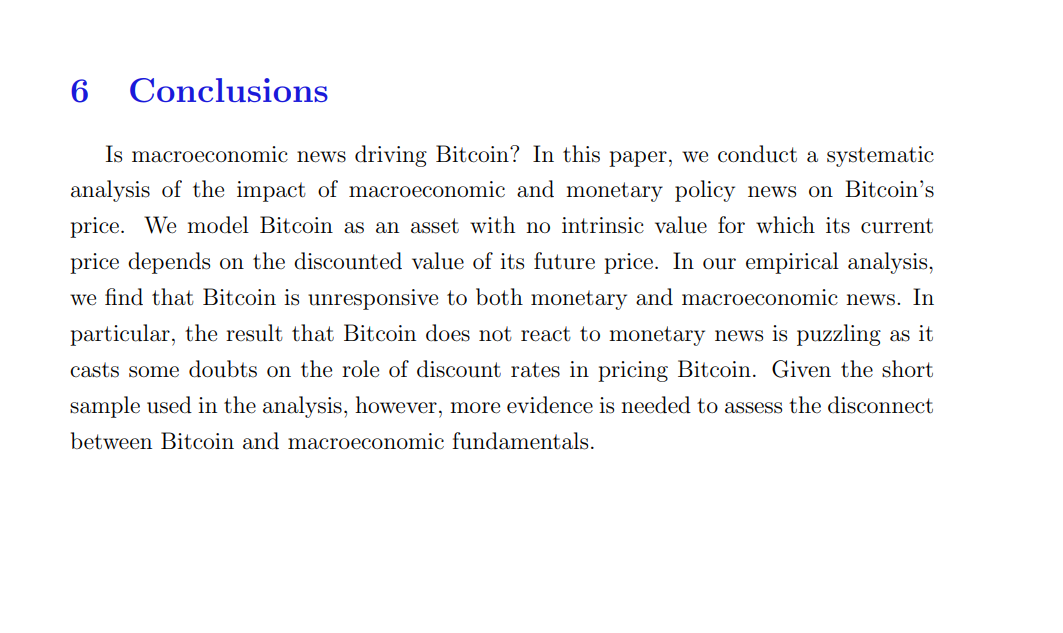
Academic findings complicate the tidy story. Early studies found essentially no relationship: a New York Fed staff report by Gianluca Benigno and Carlo Rosa, titled The Bitcoin-Macro Disconnect, documented that while stock prices respond to both the target and the expected path of policy, Bitcoin was unresponsive to unexpected changes in the short-term rate. Something then changed.
A study found that Bitcoin is unresponsive to both monetary and macroeconomic news. | Source: newyorkfed.org
Another Research published in the Journal of International Money and Finance using high-frequency event studies found Bitcoin historically did not respond to monetary policy announcements in any systematic fashion, but began doing so after late 2020, with realized volatility around FOMC announcements rising sharply. Since then, Bitcoin has responded to monetary news qualitatively like stocks, foreign exchange, and gold, but quantitatively even more strongly.
Magnitude estimates put numbers on the sensitivity. One study found that on FOMC meeting days, an unexpected tightening of just 1 basis point in the two-year Treasury yield is associated with a 0.25% drop in Bitcoin’s price.
Words matter as much as actions: a 2026 study using language models to classify more than 118,000 market messages found hawkish narratives consistently trigger negative Bitcoin price responses independently of actual rate adjustments, meaning the tone of a press conference can move the asset even when policy stays frozen.
Inflation hedge claims fare poorly in this literature, as Bitcoin’s heightened sensitivity to CPI releases in the post-2020 environment shows it trades as a risk asset when inflation surprises, falling on hot prints rather than rising as a hedge would.
Reading 2026 Through the Warsh Fed
This year has stress-tested every finding above. The Fed has not moved since cutting 25 basis points in December 2025, Jerome Powell’s final act before Kevin Warsh took over, and July’s hold extended the pause to a fifth consecutive meeting.
Nothing about the pause has been calm. June produced a unanimous hold alongside projections showing half the committee expecting hikes, while July’s 9 to 3 vote saw Beth Hammack, Neel Kashkari, and Lorie Logan dissent in favor of an immediate increase, and Chair Warsh declined to rule out a September hike.
Warsh’s communication doctrine adds a variable the older studies never measured. He has pledged to share less forward guidance than his predecessors, and July’s decision arrived without a Summary of Economic Projections, leaving markets to price policy from data alone.
Hike odds consequently swung from roughly 11% to 38% in nine days before the meeting, one of the fastest repricings on record, and Treasury yields did the tightening the committee withheld, with the 30-year pushing above 5.20% for the first time since 2007.
For Bitcoin, guidance withdrawal means announcement-day volatility now stretches across the entire inter-meeting period, since every CPI print, oil spike, and Fed speech carries information the dot plot once summarized.
Bitcoin’s 2026 price action fits the research surprisingly well. Trading near $64,000, down from levels above $80,000 earlier in the Warsh transition, the asset has tracked liquidity expectations rather than its own supply fundamentals, with spot ETF flows amplifying the linkage: June’s record $4.5 billion outflow month coincided with hawkish repricing, and July’s partial inflow recovery accompanied hopes of a friendlier Fed.
The Federal Reserve held interest rates steady at 3.5%–3.75%, but the bigger story was the dissent inside the committee.
Three policymakers voted against the decision, signaling that support for higher rates is no longer limited to isolated comments outside the meeting.
Bond Markets Flash a Warning, an Analyst Says Bitcoin Cannot Ignore
Rising long-end yields carry a darker message than simple repricing, according to onchain analyst Darkfost, who argued in a post on X that the bond market’s reaction reflects eroding faith in US debt itself.
“During the press conference a fairly hawkish tone was used and it was confirmed that the 2% inflation target remains the only target to reach. Yet the Fed decided not to act even though inflation remains much higher,” he wrote, noting the 9 to 3 vote meant “this was not a consensus” and marked the longest pause since the 2008 crisis.
Yield levels, in his view, tell the real story. With the 10-year T-Note reaching 4.7% and the 30-year surpassing 5.2%, a record since 2007, Darkfost argued “the tightening of monetary conditions continues and this dynamic reflects investors’ loss of confidence,” meaning holders of US debt, institutions and governments among them, “do not trust the US’s ability to control inflation and its deficit, and holding this debt currently seems riskier to them.”
10 year T-Note reached 4.7% and the 30 year surpassed 5.2%, a record since 2007. | Source: @Darkfost_Coc on X.
Implications for Bitcoin follow directly. “For a risk asset like Bitcoin, this vice tightening liquidity even further is not a positive development, especially with the dollar mechanically strengthening at the same time,” he wrote, adding that Bitcoin “had never faced rates this globally high during its other cycles, while the need for liquidity keeps growing as its market cap continues to climb.”
His conclusion carries a contrarian twist: conditions are “reaching extremes today, which will push the Fed to act if it doesn’t want to lose control and investors’ confidence,” suggesting the pressure itself becomes the catalyst for eventual easing.
Is the Coupling Starting To Loosen?
Not everyone reads the Fed as Bitcoin’s dominant force. Orkun Kilic, co-founder and CEO of Chainway Labs, told CCN that policy sets the stage without writing the script.
“Fed decisions only set the macro backdrop; they can hint towards where Bitcoin’s price may move, but it doesn’t necessarily define Bitcoin’s destiny. Rate policy still influences liquidity and risk appetite, but Bitcoin has been gradually decoupling from traditional risk assets as ETF flows, onchain activity, and derivatives positioning play a bigger role. Even after this week’s widely expected hold at 3.50%-3.75%, Bitcoin barely moved, very aligned with the kind of muted reaction we’ve seen in recent cycles,” Kilic said.
Wednesday’s tape supports the observation, since a percent-sized move through a contested Fed decision counts as calm by Bitcoin’s standards, even as equities swung through trillions in market cap. Kilic argues the durable answer lies in what gets built rather than what gets priced. “I’ve said this before, but Bitcoin has to become a productive financial layer that enables lending, settlement, and stablecoin liquidity secured by Bitcoin itself,” he said.
Hawkish Risk and the Emerging Market Bid
Complacency about the hold is its own risk, according to Mamadou Kwidjim Toure, CEO and founder of Ubuntu, who told CCN that the dissent deserves more weight than markets are giving it.
“The Fed’s decision to hold rates was widely expected, but the three votes in favor of a hike show that concerns about inflation remain very much alive within the committee. I think markets may be underestimating the risk of the Fed becoming more aggressive again if upcoming inflation data remains elevated. That would likely tighten liquidity, pressure risk assets, and could trigger forced selling among leveraged crypto traders, potentially interrupting Bitcoin’s current momentum,” Toure said.
Demand for Bitcoin, he argued, increasingly comes from places the FOMC never discusses. “At the same time, Bitcoin’s investment case extends beyond US monetary policy. In many emerging markets, people are not focused on the next Fed meeting. They are focused on preserving their purchasing power amid weakening local currencies. Bitcoin’s fixed supply and global accessibility make it an increasingly attractive alternative where access to stable foreign currencies is limited or unreliable.”
Volatility, in his view, stays elevated either way. “Looking ahead, I expect Bitcoin to remain volatile as markets reassess the path of inflation and interest rates heading into September. Each new inflation reading will influence expectations for the Fed’s next move. However, in regions where confidence in local currencies continues to erode, demand for alternative stores of value is likely to persist regardless of the outcome of any single Fed decision,” Toure said.
What To Watch From Here
Three lessons emerge for anyone tracking the relationship:
Expectations move Bitcoin more than decisions, so CME FedWatch probabilities and Treasury yields matter more than meeting outcomes themselves, which are usually priced by announcement day.
Communication is policy, since research shows hawkish language alone depresses prices, making Warsh’s press conferences events in their own right.
Finally, the relationship is not fixed: the same literature that documents Bitcoin’s post-2020 sensitivity also documents fifteen prior years of independence, and studies note responses change over time and can sometimes even switch signs.
Kilic’s decoupling thesis and Toure’s emerging market bid will get their test the same way the academic findings did, one meeting at a time, starting with September’s session, which carries a dot plot. Warsh may again decline to join, three dissenting hawks, and a live hike debate.
Disclaimer:
The information provided in this article is for informational purposes only. It is not intended to be, nor should it be construed as, financial advice. We do not make any warranties regarding the completeness, reliability, or accuracy of this information. All investments involve risk, and past performance does not guarantee future results. We recommend consulting a financial advisor before making any investment decisions.
Dr. Guneet Kaur is a senior editor at CCN.com and a Science Fellow at Exponential Science. She is a fintech and blockchain expert with extensive experience in digital finance education, blockchain ecosystems, and cryptocurrency markets. She has worked with global media such as Cointelegraph, as well as education and blockchain platforms, to design and lead strategic content and learning initiatives. As an educator and assessor for top-tier executive programs, she bridges real-world fintech trends with academic insight.
Dr. Kaur is also a published researcher and peer reviewer across fintech and data science journals, including Financial Innovation Journal and International Journal of Big Data Intelligence and Applications. Her work spans data-driven analysis, Web3 innovation, and technical content development. With a strong foundation in both industry and academia, she translates complex financial technologies into practical applications, empowering learners, professionals, and institutions across the rapidly evolving digital finance landscape.


 Easy
Easy