CLARITY Act Shelved: Bitcoin, ETH, XXRP Bleed $670M in Liquidations as Odds Crash to 37%
Share
Key Takeaways
Senate shelved CLARITY for Russia sanctions and Graham’s funeral, leaving days of floor time before August 8 recess.
Bitcoin fell to $63,157, XRP dropped 4.6%, and $670M was liquidated as Polymarket odds hit a record 37%.
Trump accepted ethics restrictions last week, but Democrats say they fall short of curbing his $1.4B crypto empire.
The Senate set aside the Digital Asset Market Clarity Act this week, prioritizing a package of federal nominations and a Russia sanctions bill dedicated to the late Senator Lindsey Graham, whose funeral occupies the chamber’s attention Tuesday and Wednesday.
With Senate procedure generally limiting the floor to one disputed bill at a time and the summer recess starting August 8, crypto’s central legislative effort now has days, not weeks, of realistic runway left in 2026.
BREAKING: 🇺🇸 U.S. Senate puts CLARITY Act on hold to prioritize Russia sanctions bill.
The vote is now unlikely before next week, leaving only the FINAL days before the Senate’s August 8 recess.
Markets absorbed the math immediately. Bitcoin (BTC) nearly dived below $63,000 in a sharp Monday evening selloff, trading at $63,268 (at the time of writing), down 2.97%, while Ethereum (ETH) fell 3.67% to $1,873 and XRP dropped 4.6% to $1.05.
More than $670 million was liquidated from the crypto market in 24 hours, with $533 million of that in bullish long positions, and the Fear and Greed Index registered “fear.”
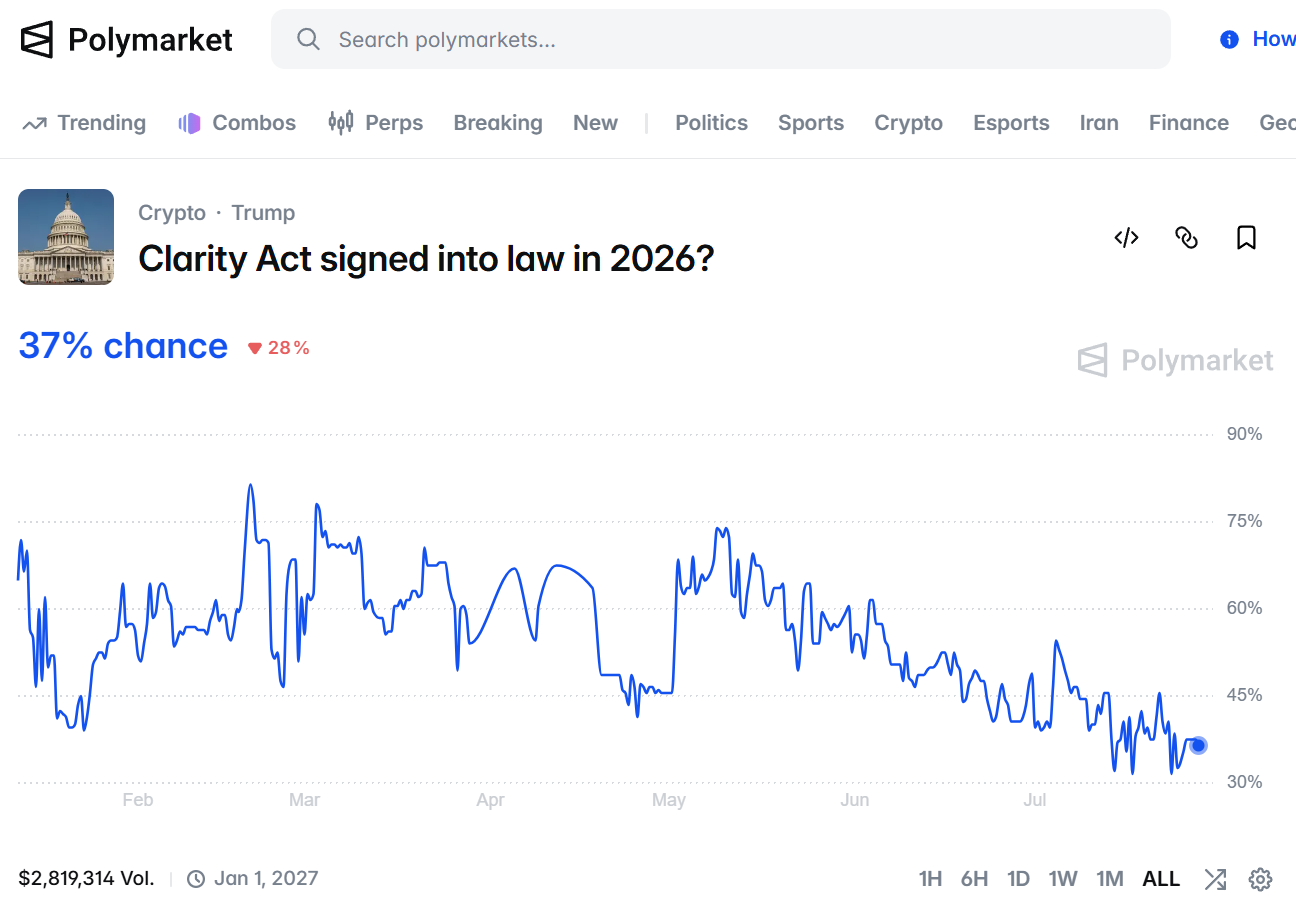
Polymarket odds of CLARITY Act crashed to a record low of 37%, down from 82% in February, completing a five-month collapse in market-implied confidence.
Polymarket CLARITY act odds fell to 37%. | Source: Polymarket
Try Our Recommended Crypto Exchanges
Sponsored
Disclosure
We sometimes use affiliate links in our content, when clicking on those we might receive a commission at no extra cost to you. By using this website you agree to our terms and conditions and privacy policy.
Ethics Fight Is the Actual Blocker, Not the Calendar
The Russia bill explains this week’s delay, but the unresolved dispute explains the odds. The contentious provision remains the ban on senior government officials, including President Donald Trump, backing crypto projects.
A potential breakthrough emerged last week when Trump agreed to accept restrictions limiting his interactions with digital assets, which White House officials framed as historic and unprecedented ethics constraints. Democrats countered that the limits fall short of curtailing Trump’s crypto businesses, which disclosed roughly $1.4 billion in 2025 income. Both sides agreed to keep talking, which is not the same as agreeing.
Majority Leader John Thune has said he hopes to reach CLARITY before the break but that leadership would have to see where the votes are. The best remaining scenario for the industry may be a preliminary cloture push in the final days before recess, starting the procedural clock even without completing a vote.
Industry advocates spent Monday pushing back on the bill’s critics. The Crypto Council for Innovation returned to Capitol Hill with a myth-versus-fact campaign, arguing CLARITY Act is the most comprehensive digital asset law enforcement bill to date rather than a weak-on-crime framework, pointing to expanded AML obligations, Treasury authority to restrict high-risk fund transfers, and an additional $150 million for FinCEN enforcement.
1/ It’s Monday and we have a big week ahead for the Clarity Act. As CCI goes back to the Hill, we are countering the Clarity myths and setting the record straight. 🧵 pic.twitter.com/ncGkYHZdTf
— Crypto Council for Innovation (@crypto_council) July 27, 2026
What Failure Actually Costs Each Asset
The fallback paths are real but slower: GENIUS Act implementation continues regardless, and the SEC and CFTC can deliver partial clarity through rulemaking.
Standard Chartered’s Geoffrey Kendrick holds conditional targets that show what is at stake, including an $8 XRP target contingent on full Senate passage plus $4 billion to $8 billion in ETF inflows, flows that do not materialize under agency guidance alone. XRP remains most exposed because the bill would convert its commodity classification into permanent statute.
The calendar from here is unforgiving. September offers a few final weeks of floor time, then the lame duck session after November’s elections, a period that produces either desperate dealmaking or paralysis.
Even Senate passage would send the bill back to a House recently hampered by Republican infighting, and Trump has refused to sign unrelated legislation until Congress delivers a voter-ID bill, though a 10-day period of presidential inaction would let an approved bill become law automatically.
Roughly ten days of remaining floor time will decide whether the market’s 37% odds underestimated or overstated the bill’s chances.
Steps CLARITY Still Needs To Clear Before Becoming Law
Passage is not a single vote but a sequence of procedural gates, each capable of consuming days the calendar no longer has. The bill has already cleared the Senate Banking Committee and passed the House in a different form, but what remains is the harder half. Here is what still has to happen.
Finalize the ethics text: Trump agreed last week to accept restrictions limiting his personal crypto dealings, a concession the White House framed as historic and unprecedented. Democrats rejected the language as insufficient to curb his crypto businesses, which generated roughly $1.4 billion in 2025 income. Both sides agreed to keep negotiating, but no compromise text exists yet. The stablecoin yield dispute, by contrast, was already resolved through language limiting rewards programs to formats that don’t resemble yield-bearing bank deposits.
File cloture: Thune must file a cloture motion to open debate, triggering a mandatory waiting period before the chamber can even vote on proceeding. Senate procedure generally allows only one disputed bill on the floor at a time, and the Russia sanctions bill currently occupies that slot.
Clear 60 votes: Invoking cloture requires seven to eight Democratic crossovers given the Republicans’ 52-seat majority, potentially 51 if Senator Mitch McConnell remains hospitalized. The senators publicly opposing the bill over ethics, including Murphy, Merkley, Van Hollen and Warren, are the same bloc whose votes are needed.
Survive floor debate and amendments: The ethics language Democrats want could reappear as a floor amendment in a form Republicans refuse to accept, potentially collapsing the deal after cloture succeeds.
Pass the Senate, then return to the House: The Senate version differs from the text the House approved nearly a year ago during Crypto Week, requiring another House vote in a chamber where Republican infighting has recently stalled unrelated legislation.
Reach Trump’s desk: He has publicly urged passage, but has refused to sign other bipartisan bills until Congress delivers voter-ID legislation. If he withholds his signature, a 10-day period of inaction would let the bill become law automatically.
The compression is the real obstacle. Cloture mechanics alone typically consume most of a week, the Senate returns for only a few weeks in September after the August 8 recess, and everything beyond that lands in a lame duck session that either produces desperate dealmaking or complete paralysis. Any single gate failing pushes the bill into 2027 and a new Congress that would renegotiate from scratch.
Disclaimer:
The information provided in this article is for informational purposes only. It is not intended to be, nor should it be construed as, financial advice. We do not make any warranties regarding the completeness, reliability, or accuracy of this information. All investments involve risk, and past performance does not guarantee future results. We recommend consulting a financial advisor before making any investment decisions.
Dr. Guneet Kaur is a senior editor at CCN.com and a Science Fellow at Exponential Science. She is a fintech and blockchain expert with extensive experience in digital finance education, blockchain ecosystems, and cryptocurrency markets. She has worked with global media such as Cointelegraph, as well as education and blockchain platforms, to design and lead strategic content and learning initiatives. As an educator and assessor for top-tier executive programs, she bridges real-world fintech trends with academic insight.
Dr. Kaur is also a published researcher and peer reviewer across fintech and data science journals, including Financial Innovation Journal and International Journal of Big Data Intelligence and Applications. Her work spans data-driven analysis, Web3 innovation, and technical content development. With a strong foundation in both industry and academia, she translates complex financial technologies into practical applications, empowering learners, professionals, and institutions across the rapidly evolving digital finance landscape.