Bridge Hacks Cost Billions: Here’s How to Safely Swap USDT on TRON Using NEAR Intents.
Share
NEAR Intents allows users to perform cross-chain swaps (e.g., USDT on TRON to tokens on NEAR or Ethereum) in one click, eliminating the need for bridging or multiple wallet setups.
The intent-based system abstracts blockchain complexity, making TRON’s DeFi ecosystem accessible to non-technical users, particularly for stablecoin transactions.
Supports AI-driven transactions and agent-driven finance, aligning with the $36B AI token market and enhancing TRON’s high-throughput (2,000 TPS) capabilities.
The beta launch in September 2024, combined with TRON’s stablecoin dominance and NEAR’s chain abstraction, positions this integration as a trending development with a potential for widespread adoption.
Using NEAR Intents on TRON makes cross-chain swaps simple. Instead of juggling multiple wallets or using risky bridges, you can swap assets like USDT on TRON to tokens on NEAR or Ethereum in just one step.
This works through an intent-based transaction system. Instead of telling the blockchain how to do something (e.g., which bridge or exchange to use), you simply state your intent, like “swap 100 USDT for ETH at the best rate.” A network of solvers then competes to find the best way to make it happen, and the transaction is settled securely.
The result: faster, safer, and easier cross-chain interactions without needing to understand the technical details.
This guide provides a step-by-step explanation of how to use NEAR Intents on TRON, tailored for both beginners and developers.
What Are NEAR Intents and Why Use Them on TRON?
NEAR Intents is a multichain transaction protocol that allows users to specify desired outcomes (e.g., “swap Token A for Token B”) and lets third-party solvers compete to provide the best execution path across blockchains.
Try Our Recommended Crypto Exchanges
Sponsored
Disclosure
We sometimes use affiliate links in our content, when clicking on those we might receive a commission at no extra cost to you. By using this website you agree to our terms and conditions and privacy policy.
By integrating NEAR Intents with TRON, users can perform cross-chain transactions, such as swapping assets, without needing to understand blockchain mechanics, set up wallets on each chain, or bridge assets manually.
The integration, announced on September 4, 2025, simplifies DeFi and AI-driven interactions by abstracting blockchain complexity, making TRON more accessible for users and developers.
How NEAR Intents Works
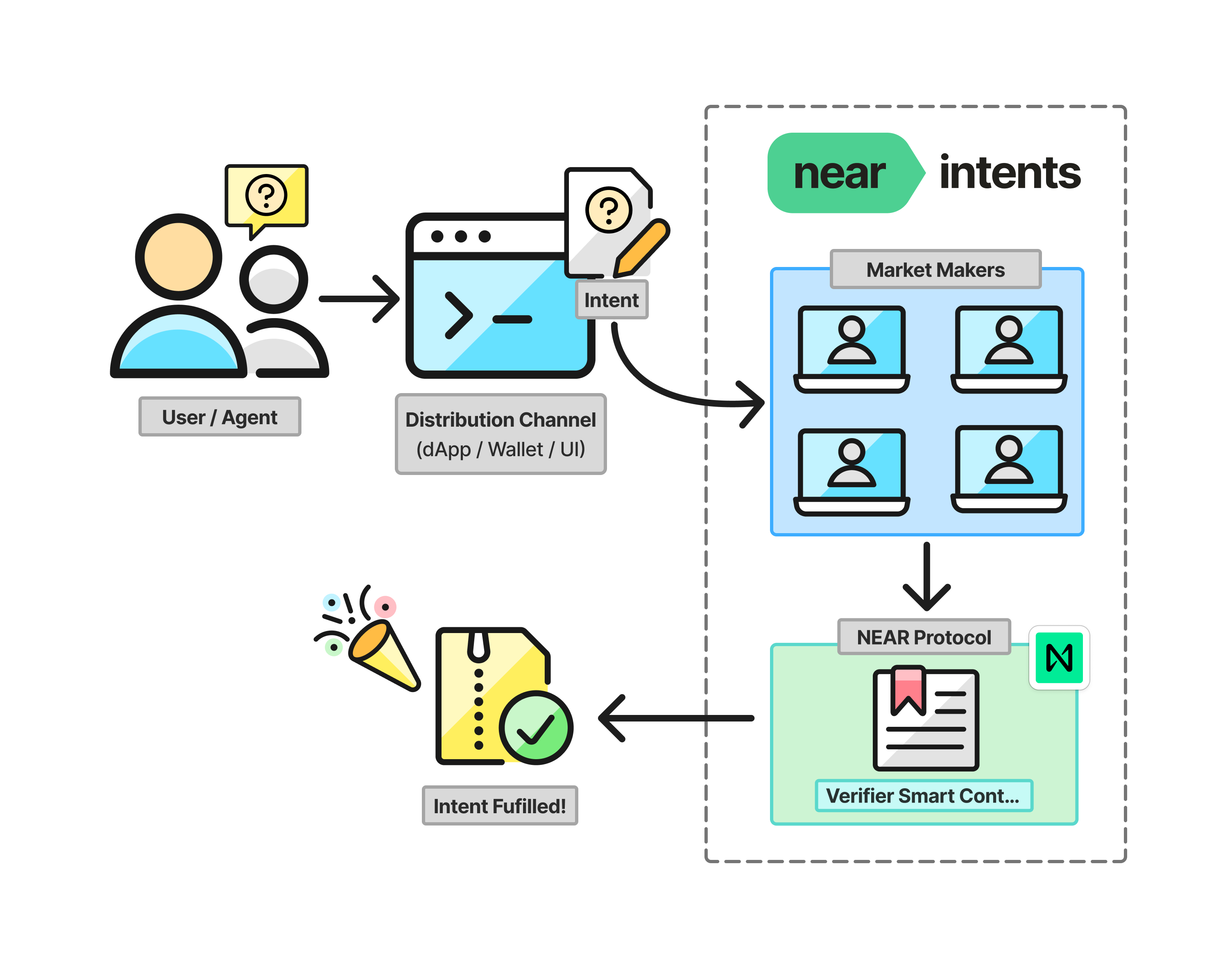
NEAR Intents is a simple way to do things like swap tokens across different blockchains (like TRON to Ethereum) without dealing with complicated steps. It’s like telling a smart assistant what you want, and it finds the best way to make it happen.
You decide what you want to do, like “swap 100 USDT on TRON for another token.” You enter this goal (called an intent) into a supported app or wallet, like one on SwapKit.dev. Your request is sent to a group of helpers called Solvers.
2. Solvers Find the Best Deal:
Solvers are like smart shoppers who search across blockchains and markets to find the cheapest and fastest way to complete your swap. They work off-chain (not directly on the blockchain) to find the best deal and send you a quote to approve.
3. Make It Happen Safely
If you like the quote, you approve it. A special program called a Verifier on the NEAR blockchain checks everything to make sure it’s safe and correct. Then, your swap happens automatically, and you get your tokens—no extra steps needed!
How Near Intents Work? | Source: docs.near.org
Who Should Care?
Users: Crypto enthusiasts, especially those using TRON for USDT transactions, benefit from simpler cross-chain interactions.
Developers: Those building dApps on TRON or NEAR can leverage Intents for innovative cross-chain solutions.
Investors: The rise of AI-driven DeFi and cross-chain protocols makes this a space to watch for investment opportunities.
Prerequisites
Before using NEAR Intents on TRON, ensure you have the following:
TRON-compatible wallet: A wallet like TronLink (browser extension or mobile app) to manage TRX and TRC-20 tokens (e.g., USDT).
TRX for fees: TRON transactions require bandwidth and energy, which can be covered by holding TRX (most transactions are low-cost or free within daily bandwidth limits).
Access to supported platforms: Use wallets or dApps that support NEAR Intents integration with TRON, such as those listed on SwapKit.dev. TRON addresses (Base58, start with T) and TIP-191 signing (e.g., TronLink) are listed as supported.
Basic understanding of Intents: Familiarity with intent-based systems helps, but NEAR Intents abstracts most complexities.
Internet connection: For interacting with blockchain explorers (e.g., TronScan) or APIs.
🚨 @trondao x NEAR Intents is LIVE$USDT swaps from $TRON to $NEAR; no wallet setup, no bridges, no chain switching.
Open the official demo: Go to the NEAR Intents demo site and choose a cross-chain token swap.
Connect TronLink when selecting TRON: When the demo needs your TRON account, TronLink will automatically inject TronWeb and prompt you to connect (and later to sign). Approvals appear in a wallet popup.
Submit your intent and review the quote: State the outcome you want (for example, “swap 100 USDT on TRON for ETH”). Off-chain solvers will compete to find the best path, and the app will display a quote.
Approve and execute: If you’re satisfied with the quote, approve it. The transaction is then executed through the NEAR Verifier smart contract. You’ll confirm where required with TronLink for the TRON side.
Verify on TRONSCAN (optional): After execution, check TRONSCAN (the official TRON explorer) to view your transaction details. You can search by your wallet address or transaction ID, and optionally sign in with TronLink for convenience.
Check balances (optional): Use your TronLink wallet or TronScan to confirm the updated balance of USDT or other tokens post-swap. For example, to check a USDT balance, interact with the TRC-20 contract using TronWeb or TronScan’s smart contract interface.
Explore further use cases(optional): NEAR Intents supports advanced use cases like trading NFTs, lending accounts, or even AI-driven transactions (e.g., agent-driven finance). Explore these on near.org/intents or SwapKit.dev.
For Developers
Confirm TRON support: TRON addresses (starting with “T”) and TIP-191 signatures are supported via wallets like TronLink.
Pick an integration method:
1Click API: Use REST endpoints for quotes, deposits, and status checks.
SDK (early stage): Embed ready-made components in your dApp.
Request and deposit
Call the /quote endpoint with swap details.
Send assets to the unique deposit address provided. Optionally, submit the deposit transaction hash for faster processing.
Track status: Use the /status endpoint to confirm when the transaction has executed
Handle signatures: For deeper integrations, use TIP-191 signing with TronLink to approve payloads, then pass them to the NEAR Verifier contract for settlement.
Manage TRON resources: Ensure the wallet has enough TRX to cover Bandwidth and Energy costs.
Show transaction details: Display transaction hashes or IDs so users can confirm execution on TRONSCAN.
Seamless cross-chain swaps: No need for bridging or wallet setup on other chains. Swap USDT on TRON to tokens on NEAR, Ethereum, or others in one click.
User-friendly: Abstracts blockchain complexity, making DeFi accessible to non-technical users.
Cost-effective: TRON’s low transaction fees (often negligible when bandwidth is available), combined with NEAR’s efficient solver network, minimize costs.
Scalability: TRON’s high throughput (2,000 TPS) and NEAR’s sharded Nightshade design ensure fast transactions.
AI and DeFi integration: Supports AI-driven transactions and agent-driven finance, opening new use cases.
Troubleshooting and Tips
Transaction fails: Ensure your wallet has enough TRX for bandwidth/energy. Check TronScan for transaction status.
Slow execution: Network congestion may delay intent resolution. Use platforms with optimized solvers like those on SwapKit.dev.
Stay updated: Monitor near.org/intents or SwapKit.dev for updates on NEAR Intents’ features, solver network improvements, or new integrations. Since the protocol is live on TRON, check TRON’s official channels (e.g., TRON DAO on X, Telegram, or Medium) for ecosystem-specific announcements.
Limitations and Considerations
Protocol maturation: As of September 2025, NEAR Intents is actively integrated with TRON, enabling cross-chain swaps without bridging. While core functionality is live, some advanced features (e.g., complex AI-driven intents or broader chain support) may still be under development or optimization, as is typical for newly launched protocols. Expect iterative improvements through Q1 2026 as the solver network scales.
No testnet deployment: According to the official NEAR Intents documentation, there is currently no testnet deployment — everything runs on mainnet only. That means you can’t try Intents on TRON’s Shasta testnet (or NEAR testnet) for now. The docs specifically state “no testnet deployment.
Regulations: If regulators tighten rules around stablecoin transfers or cross-border swaps, platforms using Intents could face stricter compliance requirements (e.g., KYC/AML checks). This may affect liquidity, accessibility, and the speed of adoption in certain regions.
Solver dependency: The efficiency of NEAR Intents relies on the solver network’s ability to find optimal cross-chain execution paths. Performance may vary based on liquidity, solver participation, or market conditions. For example, low liquidity for certain token pairs (e.g., TRX to obscure tokens) could result in suboptimal swap rates. Platforms like SwapKit.dev are working to expand solver networks to improve reliability.
Market and competition risks: TRON faces competition from other layer-1 blockchains like Ethereum, Solana, and Polkadot, which could impact its DeFi dominance. NEAR Intents competes with cross-chain solutions like Chainlink CCIP and LayerZero. While TRON’s low fees and 2,000 TPS throughput give it an edge, market volatility or regulatory changes could affect adoption.
How does NEAR Intents differ from traditional cross-chain bridges for TRON transactions?
Unlike traditional bridges, which require manual asset transfers and wallet setups across chains, NEAR Intents uses an intent-based protocol where users specify outcomes (e.g., “swap USDT for ETH”). Off-chain solvers find the best execution path, and a Verifier contract on NEAR ensures secure settlement, making it faster and more user-friendly.
Can I use NEAR Intents on TRON without holding NEAR tokens?
Yes, you don’t need NEAR tokens to use NEAR Intents on TRON. You only need TRX for TRON’s transaction fees (bandwidth/energy) and access to a compatible platform like SwapKit.dev. The intent system handles cross-chain interactions without requiring native tokens from other chains.
What happens if a solver gives me a bad swap rate for my USDT on TRON?
Solvers in NEAR Intents compete to find the best path for your cross-chain swap (e.g., USDT on TRON to ETH). If liquidity is low or solvers are limited, you might get a poor rate. To avoid this, use trusted platforms like SwapKit.dev, check quotes before approving, and ensure multiple solvers are active for better competition.
Do I need wallets on multiple blockchains to use NEAR Intents with TRON?
No. One of the main benefits of NEAR Intents is that it removes the need for multiple wallet setups. You can use a single TRON wallet (like TronLink) to initiate your swap, and the solver network handles the cross-chain execution behind the scenes.
Disclaimer:
The information provided in this article is for informational purposes only. It is not intended to be, nor should it be construed as, financial advice. We do not make any warranties regarding the completeness, reliability, or accuracy of this information. All investments involve risk, and past performance does not guarantee future results. We recommend consulting a financial advisor before making any investment decisions.
CCN Editorial delivers comprehensive coverage of cryptocurrencies, blockchain breakthroughs, decentralized finance, and emerging fintech trends. From Bitcoin and Ethereum to stablecoins, NFTs, and global market innovation, our team provides timely news, in-depth analysis, and expert commentary. In addition to market insights, CCN Editorial is dedicated to educating readers, offering accessible guides, explainers, and learning resources to help everyone, from beginners to professionals, navigate the rapidly evolving world of digital finance and the future of money.


 Intermediate