Visa, Mastercard, Coinbase and BlackRock Unite Behind OUSD: The First Real Threat to USDT and USDC?
Share
Key Takeaways
OUSD launches with 140+ partners including Visa, Mastercard, Stripe, BlackRock and Coinbase.
Revenue-sharing model overturns the issuer-keeps-the-reserves economics of USDT and USDC.
Coinbase and Ripple return to consortium stablecoins despite complicated histories with their own projects.
Success now depends on real payment adoption, liquidity and merchant usage, not partner announcements.
Open Standard’s launch of Open USD (OUSD) has landed with a roster few stablecoins have ever assembled at debut: Visa, Mastercard, Stripe, BlackRock, BNY, Coinbase, Google, IBM, Ripple, OKX, Standard Chartered and more than 140 other companies spanning banking, payments, technology and crypto.
Open USD is a stablecoin built for the internet economy, designed by the businesses growing it. | Source: Open Standard
The announcement moved markets within hours, with Circle’s stock dropping 13% as traders priced in OUSD as a direct competitor to USDT and USDC.
OUSD will be operated by Open Standard, an independent company whose board is composed of the stablecoin’s partners, with Zach Abrams serving as founding CEO.
Businesses will be able to mint and redeem OUSD without fees or volume limits, while most of the income from OUSD’s reserves goes to participating businesses after a small management fee, a direct inversion of the issuer-keeps-the-float model that built Tether and Circle.
Try Our Recommended Crypto Exchanges
Sponsored
Disclosure
We sometimes use affiliate links in our content, when clicking on those we might receive a commission at no extra cost to you. By using this website you agree to our terms and conditions and privacy policy.
Coinbase Has Been Here Before, and It Ended in a Buyout
Coinbase’s presence in the OUSD consortium carries history. Coinbase co-founded USDC’s original governance body, Centre Consortium, with Circle in 2018. Circle and Coinbase dissolved Centre in August 2023, citing changing regulatory conditions, and said USDC would instead be governed and operated in-house by Circle going forward, with Coinbase taking an equity stake in Circle as part of the change.
Circle’s IPO prospectus later disclosed it had paid Coinbase approximately $209.9 million in stock to acquire the remaining 50% stake in Centre, which was dissolved entirely in December 2023.
That history makes Coinbase’s return to a multi-party stablecoin governance model notable: this time the consortium spans 140-plus firms rather than two, and reserve earnings are structurally shared by design rather than negotiated bilaterally.
Ripple Backs a Stablecoin Built to Compete With Its Own
Ripple’s participation carries its own tension. Ripple kept its own stablecoin, RLUSD, and still signed on to OUSD. Ripple joins as a day-one integration partner rather than an issuer, positioning the XRP Ledger as one of several rails the coin could run on, profiting from the traffic whichever stablecoin wins.
RLUSD is issued by Standard Custody and Trust Company, a Ripple subsidiary, under a limited-purpose trust company charter from the New York Department of Financial Services and was positioned around regulatory standing and enterprise payments from day one.
Ripple has also joined OUSD as a day-one integration partner, supporting a stablecoin that will compete in many of the same institutional payments markets RLUSD targets.
OUSD Could Trigger Real-Time Stablecoin Competition
Will Harborne, co-founder and CEO of Rhino.fi, a stablecoin infrastructure provider for enterprises, told CCN the consortium model changes the competitive dynamic in a way previous stablecoin rivalries never did.
When asked whether OUSD is just more fragmentation layered onto the existing USDT-versus-USDC split, Harborne pushed back.
“Historically, USDT and USDC have mostly lived in different lanes, by geography and use case,” he said. “OUSD is different because it will overlap with the same businesses that previously favored USDC, so competition and migration will happen in real time, not gradually.”
On timing, Harborne said the operational impact won’t wait for full rollout.
“On cross stablecoin complexity, the problem becomes real as soon as OUSD launches,” he noted. “If the incentives are strong enough, you’ll see apps start migrating quickly, and that creates immediate confusion for businesses that now have to support multiple stablecoins in the same flow.”
He located the first point of breakage not in the back end, but in front of the customer.
“For consumer facing businesses, that’s where the friction bites first,” Harborne said. “Payments start getting sent in one stablecoin and received in another, refunds become messy, and support teams end up explaining why money moved, but not quite in the way anyone expected.”
Circle Stock Slides as Russell Index Removal Compounds OUSD Pressure
Circle’s market position was already under strain before OUSD’s announcement landed. According to Simply Wall St, Circle (NYSE: CRCL) was removed from several major Russell Growth Indexes during the annual Russell reconstitution on June 26, including the Russell 1000 Growth Index, Russell 3000 Growth Index and Russell Midcap Growth Index.
Index removals of this kind typically prompt institutions and passive funds tracking those benchmarks to reduce their holdings, putting additional pressure on trading liquidity at a moment when Circle can least afford it.
Circle (CRCL) got removed from multiple Russell Growth Indexes. | @WuBlockchain on X.
CRCL shares had already fallen 32.8% over the previous 30 days, reflecting selling pressure tied to index rebalancing, before OUSD’s launch added a new catalyst.
The stock fell to $62 on Tuesday, down 16.55% over the prior 24 hours, as investors weighed what a 140-company consortium offering zero-fee minting and reserve yield sharing could mean for a business built around retaining reserve income.
Circle’s latest decline reflects two separate pressures converging in the same week: passive fund outflows following its index removal and a market reassessment of USDC’s long-term economics after OUSD launched its consortium model.
While neither development alone determines Circle’s outlook, together they mark one of the company’s most significant public market tests since its NYSE debut in June 2025.
Infrastructure Test, Not Just a Token Launch
Alvin Kan, COO at Bitget Wallet, told CCN the launch should be read as a structural test rather than a product announcement.
“Open USD should be seen less as another stablecoin launch and more as a test of whether stablecoins can move into mainstream payment infrastructure,” he noted. “The stablecoin market is already around $312 billion, but much of that activity still sits in trading, settlement, and treasury use cases. The next frontier is merchant payments, institutional settlement, and real-time cross-border commerce.”
Kan pointed to the distribution model as OUSD’s sharpest competitive edge.
“Zero-fee minting and redemption, combined with partner revenue sharing, gives payment networks and financial platforms a stronger reason to support adoption,” he said. “If partners such as Stripe and Visa can make stablecoin settlement feel invisible to merchants and users, Open USD could become infrastructure rather than just another token.”
On what the market needs to see to take OUSD seriously, Kan pointed to several key metrics.
“USDT remains dominant, while USDC is already well established with institutions,” he argued. “Open USD will need to prove real usage through circulating supply growth, partner-led mint and redeem activity, merchant payment volume, institutional settlement flows, multi-chain adoption starting with Solana and Ripple integrations, and sustained peg stability.”
He set out a two-horizon test.
“Near term, the market should watch whether Open USD can build liquidity beyond announcements,” he said. “Mid-term, if real payment demand grows, it could become a meaningful step toward stablecoins becoming core financial infrastructure.”
Roster Built to Bridge, Not Pick Sides
Stripe’s Gaybrick said OUSD will become the default stablecoin for businesses using its platform.
DoorDash co-founder Andy Fang pointed to faster, more affordable access to cross-border earnings, and BNY emphasized the value of neutral, interoperable digital asset infrastructure for institutional participants.
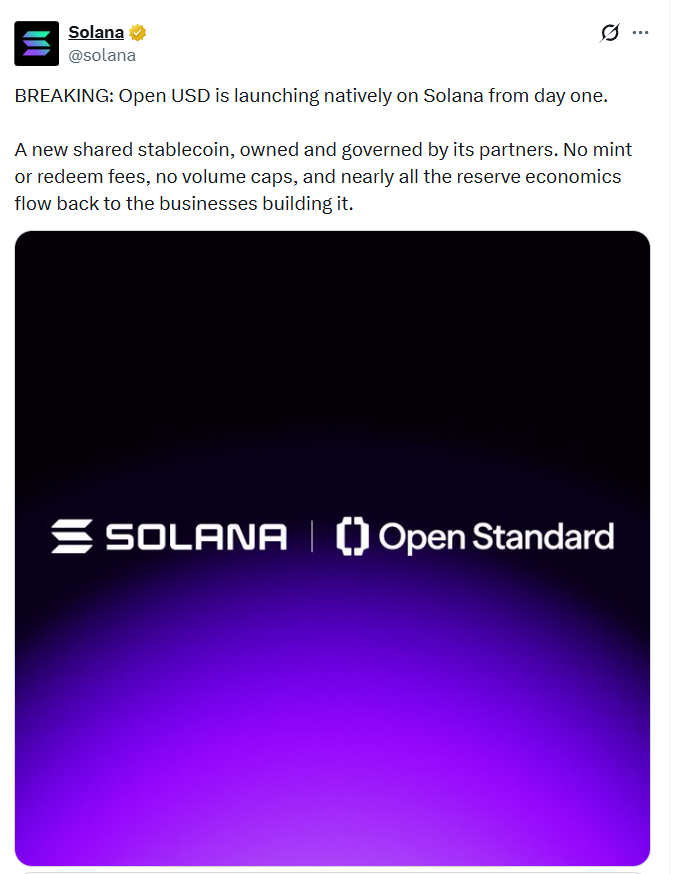
OUSD goes live across Solana, Stellar, Base, Polygon and other chains later in 2026.
Open USD is launching natively on Solana from day one. | Source: @solana on X
Biggest Open Question
Two of the loudest names in the launch lineup, Coinbase and Ripple, are both walking back into multi-party stablecoin territory carrying scar tissue from their own prior arrangements: one from a consortium that ended in acrimony and a nine-figure buyout, the other from a coin it now risks cannibalizing.
Whether OUSD’s governance structure survives contact with competing commercial interests any better than Centre did, or whether Ripple’s day-one hedge becomes the model every issuer follows, is the question that decides if this is Libra‘s second act or a genuine rewiring of how money moves.
Disclaimer:
The information provided in this article is for informational purposes only. It is not intended to be, nor should it be construed as, financial advice. We do not make any warranties regarding the completeness, reliability, or accuracy of this information. All investments involve risk, and past performance does not guarantee future results. We recommend consulting a financial advisor before making any investment decisions.
Dr. Guneet Kaur is a senior editor at CCN.com and a Science Fellow at Exponential Science. She is a fintech and blockchain expert with extensive experience in digital finance education, blockchain ecosystems, and cryptocurrency markets. She has worked with global media such as Cointelegraph, as well as education and blockchain platforms, to design and lead strategic content and learning initiatives. As an educator and assessor for top-tier executive programs, she bridges real-world fintech trends with academic insight.
Dr. Kaur is also a published researcher and peer reviewer across fintech and data science journals, including Financial Innovation Journal and International Journal of Big Data Intelligence and Applications. Her work spans data-driven analysis, Web3 innovation, and technical content development. With a strong foundation in both industry and academia, she translates complex financial technologies into practical applications, empowering learners, professionals, and institutions across the rapidly evolving digital finance landscape.