CLARITY Act Recess Deadline Looms: Will the Crypto Bill Pass by July 4?
Share
Key Takeaways
The CLARITY Act faces a critical four-week window before Congress’s July 4 recess, but key disputes over ethics rules, DeFi oversight, and anti-money laundering provisions remain unresolved.
Despite bipartisan momentum, the bill still needs 60 Senate votes to overcome a filibuster, with Democratic support contingent on further amendments and negotiations.
Supporters argue the legislation would provide long-awaited regulatory clarity for crypto markets, while delays risk pushing innovation and capital toward jurisdictions such as the EU, Dubai, Singapore, and Abu Dhabi.
The Digital Asset Market Clarity Act is sitting on the Senate Legislative Calendar with a four-week window to reach a floor vote before Congress breaks for the July 4 recess, and the path to 60 votes remains unresolved on at least three substantive issues that have held up Democratic support since the bill cleared the Senate Banking Committee last month.
The margin was enough to move the bill forward, but not enough to signal the 60 votes needed to overcome a filibuster on the Senate floor.
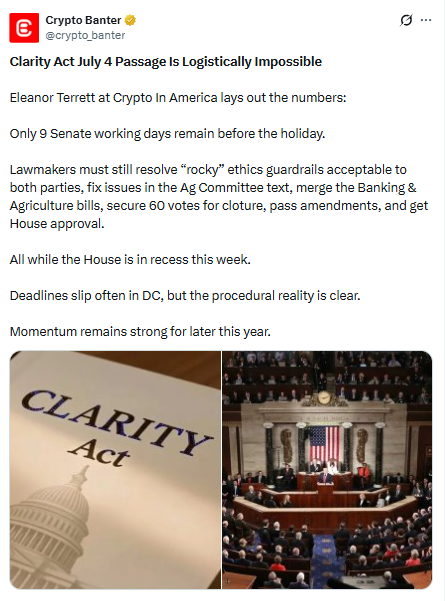
Clarity Act’s July 4 passage seems impossible. | Source: @crypto_banter on X.
The two Democrats who voted yes each said their committee votes did not guarantee floor support without further progress on outstanding issues, leaving the vote count publicly unresolved as floor time approaches.
JUST IN: 🇺🇸 White House Official Patrick Witt says they're aiming to pass crypto Clarity Act by July 4th.
Ethics Rules, DeFi Oversight, and AML Requirements Remain Key Hurdles
Three issues have dominated the final weeks of negotiation. Ethics language requiring government officials with ties to the crypto industry to recuse themselves from related regulatory decisions has been the most publicly contested provision, driven in part by scrutiny of the Trump family’s crypto holdings and World Liberty Financial’s expanding stablecoin operations.
Senate Democrats have made the ethics provision a condition of their floor votes, while Republicans have resisted language they argue would set a precedent beyond what existing ethics rules require.
DeFi provisions represent the second fault line. The bill, as written, establishes a framework for dividing crypto oversight between the SEC and the CFTC, and how decentralized protocols are classified under that division has drawn objections from both the crypto industry, which wants DeFi explicitly excluded from broker-dealer requirements, and from Senate Democrats, who want stronger consumer protection provisions applied to DeFi platforms before they receive regulatory clarity.
Illicit finance requirements make up the third unresolved cluster. Law enforcement agencies have pushed for on-chain transaction monitoring obligations and clearer AML provisions covering decentralized exchanges and self-custodied wallets.
Those provisions have created tension with the crypto industry’s core argument that privacy and self-custody are non-negotiable features of the technology.
What the Bill Does for Consumers
Orest Gavryliak, chief legal officer at DeFi protocol 1inch, said the most immediate benefit the bill delivers to ordinary users is not a specific protection mechanism but something more foundational.
“Even the best companies in nascent industries, especially those in crypto and DeFi, struggle to earn public trust quickly,” Gavryliak said. “Government-backed standards introduced through the Clarity Act can establish trust. Consumers wouldn’t need to understand DeFi; they could rest assured that they are dealing with a regulated industry with government oversight, risk management requirements, and mandated channels for recourse and grievances.”
Gavryliak also pointed to the bill’s relevance beyond current crypto use cases, arguing it lays the groundwork for the next wave of interactions between users and AI agents. “Blockchain infrastructure will provide the seamless backend for AI to execute trades, handle investments, and engage with networks on users’ behalf,” he said. “Having a regulated, structured environment in place before that wave arrives is exactly the kind of forward-thinking consumer protection that matters most.”
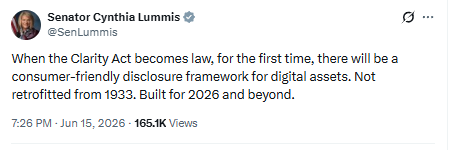
Senator Lummis on Clear rules for digital asset markets. | Source: @SenLummis on X.
Where Consumer Protection Falls Short
Gavryliak acknowledged the bill leaves significant ground uncovered.
“As the Clarity Act sets the market structure, it is relatively light in terms of nuanced consumer protections,” he said, adding that detailed rulemaking on recourse for fraud, disclosure standards and liability is expected to follow from the regulatory bodies the bill mandates rather than being specified in the legislation itself. “This is the first comprehensive attempt by the US to create standards for the crypto industry, so it is inevitable that it will not get everything right or cover all bases on the first try,” he said.
How the Crypto Bill Got Here
The House passed its version of the CLARITY Act in July 2025 with a bipartisan margin of 294-134, handing the Senate a finished framework that had taken more than two years to assemble. The Senate, rather than taking the House text, began building its own version, a process that produced a 182-page draft from the Banking Committee, a competing framework from twelve Senate Democrats, and months of negotiation before the May 14 markup.
The bill was placed on the Senate Legislative Calendar under General Orders on June 1, making it formally eligible for floor consideration, but Senate leadership must still schedule the debate and vote, and the bill must still be reconciled with the Senate Agriculture Committee’s version before a unified text can go to the floor.
The CLARITY Act was placed on the Senate legislative calendar under general orders. | Source: @BullTheoryio
That reconciliation step, which involves resolving differences between the Banking and Agriculture committee texts on how digital commodities are defined and regulated, has not been completed publicly as of mid-June.
Momentum Has Shifted Even if the Timeline Has Not
Markus Levin, co-founder of blockchain data network XYO, argued the July 4 deadline matters less than what it represents.
“A year ago, crypto regulation was still mostly a partisan fight,” Levin said. “July 4th is important because it represents newfound commitment behind it. Lawmakers, regulators, and financial institutions are now converging at the same point. The CLARITY Act, becoming law now, appears stronger than at any point in the industry’s history.”
Levin said the timeline may slip past the recess, but that the underlying debate has already shifted in a way the deadline cannot reverse. “The timeline may slip past the recess, but the broader momentum behind the CLARITY Act suggests the debate has shifted from whether digital asset market structure legislation should exist to what form it will ultimately take,” he said. “I expect further amendments to the bill as it moves through the legislative process, and the key question will be how lawmakers balance the interests of banking institutions and the crypto industry.”
Banking Competition and the Offshore Risk
Didier Lavallee, founder and chief executive of Tetra Digital Group, said the bill’s significance extends beyond its immediate regulatory provisions to the competitive structure of the financial system itself.
“For a long time, banks operated with little competition over how value moves through the financial system, a significant part of that was because the rules for alternative systems were unclear or didn’t exist,” Lavallee said. “The CLARITY Act begins to change that dynamic by creating a framework where blockchain-based networks can compete on a more equal footing.”
Lavallee argued the bill’s core question is one of economic geography as much as regulation. “This bill is about allowing markets to determine whether settlement, custody, asset issuance, and value transfer can be done more efficiently on open infrastructure,” he said. “What Congress is ultimately deciding is whether the US wants to lead that transition or watch it develop offshore and import it later.”
Lavallee added that the bill’s progress is being watched well beyond Washington.
“Developments like the CLARITY Act are also being closely watched beyond the United States, including in Canada, as policymakers and industry participants consider the increasing role digital assets play in financial markets and infrastructure,” he said.
“Whether the bill reaches the President’s desk by July 4 or later this year, the more important takeaway is that the US is making meaningful progress toward establishing a comprehensive framework for digital asset markets. Greater regulatory clarity helps support continued innovation, investment, and institutional participation across the sector.”
60 Votes Remain the Hard Constraint
Agata Ferreira, chief legal officer supporting Logos, said the July 4 target was never a realistic legislative deadline, regardless of the bill’s political momentum.
“The July 4 target was always more aspirational than realistic, not because of a lack of support; it clearly has significant political and industry support, but because there is simply very little time to complete the legislative process,” Ferreira said. “Key issues remain unresolved, and negotiators still need to bridge meaningful policy differences before there is even a final bill to consider.”
Ferreira pointed to the Senate’s procedural requirements as the binding constraint that optimistic timelines tend to underestimate. “Even then, the bill would need 60 votes to invoke cloture and overcome a Senate filibuster, meaning it must attract bipartisan support,” she said. “Building that coalition will take further negotiations, potential amendments, and time for the Senate to complete the required procedural steps.”
The CLARITY Act could unlock a wave of institutional capital.@CodyCarboneDC CEO of @DigitalChamber, says major products for U.S. investors are ready but waiting for clear rules on tokens, listings and SEC/CFTC oversight. Now the Senate needs 60 votes. pic.twitter.com/vZ0aWemhID
Missing the July 4 recess deadline does not kill the bill, but it narrows the remaining window significantly. The Senate returns from recess in mid-July, and the midterm campaign recess begins in early October, leaving roughly 18 working weeks of available legislative time between now and when Congress effectively disperses for the election cycle.
Every week of floor time consumed by other priorities, including appropriations, judicial confirmations, and the debt ceiling, shrinks the window further.
Treasury Secretary Scott Bessent has warned publicly that regulatory delay is pushing digital asset development toward Dubai, Singapore and Abu Dhabi, which are actively competing for US crypto capital with licensing frameworks already in place.
Congress has spent the better part of half a decade trying to pass a framework to onshore the future of finance.
It is time for @BankingGOP to hold a markup and send the CLARITY Act to President Trump’s desk.
Senate time is precious, and now is the time to act.
— Treasury Secretary Scott Bessent (@SecScottBessent) April 9, 2026
Whether the four-week window before the July recess is enough to resolve the ethics language, reconcile the committee texts, and secure seven Democratic floor votes is the open question the next three weeks will answer.
Disclaimer:
The information provided in this article is for informational purposes only. It is not intended to be, nor should it be construed as, financial advice. We do not make any warranties regarding the completeness, reliability, or accuracy of this information. All investments involve risk, and past performance does not guarantee future results. We recommend consulting a financial advisor before making any investment decisions.
Dr. Guneet Kaur is a senior editor at CCN.com and a Science Fellow at Exponential Science. She is a fintech and blockchain expert with extensive experience in digital finance education, blockchain ecosystems, and cryptocurrency markets. She has worked with global media such as Cointelegraph, as well as education and blockchain platforms, to design and lead strategic content and learning initiatives. As an educator and assessor for top-tier executive programs, she bridges real-world fintech trends with academic insight.
Dr. Kaur is also a published researcher and peer reviewer across fintech and data science journals, including Financial Innovation Journal and International Journal of Big Data Intelligence and Applications. Her work spans data-driven analysis, Web3 innovation, and technical content development. With a strong foundation in both industry and academia, she translates complex financial technologies into practical applications, empowering learners, professionals, and institutions across the rapidly evolving digital finance landscape.