Here's why Bitcoin's price may be in trouble | Source: CCN
Share
Key Takeaways
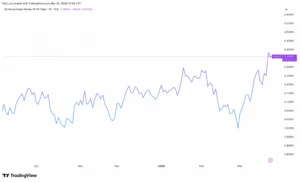
The U.S. 10-year Treasury yield is climbing towards what analysts describe as the “danger zone.”
Rising yields strengthen the dollar and create structural pressure on Bitcoin and other risk-sensitive assets.
Bitcoin’s gains driven by U.S.-Iran headlines quickly reversed after conflicting reports.
Bitcoin climbed on Tuesday amid volatile signals around U.S.-Iran tensions, as a sharp rise in U.S. Treasury yields pushed yields toward levels that have previously destabilized markets.
A rise towards the so-called “danger zone” in the U.S. 10-year Treasury yield has raised concerns from analysts about potential damaging pressure on Bitcoin and the wider crypto market.
Try Our Recommended Crypto Exchanges
Sponsored
Disclosure
We sometimes use affiliate links in our content, when clicking on those we might receive a commission at no extra cost to you. By using this website you agree to our terms and conditions and privacy policy.
The U.S. 10-year Treasury yield has risen sharply since the latest escalation in the Iran conflict began in late February, climbing roughly 45 basis points and nearing 4.40%, according to market estimates.
Market commentary from The Kobeissi Letter suggests investors are closely watching the 4.50%–4.60% range, which previously prompted policy shifts from the White House.
Oil prices are no longer the biggest threat to markets.
It has become increasingly clear that bond markets will dictate just how long President Trump can continue increase pressure in the Iran War.
The 10Y Note Yield is now up ~45 basis points since the war began on February… pic.twitter.com/UwVtZPx06B
In April 2025, yields breaching that level coincided with President Donald Trump pausing reciprocal tariffs amid concerns over tightening financial conditions.
Analysts warn a return to that range could once again force policy recalibration, with some arguing the U.S. economy would struggle to absorb a sustained move toward 5% yields.
“Don’t forget: we cannot afford a 5% 10Y Note Yield,” Adam Kobeissi wrote on X.
Why Rising Yields Threaten Bitcoin
Higher Treasury yields pose a structural challenge for Bitcoin and other non-yielding assets by increasing the relative attractiveness of government bonds.
As yields climb, investors can secure stronger returns from Treasuries with lower perceived risk, raising the opportunity cost of holding assets like Bitcoin.
At the same time, elevated yields tend to support the U.S. dollar, tightening global liquidity conditions and weighing on alternative stores of value.
Market participants say this dynamic has been one of the most consistent macro forces shaping crypto performance over the past year, even if short-term price movements occasionally diverge.
US 10-Year Treasury Yield Chart | Credit: TradingView
Higher rates can also weigh on valuations more broadly.
As the discount rate rises, the value of future gains declines, dampening investor appetite for speculative assets such as Bitcoin.
Additionally, higher yields can drive portfolio rebalancing, with investors rotating toward fixed income as returns become more competitive, reducing demand for cryptocurrencies.
Together, these forces mean that even if Bitcoin benefits from geopolitical uncertainty in the short term, a sustained rise in yields can act as a persistent headwind, limiting the durability of rallies.
“Looking ahead, prolonged conflict could force significant increases in defense spending, further widening deficits and putting upward pressure on Treasury term premiums,” CCN analyst Victor Olanrewaju wrote in a report on Monday.
Adding: “Until the Strait of Hormuz reopens and oil stabilizes, yields and inflation pressure have room to climb further.”
Bitcoin Rises Despite Conflict Uncertainty
Despite these headwinds, crypto markets rallied early this week after Trump said the United States would delay potential strikes on Iran’s power infrastructure for five days, describing talks as “productive.”
The announcement briefly eased fears of a broader regional escalation, with Ethereum, Solana, and other major tokens rising alongside Bitcoin.
However, the optimism proved short-lived.
Iran’s Fars news agency denied that any talks had taken place, citing an unidentified source, which contributed to a price pullback later in the day.
In line with the announcements, Bitcoin climbed above $71,000 in early Monday trading before retreating quickly after Iran’s conflicting response.
However, at the time of reporting, Bitcoin’s price is sitting at around $71,224, up almost 5% in the last 24 hours.
The geopolitical backdrop remains highly uncertain.
Iran continues to launch strikes across the Gulf, while any lasting de-escalation would likely require broader agreement, including from Israel.
BBC Chief International Correspondent Lyse Doucet said signs of progress remain limited, noting Iran’s deep mistrust of U.S. intentions after previous talks collapsed amid military action.
“Reports suggesting a breakthrough appear premature,” she said, pointing to only “very preliminary” contacts between officials and ongoing mediation efforts by regional powers including Oman, Turkey and Egypt.
Kurt Robson is a London-based reporter at CCN, specialising in the fast-moving worlds of crypto and emerging technology. He began his career covering local news in Cornwall after graduating from Falmouth University with First Class Honours in Journalism. There, he cut his teeth on everything from council meetings to missing swans.
He quickly rose through the ranks to become a frontline journalist at several of the UK’s leading national newspapers. Over the years, he has interviewed musicians and celebrities, reported from courtrooms and crime scenes, and secured multiple front-page exclusives.
Following the upheaval of the COVID-19 pandemic, Kurt shifted his focus to technology journalism—just ahead of the AI boom. With a natural curiosity and a trained eye for emerging trends, he has found a new rhythm in reporting on innovation.
At CCN, Kurt's work focuses on the cutting edge of crypto, blockchain, AI, and the evolving digital world. Drawing on his background in people-first reporting and his deep interest in disruptive tech, Kurt delivers stories that are insightful, entertaining, and human-centric.