SWIFT-Ripple Partnership Rumor Sends XRP Community Into Overdrive Ahead of Possible Announcement
Share
Key Takeaways
XRP enters Q1 2026 at a crossroads after one of its most volatile years, with price swinging from a July record of $3.66 to an October low near $0.78.
Fundamentals are improving even as technicals remain weak, creating a setup where policy and institutional catalysts may outweigh traditional chart signals.
Progress on U.S. crypto market-structure legislation is the most critical near-term driver.
The $2.00 level remains a significant psychological and technical inflection point.
XRP enters 2026 carrying the scars and the opportunity of one of its most volatile years on record. In 2025, XRP surged to a record high of $3.66 in July before plummeting to $0.7773 in October, a swift reversal that reminded traders and long-term holders alike that narrative-driven rallies can unwind rapidly when macroeconomic conditions, regulatory timelines, and market structure shift.
Heading into Q1 2026, the setup looks unusually “split-brain.” On one hand, technicals deteriorated into the year-end after a multi-month downtrend. On the other hand, fundamentals have improved materially, and the list of potential catalysts for renewed institutional demand is longer than it has been in years, especially if U.S. market-structure legislation advances and the spot ETF pipeline accelerates.
The key for Q1 is understanding one reality: XRP is a catalyst-sensitive asset. It tends to re-rate quickly when the market perceives “legitimization” (legal, regulatory, distribution, or utility-driven). And it tends to de-rate quickly when those catalysts stall.
Below are the main XRP price drivers to watch in Q1 2026, with a blend of narrative context and actionable checkpoints.
1. US Crypto Market Structure Bill Update: How Regulation Could Move XRP Price
If tracking XRP historically, one theme is consistent: regulatory clarity tends to matter more for XRP than for most large-cap tokens, because Ripple’s lengthy battle with U.S. regulators made classification risk a central part of the story.
That’s why progress on the Market Structure Bill (often framed as “crypto market structure” or “Clarity”) is arguably the single most important Q1 driver.
XRP main events in 2025. | Credit: FXEmpire/TradingView
A few reasons this matters for price:
Institutional eligibility expands when the rules of the road are more straightforward.
ETF flows tend to grow when compliance risk shrinks.
Brokerage and bank participation increase when legal ambiguity fades.
“Is it safe to hold?” turns into “How much exposure do we want?”
XRP has already demonstrated its sensitivity to this topic. XRP surged sharply when the House passed the bill to the Senate, and it weakened meaningfully after the U.S. government shutdown delayed progress. That’s not because the market “loves politics.” It’s because capital hates uncertain enforcement risk.
January: Senate markup process (the “sausage-making” stage markets tend to trade in real-time).
Headlines about committee timelines, amendments, and floor vote probabilities.
Statements from key policymakers that signal whether passage is “when,” not “if”.
In practice, XRP often trades these developments like earnings: it doesn’t need final passage to move; it requires confidence that passage is likely.
2. XRP Spot ETF Flows to Watch in Q1 2026
The second major driver is institutional access, specifically, the acceleration of spot XRP ETF availability and demand.
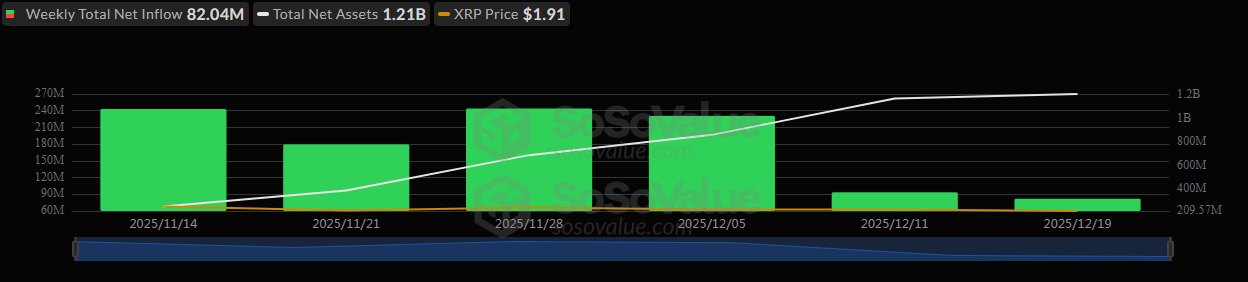
XRP ETF weekly inflows. | Credit: SosoValue
In 2025, optimism surrounding XRP spot ETFs became a key bullish catalyst, but delays also became a significant bearish factor. In Q1 2026, the story becomes more mechanical, focusing on flows and launches.
Why flows matter more than headlines:
ETF flows are one of the cleanest real-time indicators of institutional demand.
Persistent inflows tighten the supply-demand balance in a way that narratives can’t replicate.
Strong flows can shift the market from “speculative” to “allocational”.
According to SosoValue, the U.S. XRP spot ETF market saw over $1.07 billion in net inflows in the first month across five issuers, a strong signal that demand exists even after a volatile year.
A key structural accelerant here is the SEC’s Generic Listing Standards (GLS) approval (October), which reduces the typical 240-day process and can allow qualifying products to list after a short waiting period. If that framework stays intact, it increases the odds that Q1 features multiple new listings, not just a slow drip.
What to watch in Q1 2026:
Weekly net flows (inflows that persist matter more than one-off spikes).
Announcements from issuers “next in line” (e.g., WisdomTree-type launches).
Whether ETF performance holds up during macro volatility (a stress test for “sticky” demand).
A simple rule of thumb: if ETF inflows remain consistently positive through Q1, XRP’s downside tends to be better supported. If inflows stall or flip to outflows, the market typically reprices quickly.
3. Ripple Banking License News: Why XRP Utility Could Increase in 2026
In crypto, price often runs on stories. In payments-focused networks, price also runs on utility credibility.
Ripple applied to establish a bank. | Credit: RippleXity X profile
The key idea isn’t “banks will buy XRP tomorrow.” The idea is that if regulated institutions increasingly use XRPL for cross-border settlement, FX bridging, and liquidity operations, XRP shifts from ‘a token you trade’ to ‘an asset you might need.’
Utility-driven demand tends to differ from speculative demand:
It is usually less reflexive.
It can be more persistent.
It often grows slowly, then surprises the market once its scale becomes visible.
Updates on final approvals and operational readiness.
New institutional partnerships or usage disclosures tied to settlement/liquidity.
Evidence of “Main Street” or enterprise utility that the market can quantify.
Even small signals matter here, because they reinforce the “XRP is functional infrastructure” framing that institutions are more comfortable underwriting.
4. XRP and Macro Conditions: Fed Rates, Liquidity & Risk Appetite in Q1 2026
XRP can rally hard on crypto-native catalysts, but it still trades inside a broader macro environment. The second half of 2025 highlighted how quickly a hawkish shift can pressure risk assets, including cryptocurrencies.
The macro checklist for Q1 2026 centers on liquidity conditions:
Concerns about a yen carry trade unwind are tied to Bank of Japan policy.
If Q1 features softer inflation signals, a more dovish tone, or easier liquidity expectations, it tends to lift high-beta assets. XRP, historically, can behave like a high-beta asset when sentiment shifts.
What to monitor in the first three months of 2026:
Fed communication around cuts vs “higher for longer”.
Bank of Japan stance and any neutral-rate signaling.
Risk-off shocks (trade war escalation, geopolitical flare-ups).
Macro doesn’t always decide the direction, but it often determines whether catalysts are effective.
5. XRP On-Chain and Exchange Supply Trends: What the Data Signals
Beyond macroeconomic and policy considerations, XRP’s internal market structure is crucial, especially during periods of volatility.
Three structural variables tend to influence Q1 price behavior:
Liquidity depth: Thinner order books amplify moves.
Whale distribution vs. accumulation: Large holders can dampen rallies.
Exchange supply trends: Supply moving off exchanges can reduce immediate sell pressure.
This is why on-chain and flow indicators matter even when not doing “technical analysis.” XRP can look weak on a chart while quietly improving in structure, or vice versa.
$3.00 (regime shift level; tends to invite momentum traders)
$3.66 (prior record high; significant supply overhead)
XRP is forming a falling wedge pattern on its charts. | Credit: Skipper XRPL X profile
Why $2.00 Matters
$2 isn’t magical: it’s behavioral. Above it, sentiment tends to shift from “broken chart” to “possible trend reversal.” Below it, rallies can be sold as “dead-cat bounces.”
If XRP reclaims and holds $2 while catalysts are active (such as legislative progress and ETF inflows), the market often starts to price higher targets sooner.
XRP Technical Analysis Shows Potential Upside
XRP has flipped its short-term structure after breaking above the upper trendline of a falling wedge. This move contrasts with last week’s bearish setup.
The breakout has been supported by broader market strength and a noticeable increase in buy-side momentum, enabling XRP to reclaim the $2 level. This shift is reflected in the Money Flow Index (MFI), which has trended higher, signaling improving demand rather than a low-liquidity bounce.
The Supertrend indicator is also reinforcing price action. Its green support line has moved beneath spot price, a configuration that typically suggests bulls retain control as long as XRP holds above key support zones.
XRP/USD daily chart. | Credit: TradingView
If momentum remains intact, XRP’s price could attempt a break above resistance near $2.21. A clearance would place $2.49 into focus as the next short-term upside target.
Over a longer horizon, a sustained bullish structure could pave the way for a move toward $2.94, although follow-through will depend on continued demand.
That said, the setup remains conditional. If selling pressure reasserts itself and buying volume fades, XRP’s price could lose its breakout structure and drift back toward support near $1.77.
XRP Bearish Risks in Early 2026: What Could Derail a Recovery
Q1 catalysts are powerful, but they’re also fragile. The bearish scenarios to keep on the radar are straightforward:
Evidence of heavy whale distribution into rallies.
If several of these stack at once, the market can shift quickly from “recovery setup” to “capital preservation mode,” with $1.75 and $1.50 becoming the critical lines.
Key XRP Price Catalysts to Track Heading Into 2026
A simple way to track XRP’s Q1 setup without drowning in noise is to focus on four dashboards:
Legislation: Is “Clarity” moving forward in January?
ETFs: Are flows staying positive week after week?
Utility: Are there credible signs of increased XRPL/XRP usage?
Macro: Is liquidity improving or tightening?
When all four point the same way, XRP tends to trend. When they conflict, XRP tends to chop violently.
Why Q1 2026 May Set the Tone for Rest of the 2026
Extremes defined XRP’s 2025 story: a run to $3.66, followed by a collapse to $0.7773, and then a year-end technical hangover. However, heading into 2026, the market is no longer trading only on hope; it’s trading structures, including legislation, ETF rails, and institutional pathways, that can translate into persistent demand.
Q1 2026 is likely to be decisive not because it guarantees a breakout, but because it will reveal whether XRP’s improved fundamentals can finally overpower its weak technical inheritance.
If regulatory clarity advances, ETF inflows remain strong, and macro conditions don’t turn hostile, XRP has the ingredients for a meaningful re-rating. If those catalysts stall, the market may continue treating XRP as a high-volatility asset in search of a stable regime.
Either way, the first quarter is where the signal will emerge.
What are the main XRP price drivers to watch in Q1 2026?
The key drivers include progress on U.S. crypto market structure legislation, XRP spot ETF inflows and new launches, Ripple’s banking and utility developments, macroeconomic conditions, and overall liquidity in the crypto market.
Why is the Market Structure Bill important for XRP?
The Market Structure Bill could provide regulatory clarity around digital assets in the U.S. For XRP, more precise classification may legitimize the token for institutional investors, expand brokerage access, and support sustained demand through regulated investment products.
How could XRP spot ETFs impact XRP’s price in 2026?
Spot XRP ETFs provide institutions and retail investors with regulated exposure to XRP, eliminating the need to hold the token directly. Persistent ETF inflows can tighten supply, increase demand, and improve price stability, especially if additional issuers launch products in early 2026.
Does XRP still have strong institutional support despite weak price action?
Yes. Institutional demand has remained relatively resilient, with XRP-related investment products attracting inflows even during periods of price weakness. This suggests longer-term positioning rather than short-term speculation.
Disclaimer:
The information provided in this article is for informational purposes only. It is not intended to be, nor should it be construed as, financial advice. We do not make any warranties regarding the completeness, reliability, or accuracy of this information. All investments involve risk, and past performance does not guarantee future results. We recommend consulting a financial advisor before making any investment decisions.
Giuseppe Ciccomascolo began his career as an investigative journalist in Italy, where he contributed to both local and national newspapers, focusing on various financial sectors.
Upon relocating to London, he worked as an analyst for Fitch's CapitalStructure and later as a Senior Reporter for Alliance News. In 2017, Giuseppe transitioned to covering cryptocurrency-related news, producing documentaries and articles on Bitcoin and other emerging digital currencies. He also played a pivotal role in establishing the academy for a cryptocurrency exchange website. Crypto remained his primary area of interest throughout his tenure as a writer for ThirdFloor.
Victor Olanrewaju is a crypto analyst and reporter at CCN with deep roots in on-chain research and technical analysis. His crypto journey began in 2017, but it was the 2020 Uniswap airdrop that sparked a full-time pivot into the space.
With a foundation in copywriting, Victor honed his craft creating high-converting content for leading crypto brokers — most notably an XRP price prediction that ranked #1 on Google during the 2021 bull run.
He later joined AMBCrypto in 2022, where he combined storytelling with technical and on-chain analysis to cover key market narratives.
In 2024, he expanded his expertise at BeInCrypto, collaborating with analysts and using tools like Glassnode, Santiment, and IntoTheBlock to break down Bitcoin and altcoin trends.
At CCN, Victor covers the top cryptocurrencies, memecoins, macro shifts, blending real-time insights with deep-dive metrics.
He holds a Bachelor’s degree in Physics from the University of Ibadan, equipping him to simplify complex data for a wide audience. Follow his work or connect on LinkedIn or X.


 Easy
Easy