XRP Ledger Powers $800M Energy Tokenization in Argentina — What It Means for XRP’s Bridge Asset Case
Share
Key Takeaways
Ripple’s tech stack lets banks add a “fast lane” for cross-border payments without getting rid of SWIFT.
When a bank uses ODL, XRP acts as the bridge asset on the XRP Ledger between two fiat currencies.
Most banks in this list still rely on SWIFT for many routes, but may push transactions through Ripple’s rails instead, depending on the need.
Regional banks in Asia, Latin America, and the Middle East lead live ODL adoption, while global giants move more slowly.
While Ripple’s XRP remains in the top 10 cryptocurrencies regarding market cap, the project’s various technical developments are working with traditional banks as well. Of course, these banks have replaced their tech exclusively with XRP, as the current technology, SWIFT, is still alive and well.
This piece breaks down 10 global banks testing Ripple’s variety of technologies and how they best use it.
Try Our Recommended Crypto Exchanges
Sponsored
Disclosure
We sometimes use affiliate links in our content, when clicking on those we might receive a commission at no extra cost to you. By using this website you agree to our terms and conditions and privacy policy.
But first, what is Ripple, and what are its technologies?
Ripple
Ripple is the US fintech company behind all of the XRP technology. It builds software for banks and payment firms. Ripple doesn’t own the XRP ledger. No one does. But it develops tools for using the network.
XRPL (XRP Ledger)
An open, public blockchain that settles transactions in 3 to 5 seconds with very low fees. XRP is the ledger’s native asset, and the blockchain records it all.
RippleNet/Ripple Payments Software
A private network and messaging layer that banks join to make real-time cross-border payments with fiat. Think of it like a secure messaging app that connects banks and payment companies, allowing them to send money with detailed tracking and compliance information.
ODL/Ripple Payments with Crypto
On-demand liquidity (ODL), also pitched as “Ripple Payments” with a focus on crypto, is the company’s liquidity product. It keeps a large amount of XRP in hand to facilitate cross-border payments. The most complex product Ripple offers, ODL:
Takes the sender’s currency (like USD).
Converts it into XRP, sends it over the XRPL.
Sells XRP into the recipient’s currency on the other side, allowing for a seamless, practically instant, and near-fee-free conversion.
Here are ten banks that utilize Ripple’s technology.
1. SBI Remit (SBI Holdings, Japan)
SBI is one of the clearest examples of a big bank with real XRP usage out there.
Why it’s included:
SBI Remit has used Ripple Payments since 2017.
In 2021, it became the first Japanese remittance provider to use Ripple’s ODL for Japan to Philippines flows.
In 2023, it expanded the XRP model to bank accounts in Vietnam and Indonesia.
2. Travelex Bank (Brazil)
Travelex is a fully digital Brazilian bank that only does foreign exchange.
Why it’s included:
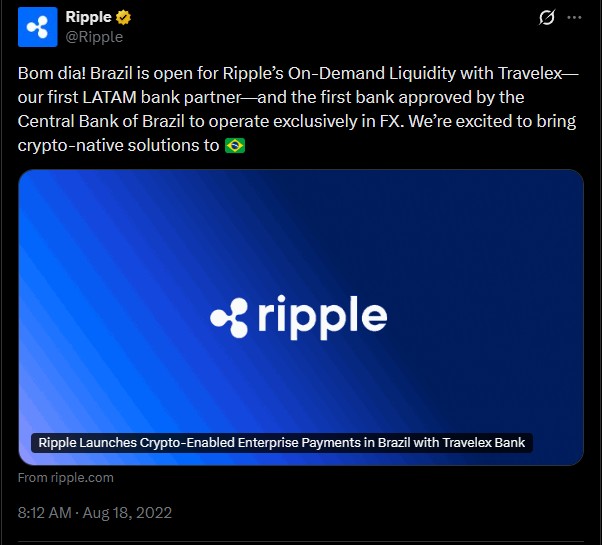
In August 2022, Ripple launched ODL in Brazil, specifically with the Travelex Bank.
This was notable not just in Brazil, however, as it was the first bank in Latin America as a whole to utilize ODL.
Ripple announces its partnership with Travelex. Source: @Ripple on X
3. CIBC (Canada)
The Canadian Imperial Bank of Commerce (CIBC) is one of the largest banks that utilizes ODL on a regular basis.
Why it’s included:
CIBC joined RippleNet in 2022 and has used it since for real-time, cross-border transaction settlement.
CIBC does still offer SWIFT wires, but it pushes a variety of routes through ODL.
4. UnionBank (Philippines)
UnionBank is one of the Philippines’ biggest commercial banks, as well as the country’s first fully-licensed virtual asset bank.
Why it’s included:
Has integrated RippleNet and ODL to facilitate its cross-border payments, allowing overseas workers to send money back home immediately, rather than over a period of days.
5. ChinaBank (Philippines) and Qatar National Bank (Qatar)
These two banks work together on a Ripple-powered rail.
Why they’re included:
In July 2022, the two banks partnered to enable XRP-backed money transfers (via XRPL) between Qatar and the Philippines.
Qatar National Bank sends money via XRPL, and ChinaBank converts it to Philippine pesos. SWIFT still exists as a backup, if needed.
6. Axis Bank (India)
Axis Bank was the first Indian bank to go live on Ripple’s network.
Why it’s included:
Axis Bank launched Ripple-powered international payments all the way back in 2017, prioritizing partners like RakBank in the UAE.
Ripple’s
7. Banco Rendimento (Brazil)
Banco Rendimento is a Brazilian commercial bank with a lot of FX and remittance.
Why it’s included:
2025 institutional research firms note that Banco Rendimento uses Ripple’s ODL to improve remittance flows throughout Latin America.
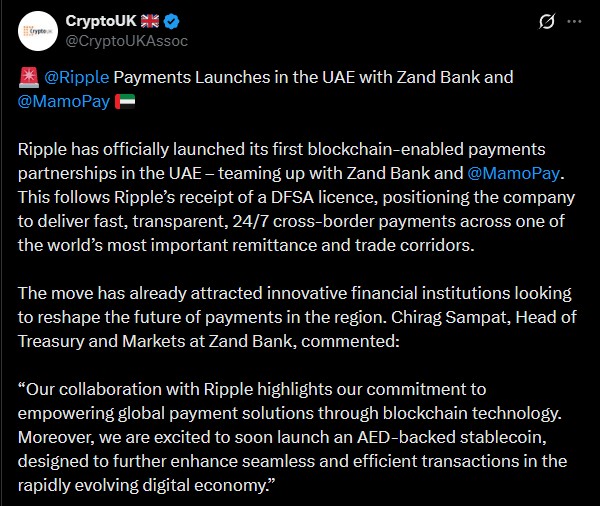
In May 2025, Ripple announced Zand Bank as one of its first UAE clients after getting a Dubai license, with Zand using Ripple Payments for cross-border transfers.
Zand’s use consists of XRP and XRPL use instead of SWIFT, depending on the transaction requirements.
Source: @CryptoUKAssoc on X
9. Interbank (Peru)
Interbank (Banco Internacional del Perú) is one of Peru’s largest commercial banks.
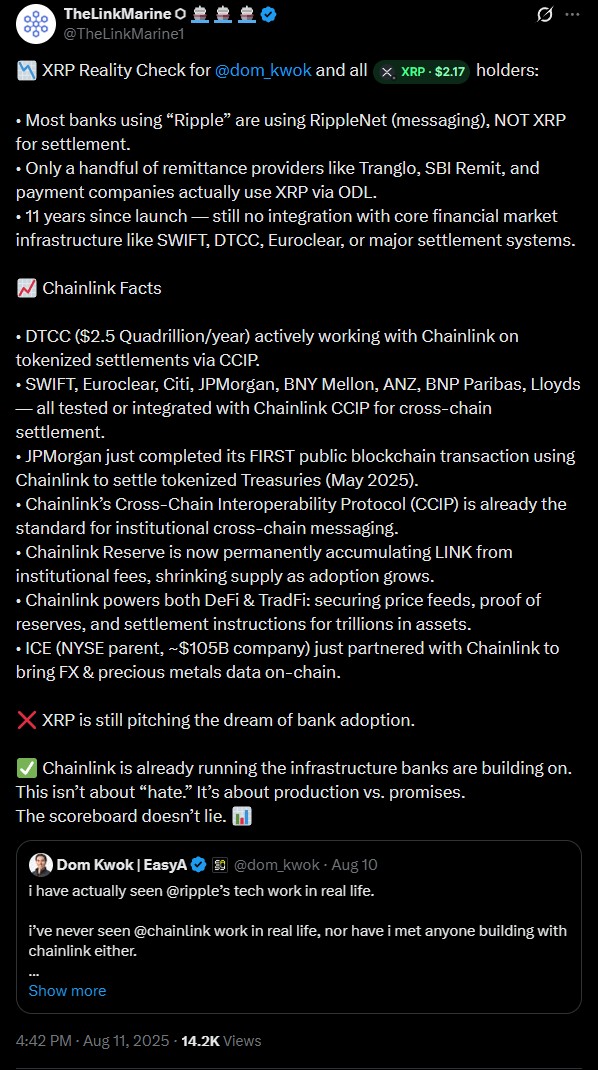
A few banks (SBI Remit, Travelex, etc.) use ODL, which means they use XRP on the XRPL as a bridge asset.
Others only run RippleNet, using Ripple as a faster, SWIFT-style network without touching XRP directly.
Almost all of them keep SWIFT running for many routes, and use XRP as an alternative when speed and cost really matter.
Source: @TheLinkMarine1 on X
All this to say, XRP didn’t replace SWIFT. Instead, Ripple’s tech stack has made its way into real bank payment flows as a special sort of “fast lane,” especially when it comes to remittances and international corridors where every cent and every second matters.
It’s also important to note that banks don’t always need to hold XRP to directly benefit from ODL. In many places, licensed exchanges or liquidity providers sit in the middle, handling the XRP buying and selling on behalf of a bank. The bank just sees fiat in and fiat out.
That model helps established institutions stay inside their regulatory rules while still taking advantage of XRPL’s speed. That said, if regulation keeps improving, and more banks get comfortable with technology like Ripple’s, XRP’s role may grow in time, even if everyday customers never see the crypto side of it.
Yes. All of them still use SWIFT for many routes. Ripple’s tools usually run alongside SWIFT, not instead of it.
Does every bank on RippleNet use XRP?
No. RippleNet can run fully in fiat. Only banks using ODL/Ripple Payments with crypto use XRP as a bridge asset.
How does XRP actually help a bank?
XRP lets banks avoid pre-funding foreign accounts. They can source liquidity on demand, settle in seconds, and free up working capital.
Do banks have to hold huge XRP balances to use ODL?
Not necessarily. In many setups, exchanges and liquidity providers hold and trade XRP. The bank just sees fiat in, fiat out.
Disclaimer:
The information provided in this article is for informational purposes only. It is not intended to be, nor should it be construed as, financial advice. We do not make any warranties regarding the completeness, reliability, or accuracy of this information. All investments involve risk, and past performance does not guarantee future results. We recommend consulting a financial advisor before making any investment decisions.
Max Moeller is a Chicago‑based writer and video editor passionate about games, tech, and crypto. Whether it’s crafting clear, insightful articles or piecing together engaging video retrospectives, he’s driven by curiosity and takes pride in keeping things human. Since 2017, Max has been published in a variety of notable crypto magazines.


 Easy
Easy