XRPL just crossed $2B in tokenized assets. As real-world finance moves on-chain, could this milestone set up XRP price for a new all-time high? | Credit: CCN.com
Share
Key Takeaways
The XRP supply on exchanges has dropped to a seven-year low of 1.6 billion tokens, representing a decline of more than 50% from approximately 3.76 billion in October.
Sustained exchange outflows suggest a deliberate repositioning, rather than short-term panic or reactive trading.
Fewer tokens on exchanges reduce immediate sell-side liquidity, making XRP more sensitive to shifts in demand.
Similar supply compressions have historically preceded major XRP price moves, though outcomes are never guaranteed.
XRP is undergoing one of its most dramatic supply shifts in years.
On-chain data indicate that the XRP supply held on centralized exchanges has plummeted to approximately 1.6 billion tokens, a seven-year low, following a peak of around 3.76 billion XRP in October. In just a few months, more than half of XRP’s readily available exchange liquidity has disappeared.
This is not a routine fluctuation. It is a structural change that alters how the XRP market behaves, how the price reacts to demand, and how risk propagates through the system.
The obvious question is simple: Where did all the XRP go?
The answer, however, is layered, and the implications matter far more than any short-term price move.
What Does XRP Supply on Exchanges Mean for Price and Liquidity?
Before jumping to conclusions, it’s important to clarify what this metric represents.
“XRP supply on exchanges” refers to the amount of XRP held in wallets controlled by centralized trading platforms. These tokens are considered immediately liquid, meaning they can be sold instantly into the open market.
In practical terms, this means fewer tokens are positioned for immediate selling pressure.
A declining exchange balance does not guarantee higher prices, but it changes the market’s structure by tightening liquidity.
XRP Exchange Supply Falls to Seven-Year Lows: What the Data Shows
The following chart, showing XRP balance on exchanges (30-day SMA), illustrates just how extreme this move is.
In October, exchanges collectively held approximately 3.76 billion XRP. By late December, that number had collapsed to around 1.64 billion XRP. This is the lowest exchange balance since 2017-2018, cutting visible supply by more than 50% in a matter of months.
XRP balance on exchange. | Credit: Glassnode
What makes this notable is not just the endpoint, but the speed and consistency of the decline. This was not a one-off event triggered by panic or a single news catalyst. It was a sustained, directional move.
Rise during distribution phases, when holders prepare to sell.
Fall during accumulation or long-term holding phases.
The current pattern aligns far more closely with the latter.
XRP Exchange Net Position Change Explains the Massive Outflows
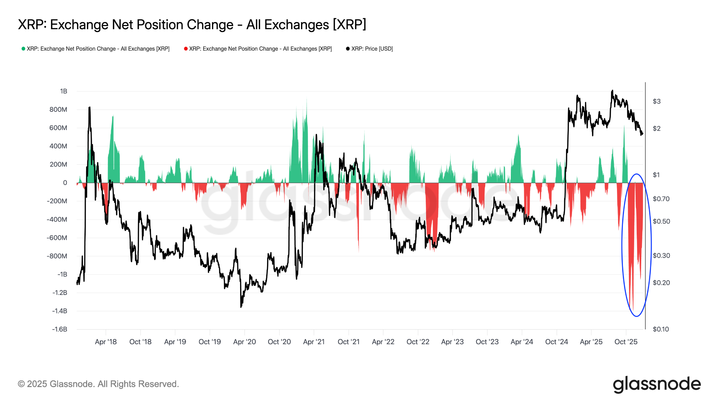
Another data, XRP exchange net position change, provides crucial context.
This metric tracks whether more XRP is flowing into exchanges or out of them on a daily basis:
Green bars indicate net inflows (potential sell preparation).
Red bars indicate net outflows (withdrawals from exchanges).
Over recent months, the chart shows repeated clusters of deep red bars, signaling persistent net outflows. Even more critical, these outflows were not followed by sharp inflow reversals, a phenomenon that typically occurs when traders rush to sell into rallies.
Instead, XRP has been steadily leaving exchanges, even as the price fluctuates.
That pattern typically suggests deliberate repositioning, rather than emotional or reactive trading.
Where Did the XRP Tokens Go After Leaving Exchanges?
The tokens didn’t vanish. They moved and likely ended up in several distinct destinations.
1. Long-Term Self-Custody
One of the most common explanations is also the most straightforward: holders withdrew XRP into private wallets.
Historically, extended periods of exchange withdrawals tend to occur when holders believe the risk-reward profile favors holding rather than active trading.
2. Institutional and Regulated Custody
Another major destination is institutional custody. As XRP increasingly appears in:
Those tokens leave exchange balances but remain economically active.
Importantly, institutional accumulation does not appear as exchange liquidity, even though it may represent substantial capital commitments. This reduces visible supply without necessarily decreasing demand.
3. OTC Transactions and Off-Exchange Settlement
Large holders rarely execute sizable trades directly on open exchanges. Instead, they often rely on over-the-counter (OTC) desks.
OTC activity:
Minimizes market impact.
Avoids slippage.
Keeps transactions off public order books.
Sustained exchange outflows combined with relatively stable price action are often consistent with OTC-style absorption, rather than panic-driven selling.
According to Jake Claver, CEO DAG Family Office, large XRP sales aren’t from escrow or retail, they’re OTC trades through Falcon X, Kraken dark pools.
“Early investors and hedge funds moving massive positions anonymously,” he said.
4. Escrow and Ecosystem Flows
XRP’s supply dynamics are more complex than many other large-cap cryptocurrencies.
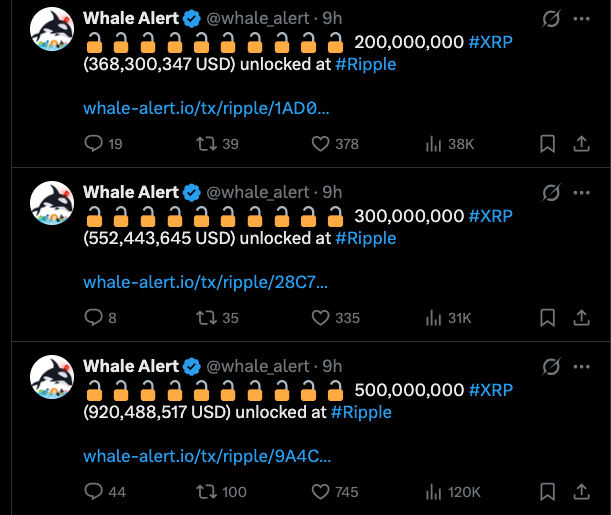
Whales are moving huge amounts of XRP tokens. | Credit: Whale Alert X profile
While escrow alone does not fully explain the 50% drop, it contributes to a market where not all movements accurately reflect trading intent. In the last three days, 1 billion XRP unlocked from escrow in minutes, catching the market’s attention fast, as confirmed by Whale Alert.
A tighter market can amplify upside moves, but it can also magnify downside risk. With fewer tokens available, even a modest wave of selling can cause the price to move sharply.
XRP supply on exchanges dropped because large amounts of XRP were withdrawn from centralized trading platforms. This typically happens when holders move tokens into private wallets, institutional custody, OTC settlement accounts, or escrow-related addresses, reducing immediately available liquidity.
Is XRP actually running out of supply?
No. XRP is not running out of supply. The total XRP supply has not changed. What has changed is where the tokens are held. Fewer XRP tokens are sitting on exchanges where they can be sold instantly.
What does low XRP exchange supply mean for price?
Lower exchange supply reduces immediate sell-side pressure and can make price more sensitive to demand changes. However, it does not guarantee a price increase. In low-liquidity environments, price movements can be sharper in both directions.
Is falling exchange supply bullish for XRP?
It can be structurally supportive, but it is not automatically bullish. Falling exchange balances indicate accumulation or long-term holding behavior, but price still depends on demand, sentiment, and broader market conditions.
Disclaimer:
The information provided in this article is for informational purposes only. It is not intended to be, nor should it be construed as, financial advice. We do not make any warranties regarding the completeness, reliability, or accuracy of this information. All investments involve risk, and past performance does not guarantee future results. We recommend consulting a financial advisor before making any investment decisions.
Giuseppe Ciccomascolo began his career as an investigative journalist in Italy, where he contributed to both local and national newspapers, focusing on various financial sectors.
Upon relocating to London, he worked as an analyst for Fitch's CapitalStructure and later as a Senior Reporter for Alliance News. In 2017, Giuseppe transitioned to covering cryptocurrency-related news, producing documentaries and articles on Bitcoin and other emerging digital currencies. He also played a pivotal role in establishing the academy for a cryptocurrency exchange website. Crypto remained his primary area of interest throughout his tenure as a writer for ThirdFloor.


 Easy
Easy