History of US Crypto Regulation: From Legal Gray Zones to the GENIUS, CLARITY & Anti-CBDC Acts
Share
Key Takeaways
The CLARITY Act rewards blockchains that are decentralized, functional, and widely distributed.
Bitcoin (BTC) is already treated as a commodity, Bitcoin gains from the CLARITY Act through expanded institutional participation, not regulatory reclassification.
Ethereum benefits by setting the benchmark for a digital commodity, unlocking regulated staking and deeper institutional products.
Solana benefits by graduating out of regulatory limbo, removing the SEC “security” label and opening the door to spot ETFs and broader exchange listings.
Stellar (XLM) benefits as a compliance-ready settlement network, positioning it as a preferred rail for regulated stablecoins under the CLARITY and GENIUS Acts.
XRP benefits from clarity, but supply concentration and stablecoin competition limit its upside compared to ETH and SOL.
The proposed CLARITY Act could mark the most important regulatory shift in U.S. crypto history. By formally separating digital commodities from digital securities and introducing the concept of a “mature blockchain,” the bill aims to replace years of enforcement-by-lawsuit with predictable rules.
GUIDE: The Clarity Act (Crypto Regulation 2026)
The Clarity Act is a major crypto market structure bill moving through Congress, aiming to define how digital assets are regulated in the US.
Our research team broke down what the bill does, how oversight shifts between the SEC… pic.twitter.com/IHxmTVLEyJ
Two independent AI analyses, one from ChatGPT and one from Gemini, largely converged on the same conclusion: Ethereum and Solana stand out as the clearest winners.
Where they differed was in why and which edge cases matter most. When combined, a clearer picture emerges — along with a notable omission both initially made.
1. Ethereum (ETH) — The Gold Standard Digital Commodity
ETH underpins a large share of on-chain activity (DeFi, tokenization, stablecoins, L2s). Clearer market-structure rules that centralize spot “digital commodity” oversight at the CFTC should reduce compliance friction for venues and encourage broader support for ETH markets (spot, custody, derivatives).
One reason clarity helps is that regulated products (futures/options) tend to pull in institutional liquidity and hedging. CME’s long-standing ETH complex and the broader “regulated futures/derivatives” ecosystem are a direct channel for benefit.
Gemini’s View:
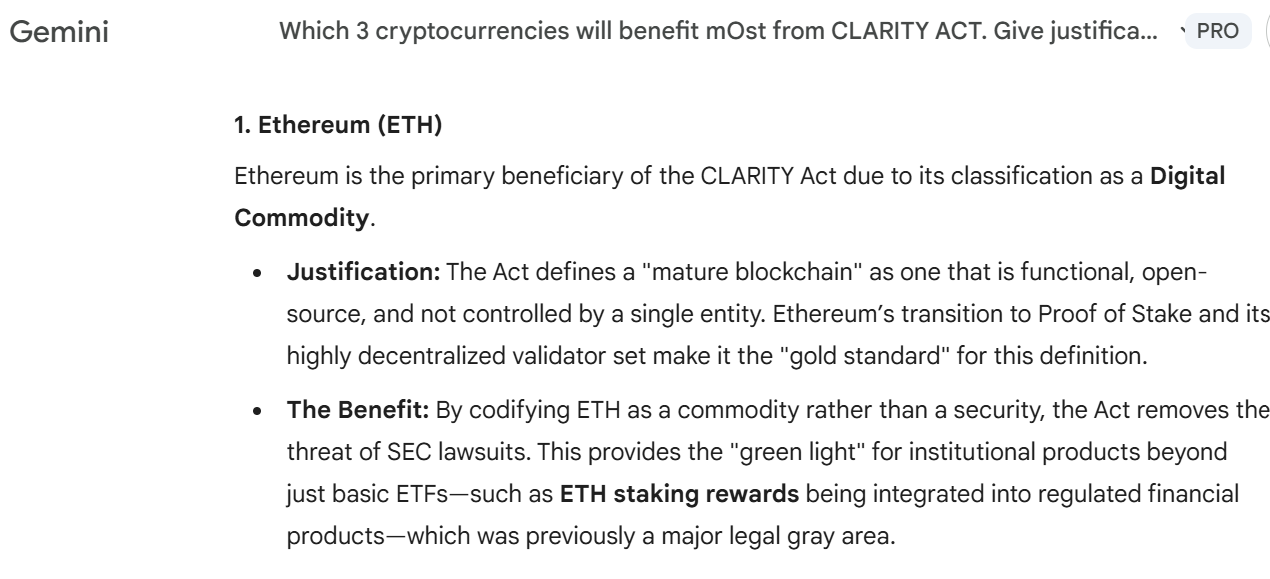
Ethereum is the single biggest beneficiary of the CLARITY Act because it most cleanly satisfies the bill’s definition of a “mature blockchain.” It is open-source, fully functional, and not controlled by a single entity. Its transition to proof-of-stake and globally distributed validator set makes ETH the model case for classification as a digital commodity.
Why ETH wins under the CLARITY Act? . | Source: Gemini
GPT’s View:
Beyond classification, Ethereum benefits from market structure clarity. ETH underpins DeFi, tokenization, layer-2 networks, NFTs, and stablecoins. Clear CFTC-style oversight reduces compliance friction for exchanges, custodians, and institutions that already rely on Ethereum infrastructure.
Ethereum doesn’t just survive clarity, it defines it.
2. Solana (SOL) — The “Path to Maturity” Winner
A “next-in-line” L1 that institutions can actually access. CLARITY-style rules are most valuable to assets that are big enough to matter but still carry meaningful U.S. regulatory ambiguity. SOL fits that: large ecosystem + heavy U.S. interest, but historically more regulatory question marks than BTC/ETH.
SOL futures launched at CME in 2025, and CME later expanded SOL derivatives (including options/spot-quoted variants). If CLARITY lowers the legal/operational risk for intermediaries, SOL is well-positioned to gain liquidity and institutional participation because the rails are already there.
Gemini’s View:
Solana is a textbook example of why the CLARITY Act matters. The SEC has previously named SOL as an unregistered security in exchange lawsuits. The Act introduces a certification pathway, allowing networks to prove they are now sufficiently decentralized and operationally mature.
GPT’s View:
Solana already has the pieces institutions care about: high throughput, a large developer ecosystem, and growing regulated derivatives infrastructure. What it lacked was legal certainty and that’s exactly what the Act supplies.
Why SOL benefits disproportionately:
Transitions from “regulatory risk” to “regulated commodity”
Becomes eligible for spot ETFs and broader exchange listings
Institutional capital can finally engage without headline risk
For Solana, clarity isn’t incremental, it’s transformational.
3. Stellar (XLM) — The Quiet Stablecoin Infrastructure Play
The CLARITY Act works in tandem with the GENIUS Act (the stablecoin bill) to create a framework for “Permitted Payment Stablecoins.” Stellar was designed specifically for the issuance of stablecoins and cross-border settlement.
The Act allows banks and non-bank issuers to use public blockchains for settlement if they meet federal standards. Stellar’s native integration of compliance features (like “clawbacks” and regulated asset issuance) makes it the most “regulatory-ready” network for the flood of new, federally-regulated USD stablecoins expected to launch under this framework.
Gemini’s Unique Addition:
While Bitcoin and Ethereum are obvious winners, Stellar stands out because the CLARITY Act works alongside the GENIUS Act, which governs payment stablecoins.
Stellar was purpose-built for:
Stablecoin issuance
Cross-border settlement
Compliance-first design
Features like native asset controls, issuer permissions, and clawbacks make Stellar one of the most regulatory-ready public blockchains.
Why XLM benefits:
Banks and regulated issuers can legally use public chains
Stablecoin settlement shifts from private rails to compliant public networks
Stellar becomes infrastructure, not speculation
This is not a hype trade, it’s a plumbing trade.
Asset
Primary classification
Why it wins
Ethereum
Digital Commodity
Legalizes staking rewards and multi-asset ETFs.
Solana
Mature Blockchain (via Certification)
Ends SEC “security” label; opens door for Spot ETFs.
Stellar
Payment Infrastructure
Becomes the preferred rail for regulated bank stablecoins.
Why Bitcoin Wasn’t the Focus (But Still Wins)
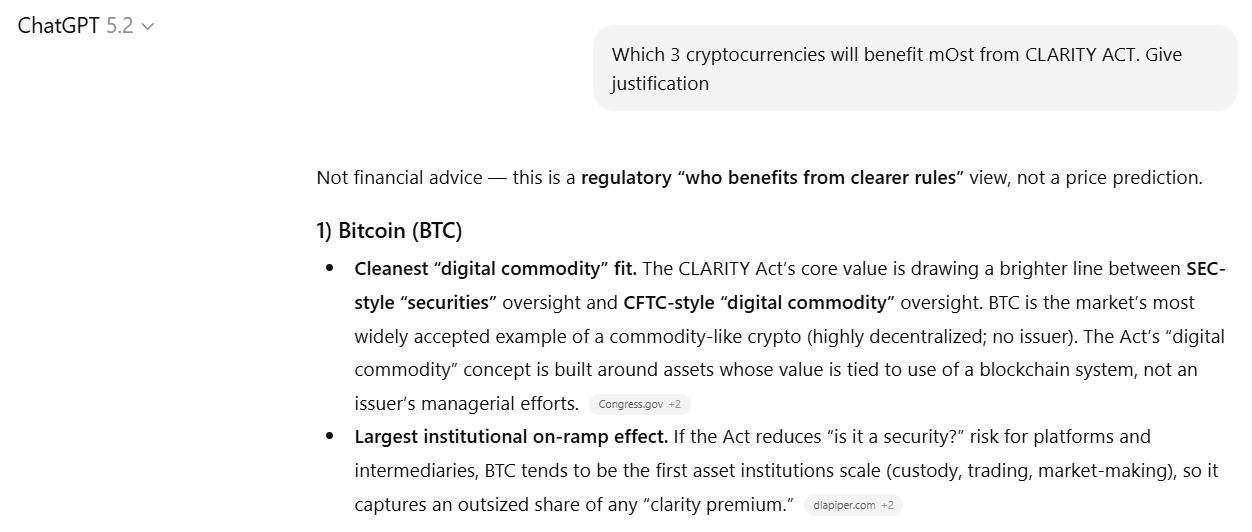
The CLARITY Act’s core value is drawing a brighter line between SEC-style “securities” oversight and CFTC-style “digital commodity” oversight. BTC is the market’s most widely accepted example of a commodity-like crypto (highly decentralized; no issuer).
The Act’s “digital commodity” concept is built around assets whose value is tied to use of a blockchain system, not an issuer’s managerial efforts.
Why BTC wins under the CLARITY Act? | Source: ChatGPT
If the Act reduces “is it a security?” risk for platforms and intermediaries, BTC tends to be the first asset institutions scale (custody, trading, market-making), so it captures an outsized share of any “clarity premium.”
So Bitcoin almost certainly qualifies as a digital commodity, but both ChatGPT and Gemini intentionally de-emphasized it because:
It already operates with regulatory acceptance in many countries
The CLARITY Act removes less uncertainty for BTC than for others
Bitcoin wins, just not incrementally the way ETH, SOL, XLM, and XRP do.
The Asset Both GPT and Gemini Initially Missed: XRP
Both AI models initially overlooked XRP, and that omission is worth telling.
According to Gemini, XRP’s primary use case is a “bridge currency” to solve liquidity gaps between different fiat currencies. If the new laws make it incredibly easy for banks to use USDC or Stellar-based stablecoins for the same purpose, the demand for a volatile bridge asset like XRP could be cannibalized by the very “clarity” the bill provides.
In contrast, ChatGPT argues that Ripple currently holds approximately 40% of the total XRP supply in escrow. While ETH and SOL are widely considered “mature” enough to move to CFTC oversight immediately, Ripple may be required to divest, burn, or restructure its escrow holdings to meet the Act’s 20% threshold. This creates a period of structural uncertainty that ETH and SOL don’t have to navigate.
Why XRP absolutely belongs in this conversation:
It already has legal clarity from U.S. court rulings
It is purpose-built for institutional payments and settlement
It fits squarely into the CLARITY Act’s commodity vs. issuer-control framework
Like Stellar, XRP benefits from:
Stablecoin and payment settlement use cases
Regulated financial institution adoption
Reduced enforcement ambiguity
In fact, XRP may be one of the biggest relative winners, because regulatory clarity removes the final barrier that has capped its U.S. market structure participation.
Standards for Mature Blockchain Systems and Asset Classification
The Act uses specific technical and governance benchmarks to decide if an asset is a “Digital Commodity.”
1. The “Mature Blockchain” Test
For a cryptocurrency to be classified as a commodity, its underlying network must be certified as a “Mature Blockchain System.” Under Section 205, the criteria include:
Functionality: The network must be fully operational and able to propagate data to reach consensus.
Decentralization: No single person or group under “common control” can have the unilateral power to modify the protocol or governance.
Ownership limits: Generally, no single entity or affiliated group can control more than 20% of the total supply or voting power.
2. The Three “Buckets”
The legislation formally divides the market into:
Digital commodities: Assets on mature, decentralized networks (e.g., BTC, ETH). These fall under CFTC spot market oversight.
Investment contract assets: Tokens sold as part of an investment contract that do not yet meet maturity standards. These remain under SEC jurisdiction.
Permitted payment stablecoins: Regulated under a separate framework (often linked to the GENIUS Act) that allows banks and licensed non-banks to issue tokens pegged to the dollar.
3. Transition Path (Certification)
The Act creates a “safe harbor” or Certification Pathway. An issuer can file a notice with the SEC asserting their network is now “mature.” If the SEC does not successfully challenge this within a set timeframe, the asset transitions to being a Digital Commodity.
Current Legislative Status of the CLARITY Act
House status: The bill passed the U.S. House of Representatives on July 17, 2025, with a bipartisan vote of 294–134.
Senate status: As of late 2025, the bill is in the Senate. It is being reconciled with other drafts, specifically the Responsible Financial Innovation Act (RFIA) and the GENIUS Act (which focuses on stablecoins).
Primary goal: To codify the distinction between “Digital Commodities” (regulated by the CFTC) and “Investment Contract Assets” (regulated by the SEC).
4/
1) Clarity Act approval
In 2025, GENIUS Act was approved and we saw a good rally in alts.
Crypto markets don’t just move on innovation, they move on permission.
Exchanges list more confidently
Institutions allocate more aggressively
Developers build without fear of retroactive enforcement
When combining both analyses:
Ethereum wins by being the benchmark
Solana wins by graduating into legitimacy
Stellar wins by powering regulated stablecoins
XRP emerges as the missed-but-critical payment asset
The CLARITY Act doesn’t pick winners directly, but it removes uncertainty, rewards maturity, and uncertainty is what keeps large pools of capital on the sidelines.
Does the CLARITY Act officially legalize "Staking-as-a-Service"?
Yes. Section 203 of the Act clarifies that “end-user distributions,” which specifically include staking rewards, do not constitute the offer or sale of a security. This is a massive win for Ethereum and Solana, as it allows U.S. exchanges to offer native staking rewards to retail and institutional users without fear of SEC retaliation.
Can an asset lose its "Digital Commodity" status once it is certified?
It is possible but difficult. Once a system is certified as a “Mature Blockchain,” the SEC has a limited window to challenge that status. If they fail to do so, the asset is legally a commodity. However, if a single entity re-acquires more than 20% of the supply or takes “unilateral control” over the code, the SEC can move to revoke the certification, shifting the asset back into the “Investment Contract” bucket.
Why did the Act choose the CFTC over the SEC for spot markets?
The legislative intent was to treat decentralized assets more like physical commodities (like oil or gold) than corporate stocks. Since a “mature” blockchain has no central issuer to provide “managerial effort,” the disclosure-heavy framework of the SEC was deemed an ill-fit. The CFTC’s mandate is better suited for monitoring decentralized spot markets for fraud and manipulation.
How does the "20% Ownership Rule" affect Ripple and XRP specifically?
Under the Act, if Ripple Labs continues to hold its roughly 40% of XRP supply in escrow, it may fail the “decentralization test” required for a Digital Commodity certification. To benefit from the Act’s full “commodity” protections, Ripple would likely need to utilize the Act’s divestment pathways or legally “lock” the escrow in a way that proves they no longer exercise “common control” over the network’s economics.
Disclaimer:
The information provided in this article is for informational purposes only. It is not intended to be, nor should it be construed as, financial advice. We do not make any warranties regarding the completeness, reliability, or accuracy of this information. All investments involve risk, and past performance does not guarantee future results. We recommend consulting a financial advisor before making any investment decisions.
Onkar Singh has three years of experience as a digital finance content creator. Throughout his career, he has collaborated with various DeFi projects and crypto media outlets. In his leisure time, he enjoys fitness activities at the gym and watching movies across different genres. Balancing his professional and personal interests, Onkar continues to contribute to the digital finance landscape while pursuing his hobbies.


 Easy
Easy