Johns Hopkins economist Steve Hanke calls Bitcoin ‘zero fundamental value,’ sparking debate on BTC price. | Credit: CCN.com
Share
Key Takeaways
The US crypto market structure bill is stuck in the Senate, even after the House passed GENIUS and CLARITY, and regulators publicly called for fast action.
How far to ban stablecoin yield, how to handle Trump-linked conflicts of interest, and how hard to regulate DeFi and developers are the three main problems.
There is momentum with a 25-day completion claim from the SEC chair, but no markup scheduled until these issues are resolved.
For builders and investors, policy risk stays high, especially around stablecoin rewards, DeFi front-ends, and politically connected projects that could face tighter rules.
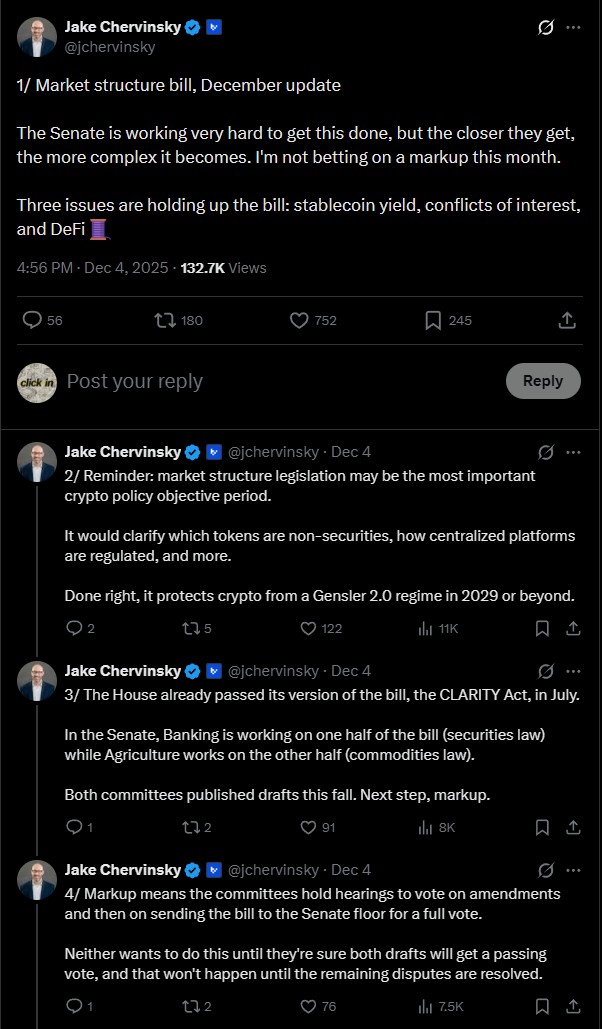
In early December 2025, crypto lawyer Jake Chervinsky posted a warning on X: he’s “not betting on a markup this month” for the U.S. crypto market structure bill, and he says three issues are blocking progress: stablecoin yield, conflicts of interest, and decentralized finance (DeFi).
For an industry that just got its first major law in the GENIUS stablecoin act, seeing the wider “market structure” fix get stalled in the Senate is a big deal. This bill is supposed to finally answer basic questions like:
When is a token a commodity vs. a security?
Who regulates which exchanges?
How do DeFi and on-chain markets fit into US law?
Source: @jchervinsky on X
Right now, the answers to those questions are still on hold.
Let’s break down what this bill does, and why, according to Chervinsky, it’s suddenly in trouble.
Top Crypto Tax Accounting Software
Sponsored
Disclosure
We sometimes use affiliate links in our content, when clicking on those we might receive a commission at no extra cost to you. By using this website you agree to our terms and conditions and privacy policy.
When people say “the market structure bill,” they usually mean the Digital Asset Market CLARITY Act of 2025, which the House passed in July with support from both parties.
Put simply, the CLARITY Act attempts to:
Split regulatory power between the Securities and Exchange Commission (SEC) and the Commodity Futures Trading Commission (CFTC).
The SEC would handle investment contracts and tokens that act as securities.
The CFTC would get wide authority over “digital commodities.” Think like decentralized tokens and their spot markets.
Officially define terms like:
Digital commodity (An asset linked to a blockchain with a valid use case).
Mature blockchain system (a truly decentralized network that no single person or group controls).
Create new licenses for digital commodity exchanges, brokers, and dealers under the CFTC, not unlike what The GENIUS Act does for stablecoin issuers. It’s also similar to how futures markets work today.
Think of The CLARITY Act as an official rulebook for the general US crypto markets, instead of letting every regulator guess on the fly and fight it out in court. That’s not an efficient process.
The House did its part, and now the Senate Banking and Agriculture Committees are putting together their own draft that, assuming it gets approved, will get attached to CLARITY.
That’s the process Chervinsky is talking about when he says this month will probably not have a “markup,” or the meeting where Senators amend and vote on the bill.
Here’s where the three big fights come in.
1. Stablecoin Yield: The Fight Over “Interest by Another Name”
The first problem is stablecoin yield. Or basically, whether or not people should be allowed to earn interest-like rewards on dollar-pegged tokens.
Earlier this year, Congress passed the GENIUS Act, the first big national law for stablecoins. It:
Requires payment stablecoins to be backed 1:1 by cash and safe assets like short-term Treasuries.
Bans issuers from directly paying interest on those stablecoins, to stop them from competing directly with bank deposits.
All of that said, there is a loophole. Keep in mind that the law did not clearly ban crypto exchanges or affiliates from offering “rewards” or yield programs on those same stablecoins. Banks and bank trade groups warn that this could drain fiat from traditional high-yield savings accounts into crypto savings entities, which promise higher yield. Coinbase already offers a product like this with its USDC savings, offering interest rates of 3.85%.
So when the Senate moved on to the market structure bill, many lawmakers and bank lobbyists demanded a fix. Chervinsky claims that some Democrats won’t support the larger regulation if nothing is done about this “stablecoin loophole.”
The problem is, crypto firms offer yield as a core feature, while banks see it as a threat.
2. Conflicts of Interest: Trump’s Crypto Ties
The second barrier consists of ethics and conflicts of interest regarding President Trump’s ties to crypto.
In November, Senators Elizabeth Warren and Jack Reed sent a letter to the Treasury and Justice Department about World Liberty Financial (WLF), a Trump-backed crypto venture. They warned that WLF governance tokens had reportedly been sold to buyers linked to North Korea, Russia, and other illicit actors, providing them with potential control over a firm backed by the U.S. President.
Reed and Warren also stressed that the Trump family earns a large cut of every governance token sold, raising direct conflict-of-interest concerns as Congress writes crypto rules that could benefit those businesses.
Chervinsky claims Democrats now want the CLARITY Act to:
Restrict how the President and their family can own or profit from digital asset ventures.
Close gaps that might let governance-token issuers avoid key disclosure and record-keeping rules.
To the Democrats, passing a sweeping crypto law without addressing these issues would look like protecting the President’s own assets.
Republicans, on the other hand, seem to feel like such wording would be a personal attack and could scare future Presidents from engaging with crypto.
3. DeFi and Developer Protections, AKA: the “Middleman”
The third, and perhaps most important, fight is about DeFi and its developers.
Senate drafts acknowledge that one cannot regulate DeFi the same way as centralized exchanges:
The Agriculture Committee’s discussion draft (covering CFTC issues) notes that the definitions of “blockchain” and “decentralized finance” are still open and controversial.
The draft also stresses new powers for the CFTC over spot digital commodity markets, but it hasn’t fully detailed what happens when there’s no “intermediary” at all.
Chervinsky’s thread ends with a clear line: “There is no market structure bill without developer protections, because there is no crypto without developers.”
Skeptics want clear rules defining:
Writing open-source code by itself does not make you a broker, dealer, or exchange.
Hosting a website or interface should not automatically trigger full financial-intermediary obligations, especially if you never take custody of user funds.
Stronger tools against illicit finance that routes through DeFi, not just banks and centralized exchanges.
To avoid a situation where bad actors hide behind “it’s just code” while running malicious financial platforms.
So the Senate has to balance:
Go too hard on DeFi, and you criminalize writing code and crush innovation.
Go too soft, and you leave big anti-money laundering (AML) gaps by emphasizing decentralization.
This argument is nowhere near finished, and it’s central to the bill.
Is the Market Structure Bill Dead, or Just Delayed?
Keep in mind that “in trouble” does not mean the bill is dead:
The House has already passed The CLARITY Act.
The Senate Agriculture and Banking Committees have each released drafts, showing that an attempt at progress is being made, but they disagree on how to define DeFi or how the SEC and CFTC should be managed.
Now, three additional fights have been stapled onto the process.
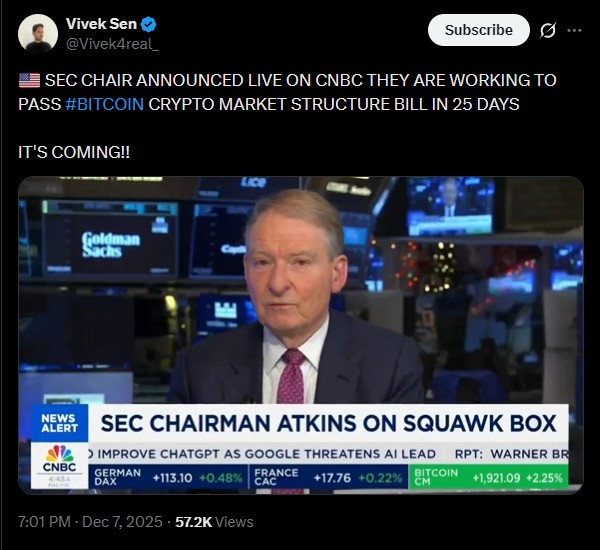
Also, on December 7, SEC Chair Paul Atkins came out in support of the market structure bill, noting it will be finished within 25 days.
Source: @Vivek4real_ on X
That said, even with Atkins’ support, understand that the politics around yield, ethics, and DeFi, are now baked into the overall problem. The Chair’s claim is just that, a claim. And like Chervinsky said, until lawmakers sort those issues out, the biggest crypto regulation in the US will stay stuck in committee.
What is the “crypto market structure bill” everyone keeps talking about?
It’s a package built around the CLARITY Act and Senate drafts that split oversight between the SEC and CFTC and set licensing rules for U.S. crypto trading platforms.
How is this different from the GENIUS Act?
GENIUS is a stablecoin law focused on payment tokens, reserves, and interest bans, while the market structure bill covers broader trading rules, exchange licenses, and when tokens count as commodities vs. securities.
Why is “stablecoin yield” such a big sticking point?
Because GENIUS bans issuers from paying interest, banks want that ban extended to third-party rewards, while crypto platforms want to keep loyalty-style yield programs alive.
Is the bill dead if there’s no markup this month?
No. It just means negotiations on yield, ethics, and DeFi aren’t done; Congress can still move the bill later this session if leadership believes there are enough votes.
Disclaimer:
The information provided in this article is for informational purposes only. It is not intended to be, nor should it be construed as, financial advice. We do not make any warranties regarding the completeness, reliability, or accuracy of this information. All investments involve risk, and past performance does not guarantee future results. We recommend consulting a financial advisor before making any investment decisions.
Max Moeller is a Chicago‑based writer and video editor passionate about games, tech, and crypto. Whether it’s crafting clear, insightful articles or piecing together engaging video retrospectives, he’s driven by curiosity and takes pride in keeping things human. Since 2017, Max has been published in a variety of notable crypto magazines.


 Intermediate