The new draft bill puts the CFTC at the center of digital-commodity oversight and gives the Bitcoin market a clearer rulebook for its next phase.
Institutions are watching closely, and clearer custody and compliance standards may unlock the next wave of large-scale Bitcoin buying.
Stronger regulation and growing institutional demand support the case for Bitcoin to push toward the higher end of current price forecasts.
A sharp fall to older cycle lows appears less likely today, as Bitcoin trades in a market with deeper liquidity and broader global participation.
As a new debate over crypto regulation gained momentum, lawmakers pushed for more explicit rules, setting the stage for the Crypto Market Structure Bill. This bill could significantly reshape the United States’ regulation of Bitcoin and the broader cryptocurrency market.
On November 10, 2025, the Commodity Futures Trading Commission (CFTC)published a draft of the Crypto Market Structure Bill, introduced by Senators John Boozman and Cory Booker, to regulate spot markets for digital commodities.
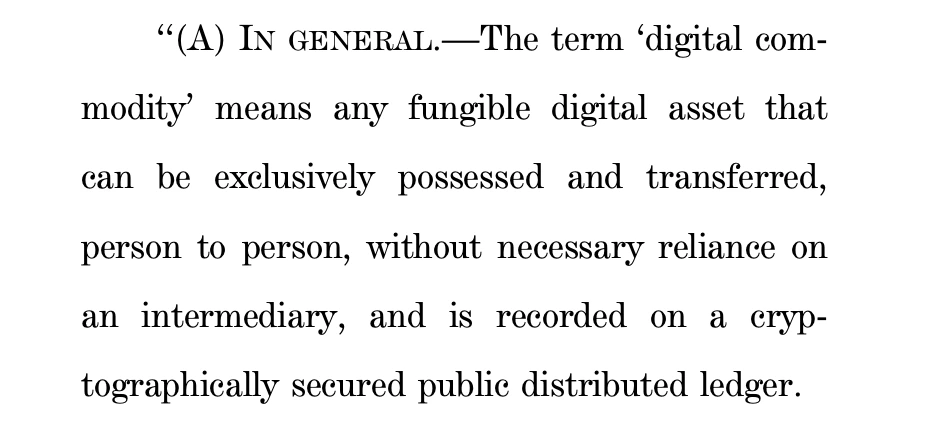
The draft of the Crypto Market Structure Bill defines digital commodities as follows:
In short, a digital commodity is a blockchain-based asset that is interchangeable, user-controlled, and transferable without any intermediaries. It clarifies how various digital assets are categorized under federal agencies.
Bitcoin (BTC) operates on a decentralized ledger and has no central controlling authority. As a result, the draft places spot trading of Bitcoin and similar assets under the CFTC’s oversight, rather than the Securities and Exchange Commission (SEC). Therefore, this shift marks the end of years of regulatory uncertainty.
This article explains how the draft bill reshapes oversight of digital commodities, what the shift means for Bitcoin and why the market now weighs different price paths. Is a climb toward 100,000 dollars or a slide toward 50,000 dollars more likely?
Why Clear CFTC and SEC Roles Matter for Crypto Regulation and Institutional Bitcoin Growth
The draft gives the CFTC control over spot digital-commodity markets, but the SEC still keeps an important role. The bill requires joint rulemaking between the CFTC and the SEC for “mixed” digital asset transactions and the definition of key terms.
The draft retains the SEC’s role in policing fraud and manipulation in digital-asset markets, even as asset classifications evolve.
By assigning clear roles, the bill aims to resolve the long-standing turf war between the CFTC and SEC that has hinderedinstitutional adoption of Bitcoin and other digital assets.
With more explicit rules in place, the infrastructure for spot Bitcoin markets becomes easier to build. Exchanges, custodians, and institutional products can operate with more confidence. The next section explains how this relates to the $100,000 Bitcoin case.
Institutional Adoption: The Catalyst for the $100K Bitcoin Target
Custody issues, regulatory uncertainty and unclear classification have kept many institutional treasuries on the sidelines. Once those concerns ease, significant capital flows may follow.
Reports estimate that institutional entry into Bitcoin could reach hundreds of billions of dollars as firms seek regulated access and stable infrastructure. That level of capital inflow could meaningfully tighten Bitcoin supply and lift prices.
Consider Bitcoin’s capped supply of 21 million coins; if a substantial portion moves into institutional hands, demand rises while accessible supply shrinks.
Will Clearer US Crypto Regulation Push Bitcoin to $100,000?
Clarity could create a positive setup for Bitcoin’s value as the market moves into its next phase. Below are key data points that support the bullish case for a six-figure price target.
Bitcoin purchases | Source: X @Andre_Dragosch
Institutional demand accelerating: In Q3, 2025 global Bitcoin ETPs and public companies acquired 944,330 BTC year-to-date, equal to about 7.4 times the new supply of Bitcoin in 2025, based on data compiled as shown in the image above.
Corporate holdings rising: According to reports, 172 companies now collectively hold about 1.02 million BTC, a 40 percent increase in Q3 2025.
Positive forward outlook: Despite Bitcoin’s volatility in 2025, Standard Chartered reiterated its projection of $ 100,000 to $ 150,000 for the 2025–2026 window, anchored in institutional inflows and reduced post-halving supply.
Mainstream analyst confidence: Intelligence analysts noted in late 2025 that Bitcoin’s post-halving structure and rising institutional participation support the possibility of a move toward the $200,000 range in the short term, describing it as a plausible continuation of the current cycle.
That outlook frames the broader environment in which regulatory clarity becomes a key variable. A stronger market structure matters as much as price projections. This leads into the next section.
From Bitcoin Price Outlook to Protections: How the Draft Crypto Bill Shapes the Market
A clearer regulatory framework only works if markets operate safely. The latest draft legislation outlines standards designed to strengthen trust, reduce operational risk and support a healthier environment for both retail and institutional participants.
Key provisions include:
Mandatory registration for platforms: The Crypto Market Structure Bill draft requires digital-commodity spot exchanges, brokers and dealers to register with the CFTC, creating a supervised environment for trading activity.
Qualified digital-commodity custodians: New rules define who can safeguard client assets and set expectations for custody infrastructure, according to McGuireWoods Consulting.
Stronger operational safeguards: Customer-asset segregation, cybersecurity protocols, dedicated compliance officers, disclosure requirements and AML/KYC rules form the core operational obligations.
Recognition of self-custody rights: The text affirms that individuals can hold their own digital assets and transact peer-to-peer without relying on intermediaries.
Targeted enforcement authority: The draft expands the CFTC’s power to investigate and prosecute fraud and manipulation in spot digital-commodity markets, giving the agency direct tools to address abusive behavior and protect market integrity.
Surveillance and accountability: Exchanges will face direct obligations to detect suspicious activity through real-time monitoring, maintain detailed reporting systems and enforce strict conflict-of-interest policies to ensure transparent market operations.
This foundation supports a safer environment for broader participation, tying back to the earlier discussion about how clarity can reinforce the higher-price scenario for Bitcoin.
Bitcoin $50,000 Risk Scenario: Key Factors That Could Trigger a Major BTC Pullback
The $50,000 risk scenario rests on a few clear factors. Despite the positive signals, the Crypto Market Structure Bill remains preliminary and many sections still need further discussion. If the final bill is delayed, trimmed, or severely amended, the regulatory clarity advantage may diminish. Institutions may wait longer, adoption momentum may stall and the bullish price thesis weakens.
Even with favourable regulation, Bitcoin remains sensitive to economic pressures. Several conditions could keep prices contained or trigger a retracement.
Key pressures include:
Regulatory delays or dilution: If the bill is postponed, softened or heavily amended, the clarity advantage fades and institutional adoption slows.
Tight monetary conditions: Higher interest rates, recession concerns and risk-asset repricing reduce inflows into Bitcoin. Reports lowered Bitcoin’s year-end target to approximately $133,000 due to macroeconomic headwinds, including a stronger U.S. dollar and weaker gold performance.
Institutional outflows: Large-scale redemptions or reduced participation from funds and corporates would weaken demand and add selling pressure.
Retail sentiment shifts: User confidence may decline if institutional flows slow or if rising compliance costs push smaller exchanges out of the market.
Muted adoption momentum: If clarity rolls out slowly or if policy remains contested, adoption may flatten instead of accelerating.
These scenarios set the stage for what is to come. The path forward now depends on how quickly the draft evolves, how institutions respond and how broader economic conditions unfold.
The next section looks ahead and examines what the future may hold for digital-asset markets under a clearer regulatory framework.
Looking Ahead: The Regulatory Roadmap and Bitcoin’s Next Phase
The next stage will depend on how quickly lawmakers refine the draft, how the SEC and CFTC coordinate their roles and how fast regulated platforms adapt to the new framework.
The strength of this roadmap will shape institutional confidence, influence product development and determine whether Bitcoin moves toward its higher target or settles into a more cautious path.
Analyst expectations for bearish outcomes range from $70,000 to $90,000, with the $40,000 to $50,000 band reserved for more severe conditions.
Bitcoin now benefits from stronger liquidity, deeper institutional participation and a more mature trading ecosystem, which makes extreme downside levels unlikely in the current cycle.
For now, the direction of regulation under the Crypto Market Structure Bill supports a stronger Bitcoin market. Clearer rules, deeper liquidity and steady institutional demand all point toward a landscape that favors upward momentum. The next move depends on how quickly lawmakers act, but the market now waits for the final version of the bill to confirm the path ahead, at least within the current U.S. policy framework.
Why does the draft bill matter for global Bitcoin markets?
It matters because U.S. regulation often shapes global liquidity conditions and influences how international institutions handle Bitcoin.
How could the bill affect new Bitcoin-based financial products?
Clearer rules may encourage exchanges and financial firms to launch regulated spot products and custodial services tied directly to Bitcoin.
Does the draft bill change how miners operate?
It does not change mining rules, but stronger market oversight could create a more predictable environment for miners planning long-term investment.
How might the bill influence crypto-related banking services?
Banks may feel more comfortable offering Bitcoin custody or settlement services once the CFTC holds defined authority over digital commodities.
Disclaimer:
The information provided in this article is for informational purposes only. It is not intended to be, nor should it be construed as, financial advice. We do not make any warranties regarding the completeness, reliability, or accuracy of this information. All investments involve risk, and past performance does not guarantee future results. We recommend consulting a financial advisor before making any investment decisions.
Dr. Lorena Nessi is an award-winning journalist and media technology expert with 15 years of experience in digital culture and communication. Based in Oxfordshire, UK, she combines academic insight with hands-on media practice.
She holds a PhD in Communication, Sociology, and Digital Cultures, and an MA in Globalization, Identity, and Technology.
Lorena has taught at Fairleigh Dickinson University, Nottingham Trent University, and the University of Oxford. She is a former producer for the BBC in London, with additional experience creating television content in Mexico and Japan.
Her research focuses on digital cultures, social media, technology, capitalism, and the societal impact of blockchain innovation.
She has written extensively on digital media and emerging technologies, with her work featured in both academic and media platforms. Her Web3 expertise explores how blockchain technologies shape culture, economics, and decentralized systems.
Outside of work, Lorena enjoys reading science fiction, playing strategic board games, traveling, and chasing adventures that get her heart racing. A perfect day ends with a relaxing spa and a good family meal.


 Easy
Easy