Circle and Ripple are pursuing U.S. banking charters, signaling crypto’s shift from disruption to integration with the traditional financial system. | Credit: CCN.com
Share
Key Takeaways
Circle, Ripple, and Kraken’s pursuit of banking charters marks a turning point in crypto’s integration with the US financial system.
USDC could become tokenized bank money if Circle gains direct access to Federal Reserve payment rails.
Banking charters reduce regulatory uncertainty but increase compliance constraints, limiting flexibility while boosting institutional trust.
Crypto’s next growth phase depends more on financial plumbing than innovation hype, signaling a shift from disruption to integration.
The line between crypto companies and traditional finance is rapidly disappearing. In December 2025, some of the largest and most established players in the digital asset industry, Circle, Ripple, and Kraken, either secured or moved closer to obtaining banking charters or bank-like regulatory status in the U.S.
These developments are not just corporate milestones. They have direct implications for the future of significant crypto assets such as USDC, XRP, and RLUSD, reshaping how they are regulated, distributed, and trusted by institutions.
The approved firms are Ripple National Trust Bank, a newly approved charter tied to Ripple; First National Digital Currency Bank, associated with Circle; BitGo, Fidelity Digital Assets, and Paxos, which are converting existing state trust charters into national ones.
To understand why these moves matter, it’s essential to examine what banking charters actually change and what they don’t.
For most of crypto’s history, companies relied on partner banks to hold customer funds, process payments, and access the U.S. financial system. That dependence became a liability during periods of regulatory pressure, bank failures, or sudden account closures.
New entrants into the federal banking sector. | Credit: US OCC X profile
Directly access payment rails such as Fedwire and ACH.
Custody of customer funds under federal or state supervision.
Reduce reliance on third-party banks.
Operate with more precise regulatory boundaries.
In short, banking charters are primarily concerned with control, stability, and legitimacy, especially for firms that issue or manage dollar-denominated tokens.
Circle and USDC: From Stablecoin Issuer to Regulated Money Infrastructure
Circle’s pursuit of a full US banking charter marks one of the most consequential shifts in the stablecoin market. USDC is already one of the most widely used dollar-backed stablecoins, with its reserves held in cash and short-term U.S. Treasury securities.
A banking charter would elevate Circle from a regulated payments company to a fully supervised financial institution.
What This Means for USDC
If Circle becomes a bank:
USDC reserves could be held directly at the Federal Reserve, rather than through intermediaries.
USDC would become a tokenized form of commercial bank money.
Institutional confidence would likely increase significantly.
OCC approved national bank charters for Circle. | Credit: LuxAlgo X profile
This would differentiate USDC from competitors that rely on offshore structures or less transparent reserve management. It could also make USDC more attractive for:
Corporate treasury operations.
Cross-border payments.
Tokenized securities settlement.
On-chain cash management for institutions.
However, increased regulation also brings constraints. Circle would face stricter compliance obligations, capital requirements, and ongoing supervision. USDC would become less flexible, but more durable.
In practice, Circle’s move signals that stablecoins are converging with traditional banking, not replacing it.
Ripple and XRP: Banking Ambitions With a Bridge Asset and a Stablecoin Core
Rather than focusing on a single stablecoin, Ripple has long positioned itself as financial infrastructure for banks and payment providers, using XRP as a liquidity and settlement asset.
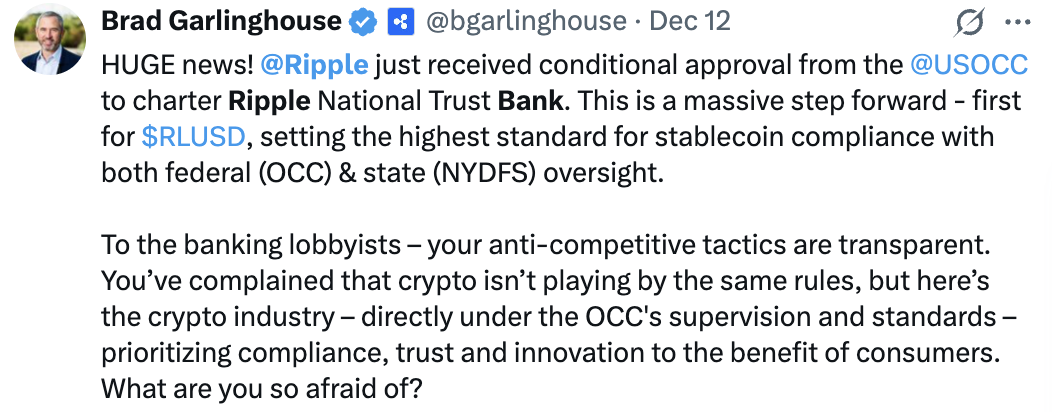
Ripple’s Brad Garlinghouse hails the OCC news. | Credit: Brad Garlinghouse X profile
Ripple’s pursuit of banking licenses and regulated trust structures aims to:
XRP itself does not become a stablecoin or bank deposit. Instead, Ripple’s regulatory progress strengthens XRP’s role as:
A bridge asset between currencies.
A tool for liquidity provisioning in regulated environments.
Infrastructure for tokenized payments and settlement.
The key impact is indirect. As Ripple becomes more embedded in regulated financial systems, XRP’s use case becomes more institutional and less speculative.
That does not guarantee price appreciation, but it does anchor XRP more firmly in real-world payment flows, especially outside the US, where Ripple already has significant traction.
RLUSD: Ripple’s Answer to Regulated Stablecoins
Ripple’s launch of RLUSD, a dollar-backed stablecoin issued under a regulated trust framework, is a direct response to the changing regulatory environment.
Unlike earlier stablecoins, RLUSD is designed from the ground up to:
Comply with US regulations.
Operate within Ripple’s licensed entities.
Integrate with enterprise payment infrastructure.
What This Means for RLUSD
RLUSD is not meant to compete head-to-head with retail-focused stablecoins. Instead, it targets:
If Ripple secures broader banking privileges, RLUSD could function as regulated on-chain cash within Ripple’s ecosystem, while XRP continues to serve as a liquidity bridge between currencies and networks.
This dual-token model mirrors traditional finance, utilizing cash (stablecoins) for settlement and specialized instruments (XRP) for liquidity and movement.
Kraken and USDG: From Exchange to Regulated Bank
Kraken became the first U.S. digital asset company to operate as a regulated bank with its Special Purpose Depository Institution (SPDI) charter in Wyoming, getting the authorization in September 2020. In fact, Kraken Bank offers deposit-taking, custody, and fiduciary services for digital assets, bridging the gap between traditional finance and cryptocurrency.
As a custody-focused SPDI, Kraken Bank maintains 100% reserves on fiat deposits, allowing instant withdrawals without FDIC insurance. Initial offerings include:
Digital asset custody.
Demand/deposit accounts.
Wire transfers and fiat on/off-ramps.
Future services may include staking, trust accounts, and treasury services, all of which will be accessible via mobile and online platforms.
With the SPDI charter, USDG mirrors tokenized deposits, offering faster settlement and programmable payments without relying on external banks.
How Banking Charters Change the Stablecoin Environment
Taken together, these moves indicate a clear trend: the stablecoin market is splitting into two distinct paths.
Neither model is inherently superior. They serve different users, jurisdictions, and risk profiles.
Can USDC, XRP and RLUSD Compete With SWIFT’s Blockchain Move?
In September 2025, SWIFT, the world’s dominant international banking messaging system connecting more than 11,000 financial institutions in over 200 countries, announced it is developing its own blockchain-based shared ledger to modernize cross-border payments. This initiative marks a major shift for a system that has traditionally relied on legacy correspondent banking and ISO 20022 messaging to move money between banks.
SWIFT’s blockchain-based shared ledger is being built in collaboration with more than 30 global banks and blockchain firm ConsenSys as a secure, real-time ledger that records transactions between financial institutions and supports tokenized value transfers (including stablecoins and digital deposits).
It aims to enable 24/7 cross-border settlement, enhanced transparency, and interoperability with existing and emerging systems, all while keeping the trust, compliance, and global reach that SWIFT is known for.
Traditional cross-border payments via SWIFT can take days to settle, involve multiple intermediaries, and carry higher costs. Blockchain technologies promise near-instant settlement, greater transparency, and programmable compliance through smart contracts — features that digital assets and stablecoins have championed. SWIFT’s move is partly a response to these pressures and the rise of stablecoins as faster and cheaper alternatives.
How This Relates to USDC, XRP and RLUSD
USDC (Circle): A regulated dollar-backed stablecoin already widely used for cross-border payments and institutional settlement. It operates on existing public blockchains and is designed for quick, transparent value transfer without traditional intermediaries.
XRP (Ripple): Positioned as a bridge asset for liquidity and cross-border settlement, Ripple’s goal is to help move value between different currencies and ledgers efficiently. XRP does not become a stablecoin in this model but facilitates fast settlement in regulated environments.
RLUSD (Ripple): A regulated stablecoin designed to operate within licensed frameworks, potentially serving as on-chain cash for institutions using Ripple’s infrastructure. It targets enterprise payments and settlement flows rather than broad retail use.
These crypto-native systems already leverage public blockchains and tokenized value to move money in ways that are faster and more transparent than legacy rails. SWIFT’s blockchain effort aims to bring similar capabilities to banks within the established global financial network, potentially connecting regulated stablecoins and tokenized deposits into the traditional system.
Why Banking Charters Bring Stability, Not Bigger Profits, to Crypto
Banking charters do not magically make crypto assets safer or more profitable. What they do is reduce uncertainty.
For institutions, uncertainty, not volatility, is the most significant barrier to adoption. By embedding crypto firms within the banking system, regulators gain oversight while markets gain predictability.
For crypto itself, this marks a shift from rebellion to integration.
The Bigger Picture: Crypto Becomes Financial Infrastructure
Circle, Ripple, and Kraken are not abandoning crypto’s original promise. They acknowledge reality: money flows through regulated systems, and scale requires trust.
USDC becomes closer to digital bank money. XRP becomes a regulated payment infrastructure. RLUSD becomes enterprise-grade on-chain cash.
The era of crypto as a parallel financial system is fading. In its place is a more complex, hybrid model, one where blockchains power settlement, but banks define the rules.
Whether that is a victory or a compromise depends on perspective. But one thing is clear: banking charters are no longer optional for serious crypto players.
They are the price of admission to the next phase of global finance.
A banking charter allows a crypto company to operate as a regulated financial institution, giving it direct access to payment systems like ACH and Fedwire, the ability to hold customer funds, and oversight from banking regulators. It reduces reliance on third-party banks and increases regulatory clarity.
Does a banking charter mean crypto firms become traditional banks?
Not exactly. Many crypto firms pursue limited-purpose or trust charters, which allow custody and payments but not traditional lending. They gain regulatory oversight without fully replicating a commercial bank model.
Will banking charters increase crypto adoption?
For institutions, yes. Banking charters reduce legal and counterparty risk, making it easier for corporations, asset managers, and banks to use crypto-based products. Retail adoption may grow more slowly due to increased compliance requirements.
Do banking charters affect crypto prices?
Indirectly. Banking charters reduce uncertainty and improve market credibility, which can support long-term adoption. However, they do not guarantee price increases for tokens like XRP or stablecoins like USDC.
Disclaimer:
The information provided in this article is for informational purposes only. It is not intended to be, nor should it be construed as, financial advice. We do not make any warranties regarding the completeness, reliability, or accuracy of this information. All investments involve risk, and past performance does not guarantee future results. We recommend consulting a financial advisor before making any investment decisions.
Giuseppe Ciccomascolo began his career as an investigative journalist in Italy, where he contributed to both local and national newspapers, focusing on various financial sectors.
Upon relocating to London, he worked as an analyst for Fitch's CapitalStructure and later as a Senior Reporter for Alliance News. In 2017, Giuseppe transitioned to covering cryptocurrency-related news, producing documentaries and articles on Bitcoin and other emerging digital currencies. He also played a pivotal role in establishing the academy for a cryptocurrency exchange website. Crypto remained his primary area of interest throughout his tenure as a writer for ThirdFloor.


 Easy
Easy