Crypto predictions for 2030 suggest Bitcoin may reach $500K, Ethereum $20K, XRP $20 as adoption and blockchain innovation reshape the market. | Credit: CCN.com
Share
Key Takeaways
2026 is shaping up to be an institutionally driven cycle, with Bitcoin, Ethereum, and XRP increasingly influenced by multiple factors.
Bitcoin remains the clearest “new ATH” candidate, supported by its fixed supply, post-halving dynamics, and growing role as a digital store of value.
Network usage, staking economics, Layer 2 scaling, and tokenization adoption will be decisive factors in ETH’s 2026 valuation.
XRP carries the highest regulatory sensitivity, meaning its 2026 performance depends less on market cycles and more on legal clarity.
As crypto markets mature and institutional participation deepens, long-term price forecasts are no longer driven solely by retail speculation.
Instead, they increasingly reflect macroeconomic conditions, regulatory clarity, on-chain fundamentals, and real-world adoption.
Looking ahead to 2026, investors are once again asking a familiar question: could Bitcoin, Ethereum, and XRP reach new all-time highs?
While no forecast is guaranteed, examining prevailing predictions and the assumptions behind them offers a helpful framework for understanding where the market could be headed.
This article examines 2026 price scenarios for Bitcoin (BTC), Ethereum (ETH), and XRP, with a focus on the forces that could shape these outcomes, rather than providing exact numbers.
Bitcoin (BTC): From Digital Gold to Institutional Asset
Bitcoin remains the reference asset for the entire crypto market. By 2026, it will have been nearly two decades since its inception, with its monetary policy fully transparent and its issuance schedule largely complete.
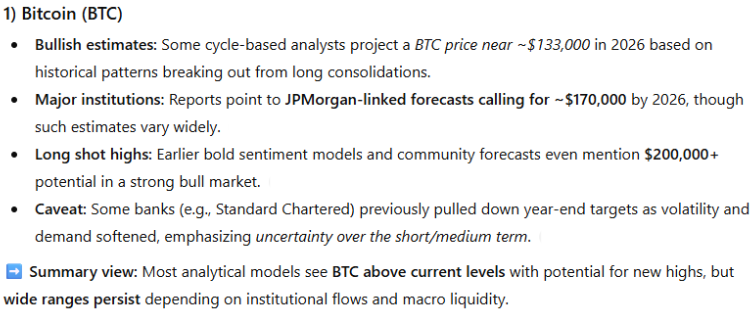
Bullish forecasts for Bitcoin in 2026 typically range between $130,000 and $200,000, depending on assumptions about demand and liquidity. These projections often rely on a combination of:
Continued inflows into spot Bitcoin ETFs.
Broader adoption of Bitcoin as a treasury or reserve asset.
A looser global monetary environment compared to the high-rate era of 2022-2024.
In this scenario, Bitcoin increasingly behaves like a form of “digital gold,” benefiting from long-term capital allocation rather than short-term speculation.
Institutional investors, pensions, and family offices would not need to dominate flows entirely; an incremental allocation alone could have an outsized effect on price due to Bitcoin’s capped supply.
ChatGPT response to BTC price prediction request. | Credit: ChatGPT
The Base Case for Bitcoin Price
More conservative analysts expect Bitcoin to consolidate but still appreciate, with a $100,000-$130,000 range representing a plausible base-case scenario by 2026. This assumes:
ETFs remain successful, but do not see exponential growth.
Bitcoin adoption continues steadily rather than explosively.
Macro conditions remain mixed, with intermittent periods of risk aversion.
In this view, Bitcoin’s volatility gradually compresses, and returns become less dramatic than in earlier cycles, but still attractive relative to traditional assets.
Risks to the Thesis
Bearish scenarios focus on regulatory pressure, stalled ETF growth, or prolonged tight monetary conditions. While few analysts expect Bitcoin to lose relevance by 2026, some warn that without sustained inflows, BTC could underperform optimistic expectations even if it remains structurally sound.
Ethereum (ETH): The Financial Infrastructure Bet
Ethereum’s 2026 outlook is more complex than Bitcoin’s. While BTC’s narrative centers on scarcity and store of value, ETH’s valuation depends heavily on network usage, developer activity, and economic design.
Why Is ChatGPT Constructive on ETH Price
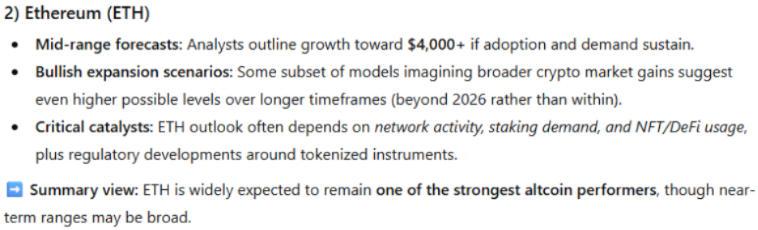
Most medium- to long-term forecasts anticipate Ethereum trading above its current levels, typically in the $4,000-$6,000 range by 2026 under favorable conditions. The reasoning includes:
Ethereum’s dominant position in DeFi, NFTs, and tokenized real-world assets.
A deflationary or low-issuance supply dynamic due to EIP-1559 and staking.
Increasing institutional interest in ETH as a yield-bearing digital asset.
Ethereum’s transition to proof-of-stake fundamentally changed its investment profile. By 2026, ETH is increasingly viewed not just as a speculative asset, but as programmable financial infrastructure with embedded yield.
What does ChatGPT sees for ETH on the horizon? | Credit: ChatGPT
The Execution Challenge
Unlike Bitcoin, Ethereum carries execution risk. Its valuation depends on:
Continued scaling progress (Layer-2 adoption, rollups, and upgrades).
Sustained developer dominance versus competing smart-contract platforms.
Regulatory clarity around staking and securities classification.
A slower-than-expected adoption curve for DeFi or tokenization could limit upside, even if the broader crypto market performs well.
The Base Case for ETH Price
A widely cited base case predicts ETH to be around $4,000-$5,000 by 2026, reflecting moderate adoption growth without a significant breakthrough in use cases.
This would still represent strong performance but likely lag Bitcoin in narrative simplicity.
XRP: Regulation as the Primary Catalyst
XRP is the most controversial of the three assets, and arguably the most sensitive to non-market forces. Unlike BTC and ETH, XRP’s 2026 price outlook hinges heavily on regulatory and institutional outcomes rather than purely on-chain activity.
The Bull Case for XRP Price: Clarity Unlocks Adoption
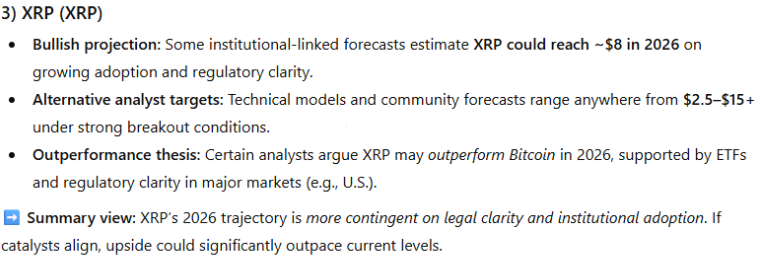
Bullish XRP predictions range widely, from $5 to $10, with some optimistic models extending higher under extreme adoption scenarios. These forecasts typically assume:
Clear and favorable regulatory treatment in the U.S. and major jurisdictions.
Increased institutional use of XRP for cross-border payments and liquidity.
Expansion of Ripple’s partnerships with banks and payment providers.
In this scenario, XRP’s value proposition as a bridge asset for international settlements gains traction, particularly in regions where traditional correspondent banking is inefficient.
ChatGPT estimate on XRP. | Credit: ChatGPT
The Base Case for XRP Price
A more conservative outlook places XRP in the $2.50-$5 range by 2026. This assumes partial regulatory clarity and incremental adoption, without XRP becoming a dominant settlement layer globally.
Elevated Risk Profile
XRP’s upside may be significant, but so is its dependency on external decisions. Unlike Bitcoin or Ethereum, XRP does not benefit from a fully decentralized governance narrative, which makes sentiment and regulation disproportionately influential.
Macro and Structural Drivers Shaping 2026
Across all three assets, several shared factors will play a decisive role in determining whether new all-time highs are achievable.
Institutional capital: ETFs, custody solutions, and regulatory-compliant products are transforming the way capital enters the crypto market. By 2026, crypto exposure may be a standard portfolio allocation rather than a niche bet.
Regulation: Clear rules tend to favor large, established networks. Bitcoin and Ethereum generally benefit from clarity, whereas XRP’s fate is more binary, with either a material improvement or a constraint.
Liquidity cycles: Crypto remains highly sensitive to global liquidity. Lower interest rates and expanding balance sheets historically correlate with stronger crypto performance.
Real-World utility: Speculation alone is no longer sufficient. Assets that demonstrate tangible economic utility, whether as stores of value, settlement layers, or financial infrastructure, are more likely to sustain long-term growth.
So, New ATHs in 2026?
A new all-time high by 2026 is plausible but not guaranteed for Bitcoin and Ethereum, with Bitcoin generally viewed as the most likely candidate due to its simplicity and institutional appeal.
Ethereum’s upside depends on execution and adoption, whereas XRP represents a higher-risk, higher-uncertainty opportunity closely tied to regulation.
Rather than focusing on exact price targets, investors and observers may benefit more from monitoring the underlying signals, including ETF flows, developer activity, regulatory decisions, and macroeconomic liquidity. If those align, 2026 could mark a new chapter, if not a new ATH, for crypto markets.
[you-my-like]
FAQs
Why are 2026 price predictions important?
2026 sits far enough beyond the current market cycle to allow structural changes, such as regulatory adjustments, institutional adoption, and technological upgrades, to take effect. It also follows the 2024 Bitcoin halving, a key event that historically influences multi-year price trends.
Is Bitcoin expected to reach a new all-time high by 2026?
Many analysts believe it is possible, particularly if institutional demand continues through ETFs and long-term capital allocation. However, outcomes depend on macroeconomic conditions, regulatory clarity, and sustained investor interest.
Why is Ethereum’s 2026 outlook more complex than Bitcoin’s?
Ethereum’s valuation depends heavily on network usage, developer activity, and adoption of applications such as DeFi, NFTs, and tokenized assets. While this creates upside potential, it also introduces execution and competition risks.
What role does regulation play in XRP’s price predictions?
Regulation is the primary driver of XRP’s outlook. Clear and favorable regulatory treatment could unlock broader institutional adoption, while uncertainty or restrictions could limit growth regardless of market conditions.
Disclaimer:
The information provided in this article is for informational purposes only. It is not intended to be, nor should it be construed as, financial advice. We do not make any warranties regarding the completeness, reliability, or accuracy of this information. All investments involve risk, and past performance does not guarantee future results. We recommend consulting a financial advisor before making any investment decisions.
Giuseppe Ciccomascolo began his career as an investigative journalist in Italy, where he contributed to both local and national newspapers, focusing on various financial sectors.
Upon relocating to London, he worked as an analyst for Fitch's CapitalStructure and later as a Senior Reporter for Alliance News. In 2017, Giuseppe transitioned to covering cryptocurrency-related news, producing documentaries and articles on Bitcoin and other emerging digital currencies. He also played a pivotal role in establishing the academy for a cryptocurrency exchange website. Crypto remained his primary area of interest throughout his tenure as a writer for ThirdFloor.


 Easy
Easy