Can gold, the yuan, Bitcoin, or the euro replace the U.S. dollar? ChatGPT, Gemini, and Claude reveal why the future of global money may be multipolar. | Credit: CCN.com
Share
Key Takeaways
Dollar debasement occurs when inflation, money printing, and rising government debt reduce the purchasing power of the U.S. dollar.
Bitcoin’s fixed supply of 21 million coins makes it attractive during periods of currency dilution.
Historically, Bitcoin has rallied during periods of dollar weakness.
Analysts argue that sustained dollar debasement could push Bitcoin toward a new all-time high.
In 2025, the value of the U.S. dollar has come under increasing pressure, and many investors are asking whether this “debasement” could fuel the next big rally for Bitcoin (BTC).
With inflation persisting and the dollar weakening against major currencies, some see Bitcoin as a potential hedge and a digital refuge.
This article examines why a declining dollar might benefit Bitcoin, identifies the remaining risks, and assesses whether the conditions are aligning for another all-time high.
The Dollar Is Losing Strength: How US Currency Debasement Impacts Investors
As inflation pressures persist and U.S. government debt reaches record levels, more investors are wondering whether continued dollar debasement could drive Bitcoin to a new all-time high.
With the Federal Reserve preparing for a shift toward looser monetary policy and global demand for hard assets on the rise, Bitcoin’s fixed 21 million supply is once again in the spotlight. The question now is whether a weakening dollar could ignite the next major BTC rally.
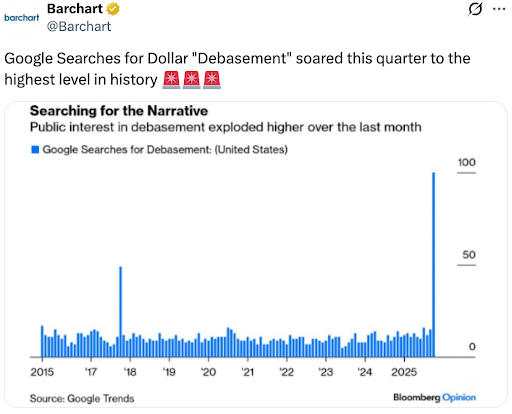
Google searches for “dollar debasement” boomed. | Credit: Barchart X profile
Dollar Weakness in 2025
In the first half of 2025, the DXY, a standard measure of the U.S. dollar’s strength relative to a basket of major currencies, declined by roughly 11%, marking the most significant six-month drop in decades.
Many analysts believe the dollar’s weakening trend may continue through 2026 as inflation, large public deficits, and U.S. interest-rate dynamics converge with global peers.
This drop in purchasing power means that every dollar is worth less than it once was, especially for imported goods, savings, and citizens relying on fixed incomes. Inflation and “money-printing” are often cited as the leading structural causes.
What “Debasement” Means for Savers and Investors
When a currency is debased, either through inflation, rising supply, or declining real purchasing power, it erodes wealth denominated in that currency. People with cash savings or fixed-rate debt see their real wealth shrink. As a result, many individuals seek alternative assets to preserve their wealth.
Historically, those alternatives have included gold and other hard assets. However, digital assets like Bitcoin are now increasingly viewed as a modern equivalent, mainly because Bitcoin has a fixed supply and cannot be printed at will.
As one financial outlet put it, investors are embracing a “debasement trade,” shifting funds from fiat-denominated savings into gold and Bitcoin to defend against currency erosion.
Why a Weakening Dollar Often Pushes Bitcoin Prices Higher
A weakening U.S. dollar has long been one of the strongest tailwinds for Bitcoin, and many analysts believe the current macro environment may be setting the stage for another significant BTC surge.
As inflation pressures persist, government debt rises, and global liquidity cycles shift, investors are increasingly turning to Bitcoin as a hedge against currency debasement. When the dollar loses purchasing power, assets with fixed or rigid caps, such as Bitcoin, tend to attract renewed demand.
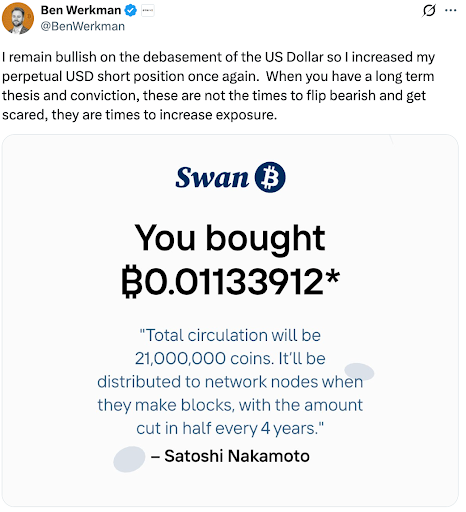
Investors remain bullish on Bitcoin after the USD weakened. | Credit: Ben Werkman X profile
This dynamic has played a significant role in past bull markets and may once again influence whether Bitcoin can climb toward a new all-time high.
1. Bitcoin as “Digital Hard Money”
Bitcoin’s fixed supply, capped at 21 million coins, stands in stark contrast to fiat currencies like the US dollar, which can be expanded through central bank policy.
When inflation and currency devaluation are on the rise, an asset that cannot be printed becomes far more attractive.
As the dollar weakens, Bitcoin (priced in dollars) may naturally appreciate, even if its value stagnates in other currencies or in terms of its underlying value. For many investors, this makes BTC a natural hedge against currency debasement.
2. Increased Global Demand and Liquidity Flows
A weaker dollar often motivates international investors and institutions to reallocate capital into assets priced in other currencies, including cryptocurrencies. For example:
A drop in DXY below key thresholds tends to lift global liquidity, benefiting assets like Bitcoin.
Reports continue to show institutional interest: a recent revival of ETF flows and accumulation by funds has helped lift Bitcoin off recent lows.
3. Macro Environment Possibly Turning More Favorable
With central banks around the world preparing for new monetary policy cycles, a weakening dollar could prompt global investors to seek alternative stores of value.
Some forecasts suggest Bitcoin could see renewed interest if global monetary conditions become more favorable.
In this environment, Bitcoin’s relative scarcity and global demand might combine to set the stage for a strong rally, perhaps even toward new all-time highs.
Bitcoin as Digital Hard Money: Why Scarcity Becomes More Valuable During Inflation
Volatility, Sentiment Swings, and Structural Headwinds
Bitcoin’s price action in late 2025 shows how quickly sentiment can shift. After reaching an all-time high above $126,000 in October, BTC has pulled back to the $92,000-$93,000 range.
At the same time, spot ETF flows, once a powerful bullish force, have turned mixed, creating additional uncertainty around Bitcoin’s near-term momentum.
As of early December 2025, Bitcoin has dropped from its October all-time high of above $126,000 to around $92,000-$93,000.
Some major financial institutions have recently reduced their short-term Bitcoin targets, citing weaker demand and a slowdown in corporate crypto adoption.
Analysts warn that ETF flows, once a strong driver, are mixed, which introduces uncertainty for near-term price strength.
The Dollar Isn’t Collapsing — Just Weakening
Some experts argue that “debasement” narratives overstate the case. For example, while inflation erodes purchasing power, the dollar remains the globally dominant currency, representing the majority of global reserves and international trade.
If global confidence in U.S. institutions or the dollar system remains stable, the greenback’s role as a reserve currency may persist longer than some theories of currency debasement suggest.
External Factors Can Still Disrupt Crypto Markets
Even if the environment seems favorable, due to a weak dollar, institutional flows, and macro uncertainty, Bitcoin’s price can still be shaken by:
Regulatory changes in major jurisdictions.
Unexpected central bank actions worldwide.
Large institutional sell-offs or market panic.
On-chain liquidity problems or sudden demand drops.
In other words, a falling dollar is a helpful tailwind, but not a guarantee.
How Global Liquidity and Investor Demand Could Boost Bitcoin’s Next Rally
If you believe the dollar will continue to weaken, Bitcoin remains a compelling option for several reasons:
It acts as a potential hedge against currency debasement.
Its fixed-supply nature appeals in times of inflation and fiat instability.
Global and institutional demand could amplify price effects.
Regulatory, macroeconomic, or market-specific shocks can test the “crypto as safe-haven” narrative.
Many mid-term observers suggest a balanced approach: view Bitcoin as a core part of a diversified portfolio, rather than a speculative bet.
Could Dollar Debasement Drive Bitcoin to a New ATH?
The current macroeconomic backdrop, a weakening dollar, rising inflation, and persistent global uncertainty, provides many of the conditions that could support a strong rally in Bitcoin. The concept of a “debasement trade” is gaining traction, and investors are increasingly viewing BTC as a modern store of value, similar to gold.
At the same time, the risks remain real. Bitcoin’s volatility, mixed institutional flows, and global economic uncertainty mean that any rally will likely be accompanied by sharp swings, rather than smooth climbs.
Still, if history is any guide, Bitcoin tends to do well in periods of fiat-currency stress and monetary easing. If the dollar continues its decline and macro liquidity supports alternative assets, then a push toward new all-time highs, perhaps even beyond $130,000 or more, remains a plausible scenario.
However, as is often the case in markets, nothing is guaranteed. The best approach may be to stay alert, diversify, and treat Bitcoin as part of a broader long-term strategy.
Dollar debasement refers to the gradual decline in the purchasing power of the U.S. dollar over time. This can happen when inflation rises, government spending increases, or the Federal Reserve expands the money supply. As the dollar weakens, people often seek assets that retain their value better than cash.
How does dollar debasement affect Bitcoin’s price?
When the dollar loses strength, investors sometimes move their money into alternative stores of value such as Bitcoin, gold, or stocks. Bitcoin is viewed by many as “digital hard money” because its supply is capped at 21 million coins. If more people buy BTC to protect their wealth from inflation, its price can rise.
Could a stronger dollar hurt Bitcoin instead?
Yes. If the dollar strengthens, usually during recessions, high-rate environments, or global market fear, Bitcoin can face selling pressure. A strong dollar often signals investors are moving back into “safe” cash instead of riskier assets.
Should I buy Bitcoin because of dollar debasement?
This is a personal decision. Many investors choose Bitcoin as a long-term hedge against inflation and currency dilution.
Disclaimer:
The information provided in this article is for informational purposes only. It is not intended to be, nor should it be construed as, financial advice. We do not make any warranties regarding the completeness, reliability, or accuracy of this information. All investments involve risk, and past performance does not guarantee future results. We recommend consulting a financial advisor before making any investment decisions.
Giuseppe Ciccomascolo began his career as an investigative journalist in Italy, where he contributed to both local and national newspapers, focusing on various financial sectors.
Upon relocating to London, he worked as an analyst for Fitch's CapitalStructure and later as a Senior Reporter for Alliance News. In 2017, Giuseppe transitioned to covering cryptocurrency-related news, producing documentaries and articles on Bitcoin and other emerging digital currencies. He also played a pivotal role in establishing the academy for a cryptocurrency exchange website. Crypto remained his primary area of interest throughout his tenure as a writer for ThirdFloor.


 Easy
Easy