US Government Shutdown happened — will Bitcoin crash or rally? ChatGPT and Grok give sharply different takes on crypto and Wall Street. | Credit: Roy Rochlin / Getty Images
Share
Key Takeaways
Without a budget deal, the U.S. government shut down on Oct. 1, 2025.
Bitcoin and crypto are not directly tied to government funding, but they can be affected by volatility, sentiment shifts, and regulatory delays triggered by a shutdown.
Key economic reports aren’t be published during a shutdown, depriving traders of Fed signals and increasing volatility across risk assets.
Agencies like the SEC and CFTC run on skeleton crews, likely delaying crypto ETF reviews or enforcement actions.
The shutdown officially ended on Nov. 13 after reaching the U.S. agencies’ most extended closing period.
The United States government has once again faced a shutdown. Lawmakers in Washington failed to agree on funding, so the federal government began closing operations at 12:01 a.m. ET on Oct. 1, 2025.
However, a solution was found after the shutdown hit a 40-day record and Trump signed the bill ending the closure of agencies.
Anyway, a government shutdown happens when Congress cannot pass a budget or temporary funding bill. Without it, many federal agencies run out of money. For most people, a shutdown means furloughed workers, delayed services, and political gridlock.
But for investors, especially in the crypto space, it raises a very different question: What does a U.S. government shutdown mean for Bitcoin and digital assets?
Try Our Recommended Crypto Exchanges
Sponsored
Disclosure
We sometimes use affiliate links in our content, when clicking on those we might receive a commission at no extra cost to you. By using this website you agree to our terms and conditions and privacy policy.
Congress is locked in a familiar standoff. Without passing either a full-year budget or a short-term continuing resolution, agencies run out of money. The sticking points this time include:
Spending levels: Disagreements over how much to cut or maintain in domestic programs.
Healthcare subsidies: Extensions of certain tax credits have become bargaining chips.
Political brinkmanship: Both sides are reluctant to back down, even as the deadline looms.
The White House has instructed federal agencies to develop contingency plans, which may include furloughs and, in some cases, permanent layoffs in programs that remain unfunded.
Major agencies like the Health and Human Services estimate they would send home nearly half their workforce.
What US Government Shutdown Means for Bitcoin and Crypto Markets
Government shutdowns are usually framed as a Washington story, but their ripple effects stretch far beyond politics.
For the crypto market, the stakes are less about direct funding and more about the knock-on effects, such as missing economic data, jittery investor sentiment, and slower regulatory action.
Together, these factors can create a choppier trading environment where Bitcoin and other digital assets become especially sensitive to headlines.
For traders, missing these signals makes it harder to gauge the Federal Reserve’s next move. With less clarity, markets often turn more volatile, and Bitcoin tends to amplify those swings.
2. Risk Sentiment Gets Hit
Economists estimate a one-week partial shutdown could shave 0.1–0.2 percentage points off GDP. Even if the damage proves temporary, headlines about a frozen government can dent risk appetite across stocks, crypto, and commodities.
3. Regulatory Delays
During shutdowns, agencies like the SEC and CFTC operate with skeleton crews. That can stall regulatory decisions, including crypto-related filings or ETF reviews. For Bitcoin investors, that means potential delays and the kind of uncertainty markets dislike.
Historical US Government Shutdowns and Bitcoin’s Price
Shutdowns are not new, but Bitcoin’s response has been inconsistent.
2013 (16 days): BTC rose from around $132.18 to $146.25 during the shutdown, logging roughly +10% gains as the market entered a bigger bull run.
January 2018 (3 days): BTC traded sideways around $11,600-12,900, with movement overshadowed by the already underway post-ATH crash.
December 2018–January 2019 (35 days): BTC fell roughly –10%, sliding from $4,000 to $3,600, consistent with the broader crypto bear market.
October-November 2025: The shutdown reached its 36th day on Nov. 5, becoming the longest one in U.S. history. It then ended on Nov.13 but the Bitcoin fell under $100,000.
SoBitcoin doesn’t respond to shutdowns in a uniform way. Its trajectory depends far more on the prevailing market cycle than on politics in Washington.
Bitcoin Price Analysis: Key Levels to Watch Amid US Government Shutdown
Bitcoin’s short-term outlook has deteriorated sharply after the cryptocurrency broke below its horizontal trend channel, signaling a continuation of the recent weak momentum. The move suggests that any short-term rebounds are likely to face stiff resistance near the lower boundary of the former trend channel, currently around the $107,000 level.
Technically, there is no clear support visible on the price chart, meaning further downside pressure remains the dominant risk. A rebound toward $107,000 could encounter selling interest, limiting recovery attempts. Meanwhile, the volume balance remains negative, with higher trading activity on down days compared to up days — a classic sign that sellers are in control.
Bitcoin technical analysis. | Credit: Giuseppe Fabio Ciccomascolo/InvestTech
In the medium-term picture, Bitcoin has also broken below the floor of its rising trend channel, undermining the longer-term bullish structure that has guided much of 2025’s rally. The drop through key support around $106,000 confirms a weakening trend and opens the door for further declines if momentum does not stabilize soon.
Technicians note that the Relative Strength Index (RSI) continues to trend lower, reflecting growing downward momentum and potentially foreshadowing a deeper correction. Combined with the negative volume profile, this suggests that buyers are stepping back, and rallies may be short-lived.
In summary, both short- and medium-term indicators now point to a technically harmful setup for Bitcoin. Unless the currency quickly reclaims the $106,000-$107,000 resistance zone with strong volume support, the probability of continued weakness remains high.
Gold, Stocks & the Traditional Markets: How They’re Reacting
The looming U.S. government shutdown is not just a crypto story. Traditional markets are already showing signs of how investors are positioning as political risk rises.
Gold, the classic safe haven: Gold has surged to record highs above $4,000 per ounce when the shutdown began, as investors sought shelter from uncertainty. A softer dollar and expectations of future Federal Reserve rate cuts have added fuel to the rally. After reaching new peaks, gold has seen brief pullbacks, suggesting some profit-taking, but overall sentiment remains bullish.
Stocks & Equities (cautious but resilient): U.S. stocks fell sharply on Tuesday as growing skepticism over lofty AI valuations weighed on sentiment, with investors digesting a busy round of quarterly earnings and fresh cautionary remarks from leading CEOs.
Other cross-market signals: The U.S. dollar has weakened slightly, pressured by safe-haven flows into gold and treasuries. Bond markets are showing demand for safety, with yields adjusting lower. Certain sectors tied closely to government spending, like defense and federal contracting, are at particular risk if funding lapses drag on.
ChatGPT vs Grok on the Shutdown’s Hit to Crypto and Wall Street
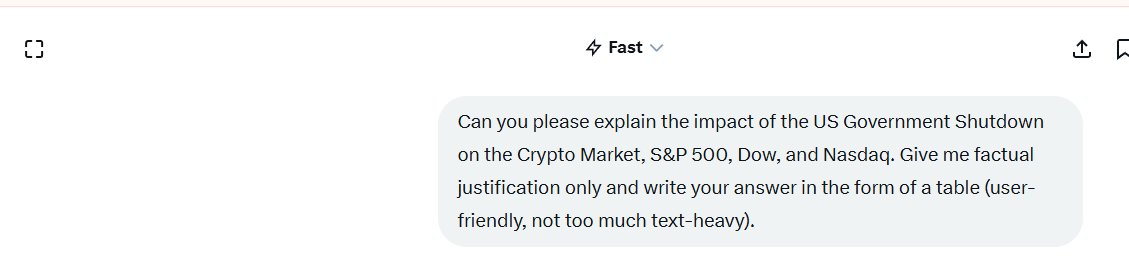
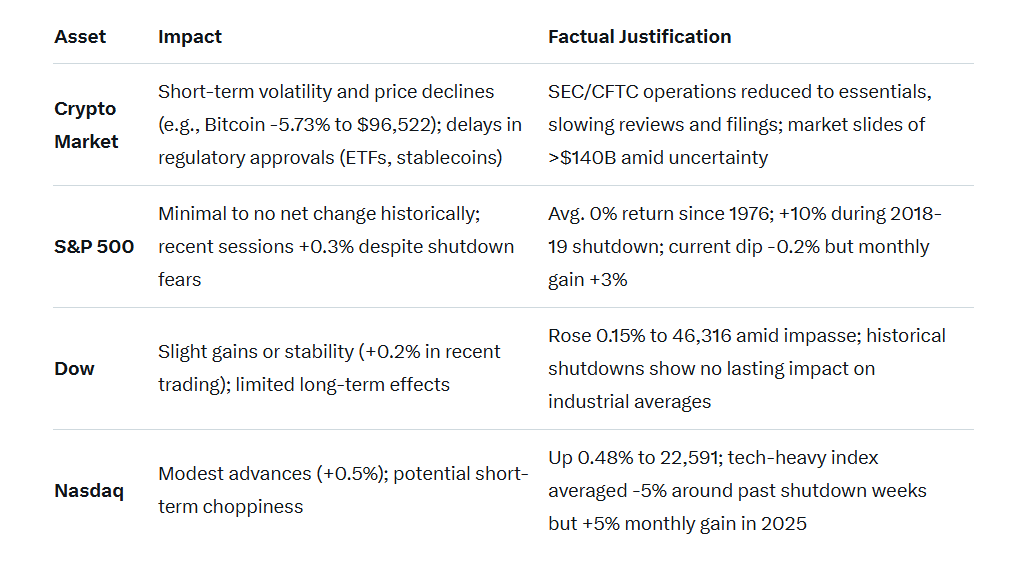
Different AI models interpret the market impact of a U.S. government shutdown in slightly different ways. ChatGPT emphasizes macro uncertainty, volatility, and sector-specific risks, while Grok adds recent trading snapshots and historical stats.
Question to GrokGrok’s responseChatGPT PromptChatGPT’s response
Together, they provide complementary views: one more structural, the other more data-point driven.
Asset
ChatGPTi’s view
Grok’s view
Crypto market
Higher short-term volatility due to missing U.S. economic data; crypto reacts strongly to uncertainty.
Short-term volatility and price declines (e.g., Bitcoin –5.73% to $96,522); ETF/filing delays as SEC/CFTC operations cut back.
S&P 500
Potential pause in rally; mild downside as GDP shaved 0.1–0.2pp per week.
Minimal net change historically; +10% during 2018–19 shutdown; recent sessions +0.3% despite fears.
Dow
Pressure on government-exposed sectors like defense and infrastructure.
Slight gains or stability; rose 0.15% to 46,316; historical shutdowns show no lasting impact.
Nasdaq
Mixed—tech resilient but upside capped by uncertainty and risk aversion.
Modest advances (+0.5% to 22,591); historically averaged –5% around shutdown weeks but +5% monthly gain in 2025.
While ChatGPT and Grok offer useful insights, AI tools cannot predict markets with certainty. Their views are based on patterns, history, and available data, not guarantees. Investors should treat these perspectives as information, not financial advice.
The U.S. government shutdown created short-term uncertainty for Bitcoin and other cryptocurrencies.
Historical precedent shows mixed outcomes: sometimes BTC rallies, sometimes it drops, and often the broader market cycle matters more than politics.
Still, with critical economic data at risk of going dark and regulators operating at reduced capacity, crypto investors braced for higher volatility and slower clarity.
Does a US government shutdown directly affect Bitcoin?
No. A shutdown doesn’t directly change how Bitcoin works or how crypto is traded. The impact comes indirectly, through missed economic data, reduced regulatory activity, and shifts in investor sentiment.
Could a shutdown make Bitcoin go up?
Possibly, but not automatically. In past shutdowns, Bitcoin has sometimes risen (like in 2013) and sometimes fallen (like in 2018–19). The bigger driver is whether the crypto market is in a bullish or bearish cycle at the time.
How might a shutdown affect crypto regulation?
Agencies like the SEC and CFTC scale back operations during shutdowns. That can delay ETF approvals, enforcement actions, and other regulatory decisions that matter to the crypto industry.
Is Bitcoin a safe haven during a US shutdown?
Some investors view Bitcoin as a hedge against government dysfunction, but history shows mixed results. Unlike gold or the dollar, Bitcoin hasn’t yet proven to behave consistently as a “safe haven” asset during political crises.
Disclaimer:
The information provided in this article is for informational purposes only. It is not intended to be, nor should it be construed as, financial advice. We do not make any warranties regarding the completeness, reliability, or accuracy of this information. All investments involve risk, and past performance does not guarantee future results. We recommend consulting a financial advisor before making any investment decisions.
Giuseppe Ciccomascolo began his career as an investigative journalist in Italy, where he contributed to both local and national newspapers, focusing on various financial sectors.
Upon relocating to London, he worked as an analyst for Fitch's CapitalStructure and later as a Senior Reporter for Alliance News. In 2017, Giuseppe transitioned to covering cryptocurrency-related news, producing documentaries and articles on Bitcoin and other emerging digital currencies. He also played a pivotal role in establishing the academy for a cryptocurrency exchange website. Crypto remained his primary area of interest throughout his tenure as a writer for ThirdFloor.


 Easy
Easy