Bitcoin fell over 2% after the Bank of Japan raised interest rates to 1%, the highest since 1995, fueling fears of yen carry trade unwinding and tighter global liquidity. | Credit: CCN.com
Share
Key Takeaways
The Bank of Japan has raised its benchmark rate by 0.25%, now standing at 0.75%.
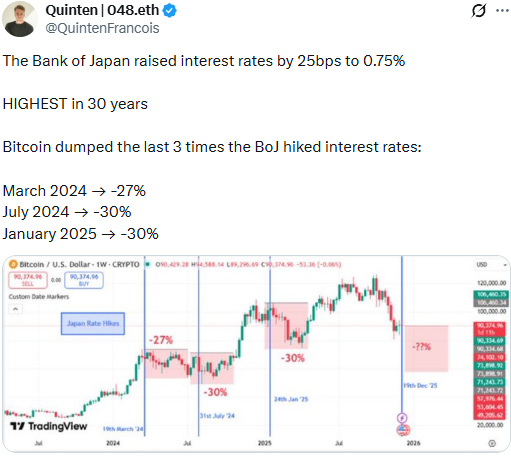
Bitcoin has historically fallen 20-30% after BoJ rate hikes, driven by yen-funded carry trade unwinds and global de-risking.
A strong recovery and a new all-time high followed every previous BoJ-driven Bitcoin sell-off.
Arthur Hayes’ bullish thesis highlights a longer-term macro risk.
The Bank of Japan (BoJ) has officially delivered what markets had been bracing for: a 25-basis-point interest rate hike, bringing its benchmark rate to 0.75%, the highest level since 1995. While the move was widely anticipated, its implications for Bitcoin and crypto markets heading into 2026 are only now beginning to unfold.
Historically, BoJ tightening cycles have triggered sharp Bitcoin sell-offs, driven by global liquidity shifts and the unwinding of yen-funded carry trades. Yet those same episodes have also marked the starting point for powerful Bitcoin recoveries and new all-time highs.
With fear elevated, positioning defensive, and macro uncertainty rising, investors are once again asking the same question: Is this rate hike a threat or a hidden catalyst for Bitcoin’s next significant move?
BoJ Rate Hike: What Just Happened to Japan and Bitcoin
Following weeks of speculation and a market-implied probability of 98.4%, the BoJ raised rates by 0.25%, pushing the policy rate to 0.75%.
While modest by global standards, the hike carries outsized importance because Japan has been the last major holdout of ultra-loose monetary policy.
For decades, the yen functioned as a global funding currency, enabling investors to borrow cheaply and deploy capital into higher-yielding assets worldwide. Even incremental rate increases disrupt this system, forcing leveraged players to unwind positions across global markets, including crypto.
The hike itself did not come as a shock. What matters now is how markets digest the consequences.
Bitcoin Price’s Historical Reaction to BoJ Rate Hikes
Bitcoin’s relationship with the BoJ is surprisingly consistent. Each time the central bank tightened policy, BTC experienced a sharp drawdown, followed by a strong recovery.
The BoJ hiked rates to the highest level in 30 years. | Credit: Quinten Francois X profile
Now, with rates at 0.75%, Bitcoin has once again entered a period of volatility. Historically, these declines were not trend-ending events. Instead, they acted as liquidity resets, flushing leverage before Bitcoin resumed its broader uptrend.
During the first quarter of 2025, amid concerns about the Trump-era tariff war.
Crypto fear & greed index. | Credit: CryptoQuant
In previous cycles, such sentiment readings often coincided with local or macro bottoms, rather than tops. They reflected forced selling and hedging, rather than fundamental deterioration.
This raises a critical question: now that the hike has already happened, how much downside risk remains?
Market Positioning Remains Bearish for Bitcoin
Derivatives data shows traders remain defensive. Nick Forster, Co-Founder of crypto options platform Derive, noted that:
Bears accumulated heavy put exposure at the $85,000 strike.
Traders are positioning for downside risk extending into Q1 and Q2 2026.
Volatility remains elevated at around 45%, while the skew of 5% suggests sustained demand for downside protection.
At the time of writing, Bitcoin trades near $87,000, after briefly tagging $90,000 in a liquidity grab before retracing. Key liquidity zones include:
Upside: $90,800 and $94,500-$95,000.
Downside: $83,000.
These levels are likely to be tested as markets recalibrate following the BoJ.
Spot Bitcoin ETFs are sending conflicting signals. Earlier in the week, the market saw over $600 million in outflows, reflecting caution and de-risking. Yet this was followed by a $457 million inflow on December 17, highlighting ongoing institutional interest.
This tug-of-war reinforces the idea that Bitcoin is not experiencing abandonment, but rather rotation and repositioning amid macro stress.
Arthur Hayes: Why the BoJ Could Ultimately Fuel Bitcoin’s Next Bull Run
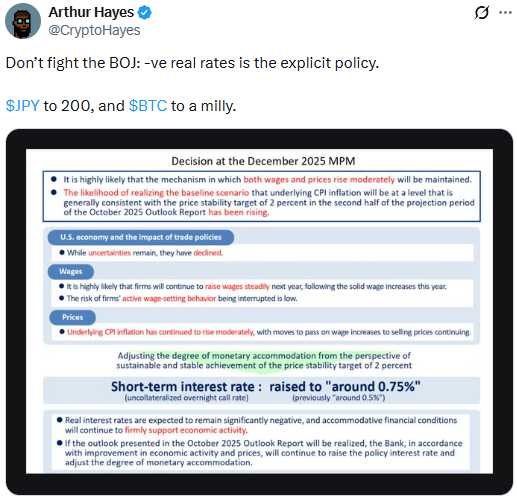
According to the BitMEX co-founder, the BoJ’s policy trajectory, not the hike itself, is bullish for Bitcoin. His core message: “Don’t bet against the Bank of Japan.”
Despite raising nominal rates, Japan continues to operate under negative real interest rates, meaning inflation still erodes purchasing power faster than yields compensate savers. Hayes argues this creates structural pressure on the yen and incentivizes capital flight into hard assets.
Arthur Hayes expects BoJ next moves to drive Bitcoin to $1 million. | Credit: Arthur Hayes X profile
Whether or not the target is reached, the key insight remains: Bitcoin is increasingly a macro hedge, not just a speculative asset.
What This Means for Bitcoin Price in 2026
With the BoJ hike now behind us, the market transitions from anticipation to digestion. Historically, this phase has been volatile but finite.
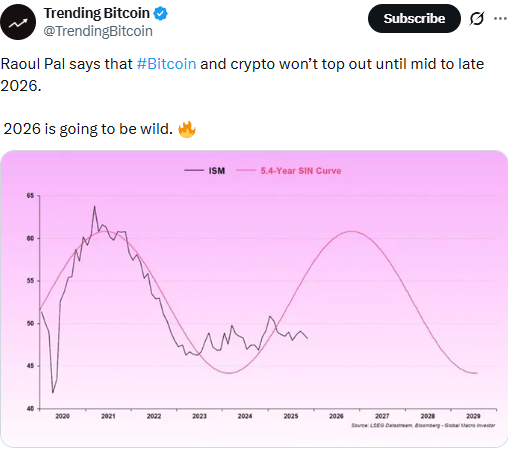
Grayscale expects Bitcoin to reach a new all-time high in H1 2026, suggesting current levels represent long-term value rather than structural weakness.
Analysts expect Bitcoin to increase in 2026. | Credit: Trending Bitcoin X profile
If past patterns repeat, the BoJ hike could ultimately be remembered as:
Further Bank of Japan Hikes On The Horizon, But Not Imminent
ING analysts told CCN that the Bank of Japan may further increase its rates next year, but not in the near future.
According to Min Joo Kang, Senior Economist for South Korea and Japan, and to Chris Turner, Global Head of Markets, the BoJ signaled rising confidence in sustainable inflation, citing steady wage growth and a stable wage-price cycle. At the same time, it stressed that real interest rates will remain significantly negative, keeping financial conditions accommodative despite the hike.
While the statement implies more rate hikes ahead, the timing and pace remain unclear.
Governor Kazuo Ueda avoided guidance on the neutral rate or a clear policy path, instead emphasizing the need for close monitoring of the economic impact of higher rates. This cautious tone disappointed markets, pushing 10Y JGB yields above 2% and lifting USD/JPY toward 156.
Looking ahead, the BoJ will focus on inflation, wage negotiations, and the yen’s exchange rate. Headline inflation is expected to fall below 2% in the first half of 2026, but core inflation is likely to remain above 2%, supported by robust wage growth.
Under a base case of moderate yen appreciation, the next rate hike is expected to occur in October 2026; however, a weaker yen could bring it forward to Q2 2026.
Inflation remains sticky, with headline CPI at 2.9% and core inflation at 3.0%, reinforcing inflation as the key driver of future BoJ policy.
What to Expect Next Year
The Bank of Japan has already raised rates to levels unseen in nearly three decades. In the short term, this has reinforced fear, pressured liquidity, and weighed on Bitcoin. But history suggests these moments often mark transitions, not endings.
As Bitcoin becomes increasingly intertwined with global macro dynamics, central bank policy, mainly from institutions as influential as the BoJ, will continue to shape its trajectory.
Whether the next move is lower before higher, or whether the market has already absorbed the shock, one thing is clear: the BoJ rate hike is not the end of Bitcoin’s story; it may be the beginning of its next significant chapter heading into 2026.
The Bank of Japan raised its benchmark interest rate by 0.25%, bringing it to 0.75%, the highest level since 1995. While the hike was widely expected, it marks a significant shift away from Japan’s long-standing ultra-loose monetary policy.
Why does a BoJ rate hike affect Bitcoin?
The Japanese yen is a major global funding currency. When rates rise, borrowing in yen becomes more expensive, forcing institutions to unwind leveraged positions funded in yen. This often leads to selling across risk assets, including Bitcoin, even though Bitcoin itself is decentralized.
Is the current Bitcoin sell-off caused by fear or fundamentals?
Mostly fear and liquidity mechanics. Market sentiment has fallen into “extreme fear,” a level that historically aligns with forced selling and hedging rather than long-term fundamental weakness. Similar fear readings in the past have often marked market bottoms.
Was the BoJ rate hike already priced into Bitcoin?
To a large extent, yes. Markets had assigned nearly 98% probability to a 25 bps hike before it happened. However, even expected rate hikes can trigger volatility due to deleveraging, risk management rules, and options hedging.
Disclaimer:
The information provided in this article is for informational purposes only. It is not intended to be, nor should it be construed as, financial advice. We do not make any warranties regarding the completeness, reliability, or accuracy of this information. All investments involve risk, and past performance does not guarantee future results. We recommend consulting a financial advisor before making any investment decisions.
Giuseppe Ciccomascolo began his career as an investigative journalist in Italy, where he contributed to both local and national newspapers, focusing on various financial sectors.
Upon relocating to London, he worked as an analyst for Fitch's CapitalStructure and later as a Senior Reporter for Alliance News. In 2017, Giuseppe transitioned to covering cryptocurrency-related news, producing documentaries and articles on Bitcoin and other emerging digital currencies. He also played a pivotal role in establishing the academy for a cryptocurrency exchange website. Crypto remained his primary area of interest throughout his tenure as a writer for ThirdFloor.


 Easy
Easy