10 Major US Banks Quietly Building Bitcoin Products
Share
Key Takeaways
Once hesitant, U.S. banks are now integrating cryptocurrency services.
Smaller institutions use Bakkt’s Crypto Connect platform to let customers buy, sell, and hold Bitcoin and Ethereum.
After pausing to secure its national bank charter, SoFi reintroduces its in-app crypto trading feature.
PNC Bank, one of the top 10 U.S. banks, is partnering with Coinbase to enable customers to trade crypto through the PNC platform.
Cryptocurrency is no longer just the playground of dedicated exchanges and fintech startups. A growing number of traditional U.S. banks are now offering clients the ability to buy, sell, or hold digital assets like Bitcoin directly through their banking relationships.
Below are five American banks making headlines by entering the crypto space. And yes, number 3 is a big surprise.
Try Our Recommended Crypto Exchanges
Sponsored
Disclosure
We sometimes use affiliate links in our content, when clicking on those we might receive a commission at no extra cost to you. By using this website you agree to our terms and conditions and privacy policy.
Small in size, but big in ambition, American Bank, headquartered in Allentown, Pennsylvania, has partnered with crypto-service provider Bakkt Holdings, Inc. to let its customers buy, sell, and hold the two largest cryptocurrencies: Bitcoin and Ethereum.
For customers, this means that their existing banking app may soon (if not already) include a “crypto” section where they can tap to invest. Because the bank is not a giant, the move stands out: even regional players believe the appetite for digital assets is strong, and want to capture it.
Key points for users:
Access via a trusted traditional bank, not just an exchange.
Crypto buy/sell/hold is likely integrated within the banking interface.
It is a good entry point for customers who prefer banking and crypto under one roof.
The downside? As a smaller bank, the scope might be more limited (e.g., fewer coins, less liquidity) than dedicated crypto platforms. But it’s a noteworthy stepping stone for mainstream users wishing to dip a toe in digital assets.
2. Sullivan Bank
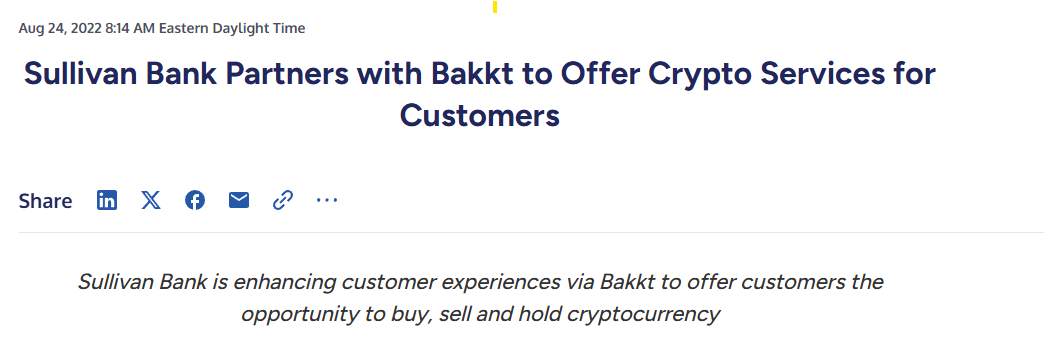
Moving to the Midwest, Sullivan Bank of Missouri has also entered the crypto fray via a partnership with Bakkt. In August 2022, the bank announced it would enable customers to buy, sell, and hold Bitcoin and Ethereum through Bakkt’s infrastructure.
Sullivan Bank’s 2022 announcement of partnership with Bakkt. | Credit: Sullivan Bank
One detail of interest: Sullivan Bank’s partnership allowed customers to view their Bitcoin and checking account balances inside their regular banking app. That kind of “one-wallet” experience is a strong convenience signal.
For users, Sullivan Bank offers:
Crypto services anchored in a conventional bank environment.
Interface integration: crypto balances shown with other banking assets.
Access a familiar banking app rather than a separate, standalone crypto platform.
Again, limitations may apply (e.g., which coins are offered, withdrawal options, external wallet transfers), but it is impressive that a bank physically in Missouri will provide crypto in 2022-23.
3. PNC Bank
Yes, the big one. PNC Bank, one of the largest U.S. banks, has announced a strategic partnership with crypto exchange Coinbase Global, Inc. to roll out crypto-buy, hold, and sell capabilities for its customers.
Here’s what we know:
Announced July 22, 2025: PNC and Coinbase will collaborate to allow PNC clients to buy, hold, and sell cryptocurrencies via PNC’s platform, leveraging Coinbase’s “Crypto-as-a-Service” (CaaS) infrastructure.
PNC will provide some banking services to Coinbase as part of the agreement. These services will tap Coinbase’s crypto infrastructure so that PNC customers can access digital assets without exiting their banking environment.
Initially, the offering may focus on wealth and asset-management clients, but is expected to expand.
A bank of PNC’s size seriously entering crypto means digital assets are no longer fringe. A “top-10 U.S. bank plus Coinbase” signals mainstream financial services are embracing crypto.
For many bank customers who were hesitant to use cryptocurrency exchanges, the ability to trade via their regular bank will be a game‐changer.
Important user considerations:
Ensure what coins will be supported: Often, banks roll out the most established ones (e.g., Bitcoin, Ethereum) first.
Custody arrangements: Will PNC custody the crypto, or will Coinbase hold? The announcement suggests Coinbase’s infrastructure is used; users should ask for clarity.
Fees, tax reporting, withdrawal options: As with any crypto offering, these matter.
In short, if you bank with PNC, the crypto door opens. That’s why this entry is the “shock you” item.
Fintech-bank hybrid SoFi recently announced it will relaunch its in-app crypto investing and holding services in 2025. These services enable members to buy, sell, and hold digital coins like Bitcoin and Ethereum.
Once a leader in consumer crypto, SoFi pulled back in 2023 to secure a national bank charter. It is now coming back strong, integrating crypto into its broad financial service offering (loans, savings, investing, payments).
From its June 2025 announcement: “Later this year, eligible members will be able to … buy, sell and hold a selection of cryptocurrencies like Bitcoin and Ethereum.”
Why this matters: SoFi is digital-native and highly app-centric. SoFi’s crypto offering may feel more seamless than legacy bank’s for younger or tech-savvy users who prefer mobile-only banking. But:
The launch is still forthcoming and not yet fully live at the time of publication.
As always, check supported coins, fees, custody, and terms.
5. JPMorgan Chase & Co. (via Chase)
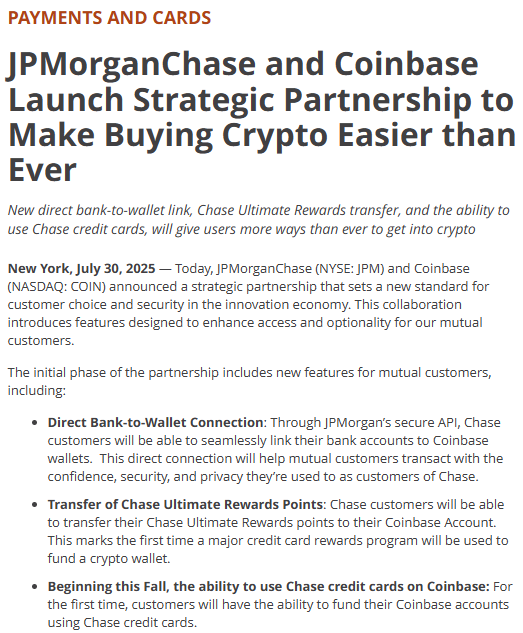
Rounding out our list is JPMorgan Chase, the largest U.S. banking institution, which announced in July 2025 a strategic collaboration with Coinbase to simplify crypto access for Chase customers.
JPMorgan partners with Coinbase to offer crypto trading to its customers. | Credit: JPMorgan
Among the notable features:
From Fall 2025, Chase credit card holders can use their cards to fund their Coinbase account.
Starting in 2026, Chase Ultimate Rewards points can be converted into cryptocurrency (USDC) and directly linked to Coinbase accounts.
Direct bank account to Coinbase wallet connections via secure API integration.
For Chase users, this means banking and crypto are merging more tightly. But note: this partnership is more about access and funding (cards, points, linking) than the bank offering full in-house crypto trading like a crypto exchange (at least initially). Still, it is an essential bridging step.
Before You Trade Crypto With Your Bank — What You Should Know
If your bank is offering crypto trading, or you’re considering switching to one that does, here are several educational points to keep in mind:
Key benefits include:
Convenience: Trading crypto via your existing bank app means less friction, fewer separate log-ins, and one interface for fiat and crypto.
Trust: Banks often provide better regulatory oversight, insurance, and support than lesser-known crypto platforms.
Integration: Ability to move money seamlessly between checking/savings and crypto, or convert rewards/points into digital assets (sometimes).
Key questions and risks:
Which assets: Many banks start with Bitcoin and Ethereum before expanding. If you’re into smaller altcoins, the bank may not support them.
Custody and control: When you buy via the bank, do you control the private keys? Or does the bank/partner custody assets on your behalf? The latter is more convenient but means less control.
Fees and spreads: Crypto trading can involve spreads, mark-ups, or inactivity fees; check what the bank charges compared to dedicated crypto exchanges.
Withdrawal and external transfer rules: Can you move your crypto to an external wallet? Some bank-partner models restrict this.
Tax implications: Crypto transactions often trigger tax events. A bank offering crypto may integrate tax reporting, but you still must know your local tax rules.
Regulatory/timing caveats: Many bank-crypto offerings are rolling out gradually. Some features (linking, points conversion, full trading) may launch in stages (e.g., PNC’s offering or Chase’s linking), so patience and monitoring are required.
Volatility and risk: Despite being offered via a bank, crypto remains high-risk. Banking origin doesn’t remove price risk.
When Banks Meet Crypto: A Sign of Market Maturity?
Seeing banks open the doors to crypto indicates that the asset class matures when banks partner with crypto-infrastructure providers (for instance, PNC with Coinbase; American Bank, Sullivan Bank with Bakkt), the ecosystem bridges the old and new financial worlds.
Yet, as with any investment, having access doesn’t guarantee success; you must treat crypto investments with the same caution, diligence, and strategic thinking you apply elsewhere.
Can I really buy Bitcoin directly through my U.S. bank now?
Several banks have begun integrating crypto trading into their platforms, often through partnerships with regulated crypto-infrastructure providers like Coinbase or Bakkt. You can log into your bank’s app or website and buy or hold Bitcoin like a stock or mutual fund.
Do I need to open a new crypto account to use these services?
Usually not. These banks aim to make crypto trading accessible within your existing account dashboard or mobile app. For example, American Bank and Sullivan Bank customers access crypto features through their regular online banking interfaces, while PNC and Chase users will connect through integrated Coinbase features.
Does the bank itself hold my Bitcoin?
In most cases, no. The crypto assets are typically custodied by the bank’s partner, such as Coinbase or Bakkt, which specializes in secure crypto storage. The bank acts as a gateway or intermediary, and the licensed crypto platform holds your crypto in custody. Always confirm custody details before transacting.
Are there limits on which cryptocurrencies I can buy?
Yes. Most banks start conservatively by offering only Bitcoin (BTC) and Ethereum (ETH). Over time, more coins could be added, but don’t expect meme coins or high-risk tokens right away. Banks prefer assets with clear regulatory treatment and liquidity.
Disclaimer:
The information provided in this article is for informational purposes only. It is not intended to be, nor should it be construed as, financial advice. We do not make any warranties regarding the completeness, reliability, or accuracy of this information. All investments involve risk, and past performance does not guarantee future results. We recommend consulting a financial advisor before making any investment decisions.
Giuseppe Ciccomascolo began his career as an investigative journalist in Italy, where he contributed to both local and national newspapers, focusing on various financial sectors.
Upon relocating to London, he worked as an analyst for Fitch's CapitalStructure and later as a Senior Reporter for Alliance News. In 2017, Giuseppe transitioned to covering cryptocurrency-related news, producing documentaries and articles on Bitcoin and other emerging digital currencies. He also played a pivotal role in establishing the academy for a cryptocurrency exchange website. Crypto remained his primary area of interest throughout his tenure as a writer for ThirdFloor.


 Easy
Easy