Is Bitcoin under attack? New soft fork proposal triggers outrage. | Credit: CCN.com
Share
Key Takeaways
A new Bitcoin Improvement Proposal by developer Luke Dashjr is creating notable controversy in the crypto world.
BIP 444 introduces a temporary one-year soft fork to restrict transaction data sizes.
The proposal includes a controversial clause claiming there is a “moral and legal impediment to rejecting the soft fork.”.
BitMEX Research sharply criticized BIP 444, saying it could backfire catastrophically.
A new Bitcoin Improvement Proposal (BIP) from long-time developer Luke Dashjr has lit up X (formerly Twitter) and GitHub, splitting the Bitcoin community into one of the most intense debates since the Ordinals controversy.
The proposal, BIP 444, aims to curb the spread of illegal data inside Bitcoin blocks, but critics say it goes much further.
Some call it a censorship attempt, others a legal threat, and a few even label it an attack on Bitcoin itself.
It makes storing non-financial data easier, like Ordinals and BRC-20 inscriptions.
Accidentally opens the door for bad actors to embed illegal material, such as copyrighted data or CSAM (child sexual-abuse material).
Developers behind BIP 444 argue that this isn’t just a theoretical risk. They claim illegal content has already been mined and that continuing to run unpatched nodes could expose participants to legal consequences.
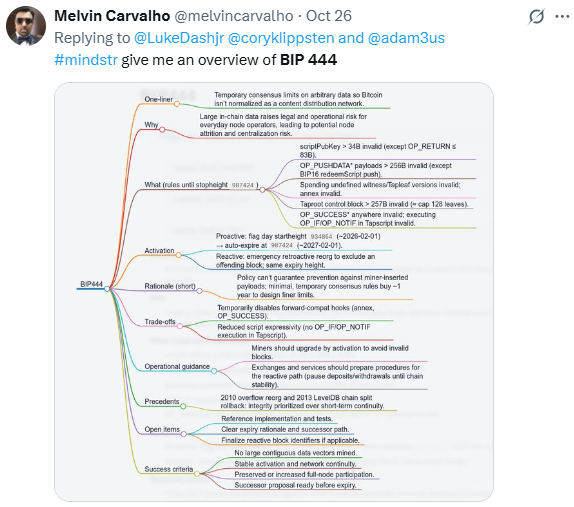
Complexity of BIP 444. | Credit: @melvincarvalho X profile
Their proposed fix:
A one-year emergency soft fork to temporarily restrict how much data can be stored in transactions.
A promise to develop a permanent, cleaner solution later.
Immediate activation, with no signaling and no lengthy review, described as a “response to an immediate crisis.”
The GitHub draft even includes alarming language: “Unfortunately, due to the release of Bitcoin Core 30 endorsing large data storage and actual illegal content being mined… the network as it stands is already contaminated.”
The tone sets the stage: this is portrayed as a crisis, not a normal technical upgrade.
Controversy Erupts Over BIP 444 Language: Legal Threats or Moral Appeal?
The uproar, however, centers on a few lines buried deeper in the draft.
The proposal states on lines 261-272: “There is a moral and legal impediment to any attempt to reject this soft fork. Rejecting this soft fork may subject you to legal or moral consequences or result in you splitting off to a new altcoin like Bcash. However, strictly speaking, you are free to choose.”
The phrasing “legal or moral consequences” sets X ablaze.
Critics saw it as:
A veiled legal threat against anyone refusing the upgrade.
According to BitMEX, it is “A bad actor who wants to conduct a double-spend attack could put CSAM onchain to cause a re-org and succeed with their attack. The proposal therefore provides an economic incentive for onchain CSAM.”
For BitMEX:
BIP 444 treats illegal content as a trigger for chain re-organization.
An attacker could intentionally upload illegal data to force a re-org, creating instability.
That instability could be exploited for double-spend attacks, a nightmare scenario for Bitcoin’s security model.
In short, the cure might be worse than the disease.
Dashjr’s Defense: “It’s Being Misinterpreted”
Luke Dashjr insists the controversial clause is misunderstood.
In a reply to a user claiming the text makes it “illegal” to reject the fork, he said: “It doesn’t say that. Maybe you can propose a clarification if you think it’s unclear.”
He later added context: “‘May’ isn’t ‘certainly.’ The line came from an older draft that didn’t include proactive activation. It probably just needs clarification.”
Dashjr seems to be saying the intent wasn’t to threaten anyone but to warn that rejecting the soft fork could result in hosting illegal content, which might bring legal risk depending on your country.
Still, the “moral and legal impediment” tone felt like a step too far for many in the Bitcoin space. Even if the intent was benign, the optics were disastrous.
Bitcoin Core vs. Bitcoin Knots: BIP 444 and the Ongoing Struggle Over Bitcoin’s Purpose
This controversy highlights a deeper rift within the Bitcoin developer ecosystem: Bitcoin Core vs. Bitcoin Knots.
Bitcoin Core: Most of the network’s reference client, focused on stability and conservative changes.
Bitcoin Knots: An alternative Dashjr maintains, with stricter filtering and extra features.
The debate reflects two visions of Bitcoin’s future:
Vision
Philosophy
Example Use
Neutral protocol
“Code doesn’t care what you store.”
Ordinals, BRC-20, metadata storage
Monetary purity
“Bitcoin is money, not a data dumpster.”
Small financial transactions only
BIP 444, in that sense, is a continuation of Dashjr’s long-standing campaign against using Bitcoin for non-financial data.
Critics Claim BIP 444 Is Toothless: Symbolic Fix or Ineffective Overreach?
Ironically, Peter Todd, one of the proposal’s fiercest critics, says the entire plan may be technically irrelevant.
He claims to have created a transaction embedding the entire text of the soft-fork proposal itself, describing it as: “100% standard and fully compatible with the proposal.”
If true, this means users could still store arbitrary text or data on-chain even after the supposed fix, effectively bypassing the restriction entirely.
That revelation adds insult to injury: a proposal that angers half the community might not even solve the problem it targets.
BIP 444’s Activation Risks: Could a Moral Dispute Trigger Bitcoin’s First Ideological Chain Split?
Even if BIP 444 were adopted, the activation process could be messy.
From the GitHub draft: “Even if non-upgraded miners continue to mine invalid blocks, old nodes will continually replace them with valid blocks every time the valid chain overtakes the invalid one.”
That sounds reassuring, but, in practice, it means:
Some miners might follow one version of the chain.
Others might reject it, causing temporary forks.
If consensus fails, Bitcoin could split into two competing networks.
Therefore, a moral or legal disagreement, not a technical bug, could lead to Bitcoin’s first major ideological chain split.
BIP 444 and the Principles at Stake
This isn’t just a developer drama. It touches on some of Bitcoin’s deepest principles:
Immutability vs. legality: Should Bitcoin ever censor its history, even to remove illegal data?
Decentralization vs. governance: Who decides what “morally acceptable” code is?
Neutrality vs. image: Should Bitcoin care about its reputation in the eyes of regulators?
Critics fear that moralizing protocol changes could set a precedent where developers or governments start using legality as leverage over consensus.
BIP 444’s Legacy: What the Debate Reveals About Bitcoin’s Governance and Human Nature
Whether or not BIP 444 proceeds, the uproar reveals a few key truths about the state of Bitcoin governance:
Bitcoin is still human: Code may be math, but developers are political beings with opinions, fears, and reputations.
Ethics in code are tricky: When legal and moral arguments enter protocol design, objectivity gets blurred.
Consensus is voluntary: No one can force a soft fork, but language that implies coercion is guaranteed to backfire.
For now, even Dashjr admits the soft fork faces no technical objections, only philosophical ones, which may be the hardest to resolve.
Bitcoin’s Moral Dilemma
Bitcoin was designed to be a system of rules, not rulers. Yet the debate over BIP 444 shows how fragile that principle can be when real-world ethics collide with cold math.
Supporters say it’s about protecting the network from legal contamination. Opponents say it’s about safeguarding Bitcoin from human interference.
Either way, the uproar has reminded everyone that the most brutal battles in crypto aren’t fought with code; they’re fought over who gets to define Bitcoin’s meaning.
BIP 444 is a proposed Bitcoin Improvement Proposal created by developer Luke Dashjr. It aims to temporarily limit the amount of non-financial data (like images, files, or arbitrary text) that can be stored in Bitcoin transactions through a one-year soft fork. The stated goal is to prevent illegal data, such as copyrighted material or CSAM (child sexual abuse material), from being stored on the blockchain after the Bitcoin Core v30 update enabled larger data payloads.
Why is BIP 444 controversial?
The controversy centers on a section of the proposal stating that there is a “moral and legal impediment” to rejecting the soft fork, and that refusing to adopt it could have “legal or moral consequences.” Critics argue this sounds like a legal threat or an attempt to coerce consensus, violating Bitcoin’s fundamental principle of voluntary participation. In short, it’s not just what the code does, it’s how it’s justified.
What is the “illegal content” problem in Bitcoin?
While Bitcoin transactions mainly store financial data, some users have discovered ways to embed arbitrary data (text, files, media) in transaction fields. Most of it is harmless, such as NFT metadata or artistic inscriptions. Still, anyone could store illegal or copyrighted data on the blockchain, which all full nodes replicate permanently. This raises the question: could running a full node someday become legally risky?
Could this lead to a chain split?
Potentially, yes, especially if miners and users don’t agree on activation. The BIP 444 draft notes that older nodes would “continually replace invalid blocks,” but disagreement among miners could produce temporary forks. And, if sustained, it could lead to a permanent split between two incompatible versions of Bitcoin. That would be disastrous for network stability and user confidence.
Disclaimer:
The information provided in this article is for informational purposes only. It is not intended to be, nor should it be construed as, financial advice. We do not make any warranties regarding the completeness, reliability, or accuracy of this information. All investments involve risk, and past performance does not guarantee future results. We recommend consulting a financial advisor before making any investment decisions.
Giuseppe Ciccomascolo began his career as an investigative journalist in Italy, where he contributed to both local and national newspapers, focusing on various financial sectors.
Upon relocating to London, he worked as an analyst for Fitch's CapitalStructure and later as a Senior Reporter for Alliance News. In 2017, Giuseppe transitioned to covering cryptocurrency-related news, producing documentaries and articles on Bitcoin and other emerging digital currencies. He also played a pivotal role in establishing the academy for a cryptocurrency exchange website. Crypto remained his primary area of interest throughout his tenure as a writer for ThirdFloor.


 Easy
Easy