Gold and silver crushed Bitcoin in 2025 as investors favored traditional inflation hedges. What the divergence means for markets in 2026. | Credit: CCN.com
Share
Key Takeaways
Gold and silver significantly outperformed Bitcoin in 2025.
Investors favored traditional precious metals as hedges against inflation and currency debasement.
Silver amplified gold’s macro signals, delivering outsized gains but also sharper volatility due to leverage, positioning, and industrial demand dynamics.
Looking ahead to 2026, gold and silver remain supported by macro tailwinds, while Bitcoin’s performance will depend more heavily on several factors.
2025 delivered an outcome that surprised many investors who entered the year with strong convictions about inflation hedges.
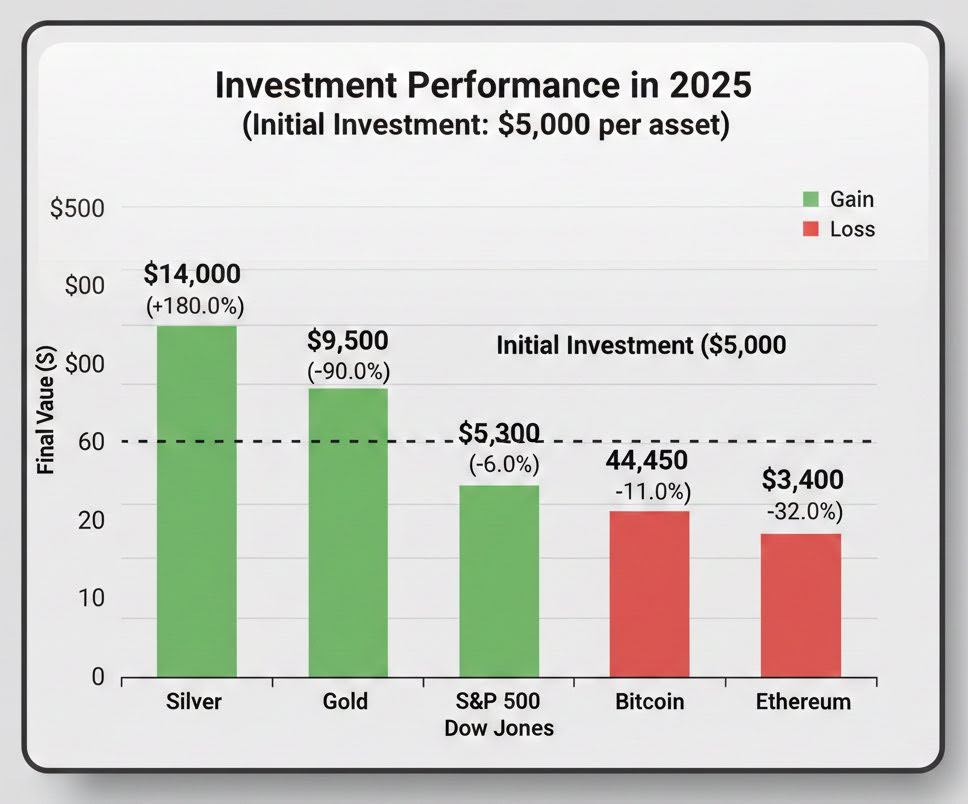
Gold and silver emerged as the clear winners, while Bitcoin, long touted as “digital gold,” lagged. Gold rose nearly 70% year-to-date, silver surged by roughly 150%, and Bitcoin finished the year down around 6%, falling back below the $90,000 level after peaking above $126,000 in October.
This divergence matters. Not because it settles any long-running debates about which asset is “better,” but because it reveals how the macro regime of 2025 rewarded certain forms of protection over others, and what that may signal for 2026.
At a glance, gold, silver, and Bitcoin are often grouped. All are discussed during inflationary periods. All are framed as alternatives to fiat currency. And all attract capital when trust in monetary policy weakens.
Robert Kiyosaki shared a bold outlook on the market, saying he expects the price of silver to surge dramatically. According to him, silver could open at around $100 and then continue rising to record-breaking levels. He presented this as a prediction and invited others to share their opinions on whether they believe such a sharp move is possible.
I PREDICT:
Silver opens tomorrow at $100 and goes to all time highs.
Yet by the end of 2026, their behavior could not have been more different.
Let’s see whether the metals-led rally keeps up this year or if Bitcoin ends up dominating.
What Is the “Debasing Trade” and Why It Dominated Markets in 2025
Analysts widely described 2025 as a year defined by the “debasing trade.” This strategy involves allocating capital to assets perceived as stores of value in anticipation of fiat currency erosion driven by:
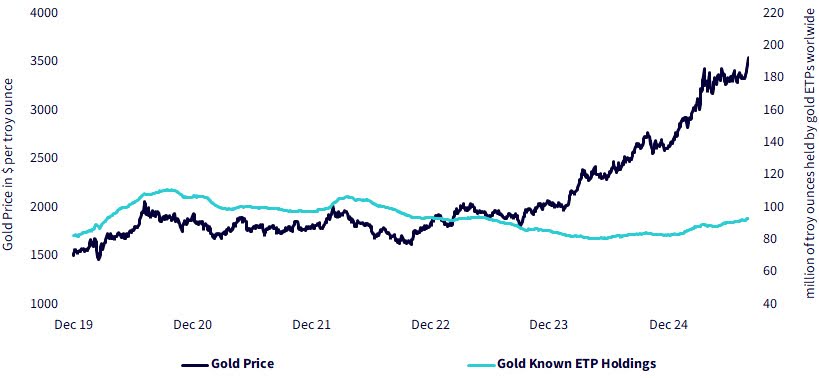
The metal remained above its 200-day moving average for approximately 550 consecutive trading days, the second-longest such streak on record, surpassed only by the period following the 2008 financial crisis. This technical resilience reinforced gold’s reputation as a dependable macro hedge.
Gold price vs. Gold Known ETP Holdings. | Credit: WisdomTree
Several forces worked in gold’s favor:
Expectations of interest-rate cuts reduced real yields.
Importantly, pullbacks were primarily viewed as positioning adjustments, rather than trend reversals. Even sharp declines late in December, triggered by margin requirement increases, were treated as pauses within a broader macro trade.
Gold ended 2025 with its most substantial annual gain since 1979, reshaping how investors interpret near-term volatility. In this environment, weakness is viewed as an opportunity for consolidation, not failure.
Gold acted as the anchor asset, the first to respond to shifts in real yields and policy expectations, and the one with the most apparent identity in the market.
Silver’s 150% Surge: How It Amplified the Inflation Hedge Trade
While gold represented stability, silver represented leverage to the same macro impulse. It benefited from inflation fears and currency debasement, but also from:
Strong industrial demand.
Supply constraints.
Its designation as a critical mineral in the U.S.
Rising interest from speculative capital.
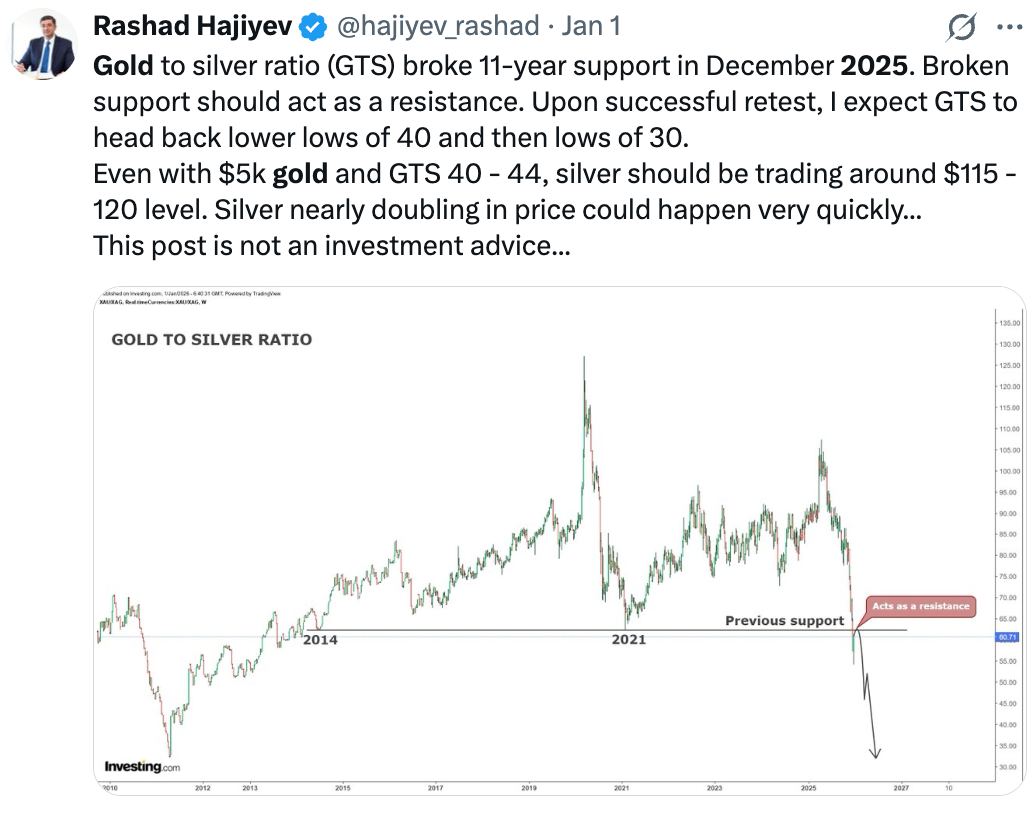
Gold-to-silver ratio broke 11-year support in December 2025. | Credit: Rashad Hajiyev X profile
That combination produced dramatic results. Silver outperformed gold during rallies and suffered sharper drawdowns during corrections.
Late-December margin increases exposed this dynamic. As requirements rose, silver fell sharply, erasing gains rapidly and surprising traders who had underestimated the extent of the leverage that had built up.
Early in the year, bullish forecasts dominated headlines. Bitcoin bulls framed the debasing trade as a primary catalyst, arguing that Bitcoin would outperform traditional hedges once fiat erosion became unavoidable.
Investment performance in 2025 with an initial investment of $5,000. | Credit: X
In December, Bitcoin slipped below $90,000, experiencing steady drawdowns during a period of thin holiday liquidity. The decline was not violent, but it was persistent, leaving Bitcoin roughly 30% below its peak by year-end.
Crucially, this weakness occurred while gold was printing record highs.
The divergence forced a reassessment. Bitcoin did not consistently capture the same safe-haven flows that supported metals. Instead, it behaved more like a liquidity-sensitive risk asset, influenced by:
The “digital gold” analogy lost traction as gold proved more reliable when uncertainty rose.
Bitcoin vs Gold vs Silver: How Each Asset Responded to the 2025 Macro Regime
By the final week of 2025, the distinction was clear:
Gold acted as the primary macro hedge, responding predictably to real yields, currency moves, and geopolitical stress.
Silver amplified those same signals, delivering outsized gains and sharper corrections due to leverage and supply dynamics.
Bitcoin operated in a separate lane, sensitive to liquidity conditions and risk appetite rather than fear alone.
This separation matters heading into 2026.
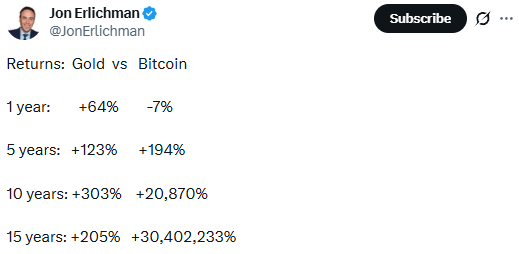
Gold vs. Bitcoin returns. | Credit: Jon Erlichman X profile
Assets that share narratives do not necessarily exhibit the same behavior, especially as markets mature.
Why Bitcoin No Longer Acts as a Reliable Safe Haven
Late-year mechanics distorted some signals.
Margin requirement changes led to synchronized selling in gold and silver futures, temporarily blurring the distinctions between the two. Bitcoin’s leverage is present on various venues, meaning forced selling does not align neatly with the metals market.
Holiday liquidity further complicated the interpretation. Thin volumes exaggerate moves, but the impact differs:
These mechanics explain why correlations can change rapidly without signaling a regime shift.
The Role of Regulation and Market Structure in Bitcoin’s Weakness
Bitcoin carries risks metals do not.
Ongoing legal, regulatory, and market-structure uncertainty adds a volatility premium that influences how investors size positions. When uncertainty rises, capital often flows first to assets with fewer unresolved questions.
Gold benefits from this dynamic. Silver follows with greater volatility. Bitcoin waits for clarity, and sometimes for renewed risk appetite.
This does not invalidate Bitcoin’s long-term case. It reframes its role.
Bitcoin increasingly behaves less like a pure hedge and more like an asset that requires supportive liquidity conditions to outperform.
Schiff Says Bull Market Is Just Beginning
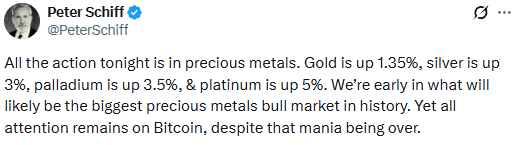
Gold bugs found fresh ammunition overnight as precious metals extended their rally, drawing renewed commentary from longtime Bitcoin critic Peter Schiff.
In a post on X, Schiff highlighted broad-based strength across the complex, with gold up 1.4%, silver gaining 3%, palladium rising 3.5% and platinum surging 5%, calling it the early phase of what he described as “the biggest precious metals bull market in history.”
Peter Schiff sees a bright horizon for metals. | Credit: Peter Schiff X profile
Momentum appeared to build through the session, with Schiff later noting gold trading above $4,400 and silver above $76.
Responding to critics who pointed out a recent pullback after his bullish calls, Schiff doubled down, arguing that short-term volatility is irrelevant within a multi-decade bull market he says began when gold traded below $300.
According to Schiff, prices remain well below where he expects them to go, reinforcing his view that investor attention remains misplaced on Bitcoin as enthusiasm for crypto fades.
What the 2025 Divergence Signals for Gold, Silver and Bitcoin in 2026
Looking ahead, the macro backdrop remains unsettled:
Prediction markets reflect this uncertainty. Polymarket assigns Bitcoin roughly a 40% chance of being the best-performing inflation hedge in 2026, compared with 33% for gold and 25% for equities.
That split captures the moment: Bitcoin’s potential remains high, but confidence is conditional.
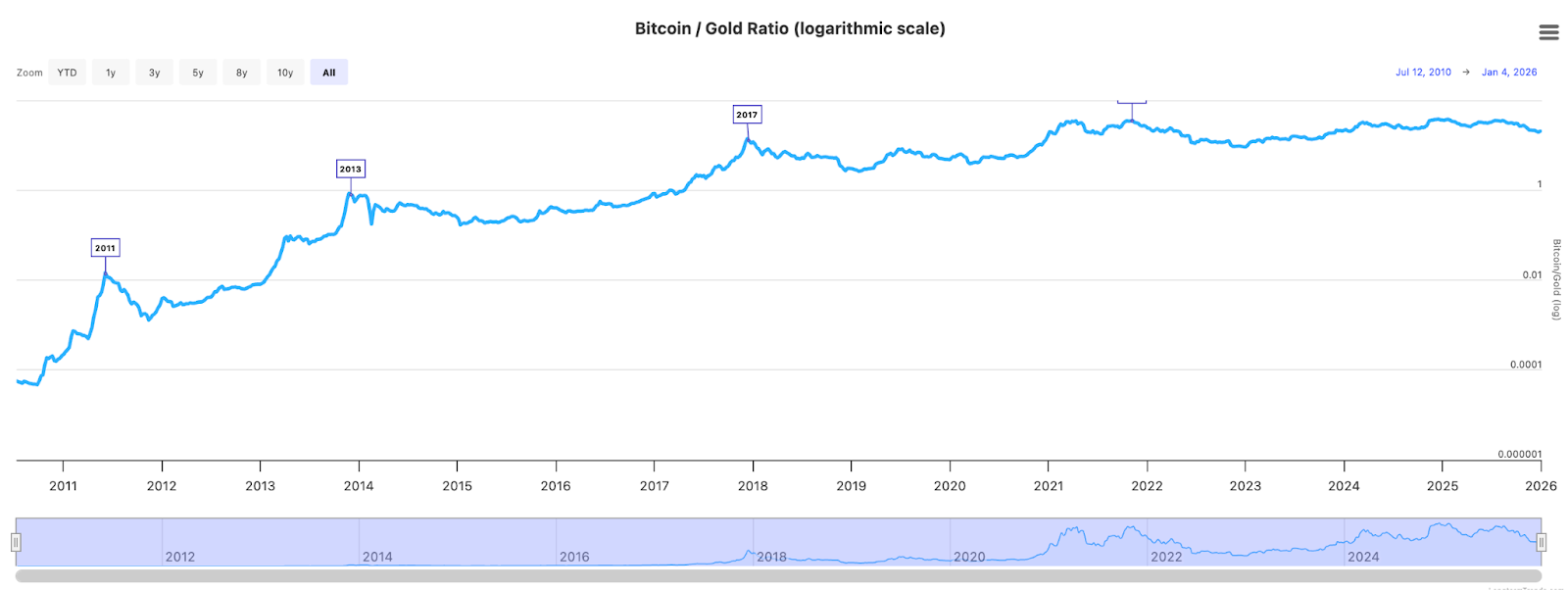
What About the Bitcoin-to-Gold Ratio?
Another point to consider is the Bitcoin-to-gold ratio, calculated by dividing the price of Bitcoin by the price of gold. It represents the number of ounces of gold required to purchase one bitcoin. When the ratio moves higher, Bitcoin outperforms gold; when it declines, gold gains relative strength.
Bitcoin-to-gold ratio. | Credit: LongtermTrends
President of Gold.Seek, Peter Spina, expects a sharp shift in the Bitcoin-to-gold ratio by 2025, projecting a potential 45% decline in the ratio. Despite repeated attempts, Bitcoin has failed to set new record highs against gold over the past five years.
Bitcoin-to-gold in 2025 dropped by 45%. | Credit: Peter Spina X profile
Spina challenges the popular “digital gold” narrative, noting that Bitcoin continues to underperform physical gold, raising questions about the durability of that comparison.
His view comes amid heightened volatility in precious metals markets, with renewed attention on gold and concerns over potential silver shortages following China’s export restrictions.
Can Bitcoin Reclaim Its Inflation Hedge Narrative in 2026?
The temptation is to declare winners and losers as the calendar turns.
History suggests restraint.
Gold’s dominance does not guarantee smooth gains. Silver’s volatility cuts both ways. Bitcoin’s underperformance does not preclude renewed relevance.
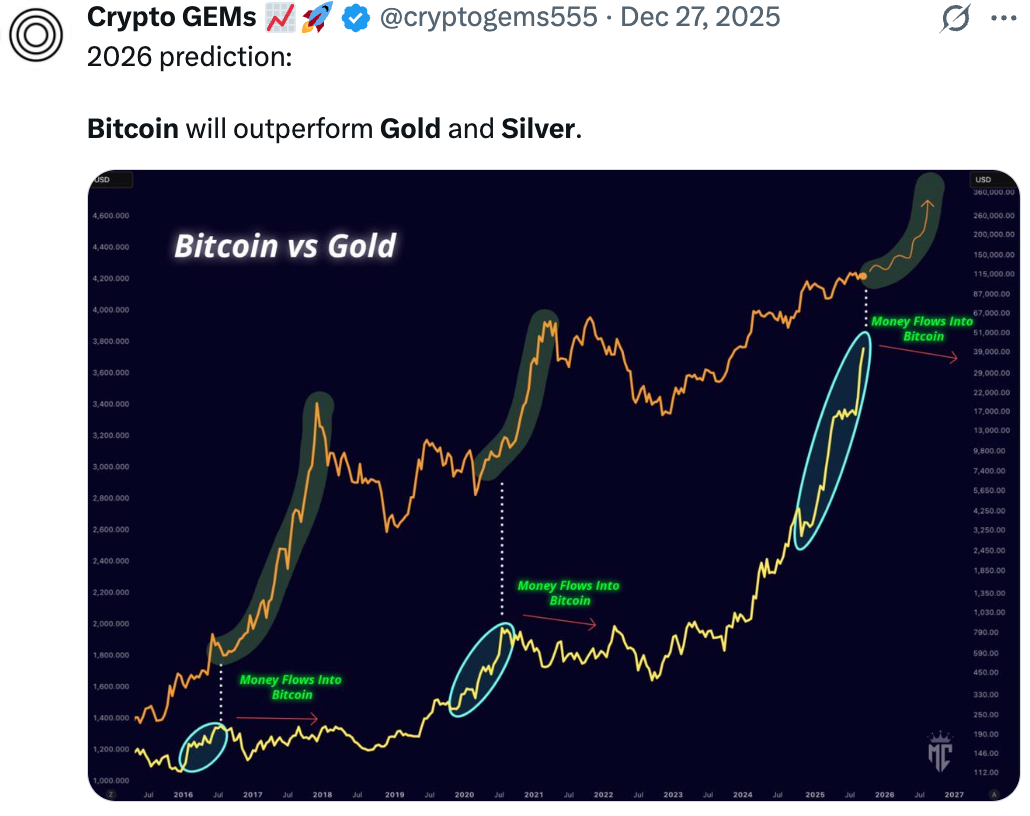
Bitcoin expected to outshine gold and silver this year. | Credit: Crypto GEMs X profile
What has changed is the assumption that gold, silver, and Bitcoin move as one.
2025 showed they do not.
What 2025 Taught Investors About Inflation Protection
Markets end 2025 asking an old question in a new way: where does safety live when uncertainty rises?
This year, investors answered clearly, with gold first, silver second, and Bitcoin waiting for its moment.
That does not close the debate. It refines it.
As 2026 approaches, understanding why these assets diverged may matter more than arguing which one ultimately wins. The macro regime has shifted, and with it, the rules of protection.
Gold outperformed Bitcoin in 2025 because investors prioritized assets with long-established roles as stores of value during a period of currency debasement, fiscal stress, and geopolitical uncertainty. Gold responded directly to falling real yields, central-bank buying, and a weaker dollar, while Bitcoin proved more sensitive to liquidity conditions and risk appetite.
Why did silver rise even more than gold in 2025?
Silver benefited from the same macro forces as gold but added strong industrial demand, supply constraints, and speculative interest. This combination amplified price movements, allowing silver to outperform gold during rallies while also experiencing sharper corrections during periods of volatility.
Is Bitcoin no longer an inflation hedge?
Bitcoin is not permanently disqualified as an inflation hedge, but 2025 showed that it does not always respond to inflation fears in the same way as gold or silver. Bitcoin’s performance depended more on liquidity, positioning, and regulatory clarity than on inflation expectations alone.
Are gold, silver, and Bitcoin still correlated?
They can be correlated during certain macro phases, but 2025 showed that their behaviors are increasingly distinct. Gold acts as a primary macro hedge, silver amplifies gold’s moves, and Bitcoin operates as a liquidity-sensitive asset rather than a pure safe haven.
Disclaimer:
The information provided in this article is for informational purposes only. It is not intended to be, nor should it be construed as, financial advice. We do not make any warranties regarding the completeness, reliability, or accuracy of this information. All investments involve risk, and past performance does not guarantee future results. We recommend consulting a financial advisor before making any investment decisions.
Giuseppe Ciccomascolo began his career as an investigative journalist in Italy, where he contributed to both local and national newspapers, focusing on various financial sectors.
Upon relocating to London, he worked as an analyst for Fitch's CapitalStructure and later as a Senior Reporter for Alliance News. In 2017, Giuseppe transitioned to covering cryptocurrency-related news, producing documentaries and articles on Bitcoin and other emerging digital currencies. He also played a pivotal role in establishing the academy for a cryptocurrency exchange website. Crypto remained his primary area of interest throughout his tenure as a writer for ThirdFloor.


 Easy
Easy