Bitcoin price is stuck as $24B in options expire. Learn how a gamma flush could break the range and why December 26 is a key turning point. | Credit: CCN.com
Share
Key Takeaways
The final week of 2025 features a major Gamma Flush, with $128 million expiring on Dec. 19 and $23.7 billion on Dec. 26.
The Dec. 19 expiry is the “appetizer” while Dec. 26 is the “boss level”.
ETF flows are small relative to dealer gamma, meaning the range-bound price is maintained mechanically, not due to a lack of buying interest.
Support at $85,000-$88,000, flip level at $90,616, and the long-term power law target around $118,000.
The final weeks of 2025 have left many Bitcoin investors scratching their heads. Despite a backdrop of cooling inflation, a priced-in Bank of Japan (BoJ) rate hike, and the fading noise of political tariff threats, Bitcoin remains stubbornly range-bound. For the average retail trader, the “tape feels glued.”
Every attempt to break above $90,000 is met with an invisible wall, while every dip toward $85,000 is mysteriously sucked back into the middle.
This isn’t a lack of interest; it’s a mechanical pin.
As the end of the year approaches, a double-barreled liquidity event is currently dictating the price of Bitcoin. With $24 billion in options set to expire, the market is caught in what experts call a Gamma Flush.
Bitcoin will stay in the $85,000 to $90,000 range until options expiry.
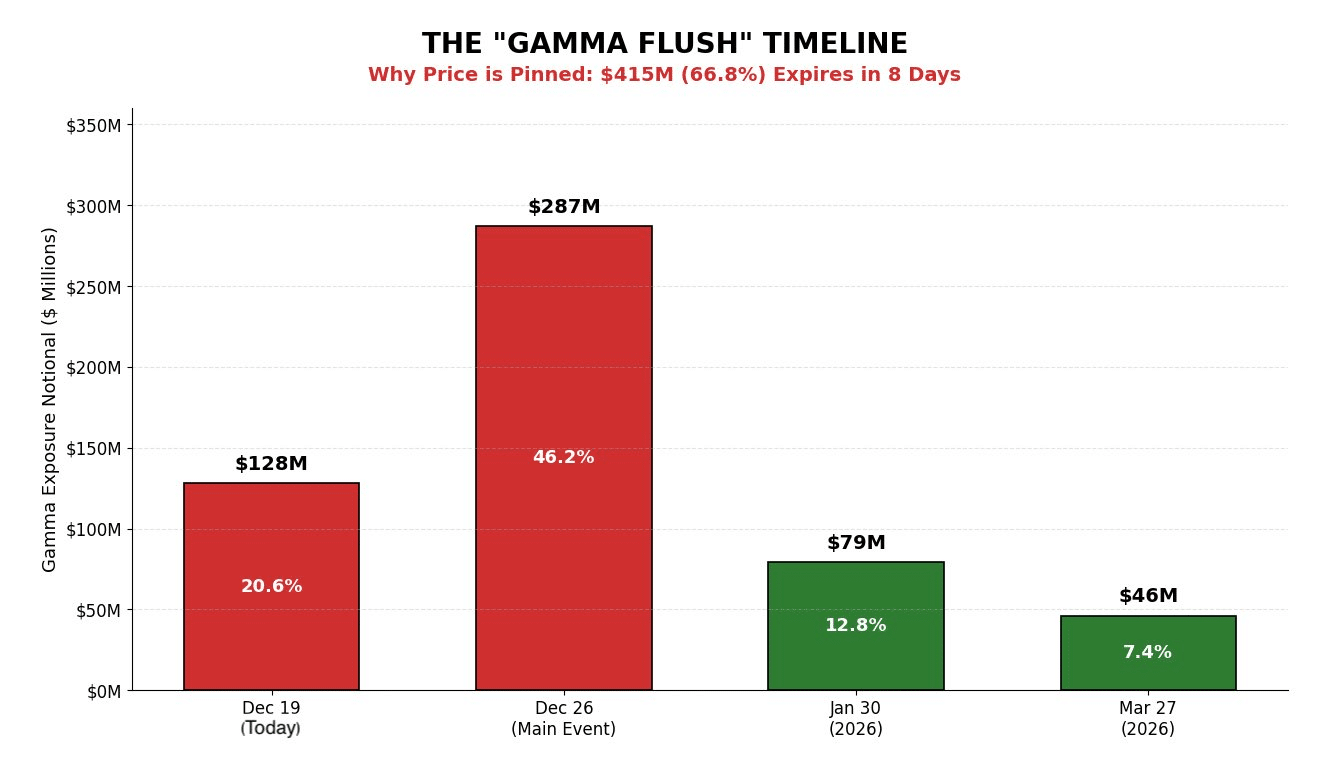
The "Gamma Flush" refers to $415M (66.8%) of Bitcoin dealer gamma exposure expiring over the next 8 days,
This is pinning the price between $85k to $90k which allow dealers to harvest premiums amid low… https://t.co/4otHwvKha4
Technically, the macro environment is surprisingly bullish. November inflation data came in softer than expected, and the market has successfully absorbed the volatility surrounding the new administration’s trade policies.
Under normal conditions, these factors would be a green light for whales and institutional ETFs to drive Bitcoin toward new all-time highs.
The Gamma Flush timeline. | Credit: CaptainAltcoin
However, as of late December, Bitcoin is trading in what analysts call “thick mud.” While you see a brief 3.08% move on Dec. 19, the follow-through was nonexistent. The reason? Options dealer mechanics. Currently, the forces of the derivatives market are significantly outweighing spot demand.
According to derivatives data, dealer gamma forces are currently 13 times stronger than ETF flows. While ETFs are seeing roughly $38 million in daily activity, dealers are managing over $507 million in gamma exposure. This massive imbalance means that for now, the “math” of the dealers is more critical than the “narrative” of the bulls.
What is a “Gamma Flush”?
To understand the “Bitcoin Price Trap,” one must understand the role of market makers (dealers). When you buy a call or put option on an exchange like Deribit, a dealer is usually on the other side of that trade.
To avoid taking a directional bet themselves, these dealers must remain “delta-neutral.”
Delta hedging: If you buy a call option (betting the price goes up), the dealer is short that call. To hedge, they buy a certain amount of Bitcoin.
Gamma: This is the rate at which Delta changes. As Bitcoin’s price moves closer to a specific strike price, such as $90,000, the dealer must rapidly buy or sell more Bitcoin to keep their books balanced.
When gamma is high, as it is now, the dealer’s hedging activity effectively pins the price. If the price starts to rise, dealers sell into the move to rebalance; if the price drops, they buy. This creates the range-bound chop we are seeing between $85,000 and $90,000.
THE 96-HOUR COIL: Why Bitcoin Is Pinned at $88K and When It Breaks
Bitcoin is not “chopping.” It is trapped. Price is being mechanically restrained by option-dealer hedging, not sentiment. This structure is tight, quantifiable, and time-bound. It is likely resolves in 96 hours.… pic.twitter.com/b7nHkMqrlI
A Gamma Flush occurs when these options expire. The shackles of these hedging requirements fall off, and the market is suddenly allowed to move based on real supply and demand rather than mechanical balancing.
Imagine stretching a rubber band and holding it in place.
While you’re holding it, nothing moves.
When you let go, it snaps quickly in one direction.
A gamma flush is the market “letting go” after being held in place by options.
Bitcoin Price Outlook: How the December 26 Gamma Expiry Could Break the Range
The current Gamma Flush is not a single event but a two-stage process that defines the window between Dec. 19 and Dec. 26.
However, it wasn’t enough to trigger a full breakout because the largest concentration of open interest remained ahead.
Stage 2: The Floodgate (Dec. 26)
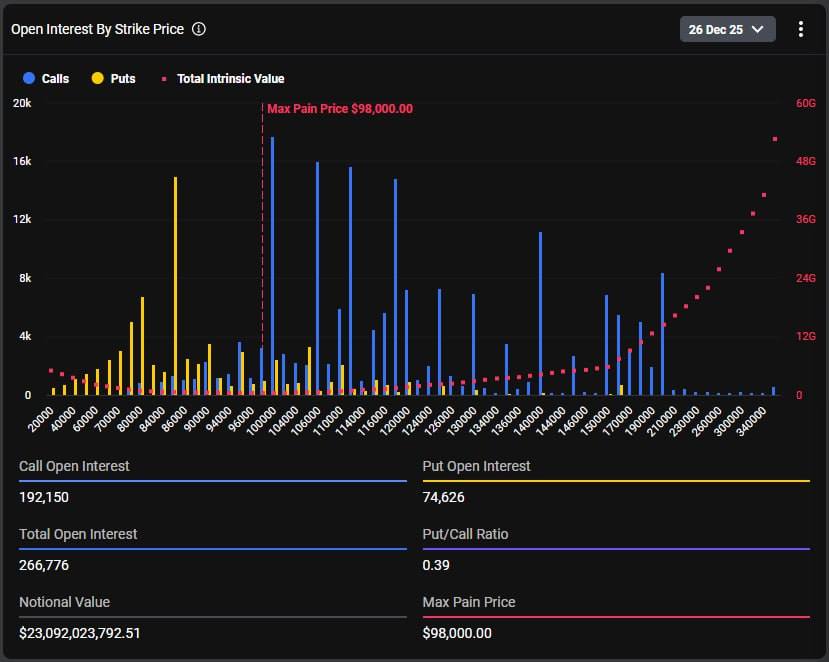
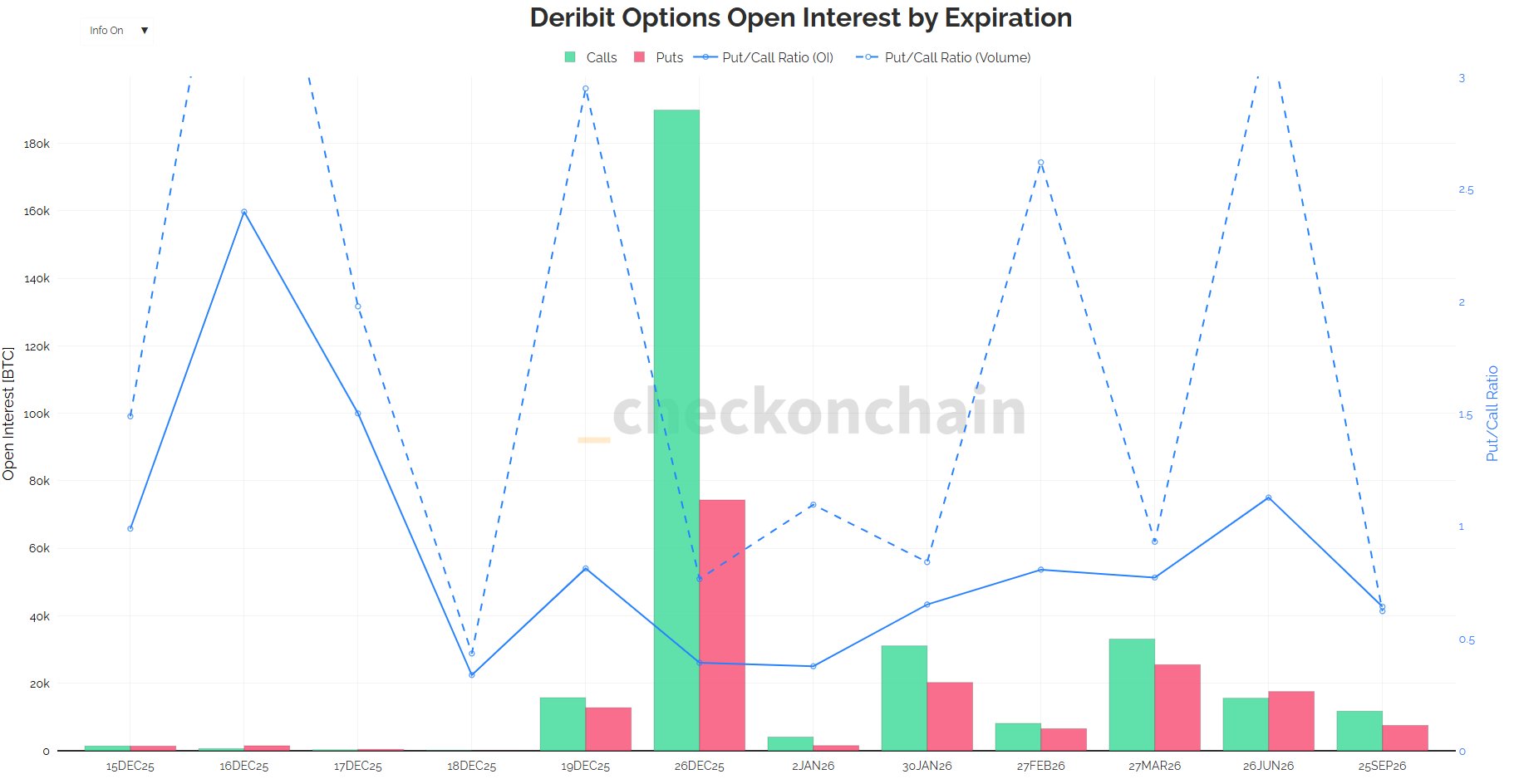
The real Boss Level arrives on Friday, Dec. 26. On this day, a staggering $23.7 billion in options gamma, nearly 50% of the entire market structure, will evaporate.
Open interest by strike prices. | Credit: Binance
Dealers currently have a quarter-billion-dollar incentive to keep volatility crushed and price pinned near the $87,000-$90,000 range through Christmas Day.
By maintaining stable price action, they harvest the premium from options that are set to expire worthless. Once the clock strikes the expiry time on 26, the mud dries up.
Bitcoin Key Levels to Watch: Support, Breakout and Post-Expiry Targets
As you navigate this window, traders should keep a close eye on specific lines in the sand that determine the validity of the breakout.
The support zone ($85,000-$88,000): As long as bulls hold this base, the structure remains bullish. Defense here is critical because it keeps “FOMO” (Fear Of Missing Out) alive for the post-expiry rally.
The flip level ($90,616): This is the level identified by analysts like David Eng. If Bitcoin can clear $90,616 after the Dec. 19 expiry but before the 26, it suggests the intraday shackles are already loosening.
The power law target ($118,000): Many long-term models, including the Bitcoin Power Law, suggest that without the dealer counter-flow suppression, Bitcoin’s natural gravity is pulling it toward the $110,000-$118,000 range.
Why Bitcoin ETF Buying Is Quiet and Why That May Be Bullish
One of the most confusing signals in the current market is the lack of aggressive ETF buying. Critics argue that if Bitcoin were truly headed higher, BlackRock and Fidelity would be buying the dip aggressively.
However, sophisticated analysts view this differently. ETF buyers are often reactive. When the market is glued and range-bound due to gamma, there is no momentum to trigger the algorithmic and FOMO-driven buying that characterizes a bull run.
Once the Dec. 26 expiry clears the suppression, the path of least resistance becomes clear.
If Bitcoin begins to move rapidly toward $95,000 or $100,000, those weak ETF bids are expected to return with a vengeance. Holding support without heavy ETF help is actually a sign of organic strength.
What Happens After Bitcoin’s Gamma Suppression Ends on December 26?
What happens after the mud dries up? History shows that when massive options expiries coincide with a period of consolidation, the following move is often explosive.
Once the $23.7 billion in gamma rolls off on the 26, the market enters a “liquidity vacuum.” Without dealers selling every pump to stay neutral, Bitcoin can finally respond to the macro-economic tailwinds that have been building all month.
Furthermore, as the market looks toward 2026, the absence of short-term volatility-dampening trades could spark a “Santa Rally” that carries well into the New Year.
Deribit options open interest by expiration. | Credit: CheckOnChain
It is also worth noting that once the king, Bitcoin, breaks out of its gamma-induced cage, capital traditionally rotates into high-beta assets. Solana, XRP, and the emerging AI-agent coins like Bittensor are expected to see renewed activity once the Bitcoin suppression mechanism is removed.
This week is likely to be a test of patience. Expect the pinning games to continue through Christmas. You may see Bitcoin bounce off the same $89,000 resistance level as if it’s hitting invisible glass. This is not a failure of the bull market; it is the mechanical reality of a $23.7 billion derivatives flush.
Avoid over-leveraging in the “mud” zone.
Watch the December 26th expiry as the definitive regime shift.
Keep an eye on the $90,616 flip.
By the time the final options expire on 26, the suppression mechanism will be gone. If the bulls have successfully defended the $85,000 support, the coiled spring of Bitcoin may finally be released.
A Gamma Flush occurs when large amounts of Bitcoin options expire, removing the hedging pressures that market makers use to stay delta-neutral. This can free up price movement, allowing Bitcoin to respond more directly to supply and demand rather than mechanical hedging.
Why is Bitcoin range-bound between $85k and $90k right now?
Dealer gamma forces are currently 13 times larger than ETF flows, meaning that options market makers are actively buying and selling Bitcoin to remain delta-neutral. This creates a “mud zone” that pins the price in a narrow range until major options expiries occur.
How much Bitcoin options gamma is expiring this week?
Approximately $23.7 billion in Bitcoin options gamma is set to expire between Dec. 19 and Dec. 26. Stage 1 on Dec. 19 involves $128 million, while Stage 2 on Dec. 26, the “boss level,” releases $23.7 billion, nearly half of the total market structure.
What happens after the Dec. 26 expiry?
Once $23.7 billion in gamma expires, dealer hedging pressures dissipate, creating a liquidity vacuum. This allows Bitcoin to move more freely and could spark a post-Christmas rally, potentially carrying momentum into early 2026.
Disclaimer:
The information provided in this article is for informational purposes only. It is not intended to be, nor should it be construed as, financial advice. We do not make any warranties regarding the completeness, reliability, or accuracy of this information. All investments involve risk, and past performance does not guarantee future results. We recommend consulting a financial advisor before making any investment decisions.
Giuseppe Ciccomascolo began his career as an investigative journalist in Italy, where he contributed to both local and national newspapers, focusing on various financial sectors.
Upon relocating to London, he worked as an analyst for Fitch's CapitalStructure and later as a Senior Reporter for Alliance News. In 2017, Giuseppe transitioned to covering cryptocurrency-related news, producing documentaries and articles on Bitcoin and other emerging digital currencies. He also played a pivotal role in establishing the academy for a cryptocurrency exchange website. Crypto remained his primary area of interest throughout his tenure as a writer for ThirdFloor.


 Easy
Easy