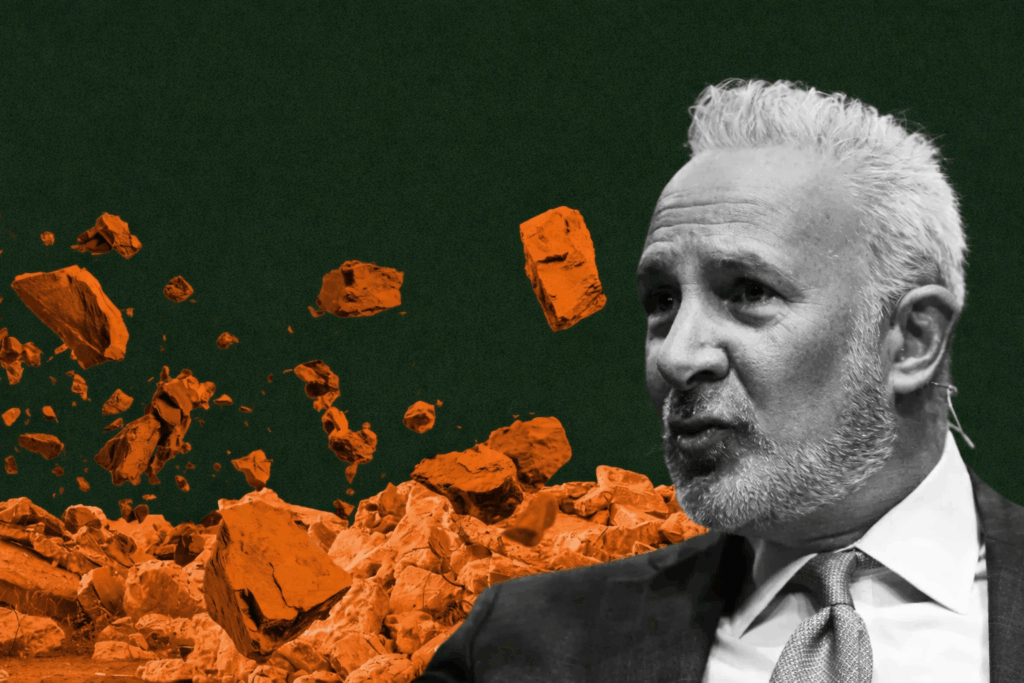
‘Gold Will Replace USD as Reserve Asset as Dollar Debasement Deepens,’ Warns Peter Schiff — Market Implications Explained
Share
Key Takeaways
According to Peter Schiff, rising debt, exploding interest costs, and renewed money printing are actively eroding the dollar’s purchasing power.
Central banks are accelerating gold accumulation as Treasuries lose appeal, signaling a structural shift away from dollar-based reserves toward neutral assets.
Reduced foreign demand for U.S. debt means the long-standing ability to finance deficits cheaply is ending, forcing higher interest rates, currency debasement, or both.
Schiff’s warning centers on declining real wages, rising import costs, and diminished purchasing power as the dollar weakens against gold and other currencies.
For decades, the global financial system has operated under a singular, unshakeable truth: the U.S. dollar is king. It is the world’s primary reserve currency, the medium for global oil trade, and the “safe haven” investors flee to during times of trouble.
On December 26, 2025, veteran economist, gold advocate, and Chief Strategist at Euro Pacific Asset Management, Peter Schiff, tweeted about the dollar crash against other fiat currencies and the need to prepare for a historic economic collapse.
King dollar’s reign is coming to an end. Gold will take the throne as the primary central bank reserve asset. That means the U.S. dollar will crash against other fiat currencies, and America’s free ride on the global gravy train will end. Prepare for a historic economic collapse.
Against a backdrop of gold prices surging past $4,500 per ounce, Schiff declared that the long-standing reign of the U.S. dollar is entering its final chapter.
His statement was unequivocal:
“King dollar’s reign is coming to an end. Gold will take the throne as the primary central bank reserve asset. That means the U.S. dollar will crash against other fiat currencies, and America’s free ride on the global gravy train will end. Prepare for a historic economic collapse.”
This forecast is not merely a philosophical warning; it is rooted in a landmark shift in global finance. For the first time in modern history, 2025 data suggests that central banks are valuing gold holdings as a more vital strategic pillar than U.S. Treasury bonds.
Exorbitant Privilege Powering America’s Global Gravy Train
To understand Schiff’s prediction, one must first understand the “gravy train” he references. In the 1960s, French Finance Minister Valéry Giscard d’Estaing coined the term “exorbitant privilege” to describe the unique advantages the U.S. gained by having the dollar as the world’s reserve currency.
According to Schiff, this privilege has allowed the United States to decouple its spending from its productivity for decades through three primary mechanisms:
1. The Global Export of Inflation
When a typical nation prints money to fund domestic programs, its currency value usually drops, and its citizens face immediate price hikes.
However, because the world uses the dollar for 88% of foreign exchange transactions and nearly 54% of global trade invoicing (per 2024 data), the U.S. has been able to “export” its inflation. Global demand for dollars acts as a sponge, soaking up excess supply and diluting the inflationary impact within America’s borders.
2. The Illusion of Infinite Deficits
The U.S. national debt reached a staggering $38 trillion in late 2025. Historically, the U.S. could run these deficits because foreign central banks, particularly those with trade surpluses like China and Japan, would “recycle” their dollars by purchasing U.S. Treasuries.
This effectively provided the U.S. government with a low-interest credit card subsidized by the rest of the world.
3. Financial System Weaponization
The dollar’s necessity in the SWIFT payment system has given the U.S. unparalleled geopolitical leverage. However, Schiff argues that this “weaponization” has backfired.
Schiff argues that this “free ride” is ending because the world is no longer willing to subsidize American debt. In 2025, for the first time in the modern era, gold has begun to surpass U.S. Treasuries as a percentage of global central bank reserves.
Gold Replacing Dollar as Primary Reserve Asset
The most startling aspect of Schiff’s December 26 message is the claim that gold has replaced the dollar as the primary reserve asset. Market data from late 2025 supports this structural shift:
The crossover milestone: In a historic pivot, the total value of gold held by global central banks surpassed their holdings of the U.S. Treasuries. According to IMF COFER and World Gold Council data, central bank gold reserves grew to roughly 27% of total official reserves by mid-2025, while the dollar’s share slipped below 57%.
A “neutral” asset: Unlike Treasuries, gold cannot be “frozen” by a foreign government or devalued by a central bank’s printing press. In an era of high geopolitical tension, gold has transitioned from a “diversifier” to a “strategic foundation.”
Why the Dollar “Crash” Against Other Fiat is Different
Schiff’s prediction highlights a nuanced point: the dollar isn’t just losing value against gold; it is beginning to decline against other fiat currencies.
In previous years, the dollar often looked strong because other currencies (like the Yen or Euro) were even worse.
However, in 2025, structural weaknesses in the U.S., specifically the $37 trillion national debt and the rising cost of servicing that debt, have made the dollar the “weakest link.”
The Debt-Interest Trap
In 2025, interest payments on the U.S. national debt reached a critical threshold, consuming nearly 40% of all federal tax revenue. This creates a “death spiral”:
The government must borrow more to pay interest on previous debt.
This debases the currency, leading to higher inflation.
Foreigners, seeing the debasement, sell their dollars, causing the currency to crash.
Gold-to-Debt Dynamics Across Major Monetary Crises
The U.S. now faces an exponential debt curve, adding $1 trillion every 100 days, a velocity that took two centuries to achieve initially.
This has triggered an interest trap, with annual payments exceeding $1 trillion, acting as economic gravity that necessitates further currency debasement.
The Interest Expense on US National Debt rose to a record $1.24 trillion in the last 12 months, more than doubling over the past 4 years. The US Government now spends more money on interest than it does on National Defense.
Consequently, gold at $4,510 serves as a stable ruler; it isn’t simply rising, but rather marking the dollar’s rapid decline as the world pivots toward gold to preserve purchasing power against an inflating debt pillar.
Era / Crisis
Macro Catalyst
U.S. National Debt
Gold Performance
Systemic Impact
1973–1980
Nixon Shock / Stagflation
$470B → $908B
+2,300% ($35 to $850)
The birth of the Petrodollar to save a failing fiat system.
2008–2011
Great Financial Crisis
$10T → $15T
+160% ($730 to $1,900)
Beginning of massive Federal Reserve balance sheet expansion.
2020–2022
Pandemic Stimulus
$23T → $31T
+40% ($1,450 to $2,050)
M2 Money supply growth spikes; high inflation begins.
2025 (Dec 26)
The Sovereign Crisis
$38.40 Trillion
+72% YTD (To $4,514)
Gold replaces USD as the primary central bank reserve asset.
Why the Figures Matter for 2026
The data suggests that the U.S. is currently in a debt spiral. To pay the $1 trillion in annual interest, the government must borrow more money, which increases the debt, which in turn increases the interest.
Schiff’s prediction of a “crash against other fiat currencies” is predicated on the idea that when the Federal Reserve is eventually forced to print money to cover these interest payments (quantitative easing), the dollar’s value will evaporate relative to “harder” currencies and assets.
Gold to Replace King Dollar as Debasement Triggers Fiat Collapse
Schiff’s claim that “Gold will take the throne” refers to a return to monetary realism. For decades, the world operated on a “Dollar Standard” where the dollar was as good as gold. Today, the world is moving back to a “Gold Standard” by choice, if not by official decree.
Unlike the dollar, gold cannot be:
Printed at will: Its supply is limited by the cost of mining.
Sanctioned: Physical gold held in a domestic vault cannot be frozen by the U.S. Treasury.
Defaulted upon: Gold carries no counterparty risk.
As central banks increase their gold holdings toward 30-40% of their total reserves, the dollar loses its anchor status. When the world no longer needs the dollar to store value, the “gravy train” derails.
Historic Economic Collapse Redefining the American Standard of Living
Schiff’s “historic collapse” isn’t just about a stock market dip; it describes a fundamental revaluation of the American standard of living. He outlines a three-pronged failure of the current system:
Interest Expense Death Spiral
As of late 2025, the U.S. federal government spent approximately $970 billion on annual interest payments, roughly 19% of all federal revenue. This means that for every dollar collected in taxes, nearly 20 cents goes solely to servicing old debt.
Schiff argues that once the world stops buying Treasuries (the end of the “free ride”), interest rates must rise to attract buyers. Higher rates make the debt even more expensive to service, forcing the Fed to print more money, a cycle that leads directly to currency collapse.
Crash Against Other Fiats
Unlike previous cycles where the dollar remained the “least ugly” fiat currency, Schiff notes that in 2025, the dollar began to crash against its peers.
As the U.S. fiscal position deteriorates faster than that of the Eurozone or emerging markets, the dollar’s relative strength is evaporating. This makes imports significantly more expensive for American consumers, fueling a persistent cost-of-living crisis.
Transition to “Real Money”
Schiff believes the global economy is returning to a “commodity-backed” reality. Whether through a formal gold standard or a digital currency tied to physical assets, the “paper-only” era is ending. For the U.S., which has outsourced much of its manufacturing and relies on cheap imports, this transition will be particularly painful.
Schiff’s 2008 Global Financial Crisis Prediction
Long before the 2008 financial meltdown, Schiff warned about vulnerabilities in the U.S. housing market and credit system, including lax lending standards and an unsustainable real estate bubble. He appeared on financial media throughout 2006 and 2007 forecasting that a housing downturn and broader credit collapse were coming.
In August 2006, Schiff publicly compared the U.S. economy to the Titanic and said he saw a real financial crisis coming if problems in housing and credit weren’t addressed. He also forecast that real estate prices, which had peaked around late 2005, were going to decline sharply.
In an interview on December 13, 2007, Schiff predicted that credit markets would deteriorate in 2008, specifically warning of a “huge crisis” and a likely collapse in consumer credit conditions such as credit-card lending.
Schiff discussed housing, lending laxity, and dollar weakness as early signals of systemic financial stress that eventually unfolded in the 2007–2009 Great Recession.
However, observers note that while some early calls, like the housing correction, were directionally accurate, not all of Schiff’s specific predictions (e.g., timing of broader credit events or dollar collapse consequences) played out exactly as forecast.
Strategic Implications of Dollar’s Crash for Investors
Schiff’s December 2025 warning suggests that the traditional “60/40” portfolio (stocks/bonds) is obsolete because it relies on a stable dollar. His recommended strategy focuses on:
Physical gold and silver: Traditionally viewed as long-term stores of value during periods of monetary instability.
Commodity-producing equities: Investing in the companies that mine the materials the world actually needs (energy, agriculture, metals).
Foreign markets: Shifting capital toward nations with trade surpluses and sounder fiscal policies.
The “free ride” on the global gravy train may be ending, but as Schiff notes, those who see the “throne” changing hands early have the best chance of preserving their wealth.
The Counter-Argument: Can the US Pivot?
Skeptics of Schiff point to the “deep liquid markets” of the U.S. and the lack of a viable fiat alternative. However, Schiff’s 2025 thesis is that the alternative isn’t another fiat currency, it is gold itself.
Market analysts frequently argue that the U.S. has a unique “nuclear option” to stabilize its currency: revaluing its official gold reserves. As of late 2025, the U.S. officially holds 261 million ounces of gold:
The audit movement: Support has grown for the Gold Reserve Transparency Act of 2025 (introduced by Sen. Mike Lee and Rep. Thomas Massie). This bill mandates a full physical audit and assay of all U.S. gold, including the “deep storage” at Fort Knox and West Point, to prove the reserves are unencumbered by leases or swaps.
The revaluation theory: Some economists suggest that if the Treasury were to revalue this gold from its statutory price of $42.22 to a market-clearing price of $10,000 or $20,000 per ounce, it could theoretically “back” the $38.4 trillion national debt and restore global confidence.
Schiff’s rebuttal: Schiff has consistently argued that while this is technically possible, the U.S. government lacks the political will to do so. In his December 2025 commentary, he noted that revaluing gold would require the government to admit the dollar has failed and accept the “honest pain” of a balanced budget, a path he believes Washington will avoid in favor of more money printing.
Ultimately, Schiff’s 2025 prediction hinges on the belief that the U.S. will choose the path of least resistance: inflation. By allowing the dollar to crash against gold and other currencies, the government effectively “defaults” on its debt in real terms, paying back creditors with money that buys significantly less.
For Schiff, the historic economic collapse is not just a market crash, but the final recognition that the U.S. cannot “pivot” without ending the very spending habits that caused the crisis.
What is dollar debasement and why does it matter now?
Dollar debasement refers to the decline in the dollar’s purchasing power caused by excessive money creation and debt financing. It matters now because rising interest costs and persistent deficits are forcing policymakers toward inflationary solutions, accelerating the erosion of real value.
How does the BRICS Unit relate to dollar debasement?
The BRICS Unit is designed to reduce reliance on the U.S. dollar in trade and reserves. Its development reflects growing frustration with dollar debasement and sanctions risk, encouraging countries to seek settlement systems and reserve assets outside U.S. control.
Does BRICS de-dollarization directly threaten the US dollar?
Individually, no single BRICS initiative replaces the dollar. Collectively, however, reduced dollar usage in trade, reserves, and settlement weakens global demand for dollars, amplifying the impact of domestic dollar debasement over time.
Why is gold central to the shift away from dollar-based systems?
Gold functions as a neutral asset that cannot be printed, sanctioned, or defaulted upon. As dollar debasement accelerates and trust in fiat systems erodes, gold provides a common reserve foundation for countries seeking stability outside the dollar framework.
Disclaimer:
The information provided in this article is for informational purposes only. It is not intended to be, nor should it be construed as, financial advice. We do not make any warranties regarding the completeness, reliability, or accuracy of this information. All investments involve risk, and past performance does not guarantee future results. We recommend consulting a financial advisor before making any investment decisions.
Dr. Guneet Kaur is a senior editor at CCN.com and a Science Fellow at Exponential Science. She is a fintech and blockchain expert with extensive experience in digital finance education, blockchain ecosystems, and cryptocurrency markets. She has worked with global media such as Cointelegraph, as well as education and blockchain platforms, to design and lead strategic content and learning initiatives. As an educator and assessor for top-tier executive programs, she bridges real-world fintech trends with academic insight.
Dr. Kaur is also a published researcher and peer reviewer across fintech and data science journals, including Financial Innovation Journal and International Journal of Big Data Intelligence and Applications. Her work spans data-driven analysis, Web3 innovation, and technical content development. With a strong foundation in both industry and academia, she translates complex financial technologies into practical applications, empowering learners, professionals, and institutions across the rapidly evolving digital finance landscape.


 Easy
Easy