Bold 2025 Bitcoin targets, from $170K to $2M, missed the mark. Here’s how Wall Street and crypto’s biggest names got their forecasts wrong. | Credit: Derek Fenech
Share
Key Takeaways
Despite forecasts calling for $170,000, $250,000, $1 million, or even $2 million Bitcoin, the market delivered a volatile year.
JPMorgan, Standard Chartered, VanEck, and Bitwise all issued six-figure predictions that proved to be mistimed due to macroeconomic shocks.
Influential analysts and on-chain models pushed million-dollar scenarios.
Models comparing Bitcoin to gold or using simple adoption ratios underestimated liquidity constraints.
2025 was supposed to be the year Bitcoin’s most audacious forecasts came true. Wall Street models, crypto maximalists, and a handful of mainstream pundits published eye-popping price targets: $170,000, $250,000, $1 million, and, in extreme corners, even $2 million or more, each backed by a story about institutions, macroeconomic liquidity, or scarcity.
Instead, the year delivered a chaotic price arc: a blow-off rally to a new record in October, followed by a rapid retracement that left many forecasts looking badly timed or simply wrong.
For instance, around 45 days ago, the self-described “world’s highest IQ record holder,” Young Hoon Kim, made headlines after claiming that Bitcoin (BTC) would surge to $220,000 within 45 days. The bold prediction was widely circulated across crypto media and social platforms, fueling short-term speculation and hype.
However, now (as of Jan 2, 2026) that the 45-day window has passed, reality has fallen far short of the forecast. Bitcoin is trading near $88,000, not $220,000, representing a miss of roughly 60% versus the predicted target.
45 days ago the "World's highest IQ record holder" Young Hoon Kim claimed Bitcoin $BTC will hit $220,000 in the next 45 days.
— Common Sense Investor (CSI) (@commonsenseplay) January 2, 2026
The episode serves as a clear reminder that viral credentials and sensational claims, even when amplified by widespread coverage, do not replace market fundamentals, risk management, or the inherent unpredictability of crypto price movements.
Below, this article walks through the major public forecasts, the actual market outcomes, and the analytical reasons why so many well-publicized targets didn’t come to pass on the timetables predicted.
Breaking Down the Wildest Bitcoin Predictions: $170K, $250K, $1M and Beyond
The past few years delivered some of the boldest Bitcoin price predictions the market has ever seen. From reputable banks to crypto-native analysts and social-media influencers, forecasts ranging from $170,000 to over $2 million spread rapidly across headlines and feeds.
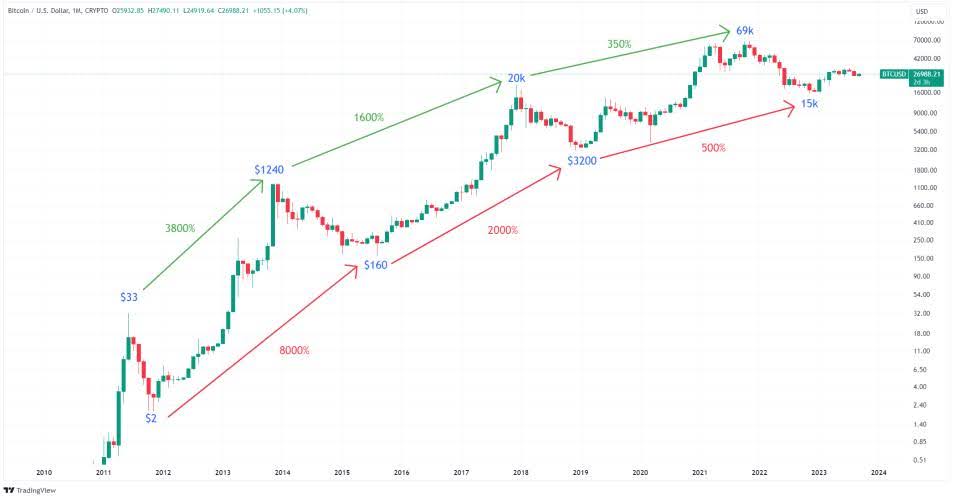
One of the many forecasts expecting Bitcoin to reach $250,000 in 2025. | Credit: TradingView
These numbers weren’t pulled from thin air, as each was backed by narratives about institutional demand, ETF flows, macroeconomic shifts, and Bitcoin’s limited supply. Yet the sheer scale and speed of these predictions revealed just how easily compelling stories can outpace market reality.
Wall Street and boutique forecasters: Firms like Standard Chartered, VanEck and Bitwise issued six-figure medium-term targets (e.g., $175,000-$250,000 or above $200,000) based on ETF flows, institutional demand, and ratio models.
Crypto bulls and thought leaders: High-profile individuals and models offered even bigger numbers. Tom Lee’s and Michael Saylor-linked narratives (and some on-chain/gold-cap models) suggested multi-hundred-thousand to million-plus outcomes; fringe voices and a handful of media pieces amplified seven-figure scenarios and, in isolated cases, $2 million or higher forecasts.
Retail and social forecasts: Countless influencers released short-timeline “$X by Y date” tweets and YouTube videos; these often used linear extrapolation, cycle-based templates, or comparisons to gold’s market cap.
Why these forecasts spread: simple narratives (scarcity = huge price), institutional demand (ETFs and custody), and macro stories (weak dollar, money printing) made big numbers easy to believe, and easy to click.
Bitcoin Reality Check: 13 Price Calls That Crashed Into 2025
2025 was the year Bitcoin reminded everyone why humility is a key investment skill. After surging to a record high above $126,000, the world’s largest crypto quickly retraced as leverage unwound, geopolitics shocked markets, and liquidity turned uneven.
Many of the most confident price targets, from Wall Street giants to crypto evangelists, proved far too optimistic.
Here’s a look back at 13 big Bitcoin calls that didn’t survive contact with reality:
JPMorgan — $170,000 Expected institutional ETF demand to fuel a sustained breakout. Bitcoin’s rally stalled well short of the mark.
VanEck — $180,000 Anticipated a post-ETF melt-up. Liquidity faded faster than inflows arrived.
Standard Chartered — $250,000 Called for Bitcoin to cement its “digital gold” role. The thesis was early; macro headwinds hit harder.
Tom Lee (Fundstrat) — $250,000 Optimistic on adoption and halving cycles, but underestimated the volatility shock of late 2025.
Robert Kiyosaki — $350,000 Bet on a fiat crisis that never came as inflation cooled and risk appetite waned.
BlackRock — $700,000 Internal modeling assumed large-scale institutional rotation into tokenized assets. The flood turned into a trickle.
Chamath Palihapitiya — $500,000 Forecast a “sovereign wealth era” for Bitcoin; tightening liquidity erased that path.
Michael Saylor — $1,000,000 Strategy’s ultra-bullish view collided with balance-sheet leverage and market drawdowns.
ARK Invest (Cathie Wood) — $650,000 Long-term innovation thesis intact, but the timeline — “by 2025” — was far too aggressive.
Galaxy Digital — $400,000 Expected easing policy to fuel a parabolic run. The Fed’s late-year tone reversed that optimism.
Anthony Pompliano — $500,000 Projected exponential network growth, ignoring the short-term liquidity crunch.
Max Keiser — $220,000 A perennial bull whose “new high soon” mantra met the reality of a leveraged market unwind.
Cathie Wood (extended target) — $2,000,000 The boldest call of all — still possible in theory, but not on a 2025 horizon.
Let’s take a walk down memory lane and see where all those bold 2025 Bitcoin targets ended up.
• JPMorgan: 170,000 • VanEck: 180,000 • SChartered: 250,000 • Tom Lee: 250,000 • Robert Kiyosaki: 350,000 • BlackRock: 700,000 • Chamath: 500,000 • Michael Saylor: 1,000,000 •…
Bitcoin Hits $126K, Then Tumbles: 2025 Shows Limits of Crypto Forecasts and Unforgiving Volatility
Bitcoin’s dramatic price action in 2025 delivered a powerful reminder of the unpredictability of crypto markets. The year saw a surge to a fresh all-time high above $126,000, followed by a sharp and turbulent retracement driven by geopolitical shocks, unwinding of leverage, and shifting macroeconomic conditions.
Even with a weakening dollar and strong early-year momentum, Bitcoin’s path defied the boldest forecasts. The volatility of 2025 offers valuable lessons about the limitations of price models and the dangers of assuming linear growth in a market characterized by rapid fluctuations.
New record, then fast retrace: Bitcoin reached a new all-time high in 2025, with prices topping roughly $126,000 in early October. That milestone confirmed that large rallies were possible under the right combination of liquidity and sentiment.
Rapid pullback: Weeks after the October peak, markets experienced sharp volatility and large liquidations tied to geopolitical shocks and leveraged positioning. Bitcoin slid back toward the low-to-mid six figures and, at times, traded under $100,000 amid heavy selling. Reuters and other outlets recorded dramatic intra-quarter swings.
Dollar backdrop: The U.S. dollar weakened materially during the first half of 2025, when the DXY fell by roughly 10-11%, and a macro tailwind, some analysts argued, should favor BTC; however, that variable alone didn’t produce a smooth, guaranteed rally to the most extreme price targets.
So, yes, Bitcoin rose significantly in 2025 and briefly cleared prior ceilings, but it did not follow a one-way trajectory to $170,000 (in all months), nor to $1 million or $2 million on the timelines many predicted.
Bitcoin’s 2025 rally exposed just how fragile even the most confident forecasts can be.
Analysts across Wall Street and the crypto industry consistently missed the mark, not because the big-picture narratives were incorrect, but because their models overlooked the complex reality of liquidity, leverage, sentiment, and shifting macroeconomic conditions.
1. Model Fragility: Matching BTC to Gold or Stock Ratios
Many bold forecasts used analogies (Bitcoin as “digital gold”) and market-cap comparisons to argue for prices in the hundreds of thousands or millions. Those models assume a static path: if BTC captures X% of gold’s market cap, then price = Y. But such models often ignore timing, flows, regulatory feedback and liquidity constraints. Models that assume easy, frictionless capital reallocation are optimistic at best.
2. Leverage and Liquidity Amplify Moves, Both Up and down
2025’s rally was partly powered by leveraged positions and concentrated flows (options and perpetual futures). When politics or macro shocks hit, forced deleveraging created outsized downside moves that any linear projection model didn’t incorporate. The October liquidation events and their aftermath are textbook examples.
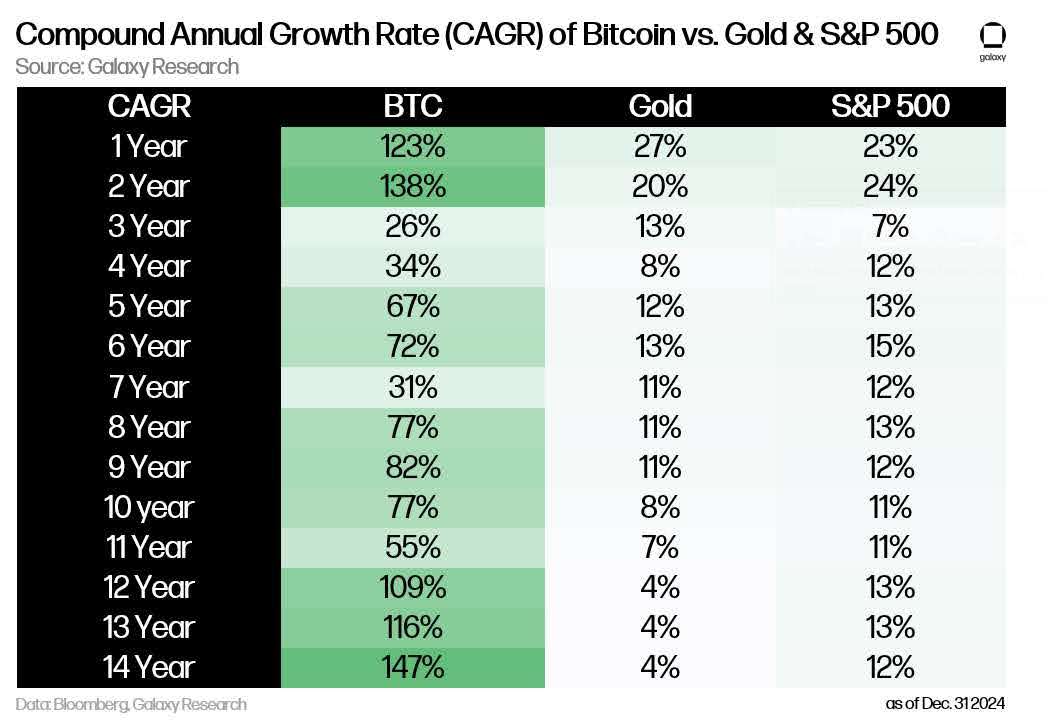
Compound annual growth rate of Bitcoin vs. gold and S&P 500. | Credit: Galaxy Research
3. Sentiment Timing Matters
Forecasts often blended long-term conviction with short-term timing. Predicting that Bitcoin will reach $1M someday is very different from predicting it by a specific year. Most public predictions conflated the two, resulting in many notable misses.
4. Regulatory and Institutional Risk
Even as ETFs and custodians created demand, regulatory shifts, index inclusion decisions, or policy uncertainty could (and did) change flows fast, a risk many bullish models underweighted. Reuters’ reporting on listing/index decisions, as well as institutional dynamics, reveals the fragility of institutional momentum.
5. Macro Is a Two-Edged Sword
A weaker dollar and inflation fears are cited repeatedly as bullish drivers. However, macro trends can reverse, and global investors can quickly rotate between safe havens. The dollar’s decline helped, but it didn’t guarantee a frictionless path to seven-figure prices.
What 2025 Exposed About Bitcoin Forecasts: Time, Leverage, and Fragile Assumptions
The misses of 2025 weren’t just about bad luck; they revealed how easily analysts can overlook the mechanics that truly move Bitcoin.
From mismatched time horizons to fragile assumptions and unchecked leverage, many forecasts failed because they relied on simplified narratives rather than the complex signals driving real market behavior.
Distinguish horizon from magnitude: “$1M someday” is different from “$1M by 2025.” Treat the latter as a trading call, not a strategic thesis.
Check the assumptions: Does the model assume steady inflows, zero regulation, and a constant risk appetite? If yes, it’s fragile.
Manage leverage: Forecasts that ignore leverage dynamics are the most likely to be wrong during stress events.
Diversify narratives: Don’t collapse your view of Bitcoin into a single model (scarcity, macro, adoption). Each offers partial insight; together they warn you about limits.
The Psychology Behind Extreme Bitcoin Price Targets
One factor rarely discussed, but arguably one of the strongest drivers behind extreme price forecasts, is investor psychology.
Bitcoin sits at the intersection of technology, ideology, and high-stakes speculation, making it uniquely vulnerable to collective optimism and collective panic. Understanding this psychological component helps explain why many 2025 forecasts fell short of their mark.
Extrapolation Bias Fuels Runaway Numbers
When Bitcoin begins to rise quickly, humans instinctively project that pace forward. This is a natural cognitive shortcut, if an asset is appreciating at 20% per month, it’s easy to assume it will continue doing so indefinitely. Analysts, influencers, and even institutional desks are not immune to this bias. In 2025, after Bitcoin broke through earlier resistance levels, the momentum narrative intensified, and a noticeable shift from rational projection to emotional extrapolation became apparent across social and financial media.
Scarcity Narratives Spark Emotional Conviction
Bitcoin’s fixed supply taps into a simple but powerful psychological response: the fear of missing out on something limited. Forecasts of $250,000, $1 million, and even $2 million often leaned heavily on the scarcity message, which is effective because it bypasses analytical skepticism and triggers emotional urgency. The issue isn’t that scarcity is wrong; it’s that emotional conviction can lead people to underweight variables like liquidity conditions, policy risk, or investor rotation.
Main price predictions for Bitcoin in 2025. | Credit: CoinGecko
Social Proof Amplifies Extreme Forecasts
Forecasts spread when big names repeat them. When major banks, high-profile executives, or respected researchers publish large numbers, social proof amplifies the credibility of the prediction. By mid-2025, dozens of reputable institutions were issuing six-figure forecasts. That consensus, real or perceived, made seven-figure forecasts from crypto natives seem almost like a natural extension of the trend. The more headlines repeated these targets, the easier it became to believe them.
The Profit Incentive Behind Predictions
Another underappreciated reality: predictions sell. In the media, bold numbers generate clicks; on social platforms, they attract followers; in financial institutions, they drive trading flows. This doesn’t make every forecast dishonest, but it does mean incentives lean toward optimistic projections, not conservative ones. When forecasts align with incentives, the extremes get louder, and nuance gets quieter.
Will Bitcoin Ever Hit $1 Million? What 2025 Reveals About Future Predictions
2025 underlined a critical truth: Bitcoin’s upside is real, and history can surprise on the upside, but timing and path-dependency matter.
Big, splashy forecasts were compelling headlines, but the market’s October peak and subsequent retracement show why such predictions frequently missed real-world realities.
For investors and students of crypto, the takeaway is not that the wild scenarios are impossible; it’s that they are highly conditional. Treat them as scenarios, not certainties, and always check the assumptions behind the math.
Why were so many 2025 Bitcoin price forecasts wrong?
Most predictions underestimated volatility, overestimated institutional inflows, and assumed smooth macro conditions. Analysts also relied heavily on models comparing Bitcoin to gold or broader risk assets, which ignored timing, liquidity shocks, and regulatory uncertainty. When geopolitical events and leveraged liquidations hit in late 2025, those assumptions broke down.
Did any forecast predict the actual 2025 price path?
Not accurately. Some analysts predicted new all-time highs above the previous cycle, but almost none foresaw the sharp spike to $126,000 followed by a fast retracement below six figures. Forecasts focused on end-of-year targets, not the intra-year volatility Bitcoin ultimately displayed.
Did macro conditions support those extreme targets?
Partially. A weakening dollar, high inflation, and shifting global liquidity conditions did offer tailwinds. However, these factors alone were not enough to push Bitcoin anywhere near the $170,000-$2 million predictions. Macro trends helped BTC reach new highs, but they did not guarantee uninterrupted upward momentum.
Why do analysts compare Bitcoin to gold when making price targets?
Gold is used as an analogy because both assets function as non-sovereign stores of value. Analysts estimate Bitcoin’s potential value by projecting how much of gold’s $10–12 trillion market it could eventually capture. The problem? These comparisons ignore timing, liquidity constraints, and behavioral factors that influence short-term prices.
Disclaimer:
The information provided in this article is for informational purposes only. It is not intended to be, nor should it be construed as, financial advice. We do not make any warranties regarding the completeness, reliability, or accuracy of this information. All investments involve risk, and past performance does not guarantee future results. We recommend consulting a financial advisor before making any investment decisions.
Giuseppe Ciccomascolo began his career as an investigative journalist in Italy, where he contributed to both local and national newspapers, focusing on various financial sectors.
Upon relocating to London, he worked as an analyst for Fitch's CapitalStructure and later as a Senior Reporter for Alliance News. In 2017, Giuseppe transitioned to covering cryptocurrency-related news, producing documentaries and articles on Bitcoin and other emerging digital currencies. He also played a pivotal role in establishing the academy for a cryptocurrency exchange website. Crypto remained his primary area of interest throughout his tenure as a writer for ThirdFloor.


 Easy
Easy