Veteran analysts warn Bitcoin could face major downside, with $10,000 risk scenarios and historical charts signaling up to 80% cycle declines. | Credit: CCN.com
Share
Key Takeaways
Senior Bloomberg Intelligence analyst Mike McGlone warns that Bitcoin could fall to $50,000 in 2026.
Unlike gold, which has limited competitors, Bitcoin now competes with millions of digital assets.
Veteran trader Peter Brandt highlights recurring parabolic bull cycles in Bitcoin that historically end in sharp corrections.
Higher correlation with risk assets, tighter liquidity, and regulatory uncertainty make Bitcoin more vulnerable in a changing global macro environment.
Bitcoin has long been celebrated as digital gold, a hedge against inflation, and a revolutionary alternative to traditional finance.
However, a growing number of veteran analysts and market strategists are now warning that the cryptocurrency market may be approaching a significant inflection point. Among the most prominent voices sounding the alarm is Mike McGlone, Senior Commodity Strategist at Bloomberg Intelligence, who has suggested that Bitcoin could fall to $50,000 in 2026, and potentially much lower, toward $10,000.
These warnings emerge amid broader macroeconomic shifts, intensified competition within the crypto ecosystem, and a renewed strength in traditional safe-haven assets, such as gold and silver. When combined with technical signals highlighted by legendary trader Peter Brandt, the outlook for Bitcoin and the broader cryptocurrency market appears increasingly fragile.
This article examines the bearish Bitcoin thesis, compares cryptocurrency with precious metals, and explores the role of the U.S. dollar, providing educational context for investors navigating an increasingly complex financial environment.
Senior Bloomberg Intelligence Analyst Predicts Bitcoin Price Will Crash to $50,000 and then $10,000 in 2026
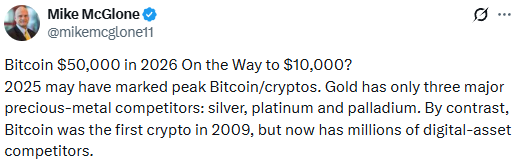
Mike McGlone has repeatedly cautioned that 2025 may mark the peak of the current Bitcoin and crypto cycle. His core argument is rooted in market saturation, diminishing marginal returns, and intensifying competition.
Mike McGlone predicts a bearish outlook for Bitcoin. | Credit: Mike McGlone X profile
Bitcoin was the first cryptocurrency to launch in 2009. At the time, it had no competitors. Today, however, there are millions of digital assets, including altcoins, stablecoins, NFTs, Layer-2 networks, and tokenized real-world assets.
This explosion of supply, McGlone argues, dilutes Bitcoin’s scarcity narrative and long-term dominance.
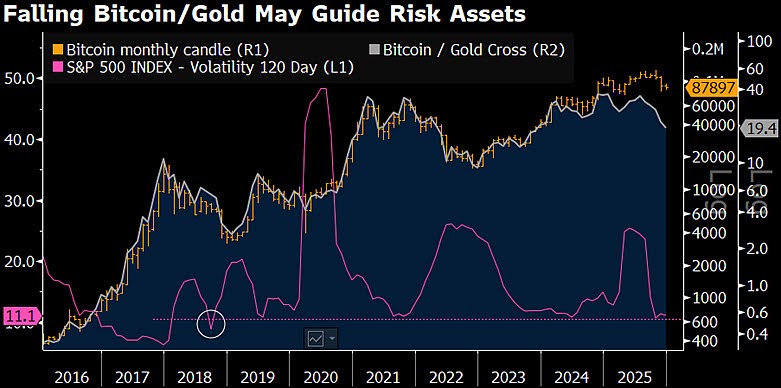
Falling BTC/gold may guide risk assets. | Credit: Bloomberg
According to McGlone, Bitcoin’s price could revisit $50,000 in 2026 as part of a broader reset in the crypto market. In a more severe deflationary or risk-off scenario, prices could ultimately fall to levels last seen during earlier bear markets, potentially reaching $10,000.
Peter Brandt’s Technical Warning: The Anatomy of Bitcoin Bull Cycles
Adding weight to the bearish narrative is Peter Brandt, a legendary technical analyst known for accurately forecasting major market moves in assets like the S&P 500, commodities, and cryptocurrencies.
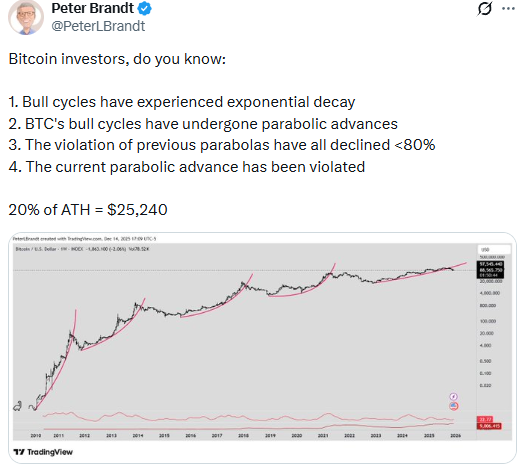
In a post on X, Brandt shared a long-term Bitcoin price chart dating back to 2010, highlighting recurring parabolic bull cycles. Each cycle follows a similar pattern:
Slow accumulation phase.
Rapid parabolic advance.
Price peak.
Sharp breakdown and prolonged correction.
Peter Brandt also sees a negative outlook for Bitcoin. | Credit: Peter Brandt X profile
Brandt outlined four critical observations:
1. Exponential Decay of Bull Markets
Each Bitcoin bull cycle has become less extreme than the previous one. While prices still rise, the percentage gains are diminishing over time, an indication of market maturation and reduced speculative upside.
2. Parabolic Advances Are Unsustainable
Bitcoin’s explosive rallies are inherently unstable. Parabolic moves almost always end with sharp corrections, as speculative excess gives way to profit-taking and liquidity stress.
3. Declines Below Parabolas Have Stayed Under 80%
Historically, Bitcoin corrections following parabolic peaks have declined less than 80%. However, Brandt warns that this historical pattern does not guarantee future outcomes, especially as macro conditions change.
4. Long-Term Risk Is Rising
As Bitcoin becomes more widely held and more correlated with risk assets, its vulnerability to macro tightening, regulatory pressure, and liquidity shocks increases.
Features
Mike McGlone (Bloomberg)
Peter Brandt (Veteran Trader)
Target
$10,000
80% decay
Core rationale
Mean reversion: Bitcoin must return to its pre-2020 liquidity levels.
Parabolic violation: Historic chart patterns signal the bull run is over.
Key variable
Infinite competition: BTC now competes with millions of other digital assets.
The 80% rule: Historically, breaking a parabola leads to an 80% crash.
Market outlook
Deflationary: A “risk-off” environment favors Gold over Bitcoin.
Exponential decay: Each bull cycle is becoming weaker and more fragile.
2026 prediction
Extreme volatility as BTC loses its “digital gold” status.
A “prolonged correction” that tests the $25k (approx.) historical support (80% drop).
Gold’s Performance: The Ultimate Safe Haven Reasserts Itself
While Bitcoin faces skepticism, gold has been surging, reinforcing its centuries-old role as a safe-haven asset.
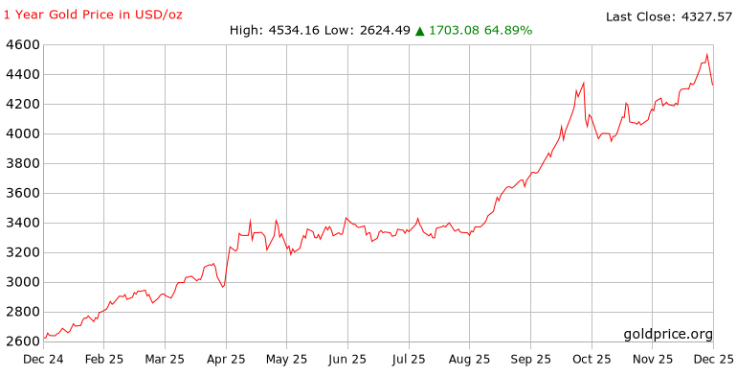
Gold prices recently climbed above $4,360 per ounce, even after experiencing the most significant intraday drop since October due to profit-taking. Despite short-term volatility, gold remains on track for its strongest annual performance since 1979.
Gold price performance in 2025. | Credit: goldprice.org
Several factors are driving gold’s strength:
Geopolitical uncertainty, including tensions involving Russia–Ukraine, Iran, and Venezuela.
Central bank gold buying, particularly by emerging market nations.
Concerns over fiscal deficits and monetary credibility.
Unlike Bitcoin, gold benefits from physical scarcity, universal acceptance, and minimal competition. It does not face technological obsolescence or protocol risk, making it particularly attractive during periods of financial instability.
Silver’s Performance: Volatility with Strong Fundamentals
Despite these swings, silver is on track for an estimated 158% annual gain, one of its strongest performances since 1979.
Silver’s appeal lies in its dual role:
Monetary metal, benefiting from inflation hedging and safe-haven demand.
Industrial metal is supported by demand from solar energy, electronics, electric vehicles, and advanced manufacturing.
Supply constraints, strong ETF inflows, central bank buying, and expectations of further US rate cuts in 2026 continue to support silver’s long-term outlook.
The US Dollar Struggle: A Tailwind for Metals, Not Crypto?
The U.S. dollar index (DXY) has fallen to around 98, near its lowest level since early October, and is down 9.6% year-to-date, marking its sharpest annual decline since 2017.
Several factors are weakening the dollar:
Expectations of Federal Reserve rate cuts.
Narrowing interest rate differentials.
Political uncertainty and tariff policy volatility.
Concerns about fiscal deficits and Fed independence.
US Dollar Index declined notably this year. | Credit: TradingView
Traditionally, a weaker dollar supports risk assets and alternative stores of value. However, recent market behavior suggests that gold and silver are benefiting far more than Bitcoin, challenging the idea that crypto automatically thrives in dollar weakness.
Investing In 2026 Will Reward Judgment, Not Comfort
Investors are likely to face a more demanding but opportunity-rich market in 2026, affirms the CEO of one of the world’s largest independent financial advisory organizations as they look to the year ahead to build and safeguard wealth.
Nigel Green of deVere Group says the year ahead rewards discipline, selectivity, and execution rather than broad momentum.
Markets have adjusted to a world of higher interest rates, geopolitical tensions, and rapid technological advancements.
This adjustment, he comments, has created clearer pricing signals and sharper differentiation between companies that deliver and those that rely on expectation.
“Opportunity isn’t disappearing, it’s becoming more precise,” Green told CCN.
Nigel Green identifies three global forces that will shape investor outcomes in 2026: the transition of AI from promise to performance, the dominance of a narrow group of market leaders, and volatility driven by policy decisions.
“Markets are no longer paying for potential alone,” says Nigel Green. “They’re paying for delivery and performance.”
“Execution separates leaders from laggards,” he notes. “This creates clearer opportunity for investors who focus on fundamentals rather than hype.”
“Dispersion creates opportunity. It rewards those willing to back quality and move away from comfort,” he added.
With respected analysts like Mike McGlone and Peter Brandt warning of a possible move toward $50,000, and even $10,000, by 2026, the narrative of perpetual crypto upside is increasingly being questioned.
At the same time, gold and silver are reasserting their dominance as trusted stores of value amid geopolitical risk, monetary easing, and dollar weakness.
For investors, the key takeaway is not to panic but to focus on education, diversification, and risk management. Markets are cyclical, narratives change, and even revolutionary assets are not immune to economic gravity.
As 2026 approaches, Bitcoin may face its most crucial test yet, not just in terms of price, but also in its role within the global financial system.
Why are analysts predicting a Bitcoin crash in 2026?
Analysts point to Bitcoin’s historical boom-and-bust cycles, diminishing returns in each bull market, increasing competition from millions of cryptocurrencies, tighter liquidity conditions, and rising regulatory pressure. Technical analysis also suggests Bitcoin’s parabolic price structure may be breaking down.
Who is Peter Brandt and why does his Bitcoin analysis matter?
Peter Brandt is a legendary technical trader known for accurately predicting major market moves in assets like the S&P 500, commodities, and Bitcoin. His analysis carries weight because it is based on long-term chart patterns rather than short-term sentiment.
What does “exponential decay” in Bitcoin bull cycles mean?
Exponential decay means that each Bitcoin bull market delivers smaller percentage gains than the previous one. While prices still rise, the magnitude of gains decreases, signaling market maturity and reduced speculative upside.
Could Bitcoin really fall to $50,000 or even $10,000?
Historically, Bitcoin has declined between 60% and 80% after breaking parabolic trends. Based on recent highs, those drawdowns would place Bitcoin around $50,000 or lower. A severe loss of confidence or prolonged crypto winter could push prices toward $10,000.
Disclaimer:
The information provided in this article is for informational purposes only. It is not intended to be, nor should it be construed as, financial advice. We do not make any warranties regarding the completeness, reliability, or accuracy of this information. All investments involve risk, and past performance does not guarantee future results. We recommend consulting a financial advisor before making any investment decisions.
Giuseppe Ciccomascolo began his career as an investigative journalist in Italy, where he contributed to both local and national newspapers, focusing on various financial sectors.
Upon relocating to London, he worked as an analyst for Fitch's CapitalStructure and later as a Senior Reporter for Alliance News. In 2017, Giuseppe transitioned to covering cryptocurrency-related news, producing documentaries and articles on Bitcoin and other emerging digital currencies. He also played a pivotal role in establishing the academy for a cryptocurrency exchange website. Crypto remained his primary area of interest throughout his tenure as a writer for ThirdFloor.


 Easy
Easy