Gold and silver crushed Bitcoin in 2025 as investors favored traditional inflation hedges. What the divergence means for markets in 2026. | Credit: CCN.com
Share
Key Takeaways
Gold hit an intra-day record $3,500 on April, 21 and held around $3,350 in June, supported by decade-high central bank buying.
BTC fell from $111K to $98K between June 13 and June 23.
Europe’s ECB and China’s PBoC interest rate easing underpins gold via reserve diversification, while Bitcoin still remains tied to U.S. Fed signals and market sentiment.
In mid-June 2025, Israeli and U.S. strikes on Iran’s nuclear sites sharply raised geopolitical tensions across the Middle East. Safe-haven demand drove spot gold to an intra-day record of just under $3,500 per ounce on April 22, and by June 23, gold was trading around $3,354 per ounce.
Bitcoin, meanwhile, initially tumbled from about $111,000 to roughly $102,800 after the June 13 attacks before recovering to trade approximately 5% below its mid-May peak. On June 24, 2025 BTC is $105,000.
This article explores how gold and Bitcoin reacted to the June 2025 Middle East escalation, the impact of diverging central-bank policies and market sentiment on their safe-haven roles, and tactical approaches to combining both assets for optimal portfolio resilience and upside potential.
Historical Perspectives on Safe-Haven Assets: Gold Vs. Bitcoin
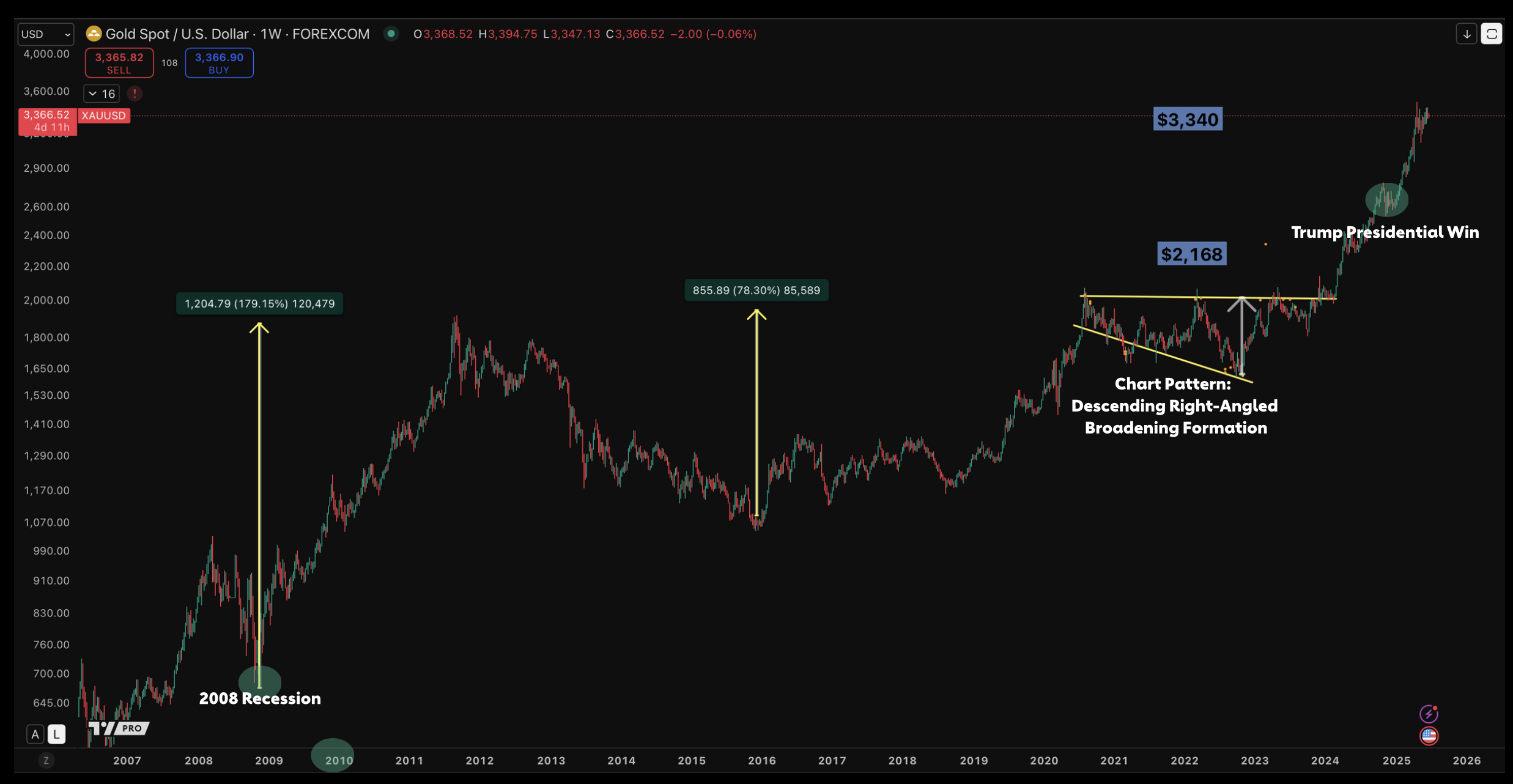
Gold’s role as a crisis hedge spans centuries. From the financial panics of 2008 to more recent geopolitical flashpoints, investors have consistently flocked to gold for its stability and intrinsic scarcity.
Gold’s long history and universal acceptance underpin its appeal when fiat currencies become hyperinflated or inflation spikes.
Gold 2007-2025
Bitcoin, introduced in 2009, was quickly dubbed “digital gold” thanks to its capped supply of 21 million coins and independence from central banks. Proponents argued it could mirror gold’s hedge properties, offering a modern alternative outside traditional finance.
Over BTC’s 16-year history, Bitcoin’s steep volatility and deep bear-market drawdowns have questioned BTC’s “digital gold” status. Yet anyone who held through the 2014, 2018, and 2022 bear market would be sitting on significant gains as of June 2025. This implies that whilst BTC is speculative and volatile in both directions, it will typically recover and make new highs.
Gold vs. Bitcoin June 2025 Reaction
Gold oscillated between $3,350 and $3,390 in the days after the strikes. By June 17, it had climbed to $3,390, reflecting sustained safe-haven demand. On June 12, just before the strike, gold had already hit a one-week peak of $3,383, driven by rising geopolitical anxieties.
Gold June Snapshot
In contrast, Bitcoin’s initial reaction mirrored that of risk assets rather than traditional havens. BTC first dropped to around $103,000 on June 13, highlighting its sensitivity during acute market stress.
🤔 Five days into the Israel/Iran conflict – what have I learned from market moves?
Bitcoin once again demonstrated it is not a “risk-off” asset.
The immediate "fear discount" reaction in the hours after the conflict began last Thursday saw a sell-off in risk-on markets like US… pic.twitter.com/hC0pstgOZz
Over the following week, however, crypto markets are appearing to rebound, with BTC holding key technical support between $100,000 and $111,000 despite ongoing volatility and geopolitical uncertainty.
How Central Banks Shape Gold and Bitcoin’s Roles
While the U.S. Federal Reserve held its policy rate steady at 4.50% in June 2025, other central authorities, from the ECB to the Bank of China (PBoC), have begun reducing interest rates.
Global Interest Rate Snapshot
This patchwork of loose monetary conditions in some regions and firm rates in others has reshaped the safe-haven landscape, where gold continues to benefit from record-high central bank gold buying.
Bitcoin’s more nuanced role as a risk-asset hedge plays out under the sway of Fed signals and geopolitical shocks.
Also, Bitcoin’s investor flows still appear to depend on the U.S. rate-cut expectations and equity-market momentum rather than the steady, structural bid provided by global reserve managers.
Comparative Roles of Gold and Bitcoin in Portfolios
Gold’s low correlation to equities and currencies makes it an effective hedge when traditional markets falter. Its physical tangibility and deep secondary markets improve gold’s resilience in times of crisis.
A World Gold Council analysis found that even a 5–10% allocation to gold in diversified portfolios significantly improved risk-adjusted returns and reduced drawdowns over 20 years.
Bitcoin, while more volatile, offers the potential for outsized returns and diversification benefits via its low long-term correlation with stocks and bonds.
A Research article titled ‘Is Bitcoin a hedge or safe haven for currencies? An intraday analysis’revealed that Bitcoin may act as an intraday hedge or diversifier for several currencies and even a safe haven under extreme conditions.
How Assets React to Geopolitical Crises: Gold and Oil as Key Hedges?
The below tweet shows how different investments, such as government bonds, corporate bonds, stocks, gold, and oil, performed after major geopolitical events. Oil tends to rise the most in the first 3 months, especially during war or crisis.
Gold performs best after 6 months, acting as a strong long-term hedge. Stocks often drop sharply, while bonds give smaller, steadier returns. For example, after the Iranian hostage crisis in 1979, gold rose 81.5% in 3 months. Overall, oil protects short-term, gold protects long-term, and stocks are usually hit hardest in the aftermath of global conflicts or shocks.
Gold is the best performing asset after ME conflict 6 months out
Here are the returns on Gold and Oil in the months following every ME conflict per Michael Hartnett 0ct. 2024
Storage and insurance costs: Physical gold requires secure storage and insurance, adding to long-term holding costs.
Limited upside: Gold’s price movements are historically gradual, making it less appealing for aggressive growth-seekers.
Liquidity constraints: In extreme geopolitical scenarios, moving or selling physical gold may become logistically difficult.
Bitcoin Risks:
Volatility: Bitcoin frequently undergoes double-digit percentage swings in short periods, which can amplify losses.
Regulatory uncertainty: Crypto assets face evolving legal frameworks; a sudden crackdown or unfavorable regulation could hit BTC prices.
Technological vulnerabilities: Risks include exchange hacks, wallet mismanagement, and network bugs — though rare, such events can undermine trust.
Market sentiment-driven: BTC remains highly reactive to speculative interest, meme cycles, and risk-on/risk-off market narratives.
Shared Risks:
Liquidity events: In times of extreme crisis, both gold and BTC could see rapid liquidation by investors needing cash.
Narrative shifts: The perception of either asset as a “safe haven” can change quickly, especially for Bitcoin, where adoption and sentiment play large roles.
Conclusion
The June 2025 Middle East escalation reaffirmed gold’s primacy as a safe-haven asset, pushing prices near record highs in a relatively orderly fashion. Bitcoin, though resilient, acted more like a risk asset, plunging on acute stress before rallying alongside equities.
Given the ongoing geopolitical uncertainties, combining gold’s stability with Bitcoin’s growth potential in a balanced allocation can provide an attractive hedge and upside opportunity.
Safe-haven demand amid Middle East tensions, combined with record-high central bank buying, drove gold to near-record levels.
What drove Bitcoin’s drop to ~$103K and quick rebound?
Bitcoin acted like a risk asset—initial sell-off on geopolitical shock, then recovery thanks to institutional inflows and equity-market strength.
How do central bank policies impact gold vs. Bitcoin?
Global easing (ECB, PBoC cuts) underpins gold via reserve diversification, while Bitcoin remains tightly linked to U.S. Fed rate signals and market sentiment.
What’s the optimal crisis allocation?
Blend gold for stability in downturns and Bitcoin for upside in liquidity-driven rallies, rebalancing tactically as conditions shift.
Disclaimer:
The information provided in this article is for informational purposes only. It is not intended to be, nor should it be construed as, financial advice. We do not make any warranties regarding the completeness, reliability, or accuracy of this information. All investments involve risk, and past performance does not guarantee future results. We recommend consulting a financial advisor before making any investment decisions.
Andrew Kamsky is a chart analyst and writer with a background in economics and ACCA certification. He has held roles at a Big Four firm, a fintech bank, and a listed bank specializing in currency hedging. His work explores Bitcoin, macro trends, and market structure. Outside finance, he's passionate about music, travel, and neon design.


 Easy
Easy