Explore how token unlocks, ETF flow volatility, and stablecoin concentration quietly drained liquidity from the 2025 crypto bull run. | Credit: Veronica Cestari/CCN.com
Share
Key Takeaways
The 2025 bull run exposed a structural shift, prices hit all-time highs, but order-book depth thinned and volatility spiked during shocks.
U.S. spot Bitcoin ETFs rerouted capital into custodial wrappers.
CME overtook Binance in BTC futures open interest, as funds favored basis trades.
Liquidity is now a topology problem.
On the occasion of Halloween, it’s only fitting to unmask the unseen forces haunting crypto markets.
Crypto’s latest bull run broke records and then sometimes broke order books. Prices sprinted to new highs, yet depth thinned, bid-ask spreads gapped during shocks, and altcoins often felt untradeable outside of majors.
If it felt like something was quietly siphoning off the market’s “juice,” you’re not wrong. The bull didn’t die; it was drained.
Here’s an autopsy of the culprits, the “vampires of volatility”, that quietly leeched liquidity from the market, and what it means for the next phase.
Spot ETFs: The Great Liquidity Vacuum
The launch of the U.S. spot Bitcoin ETFs in 2024 was hailed as a breakthrough for mainstream adoption, finally giving institutions a regulated way to access crypto exposure. But beneath the surface, it also reshaped how liquidity moves through the market.
Bitcoin ETFs reached $26.9 billion in net inflows this year so far. | Credit: Wu Blockchain/K33 Research
While ETFs improved accessibility and credibility, they quietly siphoned trading energy from native exchanges, concentrating capital inside regulated wrappers instead of circulating through spot and derivatives venues.
The Result
The results is a more mature market structure, but one with less immediate, on-chain depth.
Shift in capital flow: The launch of U.S. spot Bitcoin ETFs rerouted a significant share of crypto capital into regulated products. This boosted institutional participation but reduced day-to-day liquidity on traditional crypto exchanges.
Record ETF activity: In 2025, spot ETFs saw dramatic inflows and outflows. CoinShares reported a record $5.95 billion in crypto ETF inflows for the week ending Oct. 4, 2025, aligning with Bitcoin’s new $126,000 all-time high.
Flows cut both ways: ETF redemptions can reverse liquidity just as quickly as inflows build it. BlackRock’s IBIT posted a record single-day outflow earlier in 2025, proof that ETF pipes can act as both faucet and drain.
Externalized liquidity: Data from Farside and SoSValue show that ETF flows flip direction sharply during market shocks. Liquidity effectively moves off crypto-native venues into TradFi infrastructure, returning only when risk appetite recovers.
Impact on market microstructure: ETFs warehouse coins in custodial accounts and primary markets, limiting circulating supply. This is very different from the two-sided, real-time liquidity that native exchanges rely on for tight spreads and efficient price discovery.
Result: Price discovery is increasingly happening within regulated ETF and futures channels. Meanwhile, spot and perpetual markets, especially for altcoins, suffer from thinner order books, slower replenishment, and greater vulnerability during volatility spikes.
Basis Trade and the CME-ification of Crypto
As institutions piled in, CME overtook crypto-native venues in BTC futures open interest in 2025, marking a structural shift toward regulated venues and classic basis trades (long spot/ETF vs. short futures).
Multiple datasets flagged CME’s lead in OI this year; CME itself reported record open interest and volumes in Q3 2025, while third-party trackers noted CME surpassing Binance in OI. The basis trade dampens realized volatility and absorbs directional flow.
Cryptocurrency suit national ADV and average daily OI. | Credit: CME Group
It’s great for funding stability and institutional comfort; it’s not great for frothy two-way action.
When a large share of capital is locked into carry, volatility is harvested rather than created, which mutes impulse moves and leaves thinner marginal liquidity when shocks hit.
Stablecoin Expansion Strengthens Market Infrastructure but Drains Active Liquidity in Risk-Off Cycles
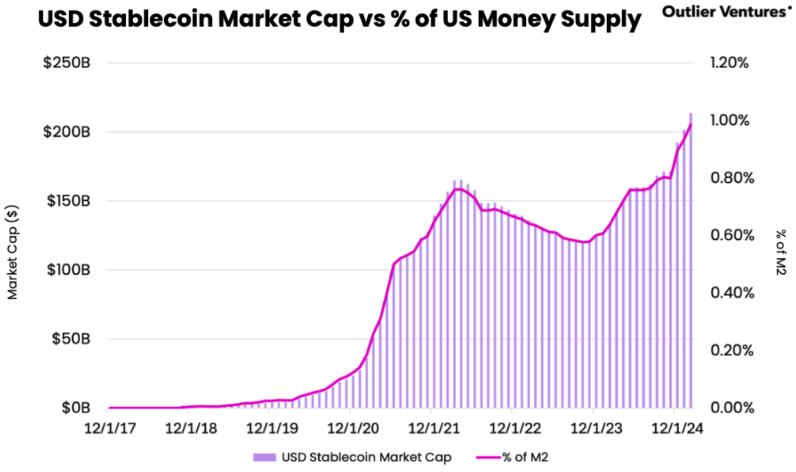
Stablecoins are the backbone of crypto trading, providing the settlement layer and unit of account for nearly every digital asset transaction.
USD stablecoin market cap vs. percentage of US money supply. | Credit: Outlier Ventures
But in 2025, their explosive growth has become a double-edged sword: while they make markets more efficient, they also absorb liquidity when investors retreat from risk.
Record market size: The total stablecoin market cap hit a record $250 billion in 2025, signaling massive demand for dollar-denominated assets on-chain. Growth was fueled by a friendlier U.S. regulatory environment and pending legislation clarifying reserve standards and disclosure requirements.
Dominant issuers: Tether (USDT) remains the largest player by far. USDC has rebounded, regaining traction among institutions and payment platforms thanks to improved compliance and on-ramp integrations.
Concentration effects: A few issuers now control most of the supply, good for scale and payment UX, but risky for market diversity. During risk-off periods, capital floods into stables rapidly but doesn’t always flow back into smaller tokens or altcoin pairs.
Why it drains liquidity: In uncertain markets, traders and institutions park capital in stablecoins, often off-exchange or in tokenized treasury products, rather than deploying it in active trading. This shift reduces live, two-sided liquidity across spot and derivatives markets, especially for altcoins.
Impact on the market: Smaller assets face thinner order books and higher trading costs. The “safe-haven reflex” into stablecoins raises the liquidity hurdle for risk assets and slows re-entry when sentiment improves.
As trading pushes on-chain, the DEX/CEX ratio set new highs in 2025 (peaking 23% in spot and 9% in futures), a secular win for decentralization.
But fragmentation across L2s/alt-L1s and venue silos spreads order flow thinly.
Binance Research highlighted this structural shift in “10 Charts Shaping 2025.” Meanwhile, data providers repeatedly flagged uneven order-book depth across exchanges, with liquidity gaps and execution costs widening during stress.
CoinGecko’s 2025 liquidity study and Kaiko’s exchange liquidity work underline the dispersion in 1–2% market depth and spreads, especially outside BTC.
Fragmentation increases slippage for size, raises cross-venue arbitrage requirements, and slows replenishment. When shocks hit, the long tail “air pockets.”
Steady Token Unlocks Add Persistent Supply Pressure to Altcoin Markets
Even as prices climbed, a steady calendar of token unlocks kept adding supply to altcoin order books.
Institutional calendars from analytics providers show heavy linear unlocks through October 2025 and beyond. They’re less dramatic than cliffs, but relentless in their cumulative impact on depth.
Major upcoming token unlocks. | Credit: @etherdrops_bot
Public dashboards make these schedules transparent; the effect is that sell-side inventory is pre-announced, and liquidity providers price that in.
Unlocks don’t always trigger immediate dumps, but they raise hurdle rates for sustainable rallies in mid-caps, pressuring makers to widen spreads or reduce inventory during unlock windows.
Macro Shocks Expose Fragile Liquidity and Amplify Market Volatility
When macro shocks arrive, today’s liquidity profile can magnify the move. On Oct. 10-11, 2025, crypto endured the largest single liquidation event on record of $19 billion after tariff headlines, a move that sent BTC down >14% at the lows, with altcoin drawdowns far worse.
Options hedging spiked, but spot/perp depth didn’t keep pace.
Less standing depth with more basis and ETF capital plus fragmented venues mean faster cascades.
Post-shock implied volatility (DVOL) has ricocheted between troughs and spikes this year, reflecting a market that swings from carry-calm to gap-risk in hours.
Systemic Shocks and Sentiment Vampires: When Code, Oracles and Narratives Drain Markets
The liquidity crunch of 2025 wasn’t just mechanical; it was psychological and technical. Beyond ETFs and basis trades, a new wave of protocol-level fragility, oracle failures, and narrative shocks deepened the chaos, triggering billions in liquidations and reigniting trust crises across chains and assets.
During the October 2025 $19 billion liquidation event, centralized oracle mispricing amplified forced liquidations across major derivatives platforms.
Several auto-deleveraging (ADL) systems kicked in simultaneously, liquidating solvent positions as feeds lagged or desynced from real prices.
Analysts noted that oracle centralization risk remains one of the least-priced forms of systemic fragility, when key data pipelines freeze or feed errors propagate, markets can unwind in minutes.
The USDe depeg added to the chaos, briefly widening spreads across ETH, BTC, and LST pairs as traders rushed to unwind positions collateralized in depegged stable assets.
The result: an artificial “flash drought” in liquidity, showing how algorithmic reflexes, not just human panic, can drain the market faster than any whale.
SWIFT CIO and Ripple’s Lesson in Reputation Liquidity
In a widely circulated October 2025 interview, the SWIFT CIO remarked that “legal victories don’t guarantee resilience,” referencing Ripple/XRP’s ongoing legal and reputational battle despite court wins.
XRP’s post-verdict price action proved the point. Volatility spiked as traders rotated away from tokens tied to uncertain cross-border payment narratives. On the other hand, Ethereum Layer-2 competitors like Linea trailed under similar uncertainty.
The episode underscored that regulatory clarity isn’t the same as investor confidence, narrative risk can be just as corrosive to liquidity as leverage risk.
Social Contagion and Reputation Shocks: The XRP–ZachXBT Effect
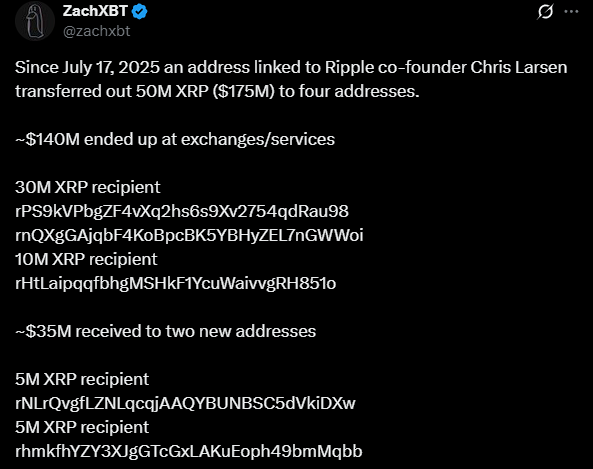
On-chain investigator ZachXBT reignited debate by labeling XRP a “scam” in a viral X post, criticizing its tokenomics and centralized distribution.
The fallout triggered a short-term surge in derivatives funding volatility as traders piled into both sides of the trade, using XRP as a proxy for sentiment on crypto’s “old guard” projects.
This episode highlighted how social credibility and influencer narratives now function as liquidity catalysts or drains.
In a hyperfinancialized market, narrative volatility means liquidity volatility: when community trust fractures, market depth follows.
ZachXBT criticized XRP. | Credit: @zachxbt X profile
Winners Keep the Straw: BTC > ETH > Alts
Liquidity concentrated up the quality curve in 2025. Kaiko’s reporting through Q1 2025 showed Bitcoin holding market depth while ETH and alts bled, a theme that persisted on stress days throughout the year.
CCData’s mid-year exchange review similarly showed derivatives dominance and Binance’s scale still towering, but not evenly across assets.
In cautious phases, makers and funds rotate inventory into BTC and a handful of mega-caps.
That leaves the rest of the universe starved for two-sided flow, especially when unlocks and venue fragmentation collide.
Who Are the Crypto Vampires?
Regulated wrappers (spot ETFs): They aggregate capital efficiently but isolate it from native order books, dampening realized volume and thinning depth when flows reverse.
Carry complex (CME basis): The institutionalization of carry soaks up directional risk and channels it to CME, muting on-venue volatility and starving alts of attention.
Stablecoin safety bid: Record stablecoin supply and better regulation accelerate risk-off parking, delaying re-risking into the long tail.
Fragmentation: On-chain growth and venue dispersion spread liquidity thinly, increasing slippage during stress.
Unlock calendars: Predictable supply raises execution costs and discourages tight quoting in many alts.
Timeline overhangs: Events like Mt. Gox pulls risk appetite forward, making LPs cautious.
None of these forces are bearish by themselves. In fact, many (ETFs, regulation, CME presence) are hallmarks of maturation.
But together, they reconfigure where and how liquidity lives. They shift it from kinetic order-book energy to warehoused, hedged, or fragmented forms. That’s how you get a market that sets all-time highs and yet trips over air pockets when a headline hits.
Key Liquidity Metrics to Watch Across ETF Flows, Derivatives and Stablecoin Supply
ETF flow volatility vs. on-venue depth: Watch daily net flows. Large, sustained inflows can drain coin float from exchanges. Big outflows can pressure price without proportionate two-sided depth to cushion it.
CME share and basis: Elevated CME OI and compressed funding/basis often coincide with calmer realized vol, until a shock unwinds carry.
Stablecoin net issuance: Rising aggregate supply is bullish liquidity, but net issuance into treasuries-backed stables can still mean fewer tokens actively market-making alts.
Unlock calendars and L2 fragmentation: Time your size around the heavier unlock weeks and be mindful of where true depth resides (not just TVL).
Volatility regime shifts (DVOL): DVOL troughs invite carry; spikes signal liquidity gaps and forced hedging, trade your liquidity expectations accordingly.
2025’s Crypto Bull Run Got Re-Routed
The bull run didn’t end; it re-routed. Spot ETFs, basis trades, stablecoin growth, fragmentation, unlocks, and overhangs redirected the lifeblood of crypto from visible, continuous order-book supply into regulated wrappers, hedged books, and many smaller pools. That’s why rallies can be vertical, but so can wipeouts.
For builders and investors, the lesson is clear: liquidity is now a topology problem.
If you understand where the liquidity actually sits (custody vs. exchange, CME vs. CEX/DEX, L1 vs. L2) and when it’s likely to move (ETF flow rotations, unlock cycles, macro shocks), you can navigate a market that’s richer than ever, just not always where you expect it to be.</span>
What does “Vampires of Volatility” mean in crypto markets?
It’s a metaphor for the forces that have quietly drained liquidity and volatility from the crypto bull run. Instead of an outright market crash, capital has been absorbed into structures like ETFs, basis trades, and stablecoins that reduce visible trading depth and dampen price swings.
Why did liquidity dry up even as prices hit new highs?
Because much of the new capital flowed into regulated wrappers, like spot Bitcoin ETFs and CME futures—where coins are locked in custody or used for hedged carry trades. That capital doesn’t circulate in on-exchange order books, leaving fewer active bids and offers when volatility spikes.
How do spot ETFs affect crypto liquidity?
Spot ETFs warehouse actual tokens in custodial accounts. While they improve access for traditional investors, they remove those coins from live trading venues, reducing day-to-day liquidity and amplifying moves when large inflows or redemptions occur.
Why is liquidity concentrating in Bitcoin and Ethereum?
Institutions and funds prefer deep, regulated markets. As risk tolerance narrows, capital rotates to BTC and ETH, leaving altcoins illiquid. This flight to quality amplifies the liquidity divide between majors and smaller assets.
Disclaimer:
The information provided in this article is for informational purposes only. It is not intended to be, nor should it be construed as, financial advice. We do not make any warranties regarding the completeness, reliability, or accuracy of this information. All investments involve risk, and past performance does not guarantee future results. We recommend consulting a financial advisor before making any investment decisions.
Giuseppe Ciccomascolo began his career as an investigative journalist in Italy, where he contributed to both local and national newspapers, focusing on various financial sectors.
Upon relocating to London, he worked as an analyst for Fitch's CapitalStructure and later as a Senior Reporter for Alliance News. In 2017, Giuseppe transitioned to covering cryptocurrency-related news, producing documentaries and articles on Bitcoin and other emerging digital currencies. He also played a pivotal role in establishing the academy for a cryptocurrency exchange website. Crypto remained his primary area of interest throughout his tenure as a writer for ThirdFloor.


 Easy
Easy