Johns Hopkins economist Steve Hanke calls Bitcoin ‘zero fundamental value,’ sparking debate on BTC price. | Credit: CCN.com
Share
Key Takeaways
The “debasement trade” refers to investors shifting from fiat currencies into scarce assets such as gold, Bitcoin, and commodities.
Major financial players, such as JPMorgan, have highlighted the debasement trade as a key driving force behind the recent surge in demand for gold and Bitcoin.
Historically, gold has reacted first to fears of debasement, while Bitcoin follows later as adoption deepens.
Those positioning for the debasement trade should treat Bitcoin and gold as diversification tools, not pure hedges.
Investors are increasingly discussing a concept known as the “debasement trade”, a strategy centered on the idea that fiat currencies are being devalued (or “debased”), and that assets like gold, Bitcoin, and other hard assets will be the beneficiaries.
For many, this trade offers a hedge against inflation, sovereign risk, and currency weakness. For others, it’s just another market narrative.
This article explores what the debasement trade is, how it applies to Bitcoin, why some analysts believe it could carry Bitcoin past $150,000, and what risks to watch along the way.
What Is the Debasement Trade Theory and How Does It Affect Bitcoin?
The term “debasement” dates back centuries, when rulers reduced the precious-metal content of coins to finance military or fiscal excesses.
In modern finance, the concept has evolved: when governments run large deficits, central banks flood the money supply, or currencies lose credibility, investors may seek assets outside the fiat-money system.
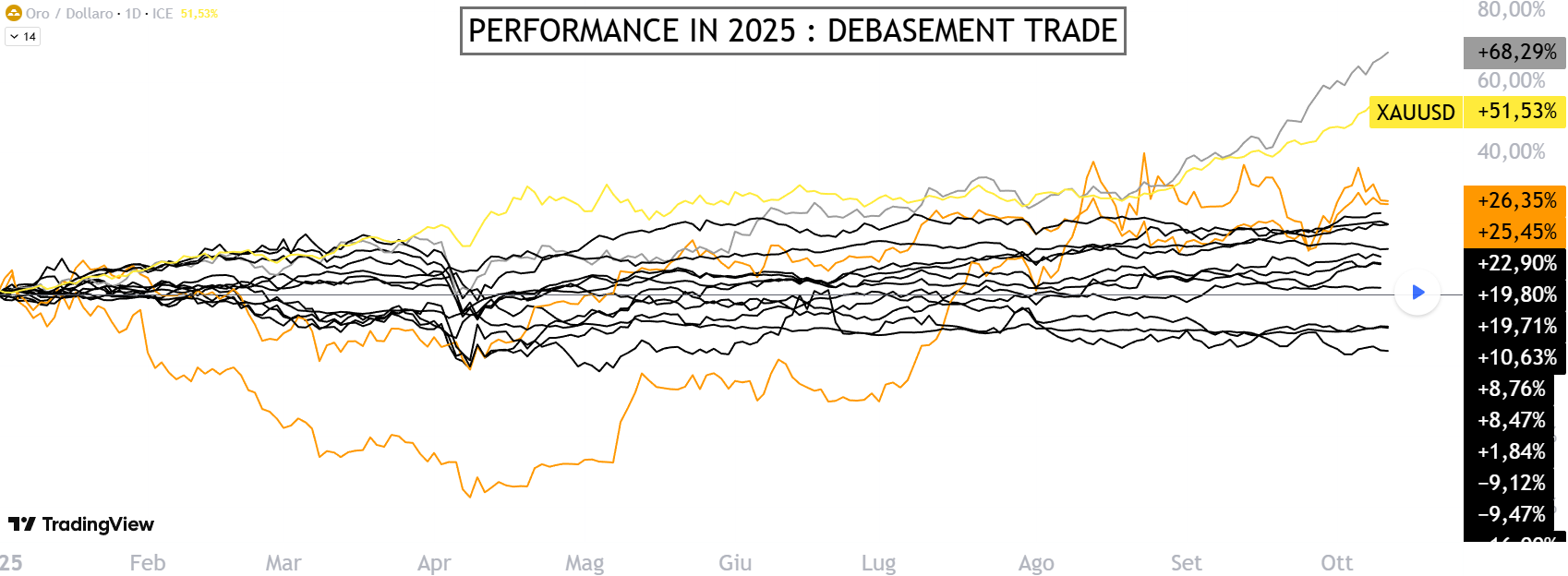
Debasement trade in 2025. | Credit: TradingView
In recent months, major financial institutions such as JPMorgan Chase & Co. have flagged the debasement trade as a theme behind rising interest in gold and Bitcoin.
According to a JPMorgan report: “The ‘debasement trade’ is a term reflecting structurally higher geopolitical uncertainty, persistent inflation risk, high government deficits, waning confidence in fiat currencies and a broader diversification away from the U.S. dollar.”
In simpler terms:
Governments borrow and spend heavily.
Central banks print or create liquidity.
The real value of currencies (i.e., what they can buy) decreases.
Investors buy scarce assets (like gold or Bitcoin) because those assets can’t be printed.
The dollar has fallen roughly 9% against other currencies, while gold and Bitcoin have surged, a sign that part of the market sees the dollar’s dominance as being under pressure.
Why Bitcoin Could Soar to $150,000 Amid the Debasement Trade
Analysts say Bitcoin could rise toward $150,000 as investors seek protection from currency debasement. With inflation concerns and growing deficits, demand for scarce assets like Bitcoin is increasing, positioning it as a hedge against the weakening value of traditional money.
Scarcity and “Digital Gold” Narrative
Bitcoin’s supply is capped at 21 million coins, and the issuance rate declines over time (via the halving cycle). Some analysts draw a parallel between gold’s scarcity and Bitcoin’s algorithmic scarcity.
According to analysts, Bitcoin currently looks undervalued relative to gold. If the debasement narrative persists, the market cap of Bitcoin would need to rise by nearly 42%, implying a theoretical price of approximately $165,000.
Institutional Flows and ETF Adoption
Better-regulated institutional products, such as spot Bitcoin ETFs, are facilitating easier entry of large capital flows into the market. As these flows grow, Bitcoin’s price may respond sharply because the supply side is limited. In fact, JPMorgan strategists estimated a possible target of $165,000 for Bitcoin if the debasement trade continues.
Weakening Fiat and Dollar Pressure
Investors fearing currency debasement often look to alternative stores of value. As the dollar weakens, assets priced in dollars (like Bitcoin) benefit from that decline. In the context of global government debt, expansionary monetary policy, and currency diversification, the argument is made that Bitcoin may outperform if the scenario unfolds.
Two-Phase Rally: Gold Leads, Bitcoin Follows
Some analysts observe a pattern: gold rallies first when concerns about debasement rise, and Bitcoin follows after a lag. Because gold is more liquid and historically accepted, the initial move tends to be there. Bitcoin picks up momentum as institutional adoption deepens.
Scenario: Bitcoin as a Leveraged Play on Currency Debasement
Here’s a possible scenario:
Inflation stays elevated and real interest rates remain negative, weakening fixed-income returns.
The U.S. federal budget deficit widens, and markets begin questioning the sustainability of the dollar’s reserve status.
Investors shift into hard assets: gold surges, and Bitcoin ETF flows increase significantly.
The Bitcoin supply remains fixed, and issuance declines; meanwhile, institutional demand grows through ETFs, custody services, and corporate treasuries.
Scarcity, combined with capital inflows, drives Bitcoin past major milestones, such as $100,000, eventually reaching $150,000 or higher.
In this scenario, Bitcoin serves as a leveraged expression of the debasement trade, benefiting from both currency erosion and the scarcity premium.
Key Macro Factors Driving Bitcoin’s Price Higher
The debasement of the U.S. dollar has significant implications for the global markets and serves as a powerful narrative for the value of Bitcoin.
According to CCN’s analyst Valdrin Tahiri, fiat currencies lose purchasing power because of money printing, inflation, and rising government debt. As a result, capital moves to assets that offer more long-term protection, and cryptocurrencies fall into this category.
“Bitcoin is one of the biggest beneficiaries of the shift, since it is the largest cryptocurrency and, unlike the U.S. dollar, has a fixed supply,” Tahiri said.
Since 2020, the average inflation rate has been 1.2, 4.7, 8.0, 4.1, and 2.9, respectively.
As of 2025, the U.S. debt exceeds $36 trillion, representing a significant increase from the $27 trillion reported in 2020. The debt-to-GDP ratio is also 120%, and has been above 100% since 2014.
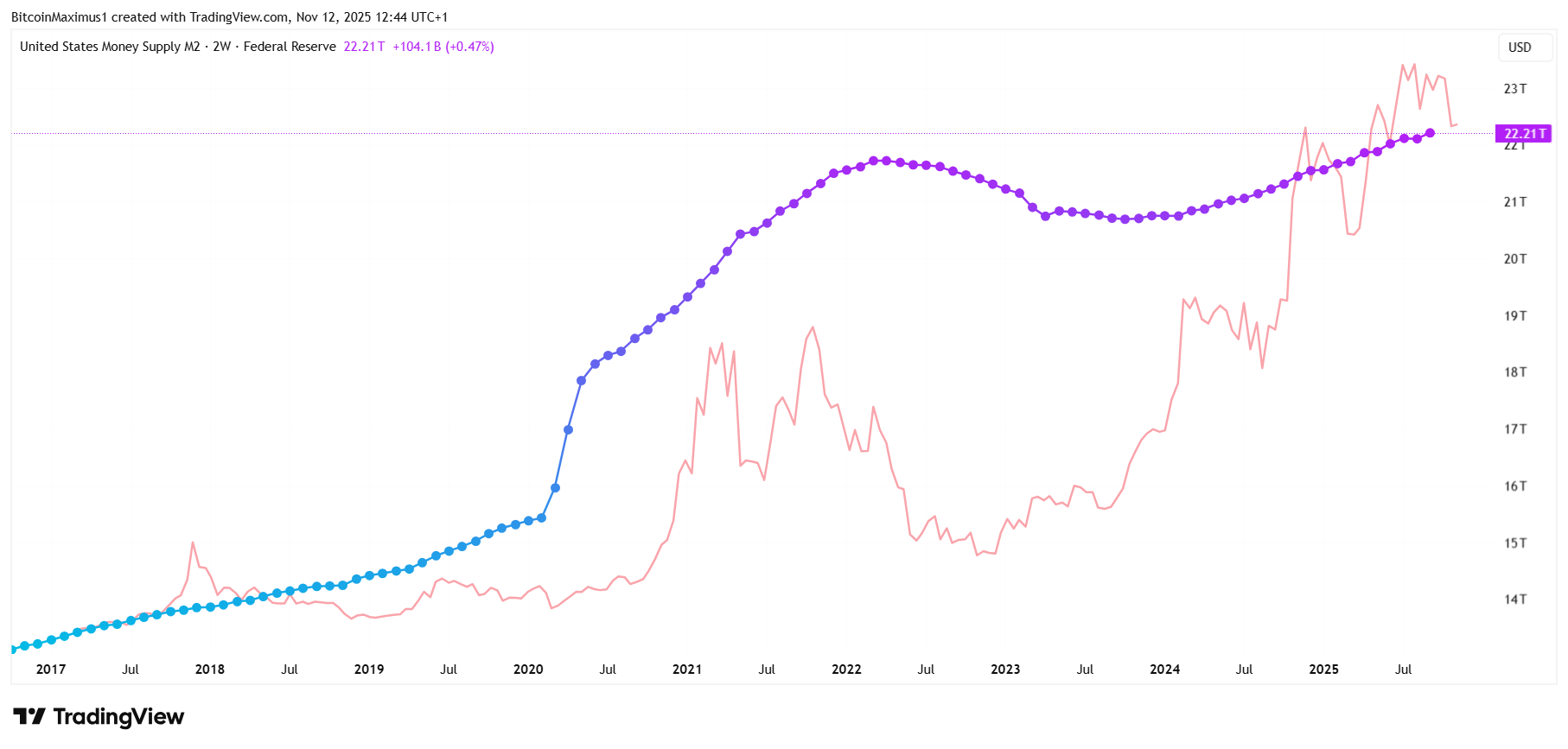
The money supply is also increasing after a brief decline in 2023. The Bitcoin price has often surged after an increase in the money supply, though this has not always been the case.
Nevertheless, the correlation is definitely positive and bodes well for the future Bitcoin price, since the money supply is currently increasing, and the Federal Reserve has hinted it will end quantitative easing and continue lowering interest rates in 2026.
“Therefore, all three factors that erode the public’s trust in the dollar are already in effect, as inflation, money supply, and debt are all increasing,” the analyst added.
A weaker dollar also tends to fuel global liquidity and improve risk appetite. When combined with the growing institutional adoption, even a moderate decline in dollar strength could ignite significant bullish pressure across the crypto market.
If the dollar continues on a path of slow erosion, Bitcoin has a clear path toward a new price discovery phase. However, the two factors working against this possible Bitcoin price increase are the strength in the DXY and the weakness Bitcoin’s long-term technical analysis.
Nevertheless, the macro factors bode well for a continued Bitcoin price increase in 2026, even if the price action does not.
Important Risks and Caveats for Bitcoin Investors
While the debasement trade story is compelling, it is not without skeptics and essential risks.
Correlation Doesn’t Always Provide Clear Hedge Status
Some research suggests that Bitcoin’s recent correlation with gold and the U.S. dollar is weak, indicating that its rally may be driven more by risk-on sentiment than by genuine currency hedging. One analysis found Bitcoin’s correlation with gold was near zero, while its correlation with U.S. equities was higher.
Dollar and Treasury Markets Don’t Fully Support the Thesis
If the debasement trade were in full swing, one might expect sharp outflows from the dollar or U.S. Treasuries. However, some reporting notes that those flows have not materialized strongly.
Volatility and Timing Risk
Bitcoin is very volatile. Even if the narrative is correct, timing is uncertain. A rising dollar or sharp tightening by central banks could reverse momentum.
Narrative vs. Fundamentals
Some analysts warn that the debasement trade may be more hype than substance, with rallies driven more by momentum or “fear of missing out” than by structural currency debasement.
Implications of the Debasement Trade for Bitcoin Investors
If you believe the debasement trade thesis and are bullish on Bitcoin’s ability to surpass $150 K, here are some practical considerations:
Positioning: Consider building exposure to scarce assets (such as gold and Bitcoin) as part of a diversification strategy.
Time horizon: Be prepared for a multi-year unfold. The rotation away from fiat isn’t always linear.
Risk management: Because Bitcoin is volatile, ensure exposure is sized appropriately and complement it with other portfolio elements.
Watch key indicators: the strength or weakness of the U.S. dollar, inflation levels and real interest rates, ETF inflows into Bitcoin or institutional adoption metrics, and regulatory and custody frameworks improving for digital assets.
Avoid purity traps: Just because something looks like a debasement hedge doesn’t mean it behaves as such. Keep expectations realistic.
The Road to Bitcoin $150,000: Debasement Trade Scenario
The “debasement trade” theory suggests that as fiat currencies lose value through expansion and dilution, scarce assets like Bitcoin gain appeal. If the thesis plays out, Bitcoin could be among the biggest beneficiaries, possibly surpassing the $150,000 mark.
That said, the narrative is not guaranteed. The market continues to send mixed signals about whether Bitcoin primarily functions as a hedge or a risk asset. Investors should tread carefully, but also recognize that the smartest money is paying attention.
In a world where fiat currencies face fiscal and monetary pressure, Bitcoin’s fixed supply and global accessibility give it a unique standing.
Whether it fulfills that role entirely remains to be seen, but if the currency system is debased, Bitcoin might rise alongside it.
The debasement trade is an investment strategy that seeks to hedge against the devaluation of fiat currencies. Historically, “debasement” referred to the reduction of the precious-metal content in coins. Today, it refers to situations where governments run enormous deficits, central banks expand money supply, or currencies lose purchasing power, prompting investors to buy scarce assets like gold or Bitcoin.
How does the debasement trade apply to Bitcoin?
Bitcoin’s supply is capped at 21 million coins, making it scarce and resistant to dilution. Investors see it as a “digital gold” hedge against inflation and currency weakness. If fiat currencies lose value, demand for Bitcoin could rise, potentially pushing its price significantly higher.
Could Bitcoin really reach $150,000?
Some analysts suggest that if the debasement narrative persists and institutional adoption continues to grow, Bitcoin’s limited supply could push its price toward $150,000 or more. Factors include ETF inflows, scarcity, and a weakening U.S. dollar. However, this is a theoretical projection and depends on macroeconomic conditions.
What macro factors support Bitcoin under this trade?
Key drivers include rising inflation, increasing government debt, a growing money supply, and a weakening U.S. dollar. Together, these factors can erode trust in fiat currencies, boosting demand for scarce digital assets like Bitcoin.
Disclaimer:
The information provided in this article is for informational purposes only. It is not intended to be, nor should it be construed as, financial advice. We do not make any warranties regarding the completeness, reliability, or accuracy of this information. All investments involve risk, and past performance does not guarantee future results. We recommend consulting a financial advisor before making any investment decisions.
Giuseppe Ciccomascolo began his career as an investigative journalist in Italy, where he contributed to both local and national newspapers, focusing on various financial sectors.
Upon relocating to London, he worked as an analyst for Fitch's CapitalStructure and later as a Senior Reporter for Alliance News. In 2017, Giuseppe transitioned to covering cryptocurrency-related news, producing documentaries and articles on Bitcoin and other emerging digital currencies. He also played a pivotal role in establishing the academy for a cryptocurrency exchange website. Crypto remained his primary area of interest throughout his tenure as a writer for ThirdFloor.


 Easy
Easy