Peter Schiff calls Bitcoin a “decentralized Ponzi,” reigniting the gold vs. crypto debate as BTC trades near $66K and institutional adoption grows. | Credit: CCN.com
Share
Key Takeaways
Peter Schiff labeled Bitcoin a “decentralized Ponzi,” arguing it lacks intrinsic value and depends on continuous inflows of new buyers.
Critics of Schiff’s view argue that Bitcoin lacks the defining features of a Ponzi scheme.
Schiff champions gold’s tangible properties and long history as money.
Gold has recently benefited from geopolitical tensions and inflation fears, reinforcing its reputation as a crisis hedge.
Few financial debates are as enduring, or as heated, as the one between gold and Bitcoin. For over a decade, economist and gold advocate Peter Schiff has been among Bitcoin’s most vocal critics, dismissing it as speculative mania destined to collapse.
This week, he reignited the argument, calling Bitcoin a “decentralized Ponzi” even as the digital asset hovered around $66,000 with a market capitalization of roughly $1.3 trillion.
The clash quickly spilled onto social media, where Bitcoin supporters pushed back, challenging the very definition of a Ponzi scheme and questioning whether gold still holds the unquestioned edge as the world’s premier safe haven asset.
At its core, the exchange highlights a deeper issue: how investors define value, trust, and safety in an era of rising debt, geopolitical tension, and technological disruption.
Peter Schiff Claims Bitcoin Lacks Intrinsic Value and Calls It a ‘Decentralized Ponzi’
Peter Schiff has long argued that Bitcoin lacks intrinsic value. Intrinsic value means the real, inherent worth of something based on its fundamental properties, not just what people are willing to pay for it.
Unlike gold, which he views as a tangible asset with millennia of monetary history and industrial use, Bitcoin, in his view, derives value solely from speculative demand.
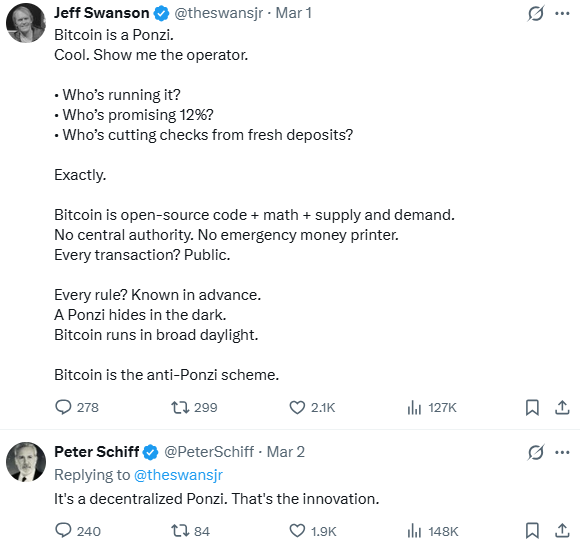
Responding to a pro-Bitcoin post asking critics to identify a central operator behind the alleged scheme, Schiff replied bluntly: “It’s a decentralized Ponzi. That’s the innovation.”
Peter Schiff says Bitcoin is “a decentralized Ponzi.” | Credit: X
Schiff’s argument rests on a familiar critique: Bitcoin’s price depends on attracting new buyers willing to pay more than previous ones. If demand falters, the structure collapses. While traditional Ponzi schemes are run by centralized operators who promise consistent returns and pay early investors with funds from later participants, Schiff suggests Bitcoin replicates the dynamic, minus the identifiable orchestrator.
To him, the absence of a central authority does not negate what he sees as speculative dependence on fresh capital inflows.
Payments to early investors sourced from new investors’ funds
Opaque accounting and concealed risk
Bitcoin, by contrast, is open-source software running on a decentralized network of nodes. It does not promise returns. There is no central entity collecting deposits or distributing payouts.
Its monetary policy, a hard cap of 21 million coins, is publicly known and enforced by consensus rules embedded in code.
As Bitcoin advocate Jeff Swanson responded on X: “Bitcoin is open-source code + math + supply and demand. No central authority. No emergency money printer. Every transaction? Public. Every rule? Known in advance. A Ponzi hides in the dark. Bitcoin runs in broad daylight.”
Supporters argue that Bitcoin’s transparency and lack of a controlling entity fundamentally distinguish it from fraudulent schemes. There are no guaranteed yields built into the protocol itself.
Price appreciation or depreciation is determined entirely by market participants.
The debate, therefore, hinges less on fraud mechanics and more on whether belief-driven assets can sustain long-term value without cash flows or industrial use.
Gold vs. Bitcoin: The Ongoing Debate Over Intrinsic Value
Schiff’s criticism often centers on “intrinsic value.” Gold has physical properties: it is scarce, durable, divisible, and widely accepted. It has industrial and jewelry demand. It has served as a store of value for thousands of years.
Bitcoin, meanwhile, is intangible. It has no physical form, no industrial application, and no yield. Critics argue that its value is purely narrative-driven.
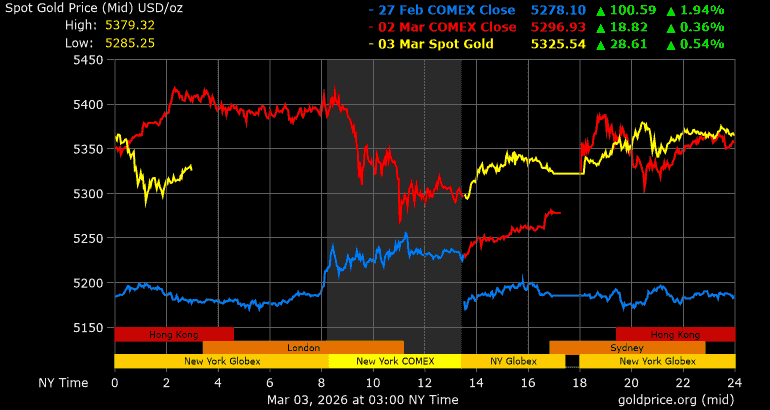
Gold’s price notably rose due to tensions in Middle East. | Credit: GoldPrice.com
Bitcoin supporters counter that monetary value has always been socially constructed. Gold’s monetary premium far exceeds its industrial demand. Fiat currencies have no intrinsic value beyond government backing and collective trust.
Bitcoin’s proponents claim its “intrinsic” properties lie in its protocol design:
Censorship resistance: Transactions cannot be arbitrarily blocked.
Verifiability: Public blockchain ledger.
From this perspective, Bitcoin’s value proposition is not physical utility but monetary reliability, particularly in a world of expanding debt and currency debasement.
Why Gold Is Still Viewed as the Ultimate Safe-Haven Asset
Gold’s defenders point to its long history as the ultimate safe haven. In times of war, inflation, or financial crisis, capital often flows into gold. Recent geopolitical tensions have reinforced that perception.
As anxiety over potential energy disruptions and inflation shocks intensified amid conflict in the Middle East, gold prices surged to near-record highs, rising more than 2.6% in a single day. Analysts described gold as benefiting from a “global uncertainty premium,” with some projecting that prolonged conflict could add another 15% to its price.
Institutional voices have echoed this sentiment. Strategists at Goldman Sachs have noted that long-term government bonds, traditionally considered portfolio ballast during risk-off events, have recently failed to provide the same protection, particularly amid stagflationary risks. In that context, gold has “time and again defended its role as the ultimate safe haven,” according to precious metals portfolio managers.
Gold’s Traditional Safe-Haven Case
Gold’s traditional safe-haven case rests on several key pillars:
Historical precedent: Thousands of years of monetary use across civilizations.
Crisis performance: Tendency to attract inflows during war, inflation, and systemic stress.
Tangible scarcity: Physical supply constraints and a costly extraction process.
Central bank demand: Significant gold reserves held by governments worldwide.
Portfolio diversification: Historically low correlation to equities during market shocks.
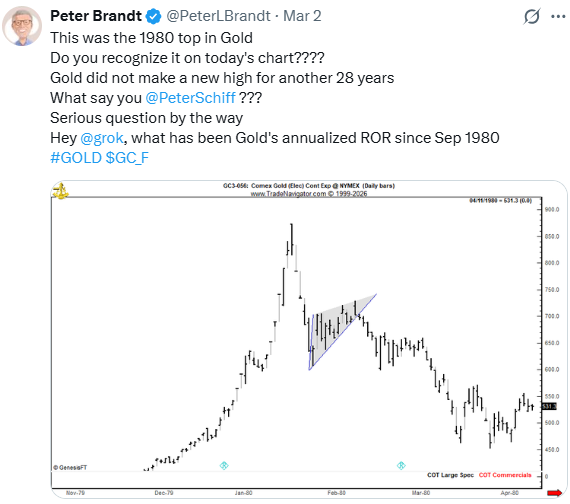
But gold’s history is not uniformly upward. Veteran trader Peter Brandt recently pointed to the 1980 gold peak, after which the metal failed to make a new high for nearly 28 years. When adjusted for inflation, gold’s long-term real returns have been far more modest than its headline price moves might suggest.
Gold’s annualized ROR since September 1980. | Credit: Peter Brandt X profile
Gold’s long-term limitations include:
Extended drawdowns: Nearly three decades to surpass its 1980 nominal high.
Inflation-adjusted stagnation: Real returns can lag during specific cycles.
No yield generation: Unlike bonds or dividend-paying stocks, gold produces no income.
Sensitivity to interest rates: Rising real yields can pressure gold prices.
That debate found fresh ammunition this week. After years of grinding sideways, gold has reasserted itself dramatically, but the manner of its resurgence, marked by violent intraday swings and geopolitical panic-buying, raises its own questions about price discovery versus pure sentiment. The two sessions of March 2–3 offer a real-time case study in that tension.
March 2 — Wild Swings Driven by Geopolitics
Gold surged to an all-time high of $5,361 per ounce on Monday, March 2, with a 2.16% intraday jump as investors scrambled for safe-haven assets following a weekend of unprecedented military escalation in the Middle East.
During the session, the spot gold price surged by more than $130 (+2.5%) to above $5,410, then quickly dropped to $5,380, returned to $5,400, and then plummeted to around $5,322 per ounce by 11 PM — far below the session’s peak.
Notably, both gold and yields rose in tandem — a rare phenomenon signaling a lack of confidence in traditional fiat-denominated safe assets.
March 3 — Partial Rebound
Gold closed near $5,387 on March 1, dropped to around $5,327 on March 2, and rebounded toward $5,359 on March 3. Current trading sits at approximately $5,330.
BREAKING: Spot gold prices fall -$100/oz in 90 minutes, officially dropping below $5,300/oz. pic.twitter.com/5SD47r5mQI
— The Kobeissi Letter (@KobeissiLetter) March 3, 2026
What’s Driving the Volatility?
Escalating Middle East conflict:US and Israel expanding airstrikes, reports of Iran’s Supreme Leader’s death, Iran claiming to have shot down a US fighter jet, and Israel attacking Beirut following Hezbollah rocket attacks.
Fed rate cut expectations have collapsed: Probability of three 2026 cuts now at 20%, down from 50% last week — tempering gold’s upside.
Safe-haven demand surging as investors lose confidence in traditional fiat-denominated assets.
Near-Term Outlook
Gold’s chart remains bullish on trend measures. If gold holds above $5,298, the path of least resistance points higher toward $5,380–$5,450. A loss of $5,160 on a daily closing basis would signal a more significant pullback.
US Debt Surge Fuels Gold vs. Bitcoin Store-of-Value Debate
Another thread in the debate centers on macroeconomics, particularly U.S. debt levels.
In 1980, U.S. national debt stood at roughly $908 billion. Today, it exceeds $38 trillion. For some gold advocates, this comparison reinforces the argument that fiat currencies depreciate over time, while gold merely preserves purchasing power.
As one commentator put it: “It’s not the gold that’s appreciating. It’s the dollar that’s depreciating.”
Bitcoin supporters adopt similar reasoning but apply it to digital scarcity. If the fiat money supply expands indefinitely, assets with hard caps, such as gold or Bitcoin, may benefit structurally.
The difference lies in age and track record. Gold has centuries of monetary history. Bitcoin has 15 years.
For conservative investors, that gap matters. For technologists and younger market participants, Bitcoin’s short history may be less concerning than gold’s physical limitations in an increasingly digital economy.
Bitcoin’s Institutional Adoption Challenges the ‘Ponzi’ Narrative
Institutional adoption has grown steadily, from publicly traded companies holding Bitcoin on balance sheets to the launch of spot Bitcoin exchange-traded funds (ETFs) in major markets. Pension funds, asset managers, and sovereign wealth funds have begun allocating small but notable percentages to digital assets.
Key signs of Bitcoin’s institutional maturation include:
Corporate treasury allocations: Public companies adding Bitcoin to balance sheets.
Spot Bitcoin ETFs: Regulated investment vehicles increasing accessibility for traditional investors.
Custodial infrastructure: Institutional-grade custody solutions and compliance frameworks.
Derivatives markets: Growth in regulated futures and options markets.
Portfolio diversification strategies: Inclusion in multi-asset institutional portfolios.
This shift complicates the Ponzi narrative. Traditional Ponzi schemes collapse when trust evaporates, and withdrawals exceed new deposits. Bitcoin, however, trades continuously on global markets with deep liquidity. Its volatility remains high, but its market infrastructure resembles that of established commodities more than clandestine fraud operations.
Structural differences from classic Ponzi schemes include:
No central operator collecting deposits
No guaranteed returns or fixed payout promises
Transparent, publicly verifiable ledger
Continuous price discovery on global exchanges
Independent custody, as investors control their own assets
Still, critics argue that institutional involvement does not guarantee permanence. Asset bubbles throughout history, from tulips to tech stocks, attracted sophisticated investors before deflating.
Skeptics caution that:
Institutional participation does not eliminate speculative excess.
One of the most essential distinctions in the debate is whether Bitcoin functions as a safe haven.
Gold’s behavior during geopolitical shocks tends to be predictable: investors buy it as insurance against uncertainty. Bitcoin’s performance during crises has been more mixed. At times, it trades like a risk asset, rising alongside equities. At other times, it behaves independently.
Proponents argue that Bitcoin is evolving. As adoption broadens and liquidity deepens, its volatility may gradually decline. Skeptics contend that its short history and speculative participation base prevent it from achieving gold’s stability.
The comparison may ultimately be imperfect. Gold is a non-digital, physical commodity deeply embedded in central bank reserves. Bitcoin is a decentralized digital asset designed explicitly to operate outside traditional financial systems.
They may serve overlapping but not identical roles.
Bitcoin vs. Gold: Belief Systems, Not Just Intrinsic Value
Calling Bitcoin a “decentralized Ponzi” is rhetorically powerful, but analytically contentious. A Ponzi scheme implies deception, centralized control, and guaranteed payouts funded by new entrants.
Bitcoin offers none of those features. It does, however, rely on continued demand to sustain its price, as do gold, equities, real estate, and most non-yielding assets.
The more substantive debate may be about belief systems.
Gold believers trust historical precedent and tangible scarcity.
Bitcoin believers trust cryptographic enforcement and digital scarcity.
Both camps express skepticism toward fiat currency systems characterized by rising debt and discretionary monetary policy.
As inflation fears resurface and bond markets struggle to provide traditional downside protection, investors are reassessing what constitutes a “neutral” asset. Gold has reasserted its role as a haven amid recent geopolitical turmoil. Bitcoin continues to gain institutional legitimacy while remaining volatile and controversial.
Gold Believers
Bitcoin Believers
Trust historical precedent and tangible scarcity
Trust cryptographic enforcement and digital scarcity
Gold has reasserted its haven role amid recent geopolitical turmoil
Bitcoin continues gaining institutional legitimacy while remaining volatile and controversial
Shared concern: skepticism toward fiat currency systems with rising debt and discretionary monetary policy
Shared concern: skepticism toward fiat currency systems with rising debt and discretionary monetary policy
Gold vs. Bitcoin Debate Reflects a Deeper Generational Divide
The intensity of the Schiff-Bitcoin debate reflects more than price movements. It represents a generational and philosophical divide about the future of money.
Is value anchored in physical reality and centuries of precedent? Or can mathematical rules and decentralized consensus create a new form of monetary trust?
Bitcoin at $66,000 and a $1.3 trillion market cap suggests that millions of market participants believe the latter is at least plausible. Schiff’s continued criticism suggests that many remain unconvinced.
Neither gold nor Bitcoin is immune to cycles, volatility, or shifts in investor psychology. Gold endured a 28-year wait to reclaim its 1980 highs. Bitcoin has experienced multiple drawdowns exceeding 70%.
The ultimate verdict may not be binary. Investors increasingly treat both as components of diversified portfolios, hedges against monetary instability, but with different risk profiles.
In the end, labeling Bitcoin a Ponzi may oversimplify a more complex reality. The real question is not whether Bitcoin fits a fraud definition, but whether decentralized digital scarcity can coexist with, or compete with, ancient metallic scarcity in shaping the future of global finance.
As markets grapple with inflation risks, geopolitical shocks, and ballooning debt, the debate between gold and Bitcoin is unlikely to fade. Instead, it may intensify, with each new price milestone adding fuel to a conversation that blends economics, technology, and ideology.
For now, the split endures: gold gleams under crisis-driven demand, and Bitcoin marches forward under open-source code, both claiming to be the safer bet in an uncertain world.
Why did Peter Schiff call Bitcoin a “decentralized Ponzi”?
Peter Schiff argues that Bitcoin’s price depends on attracting new buyers willing to pay higher prices, similar to how Ponzi schemes rely on fresh inflows to sustain payouts. While he acknowledges there is no central operator, he contends that the “innovation” is decentralization, meaning no single person is running it, but the speculative dynamic remains in his view.
Is Bitcoin actually a Ponzi scheme?
Legally and structurally, Bitcoin does not fit the classic definition of a Ponzi scheme. Traditional Ponzis involve a central organizer who promises guaranteed returns and uses new investors’ money to pay earlier participants. Bitcoin has no central operator, no promised returns, and operates via open-source code and transparent blockchain transactions. However, critics argue its valuation still depends on continued demand.
What gives Bitcoin value?
Bitcoin’s value is primarily driven by supply and demand. Supporters point to its fixed 21 million coin supply, transparent monetary policy, decentralization, portability, and censorship resistance as core attributes. Critics argue it lacks intrinsic value because it has no industrial use or cash flow.
What does “intrinsic value” mean in this debate?
“Intrinsic value” typically refers to an asset’s inherent usefulness or ability to generate income. Gold has industrial and jewelry applications, and equities produce cash flows. Bitcoin does not generate income or have physical utility, so its value is often described as purely monetary or belief-driven.
Disclaimer:
The information provided in this article is for informational purposes only. It is not intended to be, nor should it be construed as, financial advice. We do not make any warranties regarding the completeness, reliability, or accuracy of this information. All investments involve risk, and past performance does not guarantee future results. We recommend consulting a financial advisor before making any investment decisions.
Giuseppe Ciccomascolo began his career as an investigative journalist in Italy, where he contributed to both local and national newspapers, focusing on various financial sectors.
Upon relocating to London, he worked as an analyst for Fitch's CapitalStructure and later as a Senior Reporter for Alliance News. In 2017, Giuseppe transitioned to covering cryptocurrency-related news, producing documentaries and articles on Bitcoin and other emerging digital currencies. He also played a pivotal role in establishing the academy for a cryptocurrency exchange website. Crypto remained his primary area of interest throughout his tenure as a writer for ThirdFloor.


 Easy
Easy