Gold is still the main “emergency savings” asset for countries because it’s widely trusted, easy to store, and doesn’t need the internet.
Bitcoin shows up on government balance sheets mostly by accident, usually through law enforcement seizures, not because central banks chose BTC the way they chose gold.
Big countries can hold billions in Bitcoin and still be “gold-heavy.” For example, even a massive U.S. BTC stash is small compared to the value of its gold reserves.
Smaller countries can look “Bitcoin-heavy” because their gold reserves are small, so even a few hundred million dollars in BTC can outweigh their bullion.
Countries all around the world keep reserves as a sort of emergency savings. If something goes wrong, such as a global financial crisis or a war, a government wants assets it can trust.
For most of modern history, the main reserve asset has been gold. It’s a real metal, after all, and lasts a long time. People of all cultures recognize it.
But in the last few years, Bitcoin (BTC) has acted as another potential store-of-value asset. It’s a digital, moves internationally, and has a fixed supply.
So which countries actually hold gold bullion in their national vaults, and which hold Bitcoin?
Let’s discuss.
Try Our Recommended Crypto Exchanges
Sponsored
Disclosure
We sometimes use affiliate links in our content, when clicking on those we might receive a commission at no extra cost to you. By using this website you agree to our terms and conditions and privacy policy.
A country’s reserves are assets it can use in an emergency. Think of it like:
A school keeping extra pencils in case a shipment gets delayed.
A family keeping cash in a mattress, in case a bank app goes down.
Reserves often include foreign currencies as well, such as US dollars, government bonds, or gold. Many countries report their gold reserve numbers regularly through official channels, which are tracked by groups like the World Gold Council. The World Gold Council compiles information from the International Monetary Fund (IMF) and other sources.
Gold Reserves: The Long-Standing Emergency Asset
Gold has three big features that central banks covet:
Safety: Gold does not depend on one company or one country to “work.”
Liquidity: Large buyers can sell gold quickly in global markets.
Trust: Gold has a long history as a store of value.
Gold has been climbing sharply in recent weeks, reaching near record-high levels as investors seek a safe haven amid economic and geopolitical uncertainty. Spot gold has traded around $4,900–$5,000 per ounce in January 2026, with some data indicating it was recently slightly below $4,990 per ounce.
This follows a powerful rally: gold prices have risen by more than 70% compared to a year ago and remain at elevated levels as central banks and private investors continue to view bullion as a strategic reserve asset. Analysts are even forecasting that gold could hold above $5,000 through 2026 or climb further, driven by ongoing demand and market volatility.
And lately, gold buying has continued amongst central banks month over month.
If you followed the great rotation trade into Bitcoin last Fall, you are now down by over 50% !
The Bitcoin to gold ratio is collapsing to its next uptrend support, near 13 ounces to one Bitcoin. Break this level and the bleed-out will continue as the great rotation into… pic.twitter.com/hFGTAW0Fq2
— Peter Spina ⚒ GoldSeek | SilverSeek (@goldseek) January 22, 2026
Which Countries Hold the Most Gold Bullion?
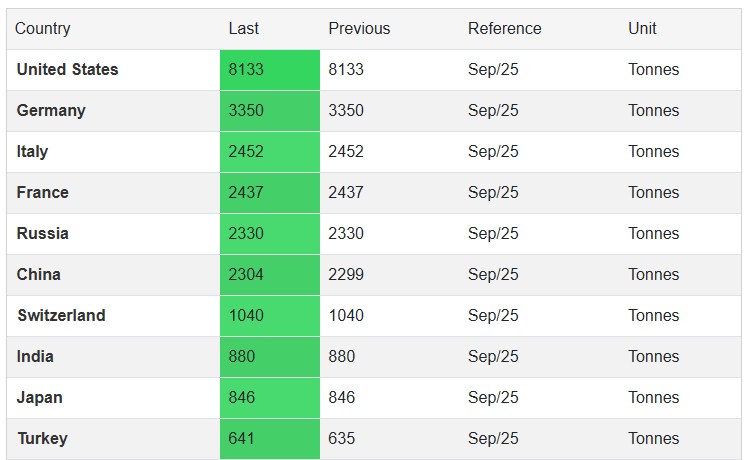
Exact numbers can shift a bit over time, but the top gold holders remain steady. Using recent reserve data, the United States holds the most gold with around 8,133 tonnes. Germany and Italy are next up, with 3,350 and 2,452 tonnes, respectively.
Gold has one main advantage over Bitcoin: it works without the internet. A gold bar in a vault stays a gold bar even during a blackout. Such durability matters more than investors may realize, especially during global tensions.
Bitcoin can work offline in rare circumstances, but the majority would become inaccessible during a blackout.
Bitcoin Reserves May Be Accidental
Unlike a country’s gold reserves, Bitcoin holdings may be unintentional. Typically, a country holds Bitcoin for one of three reasons:
They buy it on purpose.
They seize it through law enforcement.
They mine it.
Also, unlike gold, many governments do not publish a clean, official “Bitcoin reserve report.” This means that most Bitcoin totals come from a mix of court documents, blockchain tracking, and plain old investigation.
Countries That Openly Hold Bitcoin
El Salvador: The Clearest Example
El Salvador is the most famous case of a country buying Bitcoin as a policy. The country holds 7,541 BTC in its reserves.
It has also taken steps toward transparency and security. For example, the country has a public-facing tracker for its treasury holdings.
If gold is a slow, steadily increasing savings account, El Salvador chose to keep part of its “emergency savings” in something more like a roller coaster. It can go up fast, and it can drop fast.
United States: Bitcoin From Law Enforcement Actions
The United States is widely considered the largest known government holder of Bitcoin because of seizures and forfeitures.
In October 2025, the US Department of Justice announced and filed a civil forfeiture action involving around 127,271 Bitcoin, described as the largest-ever forfeiture action of its kind, at the time.
Keep in mind that this doesn’t mean the US treats it Bitcoin like gold reserves, it just means that law enforcement can end up holding Bitcoin while cases move through court, and then the government decides what happens under legal rules.
For example, if police seize a stolen sports car, the police didn’t buy the car as an “investment.” They have it because it’s evidence and part of a legal process. Bitcoin seizures are similar to that.
United Kingdom: Seized Bitcoin
Similar to the United States, the United Kingdom is one of the biggest examples of a government holding Bitcoin because of law enforcement seizures, not because it chose Bitcoin as a reserve asset.
Bhutan is a country linked to Bitcoin through mining, not seizures, with a hydropower-based mining process that uses profits to help pay government salaries, amongst other uses. It’s one of the top government Bitcoin holders (over 13K), taking its extra electricity and converting it into digital assets.
Note that some countries had significant amounts of Bitcoin via seizures or other reasons, only to sell it later on. Finland and Germany are two such examples. Each had seized millions of dollars worth of Bitcoin via crimes and sold it shortly afterward for various reasons. These fall into the “accidental” category as well.
The table below compares a country’s current Bitcoin holdings to its gold holdings, while factoring in values. Keep in mind these are estimates, as prices move every day. The below details are based on a Bitcoin price of $95,449, and a spot gold price of $4,610/oz.
Country
Why they have BTC
BTC held (approx)
BTC value (approx)
Gold reserves (tonnes)
Gold value (approx)
BTC value vs gold value
United States
Mostly seizures; now framed as a strategic reserve
200,000
$19.1B
8,133
1.21T
Miniscule
China
Reported holdings (often linked to seizures)
194,000
$18.5B
2,304
$341B
Miniscule
United Kingdom
Seizures (major fraud/money laundering case)
61,245
$5.8B
310
$46.0B
Miniscule
Ukraine
Reported holdings (often tied to wartime crypto flows)
46,351
$4.4B
27.37
$4.1B
Significant
Bhutan
State-linked mining; small gold position
12,200
$1.1B
0.06
$8.4M
Very significant
El Salvador
Treasury purchases (public tracker)
7,508.37
$0.72B
1.81
$0.27B
Very significant
In most large economies (like the US, China, and UK), their gold reserves are worth vastly more than their known Bitcoin holdings – often by tens to hundreds of times. Smaller nations with limited gold reserves can appear “Bitcoin heavy” simply because their gold stocks are tiny, not because Bitcoin is replacing gold.
This highlights how gold remains the dominant reserve asset for central banks and governments, while Bitcoin holdings mostly come from seizures, mining, or isolated policy decisions rather than broad central bank adoption.
That said, Bitcoin can still look bigger than gold in smaller countries simply because their gold stock is small, not because Bitcoin replaced gold worldwide.
Old Gold, New Digital Contender
For now, gold remains the backbone of national reserves. It’s trusted, physical, easy to store, and works even when financial systems or power grids fail. That reliability is why countries have stacked gold in vaults for decades and continue to buy more of it today.
Bitcoin, on the other hand, is still in an experimental phase when it comes to government reserves. Most countries that hold BTC didn’t choose it as a long-term policy decision, they acquired it through seizures or mining. Only a few, like El Salvador, have openly treated Bitcoin as part of their treasury strategy.
Still, Bitcoin’s fixed supply, global portability, and growing acceptance make it an asset that governments can’t ignore. While it hasn’t replaced gold, it has clearly entered the conversation.
In short: gold is still the emergency savings of nations, but Bitcoin is becoming the digital wildcard — small today, but increasingly hard to dismiss.
Do any major countries hold Bitcoin like they hold gold?
Not in the same clean, central-bank way. Most big-country BTC holdings come from seizures and legal cases, not a “we choose BTC as reserves” policy.
Why don’t governments publish official Bitcoin reserve reports?
Because BTC holdings are often tied to law enforcement, court orders, and ongoing cases, not a standard reserve program like gold.
Is gold safer than Bitcoin?
Gold is usually less volatile and doesn’t need internet access. Bitcoin can be moved quickly across borders, but its price can swing a lot.
Could more countries add Bitcoin to their reserves in the future?
Possibly, but it would likely happen slowly, with lots of political debate and legal rules, especially because reserve assets are “trust assets,” not experiments.
Disclaimer:
The information provided in this article is for informational purposes only. It is not intended to be, nor should it be construed as, financial advice. We do not make any warranties regarding the completeness, reliability, or accuracy of this information. All investments involve risk, and past performance does not guarantee future results. We recommend consulting a financial advisor before making any investment decisions.
Max Moeller is a Chicago‑based writer and video editor passionate about games, tech, and crypto. Whether it’s crafting clear, insightful articles or piecing together engaging video retrospectives, he’s driven by curiosity and takes pride in keeping things human. Since 2017, Max has been published in a variety of notable crypto magazines.


 Easy
Easy